Outdoor and garden lighting in the UK: which light each zone needs and when the rules say you need an electrician
 m8d.ioUpdated on
This guide contains affiliate links. As an Amazon Associate, m8d.io earns from qualifying purchases, at no extra cost to you.

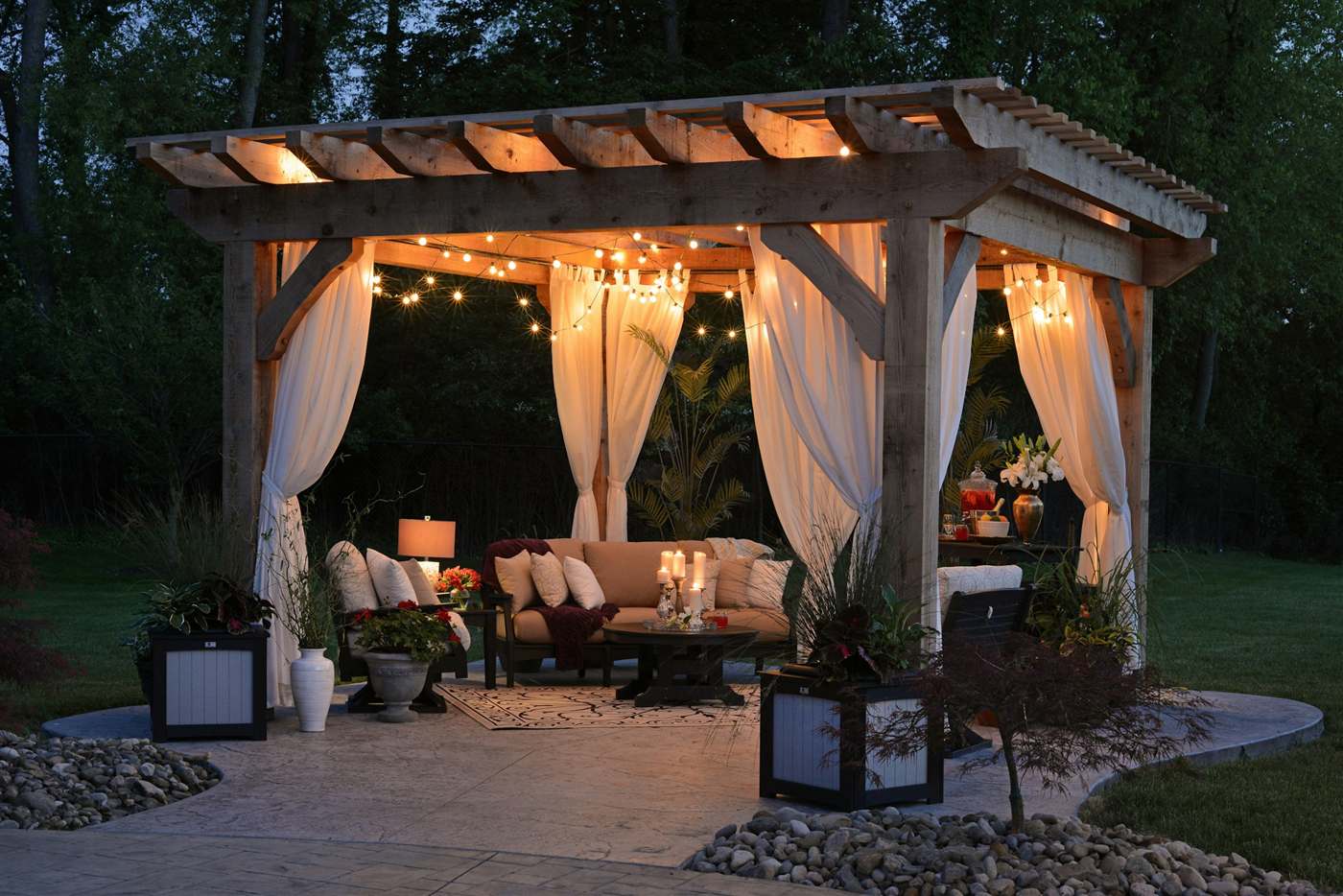
Outdoor garden lighting is bought by zone, not by product: a warm string over the table, low markers down the path, something on the boundary, and one bright light at the back door that only wakes up when someone is there. Two questions decide everything else, and neither is on the box: does this fitting need mains power, and what does its IP number actually cover.
Do you need an electrician to fit an outside light? England and Wales do not answer the same
This is the first question people ask and the last one any lighting shop answers. Outdoor electrical work in a home is covered by Part P of the Building Regulations, and what counts as notifiable work is not the same on both sides of the Severn. In England, the Planning Portal lists three notifiable jobs: a new consumer unit, a complete new circuit, and alterations to existing circuits only in a special location, and it states that "in England, special locations are the spaces around baths and showers". So adding a lantern to a circuit that already exists is not notifiable there. In Wales the same page states that "in Wales, special locations include kitchens and outdoors", and the Welsh Government's own guidance says you do not have to tell building control about "extra power points or lighting points or other alterations to existing circuits (except in a kitchen or bathroom, or outdoors)". Read the bracket: outdoors is the exception, so in Wales the outside light on an existing circuit is notifiable. Either way, the job has to meet BS 7671, and either way the route is the same: a registered competent person who self certifies, or a building control notification before the work starts.
The line is the same on every retailer that bothers to say anything: mains outdoor lighting should be fitted by a qualified electrician. It is sound advice and it is not the rule, because it never says when building control has to be told, and that is the part that costs time and money.
England: a complete new circuit is notifiable, and alterations to existing circuits only in a special location, which the Planning Portal defines as the spaces around baths and showers. Wales: special locations include kitchens and outdoors, so adding a light to a circuit that already exists is notifiable too. In both, the work has to meet BS 7671, and the route is the same: a registered competent person who self certifies, or a notice before the work starts.
m8d rule: A brand new outdoor circuit is notifiable work in both countries. Adding a light to an existing circuit is not notifiable in England, and is in Wales.
That single difference reshapes the shopping list, which is why it sits at the top of this guide instead of in a footnote. Every fitting below runs on its own solar panel, so none of it is electrical installation work and none of it needs notifying anywhere in the UK. We would spend the effort on those before paying for a new outdoor circuit: a circuit run down the garden is a day of somebody's labour and a notification, and it buys you light in exactly the places where a panel and a sensor do the same job. Where mains genuinely wins is the front of the house, and that section says so plainly.
IP44, IP65 and kelvin: how to read an outdoor light in thirty seconds
Three figures do all the work on an outdoor listing. The IP code has two digits: the first is solids, the second is water. IP44 means protection against splashing water from any direction, which is a covered porch, a balcony or under a pergola. IP65 adds a dust tight body and protection against water jets, which is anywhere rain lands straight on it: an exposed wall, a spike in open lawn, a shed. The second figure is the one that decides whether a fitting survives a British winter, and the jump from 4 to 5 is a bigger jump than any brand name on the page. Kelvin is the colour of the light, not its strength: 2200 K is the deep amber of a filament bulb, 3000 K is the warm white people mean when they say a garden looks inviting, 4000 K is neutral, and 6500 K is the hard white of a workshop. Warm belongs where you sit; cold belongs where you need to see a face or a lock. Lumens is the amount of light, and it is the figure most listings leave out, which tells you something on its own.
Two digits, solids then water. IP44 covers splashing water from any direction, which is a porch, a balcony or the underside of a pergola. IP65 adds a dust tight body and protection against water jets, which is anywhere rain lands straight on it. The jump from 4 to 5 decides more than any brand name on the page.
Kelvin says whether the light is amber or white. 2200 to 3000 K is warm: the light you sit under, the one that suits a festoon and a path. 4000 K is neutral. 6500 K is workshop white, which is the right answer at a back door and the wrong one over a dinner table.
Watts measure consumption; light is measured in lumens, and it is the figure most outdoor listings leave out. A listing that gives you an IP code and a wattage but no lumens has told you how wet the fitting can get and what it costs to run, and nothing at all about how much you will see.
m8d rule: Under cover, IP44 is enough. Anywhere the rain reaches it, look for IP65. If a listing gives an IP number but no lumens, it is selling weatherproofing, not light.
The British lighting year: you need the light most in the months solar charges least
Here is the timing problem at the heart of buying garden lights in this country, and no shop category page will raise it with you. The clocks go back at 2am on 25 October 2026, and from that Sunday the UK is on GMT until 29 March 2027. For five months the garden is already dark when most people get home, which is precisely when you want the path lit and the back door covered. It is also the stretch of the year when a solar panel gets the least to work with. The two facts point in opposite directions, and the honest conclusion is not that solar is a bad idea: it is that solar buys you the half of the year you actually sit outside, and that for the dark half there are only two fittings that keep their promise. One is anything on mains, which drags you back to the section above. The other is a light that spends the night switched off.
FIFlying solar festoon string, 10.45 m view ›
This is the fitting that changes a garden the most for the least effort: ten and a half metres of warm bulbs strung above head height, hung in an afternoon with no cable crossing the lawn and nothing to notify anyone about. Measure before you order, because the run plus the swags plus the distance back to the panel is always longer than the straight line you have in your head. Its honest limit is the one every solar string shares: it is at its best in the half of the year you are actually sitting under it.
- The listed length is 10.45 metres, 34.3 feet, and that is the figure to plan around: measure the run, then add the drop of each swag and the distance back to wherever the panel is going to sit in sun.
- G40 is the round bulb shape, the one that reads as filament rather than as fairy lights. It is the difference between a patio that looks furnished and a patio that looks decorated for a birthday.
- It carries its own panel, so there is no cable, no plug and no electrical installation work: nothing here is notifiable in England or in Wales.
- Warm bulb style rather than pinpoint fairy LEDs
- No cable, no socket and no notifiable work
- A length that covers a normal patio without joining two sets
- Like every solar string, it runs shorter in midwinter
- The panel needs a spot that gets direct sun for part of the day

Vanranger 248 LED solar security light with motion sensor view ›
The back door, the side alley and the shed are the three places in a British garden where light is a practical matter and a cable is a project. A solar head with a motion sensor solves all three without an electrician, and it is the one solar fitting whose behaviour does not collapse in midwinter, because it spends the night asleep. Mount it high, tilt it down inside your own boundary, and set the range so it ignores the pavement: aimed properly it is invisible to everyone but you.
- The motion sensor is the reason this is the only fitting here that behaves the same in December as in June: it draws current for the seconds somebody is there, not for eight hours a night.
- It screws to a wall with no cable, so the back of the garage, the shed and the side alley stop being places where a light would cost a new circuit and a notification.
- Its light is cold white, which is the right answer here and the wrong one over a table: this is a fitting for seeing a face or a lock, not for sitting under.
- A sensor is what makes solar survive a British winter
- Goes where no cable reaches, with no notifiable work
- Bright enough to cover a back door or a bin store at once
- Cold white: this belongs by the door, not on the patio
- Aim it wrong and the light is your neighbour's problem, not yours
The difference is arithmetic, not marketing. A decorative string has to run for six or eight hours a night on whatever the panel collected that day, so in December it dims or gives up early, and there is no model on sale that changes the physics. A motion light draws its current for the twenty or thirty seconds somebody is actually in the side alley, which on a normal evening is a couple of minutes in total. That is why the security pick in this guide runs on a panel without apology and the decorative ones carry a winter caveat in their own cards, instead of the caveat living in the small print.
The path, the steps and the way to the front door
A path does not want power, it wants rhythm. Markers pushed in every metre or so read as an edge, and an edge is what stops a dark garden feeling like a hole. Warm light matters more here than anywhere else: cold white turns a front garden into a car park, and it is the default on most cheap packs. Steps are the one place where this stops being decoration and becomes safety, which is where a set designed to sit low and throw light downwards earns its place.
AKTIVE 61560 warm solar path lamps, pack of 6 view ›
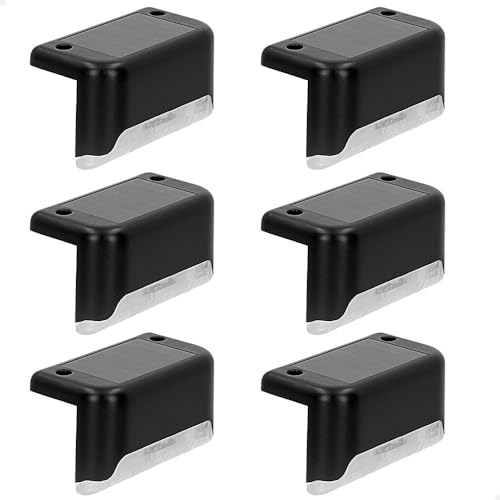
Six warm markers pushed in along the path and then forgotten: they charge in the day, come on at dusk and draw the edge so the walk to the front door stops being a guess. The warm light is what separates this from the identical looking packs that arrive in workshop white, and a declared 6 to 8 hours is more than most of this category is willing to put in writing. It marks a path rather than lighting a garden, which is exactly the job.
- The listing declares 6 to 8 hours of continuous light, which is the figure that matters on a path: a marker that gives up at ten o'clock is decorative, not useful.
- Warm light, in a six pack, is the rare combination at this end of the market. Most cheap packs come in 6500 K cold white, which turns a front garden into a car park.
- Its listing points it at steps as well as paths, and steps are the one place in a garden where lighting stops being decoration.
- Warm light, which most six packs at this level do not offer
- A declared runtime instead of the usual silence on the subject
- Push in and forget: no tools, no cable, no notification
- Markers show you the edge, they do not light an area
- Runtime falls in midwinter, as it does on every solar fitting
Over the table: festoon lighting for a patio, a pergola or a balcony
This is the zone that changes a garden the most for the least money, and the one the UK searches for by name: festoon. The job is to hang a line of warm bulbs above head height so the light falls on the table and not in anyone's eyes. Length is the only decision that matters, and it is the one people get wrong: measure the run, then add the drop of the swag and the distance back to wherever the panel is going to sit in the sun. Two sizes cover almost every case.
FIFlying solar festoon string, 10.45 m view ›
This is the fitting that changes a garden the most for the least effort: ten and a half metres of warm bulbs strung above head height, hung in an afternoon with no cable crossing the lawn and nothing to notify anyone about. Measure before you order, because the run plus the swags plus the distance back to the panel is always longer than the straight line you have in your head. Its honest limit is the one every solar string shares: it is at its best in the half of the year you are actually sitting under it.
- The listed length is 10.45 metres, 34.3 feet, and that is the figure to plan around: measure the run, then add the drop of each swag and the distance back to wherever the panel is going to sit in sun.
- G40 is the round bulb shape, the one that reads as filament rather than as fairy lights. It is the difference between a patio that looks furnished and a patio that looks decorated for a birthday.
- It carries its own panel, so there is no cable, no plug and no electrical installation work: nothing here is notifiable in England or in Wales.
- Warm bulb style rather than pinpoint fairy LEDs
- No cable, no socket and no notifiable work
- A length that covers a normal patio without joining two sets
- Like every solar string, it runs shorter in midwinter
- The panel needs a spot that gets direct sun for part of the day

FIFlying solar festoon string, 17.1 m view ›
The same idea with more metres, for the garden where the string has to go around three sides of a pergola or the length of a fence instead of straight across a table. Buying one long set beats joining two short ones, because a join is one more thing to weatherproof. The thing to work out before ordering is not the length of the fence: it is whether you can get the panel end of the run to a spot that sees real sun.
- 17.1 metres, 56.1 feet: the length for a run that goes down a fence line or right around a pergola rather than straight across it.
- Same G40 bulb style as the shorter set, so the two can share a garden without looking like two different products.
- Longer runs make the panel position the real constraint: the far end of the string is only as good as the sunniest point you can reach from it.
- Covers a long boundary or a full pergola in one set
- Same warm bulb look as the shorter string
- Still solar, so still nothing to wire and nothing to notify
- Overkill on a small balcony: the shorter set is the one to buy
- The longer the run, the harder the panel is to place well
Fences, railings and a tree you want lit
Spanish gardens solve this with a spike light aimed up a trunk. In a British garden the boundary is usually a fence panel or a railing, the tree is closer to the house than to the lawn, and a spike uplighter in wet clay spends the winter falling over. Wrapping is the version that works here: a long, thin string with small LEDs, run along the top rail of a fence or spiralled up a trunk, gives the same effect as uplighting with nothing to sink and nothing to knock over with a mower.

Realky solar string, 100 LEDs over 18 m view ›
The British answer to the tree uplighter. Instead of pushing a spotlight into soil that will be waterlogged from November, you wrap eighteen metres of small warm LEDs up a trunk or along the top rail of a fence, and get the same effect with nothing buried and nothing to knock over. It draws a shape rather than lighting a surface, which is the whole point in this zone, and it is the one fitting here that also works indoors when the season ends.
- 100 LEDs over 18 metres works out to a point of light roughly every 18 centimetres, which is the spacing that reads as a continuous line once it is wrapped around something.
- Wrapping beats spiking in a British garden: a spike uplighter in wet clay leans, and the mower finds it. A string on a rail or a trunk has nothing to sink.
- It is a thin string with small LEDs, so it draws a shape rather than lighting a surface. For light you can read by, this is the wrong zone and the wrong product.
- Enough length to wrap a fence run or a whole trunk
- Nothing to push into the ground and nothing to trip over
- The uplighting effect without a spike or a cable
- Decorative: it outlines a shape, it does not light an area
- Small LEDs, so the look is closer to fairy lights than to bulbs
Borders and the long edge of the lawn
A long border needs quantity, not brightness. Twelve small stake lights spaced along an edge read as a designed garden; three bright ones read as three bright ones. This is also the one zone where cold white is the right answer rather than the lazy one, because the job is to draw a line between lawn and planting, and a colder light draws a crisper line. Stainless steel matters more than it sounds: plastic spike bodies are what go chalky after the second summer.

Aigostar 12 stainless steel solar stake lights, IP44 view ›
Twelve stainless steel stakes to line a border or the long edge of a lawn, which is the one zone where quantity beats brightness: three bright lights look like three bright lights, and twelve small ones look like a design. The cold 6500 K is deliberate here, because the job is to draw the line between grass and planting. Check the exposure before you choose the position: IP44 covers splashing water, so keep them out of the spot where the downpipe discharges.
- Twelve units is what turns this from scattered dots into a drawn line: at roughly one a metre it holds fifteen metres of border edge.
- Stainless steel in the stake and body is the part you notice in the second summer, when plastic bodies start to go chalky in the sun.
- IP44 and 6500 K are both declared: splashing water from any direction, and a cold white that draws a crisp boundary between lawn and planting. That colour is correct here and wrong anywhere you sit.
- Twelve points of light, enough for a real border
- Stainless steel rather than the usual plastic body
- IP44 and the colour temperature both published, which is rarer than it should be
- Cold white: not for the seating area
- IP44 means splashes, not a hose or an exposed spot in a storm
The back door, the side alley and the shed: a light that only works when someone is there
This zone breaks the rules of the other four and it should. Nothing here is for atmosphere: you want a lot of light, immediately, in a place that is normally empty, and then you want it to stop. Cold white is correct because the point is to see a face, a lock or a wheelie bin, and a sensor is correct because it is the only way a solar fitting still behaves in January. If you buy one thing from this guide for the dark half of the year, we would make it this one, and not because of what it costs: it is the only fitting on the list that spends the night switched off.
Vanranger 248 LED solar security light with motion sensor view ›
The back door, the side alley and the shed are the three places in a British garden where light is a practical matter and a cable is a project. A solar head with a motion sensor solves all three without an electrician, and it is the one solar fitting whose behaviour does not collapse in midwinter, because it spends the night asleep. Mount it high, tilt it down inside your own boundary, and set the range so it ignores the pavement: aimed properly it is invisible to everyone but you.
- The motion sensor is the reason this is the only fitting here that behaves the same in December as in June: it draws current for the seconds somebody is there, not for eight hours a night.
- It screws to a wall with no cable, so the back of the garage, the shed and the side alley stop being places where a light would cost a new circuit and a notification.
- Its light is cold white, which is the right answer here and the wrong one over a table: this is a fitting for seeing a face or a lock, not for sitting under.
- A sensor is what makes solar survive a British winter
- Goes where no cable reaches, with no notifiable work
- Bright enough to cover a back door or a bin store at once
- Cold white: this belongs by the door, not on the patio
- Aim it wrong and the light is your neighbour's problem, not yours
A security light is the one fitting that can put you in front of the council
Artificial light is a statutory nuisance in law. Section 79(1)(fb) of the Environmental Protection Act 1990 lists "artificial light emitted from premises so as to be prejudicial to health or a nuisance", and the same section puts a duty on every local authority "to cause its area to be inspected from time to time to detect any statutory nuisances". The Act exempts a short list of premises from that paragraph, and the list is airports, harbour premises, railway and tramway premises, bus stations, public service vehicle and goods vehicle operating centres, lighthouses and prisons. A house is not on it. In practice this is a two minute job at installation and an expensive argument if you skip it: mount the head high, tilt it down so the beam lands inside your own boundary, and set the sensor range so it does not trigger on the pavement or on next door's landing window.
Garden lighting planner: tick the zones you have and get the list for them
Garden lighting planner by zone
Tick the parts of your garden that are dark and this builds the list for them, one fitting per zone, with what each one is doing there. Everything it can put on that list runs on its own panel, so nothing on it is electrical installation work in England, Wales, Scotland or Northern Ireland. Free, no account, no ads.
Markers set along the edge give a path its rhythm, and warm light is what stops a front garden reading like a car park.
A line of warm bulbs hung above the table is the single change that turns a patio into somewhere you stay after dark.
Every fitting on this list carries its own panel, so none of it counts as electrical installation work under Part P and none of it needs a notification. Prices and availability change daily and live on Amazon, not on this page: each button takes you to the current listing in your country's store.
Every fitting in this guide, with the zone it is for and the protection it declares
| Light | Zone | Power | Protection | Colour of light | What decides it | |
|---|---|---|---|---|---|---|
| FIFlying solar festoon string, 10.45 m view › | Patio and pergola | Solar panel | Declared for outdoor use | Warm, filament style | The run it has to cover, measured before you buy | View › |
| AKTIVE 61560 warm solar path lamps, pack of 6 view › | Path and steps | Solar panel | Waterproof declared | Warm | Six units and a declared 6 to 8 hours of light | View › |
| Vanranger 248 LED solar security light with motion sensor view › | Back door and alley | Solar panel | Declared for outdoor use | Cold white | A motion sensor, which is what makes solar survive winter | View › |
| FIFlying solar festoon string, 17.1 m view › | Long runs | Solar panel | Declared for outdoor use | Warm, filament style | 17.1 metres for a big pergola or a fence line | View › |
| Realky solar string, 100 LEDs over 18 m view › | Fence, rail, tree | Solar panel | Declared for outdoor use | Warm | 100 small LEDs over 18 metres, for wrapping rather than spiking | View › |
| Aigostar 12 stainless steel solar stake lights, IP44 view › | Borders and lawn edge | Solar panel | IP44 | Cold white 6500 K | Twelve stainless steel stakes, so a long edge gets a line and not three dots | View › |
Zone, colour and protection are what each maker declares in its own listing, read on 16 September 2026. IP44 means splashing water from any direction; anywhere rain lands straight on a fitting, look for IP65. Availability and prices vary by country: use the buttons to check the listing in your own store.
Every figure here carries its source and its date. The rules on notifiable work come from the Planning Portal's guidance for England and from the Welsh Government's own page for Wales, both read on 16 September 2026 and quoted rather than paraphrased. The clock change date comes from GOV.UK. The paragraph on artificial light and the list of exempt premises comes from the text of the Environmental Protection Act 1990 on legislation.gov.uk. The fittings come from the Amazon catalogue that m8d reads daily, filtered to things that carry their own panel and therefore need no electrical work, and every characteristic in the cards and in the table is what the maker declares in its own listing, read the same day. Where a listing does not give a figure, the cell says so instead of being filled in. Lumens are missing from most of this category, which is why this guide leans on the IP code and the colour temperature, which are published, rather than on a brightness number that is not. Availability and the exact model vary from country to country.
Do I need an electrician to fit an outside light in the UK?›
For a brand new outdoor circuit, yes, in both England and Wales: that is notifiable work and it needs either a registered competent person who self certifies or a notice to building control before the work starts. For a light added to a circuit that already exists, England does not require notification, and Wales does, because Welsh guidance counts outdoors as a special location. None of the solar fittings in this guide is electrical installation work at all.
Is IP44 enough for a British garden?›
Under something, yes: a porch, a balcony, the underside of a pergola. IP44 covers splashing water from any direction. Where rain falls straight onto the fitting, on an exposed wall or out in open lawn, look for IP65, which adds a dust tight body and protection against water jets.
Do solar garden lights work in winter in the UK?›
They work, but not for as long. A decorative string has to run for hours on whatever the panel collected that day, so from November to February it dims or stops early. The type that keeps its behaviour through winter is the motion sensor light, because it only draws current for the seconds someone is actually there.
Can a neighbour complain about my security light?›
Yes. Artificial light emitted from premises so as to be prejudicial to health or a nuisance is a statutory nuisance under section 79(1)(fb) of the Environmental Protection Act 1990, and councils have a duty to detect statutory nuisances in their area. Domestic premises are not on the exempt list. Aim the head down and inside your own boundary and the question does not arise.
Warm white or cold white outside?›
Warm where you sit and walk, cold where you need to identify something. Around 2200 K to 3000 K is the amber that makes a patio look inviting; 6500 K is workshop white, which is right at a back door or a shed and wrong over a dinner table.
How many path lights do I actually need?›
Space them at roughly one a metre along the edge you want read as a path, and count the edge rather than the area. A six pack marks a short front path; a long border or a driveway edge is where a twelve pack stops looking like scattered dots.
If you take one idea from this page, take the order of the questions: work out which zones are dark, then whether each one can be solved without a cable, and only then look at products. We would start with the festoon over the table and the six path markers, because between them they cover the two zones people use, and add the motion light before the clocks go back rather than after. Leave the mains fittings for the front of the house, where they are worth the paperwork, and check which side of the Welsh border you are on before you pay anyone to run a new circuit down the garden.
The one that still works in JanuaryVanranger 248 LED solar security light with motion sensorSee it on Amazon ›The rules and the figures behind this guide, with who publishes each one and the date it was read.
- Planning Portal (England)Building Regulations: general information, electricsThe three notifiable jobs and the sentence that defines special locations in England as the spaces around baths and showers. Read on 16 September 2026.
- Welsh GovernmentBuilding regulations: electricsThe list of work you do not have to notify in Wales, with the bracket that excludes kitchens, bathrooms and outdoors. Read on 16 September 2026.
- Ministry of Housing, Communities and Local GovernmentApproved Document P: Electrical safety, Dwellings2013 edition, published January 2013. Guidance for building work carried out in England. Read on 16 September 2026.
- legislation.gov.ukEnvironmental Protection Act 1990, section 79Paragraph (fb) on artificial light as a statutory nuisance, the duty on local authorities to inspect, and the list of exempt premises. Read on 16 September 2026.
- GOV.UKWhen do the clocks change?Clocks go back one hour at 2am on the last Sunday in October: 25 October 2026, forward again on 29 March 2027. Read on 16 September 2026.
 Outdoor security cameras, no subscriptionThe other thing that ends up on the same outside wall.
 4G cameras with no wifiFor the end of a garden the router never reaches.
 Solar battery storageIf the garden got you thinking about panels on the roof.
 Smart locks for a uPVC doorThe front door, and what actually fits a multipoint lock.
Comments
Be the firstNo sign-up: just a name. Every comment is reviewed before it is published.