Best solar battery storage UK 2026: how many kWh you need, and what it really saves against your export rate
 m8d.ioUpdated on

This guide contains affiliate links. As an Amazon Associate, m8d.io earns from qualifying purchases, at no extra cost to you.
Solar battery storage is chosen on three figures: the kilowatt hours it really stores, the voltage it works at and the cycles it lasts. Before any of them, one sum decides whether it pays at all, and it is not your electricity bill: it is the gap between what you pay per unit and what your supplier already pays you to export. In the 33 listings we counted, eleven publish a cycle figure and none says at what depth of discharge it was counted.
When solar battery storage pays for itself in the UK: the sum is against your export rate, not against your bill
A storage battery keeps what the roof makes in the day for what you spend at night. Everyone agrees that far. The argument starts at what each stored kilowatt hour is worth, and that is where almost every sum in circulation goes wrong.
If you are on a Smart Export Guarantee tariff, the kilowatt hour your roof exports right now is already taking money off your bill. Storing it does not save you the price you buy electricity at: it saves you the difference between that price and what you are paid to export. Ofgem's price cap for 1 October to 31 December 2026 puts the electricity unit rate at 26.32p per kWh. Which? checked the SEG tariffs in April 2026 and found the range runs from 1p to 25p. So the value of storing a kilowatt hour in a British home is somewhere between 25p and about 1p, depending on nothing but which tariff you are on.
And here is the turn that changes the whole calculation, and that we have not seen written anywhere: the best export rates require you to have a battery. In that same Which? table, Octopus Intelligent Octopus Flux pays 23p per kWh to customers with solar and a battery, and Good Energy's Solar Savings Exclusive pays 25p to customers whose panels and battery were installed by Good Energy Solar, while Octopus's standard SEG rate, open to anyone, is 4.1p. Read those two facts together and the battery stops being a machine that stores kilowatt hours and becomes the thing that moves you from a 4p tariff to a 23p one. Which is worth far more than anything it saves by storing.
The sector's headline is that a battery saves you the price of your electricity. It does not, and the figure that has to come off is published by your own supplier. What nobody puts next to it is the second half: the tariffs that pay well are conditional on owning the battery in the first place.
"Store your solar instead of giving it away", with the saving worked out at the full unit price of electricity. That sum only holds for someone with no export tariff at all.
Which? checked the Smart Export Guarantee tariffs in April 2026: the range runs from 1p (E, Gas & Electricity) and 1.05p (Outfox) at the bottom to 25p (Good Energy, Solar Savings Exclusive) at the top, with Octopus's standard rate open to anyone at 4.1p and Scottish Power SmartGen at 6p.
The two highest rates in that table are not open to everyone. Intelligent Octopus Flux, 23p, is for customers with solar and a battery. Good Energy's 25p is for customers whose panels and battery were installed by Good Energy Solar. That is a condition on the machine, not on the house.
On a 26.32p unit rate and a 4.1p export rate, storing a kilowatt hour is worth 22.2p. On a 15p export rate it is worth 11.3p, half as much. And on a 23p rate it is worth about 3p, at which point the battery has stopped paying for itself by storing and is paying for itself by unlocking the tariff. All three are true at once, and which one applies to you is a question for your supplier, not for a battery advert.
m8d rule: Before working out what a battery saves you, take off what you are already paid per kilowatt hour exported. Then check whether your supplier has a better export tariff that is only open to people with a battery. In the UK that second number is usually bigger than the first.
The Smart Export Guarantee in four lines, because it is the number this whole guide turns on:
- Every licensed supplier with more than 150,000 domestic customers has to offer at least one export tariff. Ofgem sets that obligation; it does not set the rate.
- The rate is set by competition, which is why the same kilowatt hour is worth 1p from one supplier and 25p from another.
- Eligibility runs on certification: the installation and the installer have to be MCS certified or equivalent, and suppliers ask to see the certificate. You also need a meter that records what you export.
- The supplier that pays you to export does not have to be the one that sells you electricity. You can buy from one and export to another.
That last point is the cheapest change anyone reading this can make, and it costs nothing: moving from a 4.1p export tariff to a 15p one is worth more per year, for most roofs, than a battery saves by storing.
The 0% VAT on home battery storage, and the reason it does not apply to a battery you buy on its own
This is the part of the arithmetic that decides whether buying the battery yourself is clever or expensive, and it is a tax rule rather than a spec. Since 1 February 2024, "batteries for storing energy converted from electricity" are on the list of energy saving materials in HMRC's VAT Notice 708/6, and installing one in a home is zero rated. The relief runs from 1 May 2023 to 31 March 2027, and the notice is explicit about what happens next: "From 1 April 2027 onwards these will revert to the reduced rate of VAT of 5%."
The catch is in the same notice, and it is the sentence nobody quotes. The zero rate is on the installation, not on the box. HMRC writes it plainly: "if you supply energy-saving materials without installing them your supply will be standard-rated. For example, the sale of energy-saving materials by a retailer is always standard-rated." Buy a battery module from a marketplace and you pay the standard rate on it. Have an installer supply and fit the same battery and the whole invoice is zero rated.
There is a middle path, and the notice covers it too: the zero rate applies to "the services of installing energy-saving materials in residential accommodation", including the case "where a customer employs a business to install energy-saving materials that the customer purchased directly from a retailer". So the labour can be zero rated even on a battery you bought yourself. The tax on the hardware cannot.
Two routes to the same battery on the same wall, with two different tax treatments, and the difference is not small. This is the figure to put next to any price comparison between a marketplace module and an installer's quote.
"0% VAT on battery storage since February 2024." True, and repeated by every installer, comparison site and manufacturer page in the country.
HMRC, VAT Notice 708/6: "A zero rate applies to the installation of certain specified energy-saving materials from 1 May 2023 to 31 March 2027", and "if you supply energy-saving materials without installing them your supply will be standard-rated". Read on gov.uk on 16 September 2026.
The list entry reads "batteries for storing energy converted from electricity", added on 1 February 2024. It covers a battery retrofitted to panels you already have, not only one fitted alongside a new array.
"From 1 April 2027 onwards these will revert to the reduced rate of VAT of 5%." If you are weighing up an installed system against a self fit, that deadline is part of the comparison and it is written into the notice rather than being a rumour.
m8d rule: The zero rate is on installing, not on buying. A battery bought on its own from a retailer carries the standard rate of VAT; a battery supplied and fitted by an installer carries none. And the relief has an end date written into the notice: 31 March 2027, after which it goes to 5%.
How many kilowatt hours of battery a UK home needs: a free calculator with your own consumption and your own export rate
The capacity that fits you does not come from the square metres of roof or the kilowatts peak installed: it comes from what you use once the sun has gone. That is the energy the battery has to hold, and everything beyond it is capacity you pay for and never touch.
The calculator does that sum with four figures that are on your bill and in your contract, and then carries it to the end: the hours of household running that capacity covers, what it saves a year with the export rate already taken off, and how long it takes to pay back. Under the result is the arithmetic, step by step, so you can redo it on the back of an envelope. It opens on a 250 kWh month with 40% of it after dark, the October 2026 capped unit rate and a 15p export tariff, which is roughly where a mid range British household sits.
Solar battery size calculator for a UK home, with your export rate
Free, no account and no adverts. Put in what you use a month, how much of it you use without sun, what you pay per unit and what you are paid to export, and out come the kilowatt hours of battery that fit you, the hours of household running they cover and how long they take to pay back. It carries two more calculators inside: the one that turns an advertised cycle count into years at your own usage, and the table that puts all eleven batteries in this guide on the same scale. Worked example: a home using 250 kWh a month with 40% of it after dark needs to store 3.3 kWh a night, and the 5.12 kWh module that covers it gives about fifteen hours of household running at its average rate of use.
The sum, in the open: 250 kWh a month over 30 days is 8.3 kWh a day; the 40% without sun is 3.3 kWh every night, or 1,217 kWh a year. Each of those kilowatt hours costs you £0.26 to buy and gives you back £0.15 if you export it, so storing it in the battery is worth £0.11, not £0.26.
This edition of the guide is published without prices, so there is no payback figure here. What the calculator does give you is the half that does not depend on a price: the capacity that fits your nights, the hours it covers and what each stored kilowatt hour is worth to you once your export rate is taken off. Put your own quote against that.
That is the case for 22 of the 33 listings we counted on 8 September 2026: they publish no cycle figure at all, so there is nothing to turn into years. Look for it on the manufacturer's spec sheet as "cycle life", and while you are there look for the two figures that make it comparable: at what depth of discharge it is counted, and at what remaining capacity it is called finished. If all three are not there, the number works for the advert and not for a comparison.
Each bar is the kilowatt hours its own listing declares. The ones in a different colour are the 48 volt modules, which are the ones that wire into a household inverter; the rest store energy just as well, but not for that. One with the inverter built in stores the same and does the converting as well, so its capacity does not compare with that of a bare module.
The saving that comes out here is the CEILING: it does not take off what is lost charging and discharging, because of the 33 listings we counted on 8 September 2026 not one declares its round trip efficiency. It does not include installation, a hybrid inverter or the paperwork either, and in a British house those weigh as much as the box. You put in the price per kilowatt hour and the export rate yourself because every tariff and every export contract is different, and the two of them are what decide whether storing is worth anything at all. The capacities in kilowatt hours are the ones each listing declares.
Fitting a solar battery in the UK: what you have to tell your network operator, and what MCS has to do with your export payments
The battery is the cheap half. The other half is the hybrid inverter if the one you have is not one, the protection it has to sit behind, and the two pieces of paper that decide whether the thing is connected legally and whether you keep getting paid to export. A cabinet of cells bought online includes none of that, and it is the difference between the price of the machine and the price of having it working.
The connection rule runs on a single threshold. A system that can export up to 3.68 kW per phase falls under G98: you can fit it and then notify your distribution network operator, within 28 days. Above that it is G99, which means an application to the DNO and approval before installation, with the usual wait measured in weeks rather than days. The classification follows the inverter rating, not the battery capacity: a 20 kWh battery behind a 3.68 kW inverter is still a G98 job, and a modest battery behind a big hybrid inverter is not.
The second piece of paper is the one with money attached. Smart Export Guarantee eligibility runs on certification: the installation and the installer have to be MCS certified or equivalent, and suppliers ask to see the certificate when you sign up. If your panels are certified and you then add a battery yourself, the sensible order of operations is to ask your supplier what that does to your export tariff before you buy the battery, not after. On the numbers in the first section of this guide, an export tariff is worth more a year than the battery saves by storing.
- A hybrid inverter, if the one you have is not one. It is the piece that knows how to share between panels, battery and grid, and it is what is missing when you buy only the battery.
- A G98 notification to your distribution network operator within 28 days, or a G99 application approved before installation if the system can export more than 3.68 kW per phase. The threshold follows the inverter, not the battery.
- An installer who signs off the work. The labour is zero rated for VAT even on a battery you bought yourself; the battery itself, bought from a retailer, is not.
- A meter that records what you export, and an MCS certificate or equivalent for the generating installation, because that is what a supplier asks for before putting you on an export tariff.
- A conversation with your supplier before anything is fitted, because the export tariff you end up on is worth more a year than the storing is.
How far this guide goes: it sets out what the published rules say and who applies them, and it is not legal, tax or electrical advice for a particular house. The sizing, the compatibility with your inverter and the certificate are signed by the installer who does the work, and the export tariff is decided by your supplier.
Plug-in solar storage and the law that changed on 27 August 2026: what it covers, and what it does not
Not everyone looking for a battery has a hybrid inverter waiting for it. Anyone with a balcony array and a microinverter has another option: storage that sits between the panels and the microinverter, or works in alternating current, and never enters the consumer unit. What you gain is obvious, because it installs like an appliance. What you give up is real too: storing and returning in alternating current adds another conversion, it does not back up the house in a power cut, and it costs more per kilowatt hour than a cabinet module.
And in Great Britain there is now a third thing to check, which is three weeks old at the time of writing. The Plugs and Sockets etc. (Safety) Regulations 1994 and Electricity Safety, Quality and Continuity Regulations 2002 (Amendment) Regulations 2026, SI 2026/848, were made on 16 July 2026 and came into force on 27 August 2026. They are what opened the door to plug-in solar in England, Wales and Scotland. Read the definition carefully, though, because a plug-in battery is not obviously on the other side of that door.
A new rule that legalises plugging solar into a socket is not the same as a rule that legalises plugging storage into one. The instrument defines exactly what it is talking about, and the definition has a clause in it that matters to anyone reading this page.
"Plug-in solar is legal in the UK from 27 August 2026." Correct as far as it goes, and the source is real: SI 2026/848, made 16 July 2026, laid 17 July, in force 27 August.
A plug-in microgenerator is a source of energy that "generates electricity from the direct conversion of sunlight into electricity", has "a maximum rated alternating current output not exceeding 800 watts", connects through a standard plug and socket, runs in parallel with the network and does not import electrical energy for storage purposes, except for control or auxiliary functions. Read on legislation.gov.uk on 16 September 2026.
A plug-in storage system that takes energy in from the socket to give it back later is doing exactly what that last clause carves out. The route opened on 27 August is written around generation, with a product specification behind it: compliance with the Plug-in Solar Device Interim Product Specification, version 2, published on 16 July 2026, is a condition of installing or operating one.
The relevant regulation extends to England and Wales and Scotland, and not to Northern Ireland. If you are reading this from Belfast, the change has not reached you.
m8d rule: The 27 August 2026 route is for a device that generates from sunlight, caps at 800 watts of AC output and does not import energy to store it. A plug-in battery that charges from the socket does not answer to that description, so do not assume the new rule covers it. Ask your network operator before you plug one in.

Elfcam Elf-BES-2K-Base view ›
It sits between the panels and the microinverter of a balcony array, so there is no consumer unit to open and no inverter to change. Its 2.01 kWh are about two thirds of the night of a mid range household, and that is exactly its job: holding what a few panels make until the evening. Read the section on the 27 August 2026 rule before you buy any plug-in storage.
- It declares compatibility with microinverters, which is what lets it be fitted without touching the fixed wiring.
- Its 2.01 kWh cover about two thirds of the 3.3 a home using 250 kWh a month spends after dark, on the sum this guide's calculator makes.
- It carries two maximum power point trackers, which is what lets two panels facing different ways be connected without the worse one dragging the better one down.
- It is one of the few systems in the census sold as a complete unit rather than as a bare cell.
- Fits with no building work, no hybrid inverter and no consumer unit change
- Two independent panel inputs
- Capacity that matches what a balcony array actually produces
- Two kilowatt hours do not cover a whole household's night
- It does not back up the house in a power cut
- Storing and returning in alternating current adds a conversion that its sheet does not quantify

WattCycle 10 kWh balcony battery view ›
Ten kilowatt hours working in alternating current that plug in, with no hybrid inverter and no building work. It is a domestic cabinet's capacity with an appliance's installation, and what you pay for that convenience shows up per kilowatt hour. Read the section on SI 2026/848 above before buying any plug-in storage in Great Britain.
- It works in alternating current, so it needs neither a hybrid inverter nor any work inside the consumer unit.
- Ten kilowatt hours are three nights of a mid range household on the sum this guide's calculator makes.
- It is the highest capacity plug-in system in the census of 8 September 2026.
- Storing and returning in alternating current adds one more conversion than a direct current system, and its sheet does not publish the efficiency of that path.
- A domestic cabinet's capacity with no building work and no hybrid inverter
- It installs like an appliance
- The largest capacity among the plug-in systems in the census
- Among the dearest per kilowatt hour in this guide
- Its sheet does not publish the efficiency of the alternating current round trip
- It does not back up the house in a power cut
How many years solar batteries last, and why 15,000 cycles are not 41 years
A battery does not age with the calendar, it ages with the number of times it is emptied and refilled. That is why manufacturers publish cycles and not years: the same machine lasts twice as long in a house that uses it half the week as in one that empties it every night.
The problem with this catalogue is what is missing next to that figure. Of the 33 listings we counted on 8 September 2026, eleven publish cycles, and the figures run from 3,000 to 15,000. At one cycle a day that is between eight and forty one years. Forty one years is longer than the inverter lasts, longer than the panel warranty and longer than anyone can be held to a promise, which is the first clue that the number is a laboratory maximum rather than a service life.
Cycles are always counted against a depth of discharge and a remaining capacity. Change either and the number changes without the battery changing, which is why two bare figures cannot be compared, and why a figure four times longer than the warranty is telling you something about the advert rather than about the cell.
"15,000 cycles" in seven listings from four different brands, and "more than 6,000" in two more. Eleven of the 33 publish a figure at all.
Not one of the 33 says at what depth of discharge it counted those cycles, and not one publishes a round trip efficiency. Without the first, a cycle count is not comparable with another cycle count.
Only four of the 33 write a warranty in their title, all four from the same brand, and they say two years. None of the listings advertised as lithium writes one at all. Fifteen thousand cycles and two years of warranty are in the same shop.
Take the figure and do the division yourself: 15,000 cycles at one a night is forty one years, which is longer than any hybrid inverter on the market is warranted for. The calculator above does it with the number of nights a year you will actually use it.
m8d rule: Divide the advertised cycles by the nights a year you will actually empty it, then compare that against the warranty the same listing offers. If the cycles give you four times more years than the warranty does, the figure that decides is the warranty.
What kind of solar battery to buy: 48 volts, talking to the inverter, and capacity you can actually use
For a grid connected home with a hybrid inverter, the short answer is a 48 volt battery (51.2 real) of lithium iron phosphate, with its management system inside and able to talk to the inverter. The 12 and 24 volt ones store energy just as well, but that is the voltage of a van, a shed or an irrigation pump: a domestic hybrid inverter does not connect to them.
And there is a third figure almost nobody looks at that decides as much as the other two: communication. If the battery and the inverter do not understand each other, the inverter does not know how much charge is left inside and works blind, which in practice means it either stops short of full or pushes the cells further than it should. Three of the 33 listings we counted name it.
- 48 volts (51.2 real)the ones a domestic hybrid inverter connects to14 listings42%
- 12 or 24 voltsa van, a shed, an irrigation pump13 listings39%
- Alternating current or built in inverterplug-in systems and all in one units6 listings18%
Census by m8d over the 33 solar battery listings returned by our Amazon API on 8 September 2026, on Amazon's Spanish shopfront, which is part of the same European catalogue that serves amazon.co.uk. The voltage is the one each listing declares; where it gives only volts and amp hours, the kilowatt hours are the multiplication, made here. Availability and model numbers vary by country: check the listing in your own store.
| Battery | Stored | Voltage | Talks to the inverter | Cycles claimed | What it is for | |
|---|---|---|---|---|---|---|
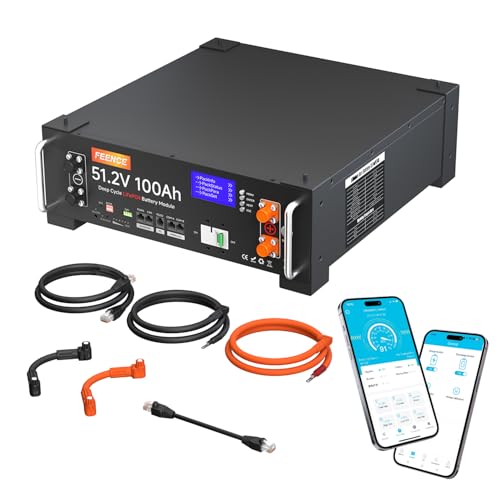
| FEENCE LiFePO4 solar battery 48 V 100 Ah view › | 5.12 kWh | 48 V | Yes, its listing names it | More than 6,000 | A normal night, on a hybrid inverter | View › |
 FEENCE LiFePO4 48 V 320 Ah view › FEENCE LiFePO4 48 V 320 Ah view › | 16.38 kWh | 48 V | RS485, CAN and RS232 | Its listing does not say | A whole day without sun | View › |
 Oasesenergy LiFePO4 48 V 300 Ah view › Oasesenergy LiFePO4 48 V 300 Ah view › | 15 kWh | 48 V | Its listing does not say | Its listing does not say | Full cabinet, named manufacturer | View › |
 Generic LiFePO4 battery 48 V 200 Ah view › Generic LiFePO4 battery 48 V 200 Ah view › | 10.24 kWh | 48 V | Its listing does not say | Its listing does not say | Replacing a lead bank | View › |
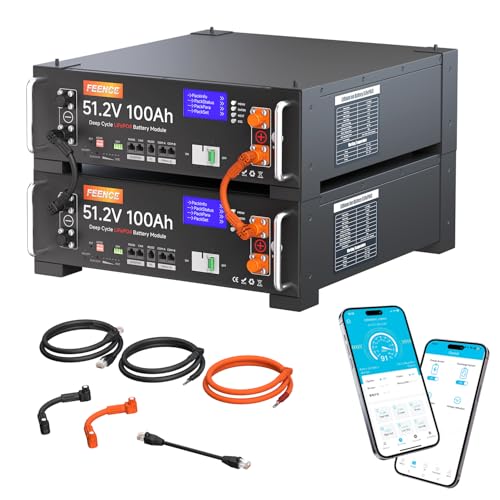 FEENCE Pack of two 48 V 100 Ah view › FEENCE Pack of two 48 V 100 Ah view › | 10.24 kWh | 48 V | Bluetooth per module | Its listing does not say | Growing in halves | View › |
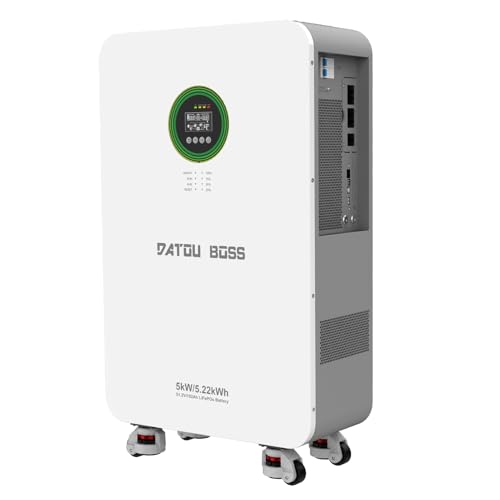 DATOUBOSS 48 V 102 Ah all in one view › DATOUBOSS 48 V 102 Ah all in one view › | 5.22 kWh | 48 V | Inverter built in | More than 6,000 | Battery and inverter in one box | View › |
 Oasesenergy 48 V 100 Ah stackable with inverter view › Oasesenergy 48 V 100 Ah stackable with inverter view › | 5 kWh | 48 V | Inverter built in | Its listing does not say | Stacking up later | View › |
| WattCycle 10 kWh balcony battery view › | 10 kWh | Alternating current | Not applicable | Its listing does not say | Cabinet capacity with no consumer unit work | View › |
| Elfcam Elf-BES-2K-Base view › | 2.01 kWh | Microinverter side | Not applicable | Its listing does not say | A balcony array | View › |
 HumsiENK LiFePO4 24 V 200 Ah view › HumsiENK LiFePO4 24 V 200 Ah view › | 4.8 kWh | 24 V | Its listing does not say | Its listing does not say | Off grid, not a house with a supply | View › |
 Electronicx AGM solar battery 12 V 100 Ah view › Electronicx AGM solar battery 12 V 100 Ah view › | 1.28 kWh, half usable | 12 V | Not applicable | Its listing does not say | A caravan, a boat, a shed | View › |
Capacities are the ones each listing declares, or the multiplication of the volts by the amp hours where the listing does not do it, and each product card says which. Cycles are the figure the listing claims; none of the 33 in the census states the depth of discharge it was counted at, so no two of these figures are strictly comparable. Census of 8 September 2026.
FEENCE LiFePO4 solar battery 48 V 100 Ah view ›
Of the fourteen 48 volt batteries in the census it is one of three whose listing says it communicates with the inverter, and it is the one that leaves the least capacity going spare for a mid range household. If you are wiring it to a hybrid inverter we would take this one, and not for the price: without that communication the inverter does not know how much charge is left and manages it blind.
- Its listing declares 5.12 kWh, which is exactly what 51.2 volts times 100 amp hours gives: the figure matches the voltage it declares.
- It says more than 6,000 cycles, one of the restrained figures in this catalogue: seven listings in the census promise 15,000 and not one of the thirty three says at what depth of discharge it counts them.
- Server rack format with the battery management system inside, which is the format domestic storage cabinets are built around.
- Its title calls capacity output power, a confusion that repeats through this catalogue: power is what it can give at once and capacity is what it holds.
- It names communication with the inverter, which 3 of the 33 listings counted do
- A restrained cycle figure, in line with the makers that do declare conditions
- The 5.12 kWh matches the voltage and amp hours it publishes
- It does not say at what depth of discharge it counts its cycles, like none of the census
- It writes no warranty in years in the title
- Five kilowatt hours cover a mid range household's night, not a whole day without sun
FEENCE LiFePO4 48 V 320 Ah view ›
The 16.384 kWh are close to five nights of a mid range household, which makes it the one for anyone who wants to ride out a grey day rather than a dark evening, or who knows they will grow and does not want to buy a second cabinet. It is also the only one here that writes down all three of the protocols that decide whether a household inverter can talk to it.
- It declares 16.384 kWh, which is what 51.2 volts times 320 amp hours gives: the figure matches the voltage.
- It names its three communication protocols (RS485, CAN and RS232), which is what decides whether the household inverter can talk to it.
- The breakers come inside, which on a storage cabinet you normally buy separately.
- Its 200 amps of management is the power it can deliver at once: about 10 kW at 51.2 volts, more than a whole house asks for at any one moment.
- Three communication protocols with the inverter written on the sheet
- Capacity to get through a whole day with no production
- The breakers come inside, which on a storage cabinet are usually bought separately
- It does not declare the depth of discharge it measures its life at either
- It weighs and occupies what a cabinet weighs and occupies: this is not a thing you move
- Capacity going spare if what you use after dark does not reach five kilowatt hours
Lithium or lead acid for solar: only half of a lead battery can be used
The question almost always arrives through the price: a lead battery, AGM or gel, costs considerably less per nominal kilowatt hour than a lithium one. The sum changes when you look at usable capacity, which is the part you can take out without shortening its life.
The technical guidance published by retailers in the sector puts the recommended depth of discharge for lead at around 50% and for lithium at 80 to 90%. Applied to the lead battery in this guide: 1.28 nominal kilowatt hours become about 0.64 usable. With that correction the cost per usable kilowatt hour stops being half of lithium and lands somewhere close to it, and you need twice as many boxes on the wall to get there.
Electronicx AGM solar battery 12 V 100 Ah view ›
It stores 1.28 kWh on paper and about 0.64 of those get used, because a lead battery is discharged to halfway if it is to last. With that sum in front of you, lead stops being half the price of lithium and lands somewhere close to it per usable kilowatt hour.
- At 12.8 volts and 100 amp hours it stores 1.28 nominal kWh, although its listing does not publish that figure.
- The recommended depth of discharge for lead is around 50 per cent and for lithium 80 to 90, according to the technical guidance published by retailers in the sector.
- It is a sealed deep cycle AGM, the lead variant built to be discharged hard many times over.
- In the census of 8 September 2026, only four of the 33 listings write a warranty in years in their title, all four from the same brand, and they say two years: none of the ones advertised as lithium writes one at all.
- A cheap way into a small or backup installation
- Sealed and maintenance free, and it can be mounted on its side
- Lead copes well with cold, where lithium needs protection
- Only half of what it stores can be used if you want it to last
- You need twice as many units for the same genuinely usable energy
- It is not a daily storage battery for a house with panels
Which of the eleven solar batteries to buy, according to your installation and what you use after dark
Five kilowatt hours cover the night of a home using 250 kWh a month, and its listing is one of the three in the census that name communication with the inverter. If you are wiring it to a hybrid inverter, we would take this one, and not for the price: without that communication the inverter does not know how much charge is left and manages it blind.
See it on Amazon ›It stores 10.24 kWh and its listing carries no brand: Amazon's API returns it as generic. It is a useful example of what is on this shelf, because at equal capacity the cost per kilowatt hour moves a great deal, and what you are not buying here is somebody to go back to in two years.
View ›Fifteen kilowatt hours is a full domestic cabinet's worth of capacity, and here it arrives with an identifiable manufacturer, which on this shelf is not the norm. Its 100 amp management system limits what it can deliver at once to about five kilowatts: enough for a house, tight for starting large loads together.
View ›A 5 kWh module with a 5 kilowatt inverter that stacks with others like it. It is the way to start small and grow without changing system, and you pay for it in the first module's cost per kilowatt hour, which is the one carrying the inverter.
View ›Every figure in this guide carries its source and its date. On 8 September 2026 we went through the solar battery catalogue with our Amazon API and collected 33 distinct listings, on Amazon's Spanish shopfront, which is part of the same European catalogue that serves amazon.co.uk. On those 33 we counted the working voltage, the cycle figures, the warranties written in a title and how many state a depth of discharge, and those counts are what open several sections of this guide. Availability, model numbers and pricing vary by country, so check the listing in your own store before buying.
The capacities are the ones each listing declares, or the multiplication of the declared volts by the declared amp hours where the listing does not do it; each product card says which of the two it is. Where a listing publishes no cycle figure, no warranty or no depth of discharge, the cell says so rather than being filled in.
The British rules and figures in this piece come from British sources, read on 16 September 2026: the electricity unit rate from Ofgem's price cap for 1 October to 31 December 2026; the Smart Export Guarantee rates from the tariff comparison Which? published in April 2026; the VAT treatment of energy saving materials from HMRC's VAT Notice 708/6 on gov.uk, quoted directly; the definition of a plug-in microgenerator from SI 2026/848 on legislation.gov.uk; and the G98 and G99 thresholds from the connection rules the network operators apply. This guide sets out what those published rules say and is not legal, tax or electrical advice for a particular installation. No manufacturer has paid to appear and the order does not change for what a link pays.
Is solar battery storage worth it in the UK?›
It depends on one figure that is not on your bill: what you are already paid to export. Storing a kilowatt hour saves you the difference between what you pay for it and what you would have been paid for exporting it. At the 26.32p cap for October to December 2026 and a 4.1p export rate, that difference is 22.2p. On a 15p export tariff it is 11.3p. And the highest rates, 23p and 25p in the tariff table Which? published in April 2026, are conditional on having a battery, which means part of a battery's value in the UK sits in the tariff it unlocks rather than in the energy it stores.
Do I pay VAT on a solar battery in the UK?›
On the installation, no, until 31 March 2027. On the battery bought on its own, yes. HMRC's VAT Notice 708/6 zero rates the installation of listed energy saving materials from 1 May 2023 to 31 March 2027, and batteries for storing energy converted from electricity have been on that list since 1 February 2024. The same notice says that if you supply energy saving materials without installing them the supply is standard rated, and that the sale of energy saving materials by a retailer is always standard rated. From 1 April 2027 the relief drops to 5%.
How many kWh of battery does a UK home need?›
As many as you use once the sun has gone, not as many as your roof produces. A home using 250 kWh a month with 40% of it after dark needs to store about 3.3 kWh a night, which a 5 kWh module covers with a little to spare. Anything beyond what you use at night is capacity you pay for and never cycle. The calculator on this page does that sum with your own consumption, your own unit rate and your own export rate.
Do I need to tell my network operator about a solar battery?›
Yes, and which form depends on the inverter rather than the battery. Up to 3.68 kW per phase of export capability it is a G98 notification, which is submitted to your distribution network operator after installation, within 28 days. Above that it is a G99 application, which has to be approved before the work is done and typically takes weeks. A large battery behind a small inverter can still be a G98 job, because the classification follows the inverter rating.
Can I fit a solar battery myself in the UK?›
The electrical work has to be done properly and signed off, and there are two consequences to doing it outside a certified installation that cost money rather than being bureaucratic. The battery bought on its own from a retailer carries standard rate VAT, while an installed one is zero rated until 31 March 2027. And Smart Export Guarantee eligibility runs on the installation and installer being MCS certified or equivalent, with suppliers asking for the certificate. Ask your supplier what adding a battery does to your export tariff before you buy one.
Is plug-in battery storage legal in the UK?›
Plug-in solar generation became legal in England, Wales and Scotland on 27 August 2026 under SI 2026/848, but read what that instrument defines. A plug-in microgenerator is a device that generates electricity from sunlight, has a maximum rated AC output not exceeding 800 watts, and does not import electrical energy for storage purposes except for control or auxiliary functions. A plug-in battery that charges from the socket is doing the thing that clause carves out, so do not assume it is covered. The regulation does not extend to Northern Ireland.
How long do solar batteries last?›
Count cycles, not years, and treat the advertised figure carefully. Of the 33 listings we counted on 8 September 2026, eleven publish a cycle figure and it runs from 3,000 to 15,000, which at one cycle a night is between eight and forty one years. Not one of the 33 says at what depth of discharge it counted them, and the only four listings that write a warranty in their title say two years. Divide the cycles by the nights a year you will use it and compare the answer with the warranty.
Lithium or lead acid battery for solar?›
Lithium, for anything that cycles daily, and the reason is usable capacity rather than chemistry snobbery. The technical guidance published by sector retailers puts the recommended depth of discharge at around 50% for lead and 80 to 90% for lithium, so a 1.28 kWh lead battery gives about 0.64 usable kilowatt hours. Once you compare cost per usable kilowatt hour instead of per nominal one, lead stops being the cheap option and you need twice as many boxes on the wall.
Every number on this page comes from one of these sources, with the date we read it.
- HM Revenue and CustomsVAT on energy saving materials and heating equipment, Notice 708/6: zero rate from 1 May 2023 to 31 March 2027, batteries on the list since 1 February 2024, and materials sold without installation standard ratedQuoted directly in the section on VAT. Read on 16 September 2026.
- legislation.gov.ukThe Plugs and Sockets etc. (Safety) Regulations 1994 and Electricity Safety, Quality and Continuity Regulations 2002 (Amendment) Regulations 2026, SI 2026/848Made 16 July 2026, in force 27 August 2026. Contains the definition of a plug-in microgenerator quoted in this guide, and the note that the regulation does not extend to Northern Ireland. Read on 16 September 2026.
- OfgemEnergy price cap unit rates and standing charges: 26.32p per kWh for electricity, 1 October to 31 December 2026Direct debit, standard variable tariff, averaged across England, Scotland and Wales. Read on 16 September 2026.
- Which?Smart Export Guarantee rates compared: the best and worst SEG tariffs for solar panel ownersRates checked April 2026. Source of the 1p to 25p range, of the 4.1p standard rate and of the two top rates that require a battery. Read on 16 September 2026.
- OfgemSmart Export Guarantee: the obligation on suppliers with more than 150,000 domestic customers, and the certification and metering conditionsRead on 16 September 2026.
- MCSSmart Export Guarantee for consumers: the MCS certificate suppliers ask forRead on 16 September 2026.
- MCSNotifying distribution network operators: the 3.68 kW per phase line between a G98 notification and a G99 applicationRead on 16 September 2026.
- m8d registerCensus over the 33 distinct solar battery listings returned by our Amazon API8 September 2026, Amazon's Spanish shopfront. Includes the count by voltage, the cycle figures, the warranties written in a title and the zero listings that state a depth of discharge.
If you have a hybrid inverter and a normal British household's usage, the FEENCE 5.12 kWh is the one we would wire in: it covers the 3.3 kilowatt hours a 250 kWh month leaves after dark, and it is one of only three listings in the census that say they talk to the inverter. If you want to get through a whole grey day rather than a night, the FEENCE 16.38 kWh, which writes its three communication protocols down. And if what you have is a balcony array and a microinverter, the Elfcam 2.01 kWh is the one built for that job, with the caveat about the 27 August 2026 rule that you will find above.
Before any of that, do the sum that decides. A battery does not save you the price of electricity: it saves the gap between what you pay and what you are already paid to export, and in this country that gap can be 22p or it can be 3p depending on nothing but which tariff you signed. Check what your supplier pays you now and what it would pay you with a battery, because that conversation is free and on most roofs it is worth more a year than the storing is. Then check the VAT, because the same battery is taxed one way in a box and another way on a wall.
m8d pick · The one that talks to the inverterFEENCE LiFePO4 solar battery 48 V 100 AhSee it on Amazon ›Comments
Be the firstNo sign-up: just a name. Every comment is reviewed before it is published.