Best video doorbells UK 2026: what fits your existing wiring, what you may fit if you rent, and the audio setting
 m8d.ioUpdated on
This guide contains affiliate links. As an Amazon Associate, m8d.io earns from qualifying purchases, at no extra cost to you.
The best video doorbell for a British home is settled by two questions that come before the brand: what is already behind your front door, and whether the wall is yours to drill. With a bell push and a chime, a battery unit like the Tapo D210 view › goes up in an afternoon and rings your phone, but it opens nothing. With two wires from an intercom, a wired kit swaps over and releases the door.
Wired or battery? In a British house that question is really about your bell transformer
A battery doorbell needs nothing from the house. A wired one needs a transformer, and the range it has to sit in is narrower than most people expect. Ring publishes the figure for the British market: its Video Doorbell Wired takes 8 to 24 V AC, 50/60 Hz, 8 VA to 40 VA, and its own support page notes that a domestic transformer is "often labeled 8V, 12V or 24V". Which? puts the working assumption for a wired unit at a standard 18 V AC supply.
Two consequences follow, and neither is in the listings. First, volts are only half the requirement: a transformer can read 12 V on the label and still fall short on VA, which is the figure that says how much current it can actually deliver. Second, the same maker's better model asks for more: the Video Doorbell Pro range is published at 16 to 24 V AC and 10 to 40 VA, so a house wired with an 8 V transformer can run the cheaper unit and physically cannot run the dearer one.
If you have a chime on the wall, there is a third thing to check before you order anything: whether the doorbell expects to keep it, replace it, or bypass it with a supplied power kit. That is the difference between a swap and an electrician.
Wired doorbells are sold on the promise that your old bell wiring will do. For most of them it will. The sentence is still doing a lot of work, because the wiring is not the variable that decides: the transformer at the other end of it is, and almost no listing names the number it needs.
m8d rule: If a wired doorbell does not publish both the volts and the VA it needs, go and read the transformer on your consumer unit before you buy it, not after.
Video doorbell compatibility checker: what your wiring, your door and your tenancy allow
Video doorbell compatibility checker: your wiring, your door and your tenancy
Three answers decide what you can buy: where you live, what reaches the bell or handset that is already on the wall, and whether you want it to ring your phone. With two wires and a house of your own, a wired kit swaps over without opening a wall; in a flat or a rental, someone else has to say yes first. Free, no account and no ads.
This is the case that goes best. Two wires already carry power, sound, picture and the door release, so the outdoor panel and the indoor screen swap over without opening a wall. The kits here declare runs of up to 100 metres, which covers a house and a gate at the end of a drive. The wi-fi sits in the indoor screen, so phone alerts need no extra box and no bell transformer at all.
Phone alerts bring recording with them, and recording brings the law. In the only British court case on a doorbell camera the video was allowed and the microphone was not, so the setting to look for before you buy is whether audio can be switched off on its own. And a memory card becomes a running cost: neither recording unit in this guide includes one.
- Two wiresTwo non-polarised cables carry power, sound, picture and the door release between them. It is how a modern intercom is wired, and it is what lets the whole kit be swapped without opening a wall.
- Four wires, or olderOne cable per function. It still works and it still has spare parts, but almost nothing with wi-fi is built for this family, so the choice narrows fast.
- A building's door entry systemThe street panel belongs to the block, so the only part that changes is your handset, and it has to match whatever system the building runs.
- A doorbell, not an intercomA bell push, a transformer near the consumer unit and a chime on the wall, or nothing at all. None of it opens a door, and a wired unit needs that transformer to sit inside a narrow range of volts and VA.

The wire counts, the maximum run and what each kit contains come from the SCS Sentinel, TP-Link, Fermax and TMEZON spec sheets read on 16 September 2026 and listed in the sources below. The electrical range for a wired unit is Ring's published British requirement, in the same list. A checker does not replace an installation manual or a qualified electrician, and it cannot read your tenancy agreement or your lease.
Renting or leasehold? Who actually owns the wall you are about to drill
In a flat or a rented home the first question is not which doorbell: it is who has to say yes. The guides answer the product question. This one decides whether you can fit the product at all, and it is the one that sends units back.
If you rent, the condition is usually written into the agreement. The London Borough of Havering publishes its own wording for council tenants: "If you wish to install your own security doors, a burglar alarm or CCTV, you must obtain our prior written permission", the installation "must be carried out by a suitably qualified technician", and "the camera must not be able to view any neighbouring property, surrounding public area". Private tenancies vary, but the pattern is the same wherever drilling, an exterior fixing or the existing doorbell is involved.
If you own a leasehold flat, the constraint is the lease rather than the landlord's goodwill. The solicitors at KDL Law set out the sequence in October 2024: where the camera sits on part of the property demised to you, the leaseholder "must consider if the fixing of the camera in the chosen position amounts to an alteration" under the lease, and in most cases that means asking the freeholder for a licence to alter, which "is not always something the landlord is obliged to provide". Where it looks at communal parts, leaseholders "do not have an unfettered right to install any form of CCTV system", and the duties of a data controller follow: signage, answering a request for footage within a month, and deleting it on a schedule.
Our advice, and it costs nothing: ask in writing before you order, not after. A battery unit fixed inside your own front door is the version that survives that conversation most often, because it leaves no hole and comes off in a minute.
What we cannot tell you: whether your particular lease or tenancy allows it. Leases differ clause by clause and a guide cannot read yours. What we can say is which document to open first, which is the alterations clause of the lease or the conditions section of the tenancy, and that the answer to "can I take it down without a trace" changes the conversation more than any specification on this page.
What the app adds to a doorbell, and the three things that arrive with it
- You find out when you are not in. That is what people are actually buying: the alert reaches the phone and you can talk and, on a wired kit, open.
- Recording arrives, and the law arrives with it. A device that records or detects motion is doing something a traditional doorbell never did, and that is the point at which the regulator's rules start to apply to you.
- A microphone arrives, and it hears further than the camera sees. It is the part a British court has already ruled on, so the setting to find is whether the sound can be switched off on its own.
- A consumable arrives. Neither recording unit here includes a memory card, and the endurance type is the one built for writing video all day.
The only British court ruling on a doorbell camera went against the microphone, not the camera
Almost every argument about doorbell cameras and neighbours is about the picture. The one British judgment on it turned on the sound. In Fairhurst v Woodard, heard at Oxford County Court in 2021, a claim in harassment and under the Data Protection Act 2018 succeeded against a neighbour whose devices included a Ring doorbell. The video was not the problem: the court accepted that a householder has a legitimate interest in protecting his home and that incidental capture of a passer-by on a public street did not override it.
The audio was. The judgment found that "the processing of such audio data by the Defendant as data controller is not lawful", because "the extent of the range means that personal data may be captured from people who are not even aware the device is there, or that it records and processes audio personal data". A doorbell microphone reaches a good deal further than its camera sees, and that gap is what the court took issue with.
Which turns a legal point into a specification. The buying question is whether the audio can be switched off on its own, without switching the camera off with it, and the makers' own support pages are where the answer is. Ring publishes an "Audio Streaming and Recording" toggle under Device Settings and Privacy Settings, with a condition attached in its own words: "To turn Audio Streaming and Recording on and off, you must have a compatible Ring subscription." TP-Link publishes Privacy Mode for Tapo cameras, and states that when it is on "it stops streaming and recording both video and audio", with no separate control for sound. Both are read on 16 September 2026.
The general position is the regulator's and it has not changed: if your camera only sees inside your own boundary, data protection law does not apply to you; the moment it reaches a neighbour, a shared space or the pavement, it does, and with it come signage, answering requests for footage and deleting on a schedule.
Every listing sells the microphone as talk-to-your-courier convenience. Nobody sells the switch that turns its recording off, and in Britain that switch is the one with case law behind it.
m8d rule: Before you buy, find the audio switch in the app's privacy settings. If it is behind a subscription, or if the only switch takes the camera down with it, you have bought a device you cannot quieten without losing what you bought it for.
The one we would fit on a British front door, and the two that come after it
For the house with a bell push and a chime, which is most of them, the Tapo D210 view › is the one we would fit. It asks nothing of the wiring, its chime comes in the box rather than as an accessory, and TP-Link publishes the figure behind the headline rather than hiding it: 180 days of battery at 300 seconds of use a day, on a 6400 mAh cell. That is five minutes a day of ringing, alerts and live view, and the maker says as much on its own page.
Note what it is not. It does not release a door, and in Britain that is not a shortcoming: a video doorbell here is not expected to. If you want to let someone in from the sofa, that is a wired kit, and it is the next section.

Tapo D210 view ›
It replaces no intercom and opens no door, and on a British front door that is what a video doorbell is: a camera with a button that rings your phone. It is the one that fits when the wall, the wiring or the lease are not yours to change.
- It is sold on six months of battery and its own spec sheet shows the arithmetic: 180 days at 300 seconds of use a day, on a 6400 mAh cell (TP-Link UK, Tapo D210 page, read 16 September 2026). Five minutes a day covering rings, alerts and live view.
- Records to a microSD card of up to 512 GB, bought separately, or to the cloud on a subscription. The indoor chime is in the box, which is what makes it ring inside the house without depending on a phone.
- The camera is 2K at 2304 by 1296, 160 degrees diagonal, with a declared IP65 rating. Read the section on audio and the law before you decide where it points: a device that records is doing something a traditional doorbell never did.
- No wiring and no transformer: it goes where nothing can be touched
- The indoor chime comes in the box rather than as an accessory
- Phone alerts with person detection, with no compulsory subscription
- It does not release a door or a gate: it is not wired to one
- Battery life depends on use, and the maker's own figure is five minutes a day

| Model | What it needs from the house | What it does beyond ringing | What its maker declares | |
|---|---|---|---|---|
| Tapo D210 view › | Nothing: it runs on a battery and screws or sticks on | Rings your phone, records, and tells people from parcels | 180 days at 300 s of use a day, 6400 mAh, IP65, chime included | View › |
 SCS Sentinel VisioFirst 4.3 view › SCS Sentinel VisioFirst 4.3 view › | Two wires, up to 100 m | See and open, with no app in the middle | 4.3 inch indoor screen, IP44, three-year warranty | View › |
 TMEZON MZ-V20 view › TMEZON MZ-V20 view › | Four wires | See and open on a 7 inch screen | Its maker files it in the four-wire collection | View › |
| SCS Sentinel VisioWifi 7 view › | Two wires, up to 100 m | Phone alerts and recording to a microSD card | 7 inch touchscreen, IP65 panel, 110 degree lens | View › |
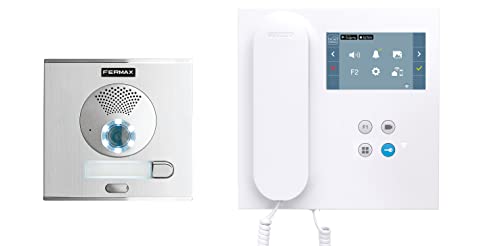 Fermax Kit City VEO Wifi Duox Plus 1L view › Fermax Kit City VEO Wifi Duox Plus 1L view › | Two wires, the brand's own digital system | Call forwarding to a phone, and a trade support network | Kit with panel, monitor, power supply and lock release | View › |
Every line in the last column comes from the manufacturer's own documentation, read on 16 September 2026 and listed in the sources below. Availability and model names vary by country: what your local Amazon lists may not match this page unit for unit.
Video doorbell or video door entry? In Britain those are two different purchases
The word covers two products that do different jobs, and the difference is whether anything opens. A video doorbell is a camera with a button: it shows you the caller and lets you talk. A video door entry system, sometimes sold here as a video intercom, is wired to a lock or a gate release, so pressing a button on the indoor screen actually lets the caller in. Search for a video doorbell and you are shown the first kind. The second is sold under a different name, so it never turns up in the same list.
The distinction matters in two British situations. One is a house with a gate at the end of a drive, where the whole point is opening it without walking down. The other is an old audio-only handset that is already wired: if two wires reach it, a two-wire kit replaces it and you gain a picture, and Fermax describes its own two-wire system in exactly those terms on its UK site, as "2 non-polarised wires from start to finish" and compatible with existing wiring.
If that is your case, we would start with the SCS Sentinel VisioWifi 7 view ›, because it is the one that does both things at once: it reuses the two wires and puts the alert on your phone without a separate bridge. If nobody in the house wants another app, the VisioFirst 4.3 view › does the door part for much less.
SCS Sentinel VisioWifi 7 view ›
A complete two-wire kit: street panel, 7 inch touchscreen and an alert on your phone when nobody is in. It reuses the two wires of an existing intercom, so in a house it goes in without pulling new cable, and unlike a battery doorbell it actually opens the door.
- Its spec sheet publishes the two figures that decide the installation: two wires, and up to 100 metres of cable between the panel and the screen (SCS Sentinel, VisioWifi 7 spec sheet, reference PVF0055, read 16 September 2026). One hundred metres covers a house and a gate at the end of a drive.
- Opens a door and a gate, has a 110 degree wide angle and a declared IP65 rating on the outdoor panel, with a three-year warranty from the maker.
- Records stills and video to a microSD card of 4 to 128 GB that is not included. For daily recording it has to be an endurance card: an ordinary one wears out under continuous writing.
- Reuses the two wires of an existing intercom: no new cable, no wall opened
- Phone alerts with no monthly fee declared
- Three-year warranty on the maker's own spec sheet
- The memory card is bought separately
- No use in a flat: the street panel belongs to the building
The card the VisioWifi 7 needs in order to record
SCS Sentinel VisioFirst 4.3 view ›
The same job without a phone in the middle: see who is there and let them in. Mechanical buttons, anti-vandal screws and nothing to set up. For the household that wants a picture at the door and does not want one more app.
- Two wires and up to 100 metres, the same as the unit above, powered at 15 V and 0.8 A by its own adapter (SCS Sentinel, VisioFirst 4.3 spec sheet, reference PVF0050, read 16 September 2026).
- Takes up to two extra indoor screens under reference PAP0011, which is the line to read if you want a second one upstairs.
- With no wi-fi there is no app to maintain and no account to create, and that is its whole argument. What you give up is knowing who called while you were out.
- The entry point of this selection, and still a complete kit
- Mechanical buttons and anti-vandal screws on the outdoor panel
- Three-year declared warranty, and it takes two more indoor screens
- No phone alerts: if you are out, you do not find out
- A 4.3 inch screen, half the size of the one above
The one that fits when four cables come out of the old handset and you would rather not touch them. Its own maker files it in the four-wire family, and that is exactly the reason to buy it or to rule it out.
View ›The kit from a door entry manufacturer rather than a consumer electronics one, with a trade network and spare parts on a ten-year horizon. That network is what it costs, and for a house you plan to stay in that is the sum that matters.
View ›
The VisioFirst with the screen from the expensive model and none of the wi-fi. For the household that wants to see properly and does not want an app, it is the cheapest way to get both.
View ›The selection is made by installation rather than by brand: first what is already behind the door, then what somebody in that position can actually buy. The six units come from the Amazon Spain catalogue that m8d's register reads every day, read on 16 September 2026. Availability, model names and variants change from one country to another, so what your local Amazon lists may not match this page unit for unit.
The British part of the page does not come from that catalogue, and deliberately so. The electrical requirement comes from Ring's published UK support pages, the working assumption for a wired unit from Which?, the law from the judgment in Fairhurst v Woodard and from the Information Commissioner's own public guidance, the tenancy condition from a London borough's published terms for its tenants, and the leasehold position from a firm of property solicitors. Each is dated in the source list.
The price bands that the Spanish edition of this guide publishes are not reproduced here: our price register reads Spanish retailers, and a figure in the wrong currency is no use to anybody buying here. Where the original compared units by price, this edition compares them by what they need and what they do. Where a maker does not publish a figure, the table says so instead of filling the gap.
The ones that hold up the specific claims on this page, each with the date it was read.
- Ring, UK supportChecking if your existing doorbell wiring is compatible with Ring Video Doorbells8 to 24 V AC, 50/60 Hz, 8 VA to 40 VA for Video Doorbell Wired; 16 to 24 V AC, 10 VA to 40 VA for the Pro range; transformers "often labeled 8V, 12V or 24V"; the warning about incompatible power sources. This is where the electrical figures on this page come from. Read 16 September 2026.
- Ring, UK supportDisabling the Audio Recording on your Ring DeviceThe "Audio Streaming and Recording" setting under Device Settings and Privacy Settings, and the condition that "to turn Audio Streaming and Recording on and off, you must have a compatible Ring subscription". Read 16 September 2026.
- TP-Link, UK supportHow to Use Privacy Mode on Tapo and Kasa Cameras"When Privacy Mode is enabled on a Tapo or Kasa camera, it stops streaming and recording both video and audio", with no separate control for sound. Read 16 September 2026.
- TP-Link, UKTapo D210 product page: battery life, capacity, resolution, field of view, IP rating and what is in the box180 days at 300 seconds of use a day, 6400 mAh, 2K 3MP at 2304 by 1296, 160 degrees diagonal, IP65, chime included in the box, microSD up to 512 GB. Read 16 September 2026.
- Inforrm, case report on Oxford County Court, HHJ Melissa Clarke, claim G00MK161Case Law: Fairhurst v Woodard, neighbour CCTV harassment and data protection claim succeedsThe claims in harassment and under the Data Protection Act 2018 that succeeded, and the distinction the court drew between the video, which it accepted, and the audio, which it did not. Read 16 September 2026.
- Charles Russell SpeechlysFairhurst v Woodard: property audio and video surveillance system breached GDPRThe second reading of the same judgment, and the source of the wording quoted on this page: that "the processing of such audio data by the Defendant as data controller is not lawful" and that "the extent of the range means that personal data may be captured from people who are not even aware the device is there". Read 16 September 2026.
- London Borough of HaveringVideo doorbells and CCTV in council tenant homesA landlord's published conditions, quoted on this page: prior written permission, installation by a suitably qualified technician, and that the camera must not be able to view a neighbouring property or a public area. Read 16 September 2026.
- KDL Law, property solicitors, 11 October 2024Can I install a door bell camera at my flat?The leasehold sequence: whether the fixing amounts to an alteration under the lease, the licence to alter, and the data controller duties that follow when a camera covers communal parts. Read 16 September 2026.
- Information Commissioner's OfficeHome CCTV systemsThe regulator's own public page: when domestic footage falls outside data protection law and what applies the moment it does not, including signage, requests for footage and deletion. Read 16 September 2026.
- Which?How to buy the best smart video doorbellThe working assumption quoted on this page: that wired doorbells "require existing doorbell wiring, along with a standard 18-volt AC supply". Read 16 September 2026.
- SCS Sentinel, official spec sheetVisioWifi 7 (reference PVF0055) and VisioFirst 4.3 (reference PVF0050): wire count, maximum run and warrantyTwo wires and up to 100 metres between the panel and the indoor screen, and the declared three-year warranty. The maker publishes this range in French and Spanish rather than English; the reference number is what identifies the unit. Read 16 September 2026.
- Fermax, UK2-wire door entry system, UK site: what a two-wire system is and what a kit containsThe maker's own description of a two-wire system as "2 non-polarised wires from start to finish in the installation", compatible with existing wiring. Read 16 September 2026.
- TMEZON4-Wire Intercom collection, where the maker files the MZ-V20Where this unit sits in the maker's own catalogue, which is the reason to buy it or to rule it out. Read 16 September 2026.
Will a video doorbell work with my existing doorbell wiring?›
Only if the transformer behind it is in range. Ring publishes 8 to 24 V AC and 8 VA to 40 VA for its wired unit and 16 to 24 V AC and 10 VA to 40 VA for its Pro range, and notes that a domestic transformer is often labelled 8V, 12V or 24V. Volts alone are not enough: the VA figure is the one that says whether it can supply the current. If you have two wires from an intercom rather than a bell, that is a different family again, and a two-wire kit replaces it.
Do I need permission to fit a video doorbell in a rented flat?›
Almost always, and in writing. The London Borough of Havering tells its tenants they must obtain prior written permission before fitting CCTV and that the work must be done by a suitably qualified technician. If you own a leasehold flat, fixing anything to the door or frame can count as an alteration under the lease and need a licence to alter from the freeholder. Ask before you order.
Is a video doorbell legal in the UK?›
Yes, and the boundary is where it points. The Information Commissioner's Office says that if a home system captures only images within your own property, data protection law does not apply; the moment it captures a neighbour, a shared space or the pavement, it does, and with it come signage, answering a request for footage and deleting on a schedule. The one court ruling, Fairhurst v Woodard in 2021, accepted the video and found the audio unlawful.
Can I turn off the audio on a video doorbell?›
It depends on the model, and it is worth checking before you buy rather than after. Ring publishes an Audio Streaming and Recording toggle under Privacy Settings and states that you need a compatible subscription to use it. TP-Link publishes Privacy Mode for Tapo cameras and says it stops streaming and recording both video and audio, so the sound cannot be switched off on its own.
Can a video doorbell open my front door or a gate?›
A battery video doorbell cannot: it is not wired to a lock or a gate release. What does that job is a video door entry system, sometimes sold as a video intercom, which is wired to one. If two wires already reach an old handset, a two-wire kit replaces it and the button on the indoor screen releases the door.
What is the difference between a two-wire and a four-wire system?›
How many cables the installation uses to carry power, sound, picture and the door release. A two-wire system sends all four down two non-polarised cables, which is what a modern intercom is wired with; a four-wire system separates the functions. They are not interchangeable, and buying from the wrong family is the expensive mistake in this category. Makers file their models by family in their own catalogues.
Read the wall before you read the reviews. A bell push and a chime means a battery doorbell, and in Britain that is the normal answer, with the caveat that it opens nothing. Two wires from an intercom means a wired kit and a picture where there used to be a handset. Four wires means a four-wire kit and no wi-fi. And if you rent or hold a lease, none of that matters until somebody has said yes in writing, so we would make that call first and choose the model afterwards.
The m8d choice for a British front door · Fits where nothing can be touchedTapo D210See it on Amazon ›
Comments
Be the firstNo sign-up: just a name. Every comment is reviewed before it is published.