Best handheld vacuum UK 2026: which to buy for crumbs, pet hair or the car, and how many minutes it lasts at full power
 m8d.ioUpdated on
This guide contains affiliate links. As an Amazon Associate, m8d.io earns from qualifying purchases, at no extra cost to you.
The best handheld vacuum for most homes is the Rowenta X-Touch: 0.6 kg, living on its charging base. Before buying any other, check the runtime. The Conga Rockstar 25.2 V Animal Hand advertises 40 minutes, yet the battery on its own spec sheet, 25.2 V and 2,200 mAh, gives 16.6 minutes at its 200 W.
Handheld vacuum runtime checker: how many minutes a battery really gives at full power
Handheld vacuum runtime checker
A battery's energy is its volts times its amp hours, and divided by the motor's watts it gives the minutes that motor can run flat out. All three figures are on the maker's spec sheet, so the minutes in any listing can be checked in ten seconds. It opens with the Conga Rockstar 25.2 V Animal Hand already worked out: it advertises 40 minutes and its own battery gives 16.6. A tool from m8d.io: free, no account and no ads.
Its battery stores 55.44 watt hours, and at 200 W that gives 16.6 minutes flat out, not 40. For the 40 minutes it advertises to come out, the motor would have to average 83 W instead of 200.
A full charge on one of these machines takes four to five hours according to Cecotec's spec sheets, so two charges are not a ten-minute wait: they are half a day. That is why the minutes at full power decide more than the kilopascals in the headline.
The sum, step by step, and what it does not tell you
The energy a battery stores is its volts multiplied by its amp hours, and the result comes out in watt hours. Divided by the watts the motor declares, it gives the hours that motor can run at full power; multiplied by sixty, the minutes. It is the same sum used for a laptop or an e-scooter battery.
When the result comes out below the minutes the maker advertises, the conclusion is not that it lies: it is that those minutes belong to another mode. The sum itself says what average power they would correspond to, and that is the figure worth looking at when comparing two machines.
What this sum does not tell you: how much dirt fits in the bin before suction drops, or how long it takes to fill, because that depends on what you vacuum and no single figure fits every home. Nor does it count the battery's loss of capacity over the years, which no spec sheet in this category publishes. The cleaning times you pick above are a reference for the sum, not a measurement: put in your own if you know how long you take.
There is no need to trust or distrust the listing: the maker's own spec sheet carries the three figures that check it, and the sum is one multiplication and one division.
m8d rule: Multiply the battery's volts by its amp hours and divide by the motor's watts. If the result is below the minutes on the listing, those minutes belong to a softer mode.
Which handheld vacuum has the best suction? Why 28,000 Pa and 28 kPa are the same figure, and why neither decides
It is the first question British shoppers put to Google about these machines, and the answer starts with a finding from the UK's consumer association: in its handheld vacuum buying guide, updated in July 2026, Which? reports finding no direct link between a vacuum's voltage and cleaning performance, and that claimed suction did not consistently translate into better results. The number printed biggest on the box is not the one that tells you what ends up in the bin.
Suction is the headline figure because it is the easiest to make large, and it is published in two different units. In the 32 handheld listings we counted on Amazon Spain on 16 September 2026, eight gave it in kilopascals and thirteen in pascals. A machine that says 28,000 Pa and another that says 28 kPa are stating exactly the same thing, and the one that looks stronger is simply the one that chose the unit with more zeros.
It is the detail that confuses most on the first page of any shop's results, and it takes no physics to switch it off.
m8d rule: Before comparing two suction figures, put them in the same unit: divide pascals by a thousand. Then remember that the result is pressure at the mouth of the nozzle, not the ability to pull hair out of fabric.
One more thing about that figure: suction pressure is measured with the nozzle sealed, which is the one moment a vacuum is not picking anything up. What drags dirt in is that pressure combined with the air the machine moves, and airflow in litres per minute is published by only one of the four machines in this guide, the Rowenta X-Touch, with 480.
Which handheld vacuum to buy for what you clean: crumbs, the sofa, stairs, the car or pet hair
This is the decision that comes before the model, and two questions settle it. First: how long is your clean? If it is thirty seconds several times a day, what decides is the weight and that it is charged, not the minutes. If it is the inside of the car, what decides is the minutes at full power and the size of the bin, because you will reach the end of both.
Second: what are you lifting? Crumbs, dust and sand come up with little suction. Pet hair woven into a fabric does not come up with suction: it comes up with a brush that spins. And a liquid comes up with neither unless the machine is built to get wet. We recommend choosing on those two answers before the kilopascals on the box, because a big suction number does not lift a hair gripping the weave.

0.6 kg and a charging base: it is in your hand in two seconds and back on its base without thinking.
See it on Amazon ›| Handheld vacuum | Volts and mAh | Watts | Minutes advertised | Bin | |
|---|---|---|---|---|---|
 Cecotec Conga Rockstar 25.2 V Animal Hand view › Cecotec Conga Rockstar 25.2 V Animal Hand view › | 25.2 V · 2,200 mAh | 200 W | 40 min (mode not stated) | 500 ml | View › |
 Cecotec Conga Rockstar Hand 8.4 V X-Treme view › Cecotec Conga Rockstar Hand 8.4 V X-Treme view › | 8.4 V · 2,200 mAh | 50 W | 20 min | 500 ml | View › |
 Cecotec Conga Immortal ExtremeSuction 22.2 V Hand view › Cecotec Conga Immortal ExtremeSuction 22.2 V Hand view › | 22.2 V · not published | not published | 25 min | 500 ml | View › |
| Rowenta X-Touch AC9736 view › | not published | not published | 10 min (Rowenta France) | 200 ml | View › |
Figures from the official cecotec.es and rowenta.es spec sheets, read on 16 September 2026. The 2,200 mAh of the Conga Rockstar Hand 8.4 V are those of the base version of that family: the X-Treme variant does not publish them. The highlighted row is the only one that publishes all four figures, which is what makes it checkable, not what makes it better.
A lightweight handheld vacuum for an older parent or weak wrists: the weight that decides, and the one that weighs 0.6 kg
“What is a good lightweight vacuum cleaner for elderly people?” is one of the questions Google shows British shoppers under this search, and the weight range is wider than it looks. The handheld vacuums in Which?'s buying guide, updated in July 2026, run from 0.55 to 1.55 kg: almost three times more weight at the top of the range, held at arm's length under a table or up at a curtain rail.
Rowenta declares 0.6 kg for the X-Touch, the lightest in this selection, and it adds the other detail that matters in this case: it lives on a charging base, so nobody has to find a socket, bend down to a cable or remember to charge it. The trade-off is its 0.2 litre bin, the smallest of the four, which means emptying it more often; for someone with weak hands, a bin that opens over the kitchen bin with one button is worth checking in the photos before buying.
The four handheld vacuums in this guide, one by one, with what each spec sheet publishes and what it leaves out
Rowenta X-Touch AC9736 view ›
Built for the way a handheld vacuum is really used: thirty seconds, several times a day, without thinking about it. It weighs 0.6 kg and lives on its charging base, so it comes off with one hand and goes back without looking for a shelf.
- Weight is the spec that decides this kind of cleaning, and it is the one Rowenta does publish: 0.6 kg, against the kilo or more of many machines sold as handheld vacuums (the ones in Which?'s guide go up to 1.55 kg). A vacuum you can lift with one hand gets used; one you have to fetch from a cupboard does not.
- Rowenta's Spanish spec sheet declares a 0.2 litre bin, 0.6 kg, 80,000 revolutions per minute and 480 litres per minute of airflow, with no runtime; its French page puts 10 minutes in the product's title. Neither publishes the battery's capacity or the motor's watts, so those 10 minutes cannot be checked with this guide's sum.
- The 0.2 litres are the smallest bin in this guide, less than half the 500 ml of the three Cecotec machines. For crumbs and a sofa that is plenty; for the inside of a whole car you will empty it several times.
- 0.6 kg declared: the lightest in the selection
- Charging and storage base: it is always ready
- Its replacement filter has its own part number and is sold on its own
- No battery figures published: its 10 minutes cannot be checked
- 0.2 litre bin: the smallest of the four
Filter for the Rowenta X-Touch: the ZR009009 replacement filter view ›, the part number Rowenta gives for this model. It is the one piece a handheld vacuum wears out before its battery, and buying it with the vacuum saves the week without suction when the first one clogs.
Cecotec Conga Rockstar 25.2 V Animal Hand view ›
The most motor of the four and the only one with a brush designed for hair, which is what really takes effort to lift from a sofa. The catch: its 40 advertised minutes are not at full power. With the 25.2 volts and 2,200 milliamp hours its own spec sheet declares, the sum at 200 W gives 17.
- It is the only one of the four whose spec sheet publishes all four figures at once: volts, milliamp hours, watts and minutes. That is exactly why its runtime can be checked, which is more than can be said for the rest of the category.
- 55.44 watt hours of battery divided by a 200 W motor is 16.6 minutes flat out. For the advertised 40 to come out, the motor would have to average 83 W. It is not a trick: the advertised minutes belong to a softer mode, and the sheet does not say which.
- A full charge takes 4.5 hours, according to the same spec sheet. With 17 useful minutes at full power, a second pass turns into an afternoon's wait.
- 200 W and 20 kPa declared: the most motor in the selection
- 500 ml bin, the joint largest of the four
- Publishes the four figures that let you check its runtime
- The 40 minutes it advertises do not come out at full power
- 4.5 hours for a full charge: no quick second pass
Cecotec Conga Immortal ExtremeSuction 22.2 V Hand view ›
The only one of the four whose spec sheet declares a removable battery, and that decides how long the machine lives: the day the battery stops charging you replace the part, not the vacuum. It declares 25 minutes, 500 ml and a system for solids and liquids.
- A removable battery is the spec that most extends the life of a handheld vacuum, and the one least looked at. In a machine that takes four or five hours to charge and is used every day, the battery is the part that wears out; when it cannot be swapped, the whole machine goes.
- It picks up solids and liquids, like the Animal Hand in this guide: if what you want is to hoover up a spilt glass, both will do and the difference lies in the other figures.
- Its spec sheet declares 25 minutes of runtime and does not publish the motor's watts, so it is the only one of the four whose minutes cannot be checked with this guide's sum. That is said here rather than hidden.
- Removable battery declared on its spec sheet, with a spare in the maker's catalogue
- Wet and dry: it picks up a spill
- 500 ml bin
- Its spec sheet publishes neither watts nor amp hours
- After liquids the bin has to be dried every time
Cecotec Conga Rockstar Hand 8.4 V X-Treme view ›
The 50 W and 4.5 kilopascals it declares leave it far behind the 200 W model, and yet it is the only one of the four whose advertised minutes stand up to the sum: with 8.4 volts and 2,200 milliamp hours, 50 W gives 22 minutes, and the sheet promises 20.
- Advertising less than it delivers is the rarest signal in this category. Of the four machines in this guide, it is the only one where the battery sum comes out above the advertised minutes.
- 4.5 kilopascals is a quarter of the Animal Hand's 20, and that shows exactly where it should: in lifting hair that is embedded in fabric. For crumbs, shelf dust and a car floor, it does not.
- The spec sheet of the X-Treme variant declares 50 W, 4.5 kilopascals, 20 minutes and 500 ml, and does not publish the milliamp hours; the 2,200 used in the sum are those of the Conga Rockstar Hand 8.4 V spec sheet, the base version of the same family.
- Its advertised minutes stand up to its battery sum
- 500 ml bin, the same as the Animal Hand
- 50 W: the battery lasts at full power, not in a weak mode
- 4.5 kilopascals: short for embedded hair
- Its variant does not publish the battery's milliamp hours
When not to buy a handheld vacuum, however cheap it is
- If you want it to vacuum the house. With bins of 200 to 500 ml and 17 to 22 minutes at full power, the floor of a flat does not fit: that is a cordless stick vacuum.
- If you already own a cordless stick vacuum with a handheld mode. Most of them come apart into a handheld: check whether yours does before buying a second machine.
- If what you want is not to vacuum at all. That is a robot, and a different decision.
- If the only figure you are looking at is suction. With pascals and kilopascals mixed on the same page, that comparison does not hold, and the figure that decides your case is rarely that one.
What a handheld vacuum needs after the first year: the filter, the battery and why suction drops
A handheld vacuum that loses power after a few months almost never has a worn motor: it has a clogged filter. It is a fine mesh that all the air passes through, and as it fills with dust the motor has to pull air through a wall that gets tighter every week. Rinsing it and letting it dry completely before refitting recovers most of the pull, and replacing it once rinsing no longer does costs little on the models that sell it on its own with a part number.
The second part that decides the machine's life is the battery, and there is a difference that no headline mentions: on some models it is removable and on others it is not. Where it is, the day the battery stops charging you change the part; where it is not, you change the machine. Of the four in this guide, the Conga Immortal declares a removable battery on its spec sheet. On how many years a battery lasts, the floorcare expert from AO.com quoted by The English Home in December 2025 puts it at around four on average, and the sign is the same in every model: runtime that drops sharply, or charging that takes far longer.
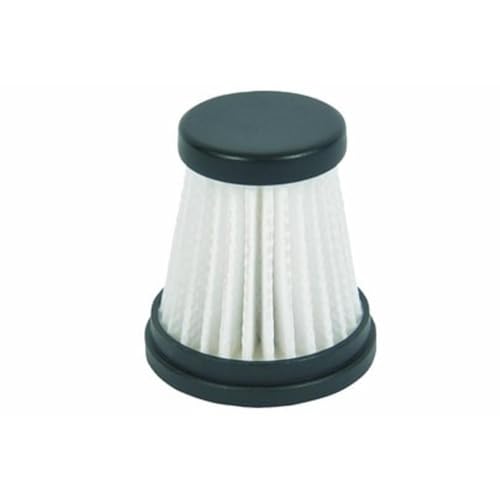
Rowenta ZR009009 view ›
The filter that sits in front of the X-Touch's motor, with the part number Rowenta itself gives in its accessories shop. It is the part that decides whether the machine still has its pull a year later.
- A handheld vacuum that loses power after a few months almost never has a worn motor: it has a clogged filter, and the air has to pass through a wall that gets tighter every week.
- It is rinsed with water and left to dry completely before going back in. When rinsing no longer brings the suction back, it is replaced.
- Having a published part number is what separates a machine you repair from one you throw away, and not every vacuum in this guide has one.
- The maker's own part number for this model
- Sold on its own, without replacing the vacuum
- It only fits the X-Touch: it is not a universal filter
Handheld vacuum batteries and UK bins: why they never go in the rubbish, and the shop that has to take the old one back
Cordless handheld vacuums run on lithium-ion batteries, like the 25.2 V pack the Animal Hand's spec sheet declares, and in the UK that battery has a rule of its own. Material Focus, the not-for-profit behind the Recycle Your Electricals campaign, reported with the National Fire Chiefs Council on 10 May 2024 more than 1,200 battery fires in bin lorries and waste sites in a single year, up 71% from 700 in 2022, and its advice is flat: batteries, loose or hidden inside electricals, are never binned. The vacuum goes to a household recycling centre or an electricals collection point, and a removable battery goes separately to a battery recycling point; the Recycle Your Electricals postcode locator lists the nearest ones.
The other half is a right most buyers do not know they have. Under the UK rules on electrical waste, a shop that sells you a new household appliance must give you a way to dispose of the old one of the same kind: a free take-back in store, another free take-back service, or membership of the Distributor Take Back Scheme, which funds council collection points. Online shops have to publish how they do it on their website. So when a handheld vacuum is replaced, the old one does not go in the kitchen bin: it goes back with the new one's shop or to the tip.
Listings sell handheld vacuums on minutes and suction, and almost never say whether the battery comes out. In the UK that detail decides whether a tired battery means a spare part or a trip to the recycling centre.
m8d rule: If a handheld vacuum's spec sheet does not say the battery is removable, assume it is not: the day it stops charging, the whole machine goes to the recycling centre, never in the bin.
Which handheld vacuum cleaner has the best suction?›
By declared figures in this guide, the Cecotec Conga Rockstar 25.2 V Animal Hand, with 200 W and 20 kilopascals. But suction is a weak guide: Which? reports in its July 2026 buying guide that claimed suction did not consistently translate into better cleaning, and the figure is published in two units, so 28,000 Pa and 28 kPa are the same number. For pet hair, what decides is a motorised brush.
Are there any handheld vacuums that actually work?›
The ones whose figures add up. Multiply the battery's volts by its amp hours and divide by the motor's watts: the Conga Rockstar Hand 8.4 V gives 22 minutes at full power and advertises 20, while the Animal Hand gives 16.6 and advertises 40. The runtime checker on this page does that sum for any spec sheet that publishes the three figures.
What is the best handheld vacuum cleaner for home use?›
For the way a handheld is used at home, thirty seconds several times a day, the Rowenta X-Touch: 0.6 kg declared and a charging base that keeps it ready. If there is a dog or a cat, the Conga Rockstar 25.2 V Animal Hand, which has the brush that lifts hair, knowing it gives about 17 minutes at full power.
What is a good lightweight vacuum cleaner for elderly people?›
One under a kilo that charges on a base. The handhelds in Which?'s July 2026 guide weigh from 0.55 to 1.55 kg; the Rowenta X-Touch declares 0.6 kg and docks on its charging base, so there is no cable to plug in. Its small 0.2 litre bin means emptying it more often.
How long does a handheld vacuum battery last?›
Two different answers. Per charge, the listings in this guide say 20 to 40 minutes, but those minutes are rarely at full power: at 200 W the Animal Hand's battery gives 16.6. In years, an AO.com floorcare expert quoted by The English Home in December 2025 puts it at around four on average, which is why a removable battery, like the Conga Immortal's, extends the machine's life.
Can you put a handheld vacuum or its battery in the bin?›
No. Lithium-ion batteries cause fires in bin lorries and waste sites: Material Focus and the National Fire Chiefs Council counted more than 1,200 in a year (May 2024). Take the vacuum to a household recycling centre or an electricals collection point, the battery to a battery recycling point, or hand the old one to the shop that sells you the new one, which has to offer a way to take it back.
Is a corded or cordless handheld vacuum better?›
With a cable there is no battery to run out or age, and there is usually more motor for the money. Without one, it is in your hand and working in ten seconds, which is why people buy this kind of machine. For thirty seconds several times a day, cordless; for the whole car or a house move, the cable stops being a problem.
How often should you clean a handheld vacuum filter?›
Whenever you notice it losing pull, and every few weeks as a rule if you use it daily. Rinse it and let it dry completely before refitting. When rinsing no longer brings the suction back, replace it: the models that sell the filter on its own, like the X-Touch with its ZR009009, make that a small job.
The starting point was the category's catalogue: the handheld vacuum listings from six different searches on Amazon Spain, read through our Amazon interface on 16 September 2026, which gave 32 different products. The counts of what is published and what is not come from there, and they describe the Spanish shelf: the same models can be worded differently on Amazon UK.
Then come the makers' official spec sheets, the only source accepted here for a specification: Cecotec's for the Conga Rockstar 25.2 V Animal Hand, the Conga Rockstar Hand 8.4 V and the Conga Immortal ExtremeSuction 22.2 V Hand, and Rowenta's for the X-Touch. When a spec sheet does not publish a figure, this guide says so instead of taking it from a shop's listing. The UK sources, Which?, GOV.UK and Material Focus, were read on 27 September 2026.
The runtime sum uses only figures published by the maker and arithmetic anyone can repeat. Which models are on sale, and in which version, changes from country to country: the button takes you to the Amazon shop of your country.
The spec sheets and UK sources behind the numbers above, with the date they were read.
- CecotecConga Rockstar 25.2 V Animal Hand200 W, 20 kPa, 40 min, 500 ml, 25.2 V and 2,200 mAh battery, 4.5 h charge. Read on 16 September 2026
- CecotecConga Rockstar Hand 8.4 V50 W, 4.5 kPa, 20 min, 500 ml, 8.4 V and 2,200 mAh battery. Read on 16 September 2026
- CecotecConga Immortal ExtremeSuction 22.2 V Hand25 min, 500 ml, removable 22.2 V battery, wet and dry. Read on 16 September 2026
- RowentaX-Touch AC97360.6 kg, 0.2 l bin, 80,000 rpm, 480 l/min, ZR009009 filter. The Spanish spec sheet publishes no runtime. Read on 16 September 2026
- Rowenta FranceX-Touch, cordless handheld vacuum, 10 minutes, 0.2 lRef AC9736WO: 10 minutes and 0.2 l in the product title; no battery capacity. Read on 27 September 2026
- Which?How to buy the best handheld vacuum cleanerNo direct link found between voltage and cleaning performance; claimed suction did not consistently translate into better results; the handhelds in its guide weigh 0.55 to 1.55 kg. Updated July 2026, read on 27 September 2026
- GOV.UKElectrical waste: retailer and distributor responsibilitiesA shop selling new household electrical equipment must offer a way to dispose of the old item of the same kind: in-store take-back, an alternative free service or the Distributor Take Back Scheme. Read on 27 September 2026
- Material Focus, with the National Fire Chiefs CouncilOver 1,200 battery fires in bin lorries and waste sites across the UK in the last yearPublished 10 May 2024: over 1,200 fires, up 71% from 700 in 2022; batteries never go in the bin. Read on 27 September 2026
- The English HomeThe best handheld vacuumsPublished 8 December 2025; quotes an AO.com floorcare expert on battery life of around four years. Read on 27 September 2026
For the real use of a handheld vacuum, thirty seconds several times a day, we would take the Rowenta X-Touch: 0.6 kg and a charging base weigh more in that decision than any suction figure, and its filter is sold on its own with its own part number. If there is animal hair at home, the Conga Rockstar 25.2 V Animal Hand, with the brush that lifts it, knowing it gives 17 minutes at full power and takes 4.5 hours to charge.
And if what worries you is that the machine lasts, check two things no headline mentions: that the filter is sold on its own and that the battery is removable, like the one in the Conga Immortal ExtremeSuction 22.2 V Hand. A handheld vacuum is not retired for lack of power; it is retired the day its battery stops charging.


Comments
Be the firstNo sign-up: just a name. Every comment is reviewed before it is published.