Best robot vacuum and mop 2026: seven compared on what the mop does, whether it lifts on rugs and who washes it
 m8d.ioUpdated on

This guide contains affiliate links. As an Amazon Associate, m8d.io earns from qualifying purchases, at no extra cost to you.

The best robot vacuum and mop is chosen by what its mop does, not by suction. Of 44 robot listings read on Amazon Spain on 3 September 2026, 39 promise to mop and 34 lead with pascals; three say what moves the mop and two what temperature washes it. The m8d pick: the roborock QV 35A.
Robot vacuum and mop checker: which of the five mopping levels a listing is really selling
Three questions, and all three are answered by looking at the listing and the maker's spec sheet. The answer is the mopping level you're buying, with what it does, what it doesn't do and what happens to the rug in the living room.
Robot vacuum and mop checker: which mopping level a listing is selling
The word 'mop' on a robot covers everything from a damp cloth dragged along to two discs spinning at 200 revolutions a minute, with a dock that washes them at 75 °C and dries them. Of the 39 listings we counted on Amazon Spain that promise to mop, 33 declare none of the three things that separate one level from the next: if the one you're looking at is among them, the checker tells you what that means. Free, with no account.
- What it does
- Picks up fine dust, the day's footprints and fresh drips in the kitchen, and leaves the floor smelling clean.
- What it doesn't do
- A dried-on tomato or mud stain doesn't get scrubbed: it gets wet and spread around. And in practice it mops while it vacuums, so the cloth collects whatever the brush missed.
- With carpet or rugs at home
- If the listing doesn't say the pad lifts, assume it doesn't: either you set a no-go zone for the rug in the app, or you take the mop off every time you want it to vacuum the whole house. Four of the 39 Amazon Spain listings that promise to mop declare that lift.
- In our Amazon Spain count
- 33 of the 39 Amazon Spain listings that promise to mop stop here: they declare none of the three things that separate one level from the next.

The five levels are ordered by what each maker's spec sheet declares. The catalogue counts come from 44 robot listings read on Amazon Spain on 3 September 2026 across eight searches in the category, counting what the headline each one is sold with says; UK listings for the same models can word their headlines differently. The revolutions per minute and the temperatures are the ones roborock and iRobot publish in their own spec sheets.
Two pads spinning at 200 rpm, automatic lift and a dock that washes them: the three steps that separate mopping from wetting.
See it on Amazon ›The five mopping levels of a robot vacuum and mop, from a damp cloth dragged along to a dock that washes and heat-dries the pads
A robot mops in one of these five ways, and all five are sold with the same word. The ladder is only about the mop: the map of the house is a separate axis, and a robot with laser navigation can still be at level 1.
One, a damp cloth dragged along. Two, a pad that vibrates, which adds the scrubbing a dragged cloth lacks. Three, two spinning pads, the motion of a mop. Four, those pads and a dock that washes them with water from its tank. Five, that dock washing with hot water or drying with heat, which is what stops a stored pad from smelling.
- All threewhat moves the mop, that it lifts and that the dock washes it2 listings5%
- Two of the three2 listings5%
- One of the three2 listings5%
- None of the threenot what moves the mop, whether it lifts or who washes it33 listings85%
The three things are what moves the mop, whether the mop lifts on carpet and whether the dock washes it. m8d's own count of the headlines of 44 robot listings on Amazon Spain, read on 3 September 2026, of which 39 promise to mop. UK listings for the same models can word their headlines differently.
The cleanest way to see that 'mop' doesn't mean one thing is to look at three products from the same maker with the same word in the name. iRobot calls its robot that vacuums and mops a Combo, and today sells that word on everything from the Roomba 115 Combo view › to the Roomba Plus 516 Combo view ›.
What changes from one to the other isn't whether they mop. Both mop. What changes is what moves the mop and who washes it, and the maker publishes it: for the Roomba Plus 415 Combo view ›, the level in between, iRobot declares DualClean pads spinning at 200 RPM that lift 10 mm when they detect carpet, and a dock that dries them with heat at 113 degrees Fahrenheit. The 115 Combo's listing has none of those three: it has an extended mop pad, which describes a size.
And 200 revolutions a minute isn't one maker's figure: roborock declares exactly the same for the two spinning pads of the QV 35A view ›. Today it's the only mopping number you can compare between two brands.
m8d rule: If the listing doesn't say what moves the mop, the mop doesn't move: it's a damp cloth dragged along.
Do robot mops actually clean? What Which? found, and what each mopping level changes
The UK's consumer association is blunt about it in the open part of its buying advice. Robot mopping 'sounds fantastic', and then: 'In reality, we found ourselves doing even more cleaning.' Which? set each robot it assesses against jam and honey, and 'Even those with self-cleaning docks couldn't clear the grime.' It only recommends using a robot to mop light spills and stains, and it calls these machines 'maintenance tools rather than total replacements for a manual vacuum'.
That sets the ceiling, and the five levels explain what happens below it. A dried, sticky spill still calls for a mop and bucket. What the levels change is how much of the everyday light mopping the robot takes off you, and how much handling the pad needs afterwards. At level 1 the cloth wets and spreads what it finds; at level 3 two spinning pads work on marks instead of only wetting them; from level 4 you stop rinsing the pad by hand; and at level 5 hot water and heat drying deal with kitchen grease and with the smell of a pad stored damp.
A robot hoover that mops, on carpets and rugs: why the pad has to lift, and what to do with wooden floors
A robot that mops and doesn't lift its pad goes over the rug with the wet cloth on. Four of the 39 Amazon Spain listings that promise to mop declare that lift; the other 35 say nothing, and in this category what isn't declared should be taken as not included. iRobot is the one maker in this selection that publishes the height: 10 mm, for its Roomba Plus 415.
There are two ways round it, and both work: a no-go zone for the rug in the app, which is only possible if the robot builds a map, or taking the mop off every time you want it to vacuum the whole house. The first is convenient and the second costs nothing, but it's worth knowing which one applies to you before you pay, because a gyroscopic robot can't do the first. If you ask us, with rugs at home the lift is the first line to look for on a spec sheet, before the dock: only 4 of the 39 listings declare it.
On wooden floors or laminate, what matters isn't whether the robot mops, it's how much water it releases and whether it leaves it standing. Systems with water flow adjustable from the app let you turn it down, and those that also lift the pad stop wetting the floor when they stop. On boards with open joints, the level with the least risk is the one that can mop with an almost dry pad, and that setting is checked on the spec sheet, not in the headline.
Robot vacuums for pet hair: what a home with a dog or a cat should check first
In the PDSA's PAW Report 2025, 30% of UK adults have a dog and 24% a cat, 11.1 million dogs and 10.5 million cats, so this is the common case rather than a niche. Three things decide it, and only one is the suction figure. The pascals belong to the vacuum half: they're what pulls hair out of a rug, and they say nothing about the mop. The second is who empties the bin: Which? notes that most newer models 'have self-emptying docks, which suck debris into a larger bag so you only have to empty it every month or two'. The third is the mop, because a dragged cloth wets a muddy paw print and spreads it, and a pad stored damp is where the smell starts: that's what the heat drying of level 5 is for.
We'd put a self-emptying dock ahead of a bigger suction figure if hair is the problem, because it turns emptying the bin into a job for every month or two, in Which?'s words, and no pascal figure does that. Eleven of the 39 listings in our count declare one.
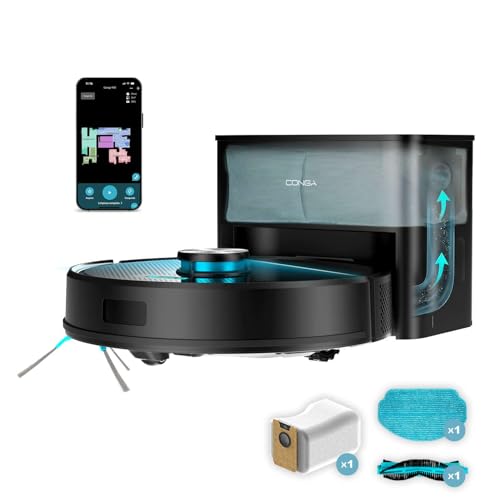
Cecotec Conga Y50 X-Treme view ›
It's here to clear up the most expensive mix-up in this category: its dock empties the dust bin into a 3-litre bag, and that has nothing to do with washing the mop. Eleven listings in the count declare the first and five the second.
- Its listing declares a self-emptying dock with a 3-litre bag, laser navigation and 5,000 Pa of suction.
- Self-emptying deals with the dust bin, not the mop: you still rinse the mop by hand after every clean.
- Laser navigation does map the house, which is the useful difference over a gyroscopic robot.
- In the 3 September count, eleven of the 39 listings that promise to mop declare self-emptying and only five declare that the dock washes the mop.
- A sensible buy for a home with allergies or a pet where the aim is not to handle the dust, knowing the mop is still a chore.
- Self-emptying dock with a declared 3-litre bag
- Laser navigation with a map, not gyroscopic
- Shows the difference between emptying the dust and washing the mop
- You wash the mop: the dock doesn't touch it
- Its listing doesn't say what moves the mop or whether it lifts
- The dock's bags are a consumable to keep in stock
Why a robot vacuum's suction in pascals doesn't compare, and what its listing leaves out
The vacuum half is sold with a figure, the pascals. The mopping half isn't sold with any, and it's the half that brings a reader to this search, so we counted the whole catalogue in the category to see what can be known before paying.
There's a second reason the pascal figure doesn't settle anything. The ecodesign rules for vacuum cleaners, Regulation (EU) No 666/2013 in the version kept in UK law, cover mains-operated vacuums and 'shall not apply to' 'wet, wet and dry, battery operated, robot, industrial, or central vacuum cleaners'. No rule makes one robot maker measure its suction the same way as the next, let alone its mop.
A pascal measures suction pressure. It helps compare how much a robot lifts from the gap between two tiles or from hair caught in a rug, and it says nothing at all about what the mop does. Even so, it's the figure on 34 of the 39 listings that promise to mop, and in practice it gets read as if it measured both halves of the machine.
The proof is at the two ends of the count. The highest suction figure in the 44 listings is 25,000 Pa, and the four listings that declare it don't say a word about the mop. The m8d pick in this guide declares 8,000 Pa, the lowest figure in the selection, because its maker spent its headline on saying that its two pads spin and lift.
m8d rule: Pascals belong to the half that vacuums. If a robot mop listing only declares pascals, it hasn't yet said anything about how it mops.
The seven robot vacuum and mop models compared on what each maker declares
| Robot | Mopping level | What moves the mop | Lifts on carpet | Who washes the mop | Navigation | |
|---|---|---|---|---|---|---|
| roborock QV 35A Set view › | 4 of 5 | two pads spin at 200 rpm | yes | the dock, with its water | PreciSense LiDAR | View › |
 iRobot Roomba Plus 516 Combo view › iRobot Roomba Plus 516 Combo view › | 5 of 5 | DualClean pads | yes | the dock, at 75 °C | ClearView LiDAR | View › |
 iRobot Roomba Plus 415 Combo view › iRobot Roomba Plus 415 Combo view › | 5 of 5 | DualClean at 200 RPM | yes, 10 mm | the dock, and dries with heat | ClearView LiDAR | View › |
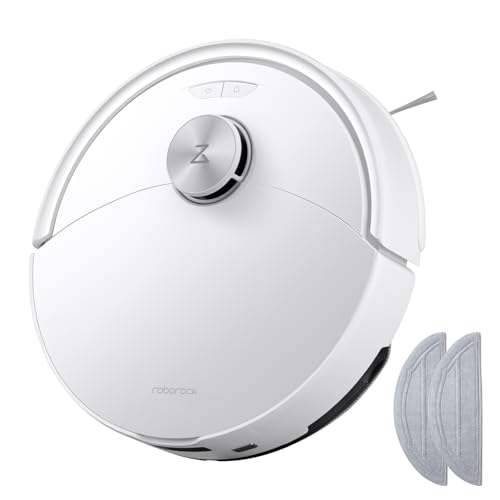 roborock Q10 S5 Set view › roborock Q10 S5 Set view › | 2 of 5 | vibrates, three levels | yes | you, by hand | PreciSense LiDAR | View › |
| Cecotec Conga Y50 X-Treme view › | 1 of 5 | not declared | not declared | you, by hand | laser | View › |
 iRobot Roomba 115 Combo view › iRobot Roomba 115 Combo view › | 1 of 5 | not declared | not declared | you, by hand | not declared | View › |
| Cecotec Conga M10 Advance Aqua Pro view › | 1 of 5 | not declared | not declared | you, by hand | gyroscopic | View › |
Each cell is what the listing or the maker's spec sheet declares, read on 3 September 2026. 'Not declared' means the spec sheet doesn't say, not that the machine lacks it. The mopping levels are m8d's own classification built on those declarations.
The seven models one by one: what each maker declares, and who each one isn't for
roborock QV 35A Set view ›
The level where mopping stops being wetting. roborock declares two pads spinning at 200 revolutions a minute, automatic lift and a dock that washes them by itself: the three things almost no listing in this category mentions.
- Its spec sheet declares two spinning mop pads at 200 revolutions a minute. That spin is the motion of a mop, and it works on marks stuck to the floor instead of just wetting them.
- The pads lift by themselves, so the living-room rug no longer has to be a no-go zone in the app.
- The dock washes the pads in a process roborock describes in three stages and dries them with cold air from its drying module. Washing, yes; drying with heat, no: that's the level above.
- PreciSense LiDAR navigation with a 360-degree scan, the same sensor family as the rest of the brand's range.
- It declares 8,000 Pa of suction, below the five-figure numbers this category advertises. The suction figure belongs to the vacuum half and says nothing about how it mops.
- Two spinning mop pads at 200 rpm, declared by the maker
- The pads lift automatically when it detects carpet
- The dock washes the pads without you touching them
- PreciSense LiDAR navigation with a map of the house
- Dries with cold air, not heat: a pad stored damp ends up smelling
- Its declared suction is the lowest in the selection
- The dock takes up the space of a large bin and needs a fixed spot
roborock Q10 S5 Set view ›
The case that explains the whole guide: its listing says 'robot vacuum and mop' and a suction figure, and its spec sheet declares a mop that vibrates at three levels and lifts by itself. What decides the purchase wasn't in the headline.
- roborock declares the VibraRise 2.0 mopping system, with vibration at three adjustable levels and controlled water flow. The vibration adds the scrubbing a dragged cloth lacks.
- The mop lifts automatically, and its spec sheet names three situations: carpets, low obstacles and slippery floors. It also lifts while it charges.
- The dock charges; it doesn't wash: you rinse the mop by hand when it finishes, and that's the job the next level up takes off you.
- It declares 10,000 Pa at its maximum setting and PreciSense LiDAR navigation with a 360-degree scan and a map of the house.
- Its Amazon Spain listing mentions neither the vibration nor the lift: both are on the maker's spec sheet, one click away.
- Mop vibration at three levels, declared by the maker
- Automatic lift on carpet, low obstacles and slippery floors
- LiDAR navigation with a map, not gyroscopic
- 10,000 Pa declared at its maximum setting
- Its dock only charges: you wash the mop after every clean
- The pad is flat, so it doesn't press like two spinning discs
- None of this is in the headline it's sold with
iRobot Roomba Plus 516 Combo view ›
One of the two listings in the whole count that gives the temperature as a figure. Hot water is what dissolves the grease that cold water spreads, and heat drying is what stops a stored pad from smelling.
- Its own Amazon Spain listing declares a self-cleaning, multi-function AutoWash dock that washes at 75 °C and dries at 45 °C. In the count of 39 listings that promise to mop, only two give a temperature as a figure.
- For the Roomba Plus 415, the level below with the same AutoWash dock, iRobot publishes DualClean pads spinning at 200 RPM that lift 10 mm when they detect carpet.
- The pads extend: they reach out beyond the robot's edge towards the skirting board, where a fixed disc can't get.
- It declares 22 kPa of suction, ClearView LiDAR navigation and 90 days of dock autonomy before you have to touch the bag.
- It's the level where you stop handling the mop every day, and also the one that asks for the most consumables: clean water, bags and filters.
- Washes at 75 °C and dries at 45 °C, declared on its own listing
- Lifting DualClean pads that extend to the skirting board
- ClearView LiDAR navigation with a map of the house
- 90 days of dock autonomy, as declared
- The most consumables to keep it running: clean water, bags and filters
- The dock is large and needs a fixed spot next to a socket
- Without kitchen grease or pets at home, hot water changes little
iRobot Roomba Plus 415 Combo view ›
The level below on the same AutoWash dock, and the only one in the selection whose maker publishes the three figures that separate mopping from wetting: 200 RPM, a 10 mm lift and heat drying at 113 degrees Fahrenheit.
- iRobot declares that its DualClean pads spin at 200 RPM. It's the same figure roborock declares for its own pads, and the only mopping number in this category that compares across brands.
- It declares an automatic 10 mm lift when it detects carpet: the only lift height we've found published in the whole category.
- The dock washes the pads and dries them with heat at 113 degrees Fahrenheit, 45 °C, after every clean.
- Its ClearView LiDAR navigation stores up to three maps, and iRobot declares it maps 93 square metres in nine minutes.
- The pad extends to reach the skirting board instead of leaving an unmopped strip.
- 200 RPM and a 10 mm lift, published by the maker
- The dock washes the pads and dries them with heat
- An extending pad that reaches the skirting board
- Nine minutes, as declared, to map 93 square metres
- Its listing gives the drying temperature, not the washing one
- Without spare bags at home, the dock stops being hands-off
- Shares the large dock of the rest of the AutoWash family
The first level, with one virtue worth pointing out: it puts gyroscopic navigation in its own title, when most listings at this level don't say which type they are. What you buy here is a damp cloth dragged along.
View ›The guide's point in a single product: the same maker sells a Combo here and a Combo several levels up, and what changes between them isn't whether it mops, it's who washes the mop and at what temperature.
View ›Before you order a robot vacuum in the UK: the plug, your 30 days, the app and the consumables
The plug. Under the Plugs and Sockets etc. (Safety) Regulations 1994, nobody may supply a domestic appliance like this in the UK unless it is 'correctly fitted with a standard plug', a BS 1363 plug with a BS 1362 fuse, or with an approved conversion plug that encloses a non-UK plug and 'can only be removed by the use of a tool'. The dock is the part that plugs in, so check that the listing says UK plug before you pay, especially for a model sold across Europe.
Your 30 days and your six months. Under the Consumer Rights Act 2015 you have a short-term right to reject faulty goods that runs to 'the end of 30 days' after delivery (section 22), and a fault that shows up within six months of delivery is taken to have been there on the day it arrived, unless it's shown otherwise (section 19). A robot that loses its map or a dock that stops washing in the first weeks falls squarely here.
The app. Maps, no-go zones and schedules live in the maker's app, so the app is part of what you buy. On 14 December 2025 iRobot announced an agreement for Picea to acquire it 'through a court-supervised process', a pre-packaged chapter 11 it expected to complete by February 2026, and said it would keep operating 'with no anticipated disruption to its app functionality, customer programs, global partners, supply chain relationships, or ongoing product support'.
The consumables. A self-emptying dock uses bags; a washing dock also needs clean water in and dirty water out, and the top level adds filters and bags. The Roomba Plus 516's listing declares 90 days of dock autonomy before you have to touch the bag. Before choosing a dock, check that its bags, filters and pads are sold in the UK.
- A UK plug on the listing: BS 1363, or a conversion plug that needs a tool to remove.
- What the dock does: empties the dust, washes the pads, or both. Eleven of the 39 listings declare the first and five the second.
- Whether the pads lift, and by how much, if you have rugs: iRobot publishes 10 mm for the Roomba Plus 415.
- That the dock's bags, filters and pads are sold in the UK, because they're what keeps it hands-off.
What is the best robot vacuum and mop?›
The one that declares the three things that separate mopping from wetting: what moves the mop, that the mop lifts and that the dock washes it. In this guide's selection the m8d pick is the roborock QV 35A Set, because its maker declares two spinning pads at 200 revolutions a minute, automatic lift and pad washing in the dock. Only two of the 39 listings we counted on Amazon Spain on 3 September 2026 declare all three.
Is a robot vacuum with a mop worth it?›
For everyday light mopping, yes, and the level decides how much of it the robot takes off you. For sticky, dried-on dirt, Which? found that the robots it set against jam and honey, including ones with self-cleaning docks, 'couldn't clear the grime', and it only recommends robot mopping for light spills and stains. Treat it as upkeep between proper mops.
What's the difference between a self-emptying dock and one that washes the mop?›
Self-emptying deals with the dust bin: the robot goes back to the station and the station sucks the dirt into a bag. A washing dock deals with the mop: it rinses it and, on the top models, dries it. They're two different things, sold separately. In the 3 September count, eleven of the 39 listings that promise to mop declare self-emptying and only five declare that the dock washes the mop.
Is a hot-water mop wash worth it?›
Hot water dissolves the grease that cold water spreads, and heat drying is what stops a pad stored damp from smelling. In a home without kitchen grease or pets the difference is small; in a home with both, it's the level where the mop stops being a daily chore. Of the 39 listings counted, two give the temperature as a figure: one declares washing at 75 °C with drying at 45 °C, and the other washing at 65 °C with drying at 45 °C.
Can a robot mop wooden floors or laminate?›
Yes, as long as the water is under control. What damages a wooden floor is standing water, not passing damp. Look on the spec sheet for water flow you can adjust in the app and for a pad that lifts when the robot stops, because a robot that stops with a wet pad down leaves the water in one place. That setting is on the maker's spec sheet, not in the listing's headline.
What happens to rugs if the robot mops?›
If the pad doesn't lift, the rug gets wet. Four of the 39 listings that promise to mop declare automatic pad lift. If yours doesn't, you have two options: a no-go zone in the app, which needs a robot that builds a map, or taking the mop off every time you want it to vacuum the whole house.
Should a robot vacuum stay plugged in all the time?›
Yes, that's how it's designed: the dock is its charger and, on washing models, its pad station, so it needs a fixed spot next to a socket. roborock says the Q10 S5's mop also lifts while it charges, so a damp pad doesn't sit on the floor.
Which robot vacuums are best avoided?›
Rather than a brand, avoid a mismatch: a robot bought on its pascal figure when what you want is mopping, a mop that doesn't lift in a home with rugs, and a gyroscopic robot if you need no-go zones, because it doesn't build a map. The three mopping facts are on the maker's spec sheet even when the headline leaves them out.
The whole catalogue, with a date. On 3 September 2026 we went through the Amazon Spain catalogue, the one behind this guide, with eight searches in the category and read 44 different robot listings. For each one we counted what the headline it's sold with declares: pascals, navigation type, what moves the mop, whether the mop lifts, whether the dock washes it and at what temperature. That count is the one in the chart and the donut on this page, and it's why the guide is ordered by mopping level rather than by power. UK listings for the same models can word their headlines differently, and availability varies by country: the buttons take you to your own country's Amazon store.
The mopping figures are each maker's own, with their date. The 200 revolutions a minute come from roborock's spec sheet for the QV 35A and iRobot's for the Roomba Plus 415, both read on 3 September 2026. The 10 mm lift and the 113 degrees Fahrenheit drying are from iRobot's spec sheet. The 75 °C and 45 °C come from the Roomba Plus 516's own listing. The VibraRise 2.0 system and the Q10 S5's automatic lift are from roborock's spec sheet. For this UK edition we added the open part of Which?'s buying advice, the PDSA's PAW Report 2025, the UK plug regulations, the Consumer Rights Act 2015, the ecodesign regulation for vacuum cleaners and iRobot's own announcement of December 2025.
Five dimensions, and none decides alone. What moves the mop, whether it lifts, who washes it, which navigation it has and what suction it declares. A robot can win on pascals and lose the guide, because pascals belong to the half that vacuums.
No shop star ratings. We don't copy a shop's average score. Each product carries a written verdict, its cons and who it isn't for. The mopping levels are m8d's own classification, built on those declarations, and every table says so.
If you take one line from this page, make it this one: pascals belong to the half that vacuums. The half that mops is decided by three things that 33 of the 39 listings promising to mop don't mention, and all three can be checked in two minutes on the maker's spec sheet.
We recommend the roborock QV 35A Set view ›, because it's the one in the selection whose maker declares the two spinning pads, the lift and the washing in the dock all at once. If you want the mopping step that shows most without a washing dock, the roborock Q10 S5 Set view › adds a vibrating mop that lifts by itself and leaves the rinsing to you. And if you never want to touch the mop again, the iRobot Roomba Plus 516 Combo view › puts both temperatures on its own listing, which only two of the 39 do.
The mop vibrates and lifts itself, and its listing doesn't say soroborock Q10 S5 SetSee it on Amazon ›The sources behind the specific figures on this page, with the date each was read.
- roborock (Spain)roborock QV 35A spec sheet: two spinning mop pads at 200 rpm, self-lifting mop, three-stage automatic washing, cold-air drying and PreciSense LiDARSpanish-language page, read on 3 September 2026.
- roborock (Spain)roborock Q10 S5 spec sheet: VibraRise 2.0 mopping with three vibration levels, automatic lift on carpets, low obstacles and slippery floors, 10,000 Pa and PreciSense LiDARSpanish-language page, read on 3 September 2026.
- iRobotRoomba Plus 415 Combo with AutoWash dock: DualClean pads at 200 RPM, 10 mm automatic lift on carpet, heat drying at 113 °F and ClearView LiDAR mappingRead on 3 September 2026.
- Cecotec (Spain)Conga M10 family spec sheet: gyroscopic navigation, water tank and mopSpanish-language page, read on 3 September 2026.
- Which?How to buy the best robot vacuum cleanerThe openly available part: robot mopping against jam and honey, 'maintenance tools', and self-emptying docks. Updated 15 July 2026, read on 22 September 2026.
- PDSAPAW Report 2025: 11.1 million dogs and 10.5 million cats in the UK30% of UK adults have a dog and 24% a cat. YouGov fieldwork, 17 December 2024 to 12 January 2025. Read on 22 September 2026.
- legislation.gov.ukThe Plugs and Sockets etc. (Safety) Regulations 1994, regulation 12Appliances supplied in the UK with a BS 1363 plug and BS 1362 fuse, or an approved conversion plug removable only with a tool. Read on 22 September 2026.
- legislation.gov.ukConsumer Rights Act 2015, sections 19 and 22The short-term right to reject, 30 days, and the six-month presumption. Read on 22 September 2026.
- legislation.gov.ukRegulation (EU) No 666/2013, Article 1: subject matter and scopeThe version kept in UK law: robot vacuum cleaners are outside its scope. Read on 22 September 2026.
- iRobotiRobot Announces Strategic Transaction to Drive Long-Term Growth Plan14 December 2025. Read on 22 September 2026.
- m8dCount of 44 robot vacuum listings on Amazon SpainEight searches in the category, read on 3 September 2026; what each headline declares.
 Best cordless vacuums UK 2026What a robot can't reach: the sofa, the stairs and the car, with the suction figures UK pages leave out
 Best air purifiers UK 2026For the pet dander and the dust a robot stirs up: the CADR your room needs
 The microwave guideThe space it has to fit into, worked out before you buy
Comments
Be the firstNo sign-up: just a name. Every comment is reviewed before it is published.