Best air purifiers UK 2026: the CADR your room needs for allergies, mould and sleep, not the m² printed on the box
 m8d.ioUpdated on

This guide contains affiliate links. As an Amazon Associate, m8d.io earns from qualifying purchases, at no extra cost to you.

The best air purifier for a UK room is chosen by its clean air delivery rate (CADR), not the square metres on the box. Levoit's UK page gives its Core 300S '100 m² once per hour'; at AHAM's 4.8 air changes, the same 258 m³/h covers about 22 m². Living room: the Philips 2200. Bedroom: the Philips 600i.

170 m³/h gives AHAM's 4.8 air changes an hour across 14.5 m² under an 8 ft ceiling.
See it on Amazon ›How much CADR does your room need? The air purifier calculator for UK rooms and ceilings
The sum fits on one line: clean air needed = floor area × ceiling height × air changes an hour. You know the first two. The third comes from AHAM, the US association that writes the standard CADR is measured against, which sizes its seal at 4.8 air changes an hour. Most room sizes you'll read, on boxes and in reviews, leave the ceiling out, and in the UK two official figures are worth having to hand: the government's nationally described space standard, which local plans in England apply to new homes, sets a double bedroom at 11.5 m² or more and a single at 7.5 m², with 2.3 m from floor to ceiling over at least 75% of the floor; London's housing design guidance raises that ceiling to 2.5 m. The calculator below does the sum with your figures, sets it next to the floor area the same flow would give depending on who divides it, and adds the other sum that decides: the filter over three years.
Air purifier CADR calculator: the m³/h your room needs, with UK ceiling heights
The clean air a room needs depends on three things you already know: its floor area, its ceiling height and what you want the purifier for. This free calculator turns them into cubic metres an hour, shows the division, and compares the floor area that flow would give with each maker's own coefficient. No sign-up and no ads. Example: a 12 m² double bedroom under an 8 ft (2.44 m) ceiling, at 4.8 air changes an hour, needs 141 m³/h of CADR; with the same 141 m³/h, Philips' coefficient gives 36 m² and Levoit's UK page 55 m².
The sum, on show: 12 m² times a 2.44 m ceiling is 29.3 m³ of air; at 4.8 air changes an hour, that's 141 m³/h. That is what the machine has to deliver, whatever square metres are printed on the box.
This isn't a gap in the calculator: it's the case for 34 of the 36 air purifier listings we counted on Amazon Spain on 8 September 2026, which don't name the flow. Without that figure, the square metres in a headline can't be compared with any other machine's, because each maker works them out with its own coefficient and none says which. Look for it on the maker's spec sheet as 'CADR', 'clean air delivery rate' or 'clean air rate', and come back with the number.
Each bar is the floor area that same flow would cover depending on who does the dividing, with your 2.44 m ceiling. The first row is the rate AHAM uses to size its seal; the other three come from dividing the two figures each maker publishes itself. Sources at the foot of the guide.
The sum, on show: 36 months divided by 8 is 4.5 filter periods; the first is covered by the one in the box, so you buy 4. With the same filter, going from thirty-six months to six means six filters through the machine instead of one, and that difference isn't in any headline.
The air changes an hour for each case are the ones published by the Association of Home Appliance Manufacturers, which writes the standard CADR is measured against. Each maker's coefficient comes from dividing the two figures it publishes itself, read on 8 September 2026 and, for Levoit's UK page, on 22 September 2026. The ceiling height and the floor area are yours, because every home is different, and the filter prices are round figures for you to set your own: none of them states what a particular product costs. The sources for every figure are at the foot of the guide.
The room size on a purifier's box is its clean air flow divided by a coefficient the maker chooses, and the makers' own pages show it. Levoit's UK page gives the Core 300S two room sizes in one sentence, and the page for its sister model, the Core 300, does the same: 'cover up to 80 m² once per hour or 40 m² twice per hour'. Divide any of those figures by a real ceiling and each turns out to be a different number of air changes an hour, and that number, not the area, is what tells you how clean the air stays.
m8d rule: Divide the CADR a purifier declares by the square metres on its box. About 12 m³/h for every m² means the area was worked out the way AHAM does it; about 4 means one and a half air changes an hour; about 2.5 means one.
What CADR means on an air purifier, and the figure almost no listing gives
CADR stands for clean air delivery rate: the volume of filtered air a purifier delivers, in cubic metres an hour in Europe and in cubic feet a minute in the US. The standard that defines it is ANSI/AHAM AC-1-2020, which rates it separately for three kinds of particle, 'dust, pollen and tobacco' smoke in AHAM's words. That is what makes it useful before you buy: two machines from two brands, compared on one number.
Square metres can't do that job, and the reason is arithmetic. A purifier doesn't clean a floor, it moves a volume of air. The area on the box is the flow divided by a coefficient each maker picks, and the coefficient is almost never printed. Our count of the Spanish Amazon catalogue shows how rarely even the flow is.
- Neither area nor CADRthe headline gives neither25 listings69%
- Area, no CADRsquare metres without the figure that explains them9 listings25%
- Give the CADRthe only ones you can do the division with2 listings6%
m8d's own count of 36 different air purifier listings from 17 brands on Amazon Spain, read through our Amazon interface on 8 September 2026 across nine searches in the category. It counts what each listing's headline declares, read up to 160 characters, because that is what a buyer reads first; replacement filters and accessories are left out. UK listings for the same models can word their headlines differently.
How far CADR goes, in a maker's own words. Dyson makes the objection itself on its Spanish website: it says CADR is not a measure of purification performance in a real-size room, points to the 28.5 m³ chamber of the AHAM standard, and publishes its own results from an 81 m³ room instead. The objection is accurate, and it comes from an interested party. It places the figure correctly: CADR is a laboratory number from a small chamber, comparable between machines, not a promise about your living room. Being imperfect doesn't make square metres with no standard behind them a better yardstick.
Air purifiers and mould: what they catch, and what UK damp and mould guidance says to fix first
Mould spores in the air are particles, so a HEPA purifier catches them the way it catches dust, and the same CADR measures it. What a purifier doesn't touch is the reason the mould is there. The UK government's guidance on the health risks of damp and mould, written by the Office for Health Improvement and Disparities with the housing ministry and the UK Health Security Agency, sets out the causes: moisture from 'showering, drying laundry and cooking' that builds up and condenses on the colder parts of a home, water that gets in through defects in walls, roofs, windows or floors, and leaks. It also puts a size on the problem: in 2019, damp and mould in English homes was estimated to be associated with about 5,000 cases of asthma and 8,500 lower respiratory infections. And its line on the visible patch: 'Simply removing surface mould will not prevent the damp and mould from reappearing'.
The same guidance lists who is most at risk, and it is the reader of this section: 'people with a pre-existing health condition (for example allergies, asthma, COPD, cystic fibrosis, other lung diseases and cardiovascular disease)', children and older adults. So the order is moisture and ventilation first (an extractor fan close to the hob, windows opened wide and closed again once the air has changed, laundry dried outdoors where possible), and a purifier in the bedroom as a supplement for the spores already in the air. For the moisture itself the appliance is a dehumidifier, not a purifier, and never a humidifier, which puts water back into the air.
The same point, from two UK sources you may already trust. Which? says in the open part of its buying advice that an air purifier 'can also eliminate mould spores' but 'won't tackle the underlying problems that cause mould'. And the NHS page on whether damp and mould can affect your health now sends readers straight to the government guidance quoted above (checked on 22 September 2026). If you rent, the guidance is written for landlords: it is the document to point to.
Air purifiers for allergies and hay fever: 4.8 air changes an hour, and what the Allergy UK seal tells you
For allergies and asthma the reference figure is the 4.8 air changes an hour AHAM uses to set the room size on its seal: 'Look for the AHAM Verifide seal to find the suggested room size based on 4.8 air changes per hour', in its own words. Below three, which AHAM cites as indoor-air researchers' minimum ventilation recommendation, the machine doesn't keep up with the dirty air coming in. For hay fever, the CADR to read is the pollen one, because AHAM rates dust, pollen and smoke separately.
In the UK you'll also see the Allergy UK Seal of Approval on some purifiers, and it is a different kind of evidence, worth reading for what it is. Allergy UK says approved products are 'independently scientifically proven to be effective at reducing/removing allergens', under a scheme 'Established in 1995' and run through Allergy Research Limited. What the seal doesn't give you is a room size: for that you still need the CADR and the sum at the top of this page.
Philips 2200 (AC2210/10) view ›
The only one of the three whose own listing publishes its clean air delivery rate, and the one that delivers most: 400 m³/h. At the 4.8 air changes AHAM uses to size its seal, under an 8 ft ceiling, that is about 34 m², not the 104 on the box. Its filter is also the longest-lasting in this guide.
- Its listing gives both figures you need to decide: 400 m³/h of clean air and 104 m². Divided under an 8 ft ceiling that is about 1.6 air changes an hour, the same coefficient Philips applies to the six models on its Spanish website, and the one its 600i leaflet shows (44 m² for 170 m³/h).
- Philips rates its FY2200/30 replacement filter for up to three years, and says the purifier tracks the filter's life and warns you when it's due. None of the 36 listings in our Amazon Spain count says how long its filter lasts.
- Philips states that its 13 dB(A) is sound pressure to IEC 60704 at one and a half metres, and that its CADR comes from the Chinese standard GB/T 18801-2022, not from AHAM's AC-1. Two standards for two figures on the same machine.
- Publishes its CADR, which only 2 of the 36 listings in our count do
- 400 m³/h keeps about 34 m² at 4.8 air changes an hour, the most of the three podium machines
- Filter rated for up to three years by Philips, with a reminder from the machine
- Says which standard and distance its noise figure uses
- The 104 m² on the box works out at about 1.6 air changes an hour, not the rate AHAM uses
- For a 12 m² bedroom it is more flow than you need, and you pay for it
- Its CADR is measured to GB/T 18801, so it isn't directly comparable with an AHAM-certified CADR

Levoit Core 300S view ›
A machine that shows this category's problem on a single page: Levoit's own UK page gives it 100 m², 50 m² and a 258 m³/h CADR in the same breath. Divide the flow by a real ceiling and the rate AHAM uses, and it keeps about 22 m² clean, which is a large bedroom.
- Levoit's UK page says the Core 300S 'can cover 50 m² twice per hour and 100 m² once per hour' and gives a 'CADR 258 cubic metres per hour'. Both room sizes are true for their pace; neither is the pace AHAM uses.
- At 4.8 air changes an hour under an 8 ft ceiling, 258 m³/h keeps about 22 m² clean. Levoit's Spanish store reaches almost the same flow another way: it times two rooms, 20 m² in 12 minutes and 50 m² in 30, which works out at about 250 m³/h.
- Levoit's UK page says to 'Replace your filter every 6-8 months'. Over three years that is four or five Core 300-RF filters on top of the one in the box, the shortest filter life of the three podium machines.
- Its maker states the CADR on its UK page: 258 m³/h
- About 22 m² at 4.8 air changes: a large bedroom
- 22 dB in sleep mode, declared by Levoit
- The '100 m² once per hour' on its UK page is one air change an hour
- A new filter every 6 to 8 months, per Levoit: four or five in three years
- No CADR published for its sleep mode, the one you sleep with
Philips 600i (AC0650/10) view ›
Philips' own leaflet gives 170 m³/h and 44 m². At the pace AHAM uses, those 170 m³/h keep about 15 m² clean: a double bedroom, not a living room. For a bedroom, it is the most compact machine in this guide whose maker publishes the CADR.
- Philips' leaflet gives 170 m³/h and 'rooms up to 44 m²'. Under the 2.4 m ceiling Philips assumes in its own footnote, that is 1.6 air changes an hour; at AHAM's 4.8, about 15 m².
- The same leaflet gives two noise figures: 19 dB in sleep mode and 49 dB in turbo. The CADR is delivered at the top speed, so the quiet figure and the clean-air figure never happen at once.
- Under 12 W at full speed and 2 W in sleep mode, per Philips: eight hours a night in sleep mode is about 5.8 kWh a year, and the running-costs section turns that into pence at the October to December 2026 price cap.
- Philips' UK site lists this model as the AC0650/20, while the unit in our register is the AC0650/10: before you pay, check that the listing states a UK three-pin plug.
- Its maker publishes the CADR and the room size in its own leaflet
- About 15 m² at 4.8 air changes: a double bedroom
- Under 12 W at full speed and 2 W asleep, per Philips
- The 44 m² on the box is 1.6 air changes an hour
- For a 30 m² living room it has less than half the flow needed
- Its quiet 19 dB is sleep mode, not the speed that delivers 170 m³/h
Is it safe to sleep with an air purifier on? The noise figure, and the fan speed it's measured at
Running it overnight is where a purifier earns its keep: eight hours in the room where you spend the most time. The catch isn't the noise, it's that the flow and the noise are never measured at the same moment. The EPA says it in one line: the CADR 'is typically measured at the air cleaner's highest speed'. The decibels on a box are the opposite end, the lowest speed.
Philips' leaflet for the 600i prints both ends: 19 dB in sleep mode and 49 dB in turbo, to IEC 60704, the standard its 2200 series also cites. Of the documents we read for this guide, it is the only one that sets the loud figure next to the quiet one. If you're going to sleep with it on, our advice is to size it with headroom: none of the 36 listings in our count publishes the flow in night mode, so assume it delivers well below its CADR.
The two figures that get compared badly. A 400 m³/h, 13 dB(A) machine doesn't do both at once: the 400 is at top speed and the 13 at the lowest. In our Amazon Spain count of 8 September 2026, nine of the 36 listings give a noise figure and only two say which mode it's measured in. None says how much air it moves in that mode, which is the figure that decides whether you sleep with it on or off.
What an air purifier costs to run in the UK at the October to December 2026 price cap
The sum is watts × hours ÷ 1,000 × the price of a kilowatt-hour, and for the last quarter of 2026 the UK has a reference price: Ofgem's cap for 1 October to 31 December 2026 puts electricity at 26.32p per kWh on average by Direct Debit, with no VAT on electricity bills until 31 March 2027 after the government removed it. Philips publishes the two figures you need for the 600i: under 12 W at full speed and 2 W in sleep mode. Round the clock at full speed that is 105 kWh a year, about £27.67; eight hours a night in sleep mode, the way a bedroom purifier usually runs, it is 5.8 kWh, about £1.54.
Which? gives a range for the purifiers it assesses of 'as little as £6 and as much as £45 a year'. The figure that decides is the wattage the maker declares, and in our Amazon Spain count 32 of the 36 listings don't give it: it is worth asking for before you buy, because it's the only way to do this sum.
HEPA, H13 and 'true HEPA' air purifiers: what the filter class says, and what it leaves out
The European standard for these filters, published in the UK as BS EN 1822-1:2019, 'High efficiency air filters (EPA, HEPA and ULPA)', names its three groups in its own title. The H in H13 is the HEPA group. What the class doesn't tell you is how much air passes through the filter, and that decides everything: an excellent filter in a machine that moves little air cleans little.
In our Amazon Spain count, 30 of the 36 listings say HEPA, eight say H13 and two write 'true HEPA', which is none of the standard's three groups. The maker that does cite the standard is Dyson, in the small print of its Spanish website: it states its filtration efficiency at 0.1 microns '(EN1822, ISO29463)'. That is the reference to look for, and almost nobody prints it.
| Air purifier | CADR declared | Kept clean at 4.8 air changes (8 ft ceiling) | Room size on the box | Noise declared | |
|---|---|---|---|---|---|
| Philips 2200 (AC2210/10) view › | 400 m³/h | 34 m² | 104 m² | 13 dB(A), lowest speed | View › |
| Levoit Core 300S view › | 258 m³/h | 22 m² | 100 m² at one air change | 22 dB, sleep mode | View › |
| Philips 600i (AC0650/10) view › | 170 m³/h | 14.5 m² | 44 m² | 19 dB sleep, 49 dB turbo | View › |
 Levoit Core Mini view › Levoit Core Mini view › | its spec sheet doesn't say | can't be worked out | its listing doesn't say | its listing doesn't say | View › |
 AROEVE DH-JH12 view › AROEVE DH-JH12 view › | its listing doesn't say | can't be worked out | its listing doesn't say | 22 dB, speed not stated | View › |
CADRs as each maker publishes them: Levoit's UK product page and Philips' own leaflet for the 600i, read on 22 September 2026; the Philips 2200 figure is the one declared for the AC2210. 'Kept clean' is the CADR divided by an 8 ft (2.44 m) ceiling and AHAM's 4.8 air changes an hour. Philips states its noise figures to IEC 60704; the other spec sheets we read don't cite a standard for theirs.
An air purifier filter over three years: how many replacements, by how long it lasts
The other half of the money isn't in the machine. None of the 36 listings in our Amazon Spain count says how long its filter lasts, and the lives the makers do publish run from six months to three years. Over the same three years that is five replacements or none: six filters through the machine instead of one.
The three podium machines cover the whole range. Levoit's UK page says to replace the Core 300S filter 'every 6-8 months'; Philips' leaflet says 12 months for the 600i; Philips rates the 2200's FY2200/30 filter for up to three years, with a reminder from the machine when it's due. This is the only sum in this guide that can reorder a whole podium, and the calculator above does it with the price you pay for a replacement.
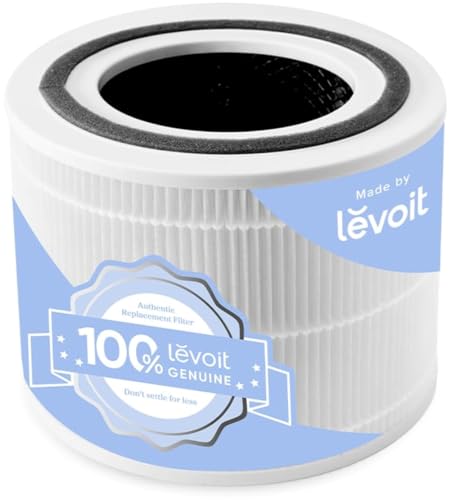
Levoit Core 300-RF filter view ›
The original filter for the Core 300 and Core 300S, the podium machine whose maker says to replace it every six to eight months. It is in this guide because a purifier's three-year cost is decided on this spec sheet, not on the machine's.
- Levoit's UK page says to 'Replace your filter every 6-8 months'. Over three years that is four replacements at eight months and five at six, on top of the one in the box.
- Pre-filter, particle filter and activated carbon come in one piece, so it's replaced whole rather than layer by layer.
- It is the only consumable in this guide, and our count explains why it's here: none of the 36 purifier listings says how long its filter lasts.
- Original replacement for the Core 300 and Core 300S
- Three filtration stages in one piece
- Its life is stated by the maker itself
- The shortest filter life of the three podium machines: four or five in three years
- Doesn't fit the Core Mini, which takes its own
- No purifier listing in our count declares this cost
Air purifiers for smoke and smells: why CADR only counts the particles
There are two problems here and only one has a number. Smoke is particles and gases at once: the particles are caught by the filter and rated by the CADR; the gases are caught by activated carbon and rated by nobody. The EPA puts it without hedging: 'there are no widely used performance rating systems for portable air cleaners or filters designed to remove gases. The CADR rating system is for particles only.'
For the part that is rated, AHAM raises the bar: for smoke it asks for a smoke CADR equal to the room's square feet, 1.55 times its usual rule, which works out at about 7.4 air changes an hour. That is the third setting in the calculator at the top of the page.
- The CADR to read is the smoke figure, not dust or pollen: AHAM rates the three separately, and smoke is the most demanding because its particles are the smallest.
- How much activated carbon matters more than having some: the EPA says 'Activated carbon filters can be effective, provided that there is a large amount of material used in the filter.'
- No filter fixes a smell whose source is still in the room: the EPA puts reducing the source and ventilating before filtration, in that order.
- Ozone generators turn up in the same searches and are not particle purifiers: the EPA says 'ozone does not remove particles (e.g., dust and pollen) from the air, including the particles that cause most allergies' and 'When inhaled, ozone can damage the lungs.'

Levoit Vital Pet Pro view ›
The one in this guide with both a particle sensor and a VOC sensor, which is what lets you see whether the machine is doing anything when the fur goes up. Its listing doesn't publish the CADR either, and that has to be said.
- It declares a PM2.5 sensor and a TVOC sensor. The first measures particles, which a HEPA filter captures; the second measures gases, and for gases the EPA says 'The CADR rating system is for particles only.'
- Its listing is one of the 34 in our Amazon Spain count that don't give a CADR, so to know which room it covers you need the maker's spec sheet. With pets the room is usually the living room, and there the gap between 170 and 400 m³/h shows up in minutes.
- The PDSA counts 11.1 million dogs and 10.5 million cats in the UK in its 2025 report, and Levoit aims this model at those homes.
- Declares PM2.5 and VOC sensors on its own listing
- Its maker aims it at homes with pets
- With a sensor you can see whether the machine reacts, the one check you can do at home
- Its listing doesn't publish a CADR
- Its VOC sensor measures gases, and CADR doesn't cover gases
- Without a CADR, you can't tell whether it keeps up in a living room
The category's best seller, and a clear example of where the limit sits: its maker's spec sheet gives a coverage area and no CADR, so there's no way to tell how many air changes it gives in any room.
View ›
Sold for bedrooms and with an auto mode, which is what keeps a purifier running instead of switched off in a corner. Its listing carries neither CADR nor area, so the check has to be done on the maker's spec sheet.
View ›The desk machine of this guide, and a clear view of what small listings leave out: it declares its power and its noise, and neither its CADR nor the room it covers.
View ›How we compared these air purifiers, and where every figure comes from
We started from the whole catalogue, not from a list. On 8 September 2026 we went through Amazon Spain, the catalogue behind this guide, with nine searches in the category and counted 36 different air purifier listings from 17 brands, plus ten replacement filters left out of the count. For each we noted what its headline says, because that is what a buyer reads: area, CADR, air changes, decibels and the speed they're measured at, filter class, power and filter life. UK listings of the same models can word their headlines differently, and availability varies by country: the buttons take you to your own country's Amazon store.
Then we went to each maker, because that's where the other half of the data lives, and for this UK edition we read the UK pages where they exist: Levoit's UK product pages for the Core 300 and Core 300S, Philips' leaflet for the 600i and its page for the FY2200/30 filter, Xiaomi's spec sheet for the Smart Air Purifier 4 Compact and Dyson's page on CADR, plus Philips' Spanish range page and Levoit's Spanish store for the figures they don't repeat in English. The UK context comes from the government's damp and mould guidance, the nationally described space standard, London's housing design guidance, Ofgem's price cap, Allergy UK and the open part of Which?'s buying advice.
Five criteria set the order, and none is a shop's star rating. One, whether the sum can be done: a purifier whose spec sheet doesn't publish its CADR doesn't tell you which room it's for, and that moves it down. Two, the floor area it really keeps clean, which is its CADR at AHAM's 4.8 air changes under a real ceiling. Three, the filter over three years, which in this category can outweigh the machine. Four, whether it solves a specific case (a bedroom, a living room, a desk, a home with pets) rather than being the biggest. Five, the running cost, from the power its maker declares.
Two of the three podium machines are from the same brand, and that isn't a preference: it's the first criterion at work. Philips publishes the CADR and the room size for every model on its Spanish website, so its machines are the ones you can check against the standard without leaving its own documents. When another maker does the same, it goes in.
Figures that don't come from the catalogue carry their source and date below: the CADR standard ANSI/AHAM AC-1-2020, AHAM's guidance on air changes, the EPA's guide and its page on ozone generators, BS EN 1822-1:2019 for filter classes, and the UK sources above. This guide is reviewed every quarter.
What is the best air purifier in the UK?›
There isn't one for every home, because the room decides. What decides is whether the machine delivers the cubic metres of clean air an hour your room needs. Of the machines in this guide whose makers publish a CADR, the one with the most flow is the Philips 2200, 400 m³/h, which at AHAM's 4.8 air changes an hour keeps about 34 m² clean under an 8 ft ceiling.
Do air purifiers really do any good?›
For particles in the air, yes: that is what CADR measures and what a HEPA filter catches. The EPA sets the order: reduce the sources and ventilate with outdoor air first, and 'filtration can be an effective supplement'. A purifier doesn't bring in fresh air, has no rated effect on gases and doesn't fix damp.
Is it safe to leave an air purifier on all night?›
Running a HEPA purifier overnight is the use it's designed for, and it's when it does the most good, because it's eight hours in one room. The catch is the flow: the EPA says CADR 'is typically measured at the air cleaner's highest speed', and at night you use the lowest. Philips' own 600i leaflet shows the gap: 19 dB in sleep mode, 49 dB in turbo. The one machine to keep out of a bedroom is an ozone generator, covered in the last question.
Do air purifiers help with mould?›
They catch mould spores floating in the air, because spores are particles. They don't touch the damp that grows the mould. The UK government's guidance on damp and mould says 'Simply removing surface mould will not prevent the damp and mould from reappearing' and puts moisture and ventilation first; for the moisture, the appliance is a dehumidifier, not a purifier and not a humidifier.
How many square metres does an air purifier cover?›
It depends on the air-change rate it's worked out at, which is why box figures don't compare between brands. With 400 m³/h under an 8 ft ceiling you get 34 m² at AHAM's rate, 28 to 48 m² with the formula Xiaomi publishes, 104 m² with the coefficient Philips uses and 155 m² with the one on Levoit's UK page. All four are published by their authors.
How often should you change an air purifier filter?›
When its maker says, and that varies a lot: Levoit's UK page says every 6 to 8 months for the Core 300S, Philips' leaflet says 12 months for the 600i, and Philips rates the 2200's filter for up to three years. Over three years that is five replacements or none, and none of the 36 listings in our count prints the figure.
How much does an air purifier cost to run in the UK?›
Watts × hours ÷ 1,000 × the price of a kWh. At the October to December 2026 price cap, 26.32p per kWh on average by Direct Debit, Philips' 600i at its 12 W maximum round the clock costs about £27.67 a year, and eight hours a night in its 2 W sleep mode about £1.54. Which? puts the models it assesses at 'as little as £6 and as much as £45 a year'.
What does the Allergy UK seal on an air purifier mean?›
That Allergy UK, through Allergy Research Limited, has approved the product as 'independently scientifically proven to be effective at reducing/removing allergens', under a scheme 'Established in 1995'. It doesn't give you a room size: for that you still need the CADR and your room's volume.
Which is better, a Philips or a Dyson air purifier?›
They publish different yardsticks, so compare like with like. Philips gives a CADR and a room size for each model, and its 600i leaflet adds the power and noise at both ends. Dyson says on its Spanish website that CADR is not a measure of performance in a real-size room and publishes results from its own larger room. Ask each for the same figure before you compare.
Is an ozone generator an air purifier?›
Not for what a purifier buyer wants. The EPA says 'ozone does not remove particles (e.g., dust and pollen) from the air, including the particles that cause most allergies' and 'When inhaled, ozone can damage the lungs.' They appear in the same searches as filter purifiers and they are a different product.
The sources behind the figures on this page, with the date each was read.
- AHAM VerifideAir Changes per Hour FAQ: 'the suggested room size based on 4.8 air changes per hour'And 'the minimum ventilation recommendation is three ACH'. Read on 22 September 2026.
- AHAM VerifideHow to choose the best air cleaner for your home: the two-thirds rule'a room that is 200 square feet, would require an air cleaner with a CADR for tobacco smoke of at least 132'. Read on 22 September 2026.
- Association of Home Appliance ManufacturersANSI/AHAM AC-1-2020, 'Method for Measuring Performance of Portable Household Electric Room Air Cleaners'The standard that defines CADR; noise has its own, ANSI/AHAM AC-2. Read on 8 September 2026.
- US Environmental Protection AgencyGuide to Air Cleaners in the HomeThe sizing table, 'typically measured at the air cleaner's highest speed', 'The CADR rating system is for particles only' and the note on activated carbon. Read on 22 September 2026.
- US Environmental Protection AgencyOzone Generators that are Sold as Air Cleaners'ozone does not remove particles (e.g., dust and pollen) from the air'. Read on 22 September 2026.
- Levoit UKCore 300S product page: 'cover 50 m² twice per hour and 100 m² once per hour''CADR 258 cubic metres per hour', 22 dB and 'Replace your filter every 6-8 months'. Read on 22 September 2026.
- Levoit UKCore 300 product page: 'cover up to 80 m² once per hour or 40 m² twice per hour'The same wording on the sister model. Read on 22 September 2026.
- Philips600i series air purifier leaflet (AC0650/10)170 m³/h, 'Purifies rooms up to 44 m²', under 12 W and 2 W in sleep mode, 19 dB and 49 dB to IEC 60704-1, filter every 12 months, and the footnote with a 2.4 m ceiling. Read on 22 September 2026.
- Philips (Spain)Air purifier range on Philips' Spanish website, with each model's CADR and room sizeAnd the 2200 series spec sheet, with its footnotes on GB/T 18801-2022 and IEC 60704. Spanish-language pages, read on 8 September 2026.
- Philips (Spain)FY2200/30 filter page: three-year lifeFits the AC2210, AC2220 and AC2221. Spanish-language page, read on 8 September 2026.
- Xiaomi (Spain)Smart Air Purifier 4 Compact specifications: coverage = (0.07 to 0.12) × PCADRThe only published conversion formula in the category. Spanish-language page, read on 8 September 2026.
- Levoit (Spain)Core 300S page on Levoit's Spanish store: a 20 m² room in 12 minutes and a 50 m² room in 30And the Core Mini page, with no CADR in its specification table. Spanish-language pages, read on 8 September 2026.
- Dyson (Spain)Air purifier page with its note on CADR and the 28.5 m³ chamberAnd its footnote on EN1822 and ISO29463. Spanish-language page, read on 8 September 2026.
- European Committee for Standardization, published in the UK by BSIBS EN 1822-1:2019, High efficiency air filters (EPA, HEPA and ULPA): classificationThe standard that defines the EPA, HEPA and ULPA groups. Read on 8 September 2026.
- OHID, MHCLG and the UK Health Security Agency (GOV.UK)Understanding and addressing the health risks of damp and mould in the homeUpdated 1 April 2026. 'Simply removing surface mould will not prevent the damp and mould from reappearing'. Read on 22 September 2026.
- Department for Communities and Local Government (GOV.UK)Technical housing standards: nationally described space standardMarch 2015, clause 10: single bedroom at least 7.5 m², double at least 11.5 m², 2.3 m floor to ceiling over at least 75% of the floor area. Read on 22 September 2026.
- Greater London AuthorityHousing Design Standards, London Plan GuidanceJune 2023, standard C2.3: 'A minimum ceiling height of 2.5m is required for at least 75 per cent' of the floor area. Read on 22 September 2026.
- OfgemChanges to energy price cap between 1 October and 31 December 202626.32p per kWh on average by Direct Debit; no VAT on electricity bills from 1 October 2026 to 31 March 2027. Published 26 August 2026, read on 22 September 2026.
- Allergy UKAllergy UK Approved Products and the Seal of Approval'Established in 1995'; products 'independently scientifically proven to be effective at reducing/removing allergens'. Read on 22 September 2026.
- Which?How to buy the best air purifierThe openly available part: running costs of 'as little as £6 and as much as £45 a year', and mould spores. Read on 22 September 2026.
- m8dCount of 36 air purifier listings on Amazon SpainNine searches in the category, read on 8 September 2026; what each headline declares, up to 160 characters.
We recommend the Philips 2200 for a reason you can check on its own listing: it publishes its clean air delivery rate, 400 m³/h, and Philips rates its filter for up to three years. For a living room of up to about 34 m² under an 8 ft ceiling, at the pace AHAM uses, it's the one that gets there.
A bedroom doesn't need that much, and this is the awkward part: if you ask us, for a 12 m² double bedroom under a standard ceiling the 170 m³/h model is enough, and 400 is flow you pay for, hear and don't use. The 600i reaches 4.8 air changes an hour in about 15 m². The Core 300S sits in between, with 258 m³/h stated on Levoit's UK page, which makes it a large-bedroom machine rather than a '100 m²' one.
And the sum that decides isn't on the box: it's the filter. Before you pay, check how long its filter lasts and multiply by three years.
 Best dehumidifiers UK 2026The same trap in another unit: litres a day from a tank that can't hold them
 Best electric radiators UK 2026What each wattage costs an hour at the October 2026 price cap
 Air cooler or portable air conditioner in the UKHow many degrees each one drops, and what they cost to run
Comments
Be the firstNo sign-up: just a name. Every comment is reviewed before it is published.