Best dehumidifiers 2026 UK: whether you need 12L or 20L, what each one costs to run, and the tank test that settles it
No domestic dehumidifier comes with a tank that can hold what its own box promises. If it really extracted those litres you would be emptying it three to six times a day, and that contradiction is printed on the same spec sheet as the headline figure. Here is what to read instead, what each machine costs at the October 2026 price cap, and what your landlord has to do if you rent.
This guide contains affiliate links. As an Amazon Associate, m8d.io earns from qualifying purchases, at no extra cost to you.
The best dehumidifier for a British house is not the one claiming the most litres. Where a maker states the conditions behind that figure, they are 30C and 80% humidity, which is not a bedroom in November. And no tank in this category can hold what its own box promises. Start with the tank and the watts, not the headline.
12L or 20L? The tank on the back answers it before the label on the front does
Almost every listing in this category is sorted by one number. Ten litres, twelve, twenty, twenty-five. The assumption is that the twenty dries more than the ten, so you buy the biggest one the budget allows. That number does not mean what it looks like it means.
Litres per day is a laboratory figure taken in fixed conditions, and in this category those conditions are usually 30C and 80% relative humidity. That is greenhouse air in August. It is not a hallway in November at 19 or 20C. A compressor machine extracts considerably less as the air gets colder, which is why the retailers themselves warn that refrigerant models struggle in cold spaces.
The interesting part is not that the figure is optimistic. It is that some makers write the conditions down and some do not, so comparing one brand's number with another's is comparing two different things. And there is a way to prove it without taking anyone's word for it, using a second number printed on the same spec sheet.
These three lines come from two manufacturers' own documentation, read on 16 September 2026. None of them is our interpretation: they are their own words, and the gap between the last two is the whole problem with this category.
“20 L/day”. It is the headline on almost every listing in the category, standing alone, with no condition next to it.
On the spec sheet for its DHW 2080 the maker writes the whole line: 20 litres a day at 80% relative humidity and 30C. The condition sits in brackets, inside the same sentence as the number.
It publishes its extraction measured at 20C and 60% humidity, which is a lived-in house in winter. In those conditions its machine is rated at 7.5 litres a day on boost and 3.5 on normal. Same machine, two figures, both with their conditions attached.
m8d rule: If the spec sheet does not say at what temperature and humidity the litres were measured, that figure is a laboratory ceiling and not what you will get at home. And if two machines declare in different conditions, their numbers cannot be compared with each other.
Now the check that needs nothing but the listing you are already looking at. Every maker publishes two figures side by side: the litres it extracts in a day, and the capacity of the tank that water falls into. Divide one by the other and you get how many times a day you would be emptying it if the big number were true.
Across the whole category the answer is between three and six times a day. Once every four or five hours, through the night included. Nobody designs a household appliance to be used like that, and no maker sells one saying so. The conclusion is not that they are lying: it is that they already know that number is not reached in a house, which is why they fit a tank that would be absurd if it were.
So the practical answer to 12L or 20L is not about the litres at all. A 12 litre machine with a 2 litre tank is designed to be plumbed in; a 20 litre machine with a 5.4 litre tank is designed to be carried to the sink once or twice a day. Pick the one whose tank matches how you are going to live with it, then check the watts.
| Machine | Litres claimed | Tank | Emptyings a day | Power declared | |
|---|---|---|---|---|---|
 Cecotec BigDry 2000 Light view › Cecotec BigDry 2000 Light view › | 300 ml | 0.6 L | 0.5 (lasts 2 days) | 23 W | View › |
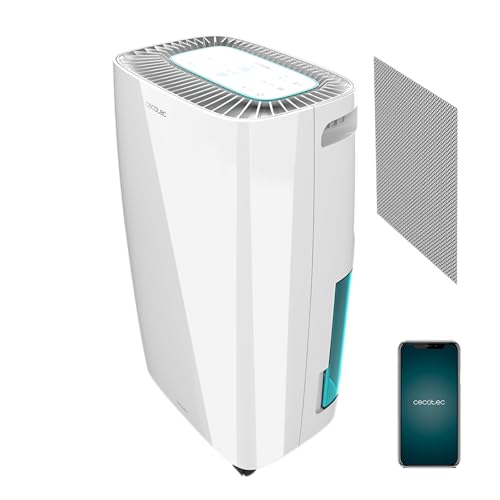 Cecotec BigDry 4000 Expert Connected Extra view › Cecotec BigDry 4000 Expert Connected Extra view › | 10 L | 2.5 L | 4.0 | 205 W | View › |
 Pro Breeze 12L Dehumidifier view › Pro Breeze 12L Dehumidifier view › | 12 L | 2 L | 6.0 | not stated | View › |
 MEDION DH20 view › MEDION DH20 view › | 20 L | 5.4 L | 3.7 | not stated | View › |
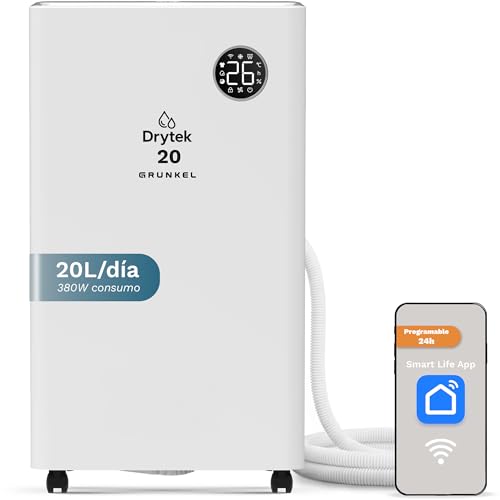 Grunkel DH-20DT view › Grunkel DH-20DT view › | 20 L | 5.5 L | 3.6 | not stated | View › |
 Cecotec BigDry 9000 Professional Connected view › Cecotec BigDry 9000 Professional Connected view › | 20 L | 4.5 L | 4.4 | 380 W | View › |
 Pro Breeze 20L Smart Dehumidifier view › Pro Breeze 20L Smart Dehumidifier view › | 20 L | not stated | cannot be worked out | not stated | View › |
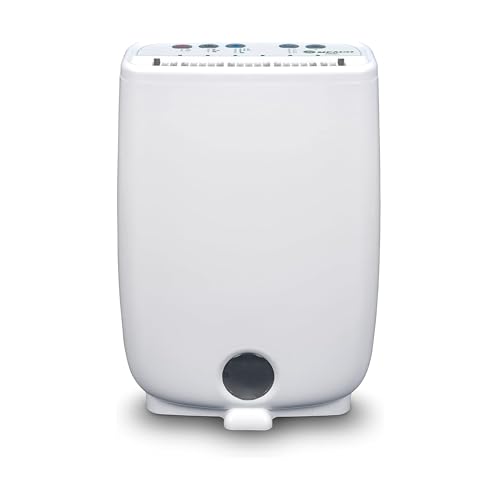 Meaco DD8L view › Meaco DD8L view › | 7.5 L (at 20C and 60%) | 2 L | 3.8 | 650 W | View › |
Cells reading “not stated” are literal: that figure does not appear on the product listing or on the maker's spec sheet as consulted on 16 September 2026. The highlighted row is the only one whose tank lasts more than a day, and it belongs to the machine that promises least.
Compressor or desiccant in a British winter: three sources, three different answers
This is the decision that actually changes what you get, and it is the one where a British buyer is told opposite things by the first results on the page. Two machines with the same name inside a shop do completely different things, and they are separated by two figures that are always on the listing: the unit the extraction is quoted in, and the watts.
One brand's own catalogue lays it out. Cecotec sells a machine of 23 watts rated at 300 millilitres a day and another of 205 watts rated at 10 litres. Thirty-three times the water for nine times the power. In between there is a 45 watt unit at 750 millilitres. The jump is not gradual: it is the moment a compressor appears inside.
All three pages were open on 16 September 2026. They are the first, third and eighth organic results for the category in this country, and a reader with a cold back bedroom gets a different instruction from each one.
Its buying guide says desiccant machines are “designed for properties with a temperature below 2C and so aren't suited for use in the home”, and that compressors are for rooms “usually between 10 and 22C”. Read literally, a cold spare room has no machine at all.
The same week, its dehumidifier guide says refrigerant models “typically struggle in colder spaces, such as cellars” while desiccant types are “effective in both warm and cold spaces”. That is the opposite instruction for the same room.
Meaco, whose shop is the top organic result for this search, sells desiccants for “cooler environments such as garages, workshops, or cellars”, and on its own DD8L product page it puts a number on it: below 10C, desiccant is the choice, with the machine running from 1C.
m8d rule: In an unheated room, go by the maker of the machine, not by the shop selling it. A compressor needs warm air to condense water out of; a desiccant does not care. If the room is below about 10C in the morning, the compressor is the wrong tool no matter how many litres it claims.
Ordinary winter condensation in a heated flat: a small compressor handles it, and the small one costs half what the big one costs to run.
See it on Amazon ›Dehumidifier running cost calculator: what it costs a month, and how often you would be emptying it
This is where the category is either cheap or expensive, and where the published advice gets vague. A consumer testing body puts the average running cost of its recommended machines at around 7p an hour, working from the 26.32p per kWh October 2026 price cap. That average is doing a lot of work: 7p an hour is a 266 watt machine, and the ten machines on this page range from 23 watts to 650.
Run through the cap, the same sum gives 0.6p an hour for the Peltier unit, 5.4p for the 205 watt compressor, 10p for the 380 watt one and 17.1p for the desiccant on boost. That is a spread of twenty-eight times between the cheapest and the dearest machine in the same category, all of them sold as dehumidifiers. Which is why one average number is no use to anybody, and why the calculator below asks for your hours and your unit rate instead.
We would not pay for the 20 litre machine to sit in a heated flat: through the cap it is 10p an hour against 5.4p for the small compressor, and the only thing separating their labels was measured in a room nobody lives in. Two honest limits before you use the calculator. The watts are the maker's own declared figure, and where the maker does not publish them the calculator says so instead of inventing one, which happens on four of the ten machines here. And the monthly figure is the ceiling: once a machine reaches the humidity you asked it for, the compressor cycles off, and the real bill is lower by an amount that depends on your house and that nobody publishes.
Dehumidifier running cost calculator: cost per month and tank emptyings per day
Dehumidifier running cost calculator, from m8d.io: put in the machine, the hours you would run it and your own unit rate, and it returns what it costs a month in electricity and how many times a day you would be emptying the tank if the box were telling the truth. Nothing here is estimated: it divides and multiplies figures the manufacturer publishes on the same spec sheet. Free, no sign-up, no ads. Worked example at the October 2026 price cap of 26.32p per kWh: the 380 watt machine run twelve hours a day costs about 36 pounds a month in electricity, and with 20 litres a day claimed against a 4.5 litre tank that is 4.4 emptyings a day, one every five and a half hours.
At that rate you would be emptying it while you sleep. If you genuinely need it running flat out, it goes in with the drain hose plumbed in permanently, or it does not go in at all.
It does not declare its conditions: the spec sheet gives the litres per day without saying at what temperature or at what humidity they were measured. Where this industry does declare it, the reading is taken at 30C and 80% humidity, which is not a British house in November.
The cost is the declared watts multiplied by the hours and by your unit rate, so it is the bill with the machine running without stopping: as soon as it reaches the humidity you asked for, the compressor cycles off and it draws less. How much less depends on your house, and no manufacturer publishes that. The middle rate is the Ofgem price cap average for 1 October to 31 December 2026, 26.32p per kWh; your own rate will differ by region and by tariff, which is why you can change it.
Damp in a rented home: what your landlord has to do about it, and by when
Not one of the buying guides sitting in the top ten for this search mentions the following, and for a large share of the people searching it is the first thing that matters. There were 1.4 million homes in England with a damp problem in 2024, 5% of the stock, and the most common form of it was severe condensation, at 3%, ahead of penetrating damp at 2% and rising damp at 1%. The rate is 10% in privately rented homes, against 7% in social housing and 4% in owner-occupied homes. Those figures are the English Housing Survey, published on 29 January 2026.
The official guidance for rented housing providers, updated on 1 April 2026, is blunt about whose problem that is: “It is totally unreasonable to blame damp and mould in the home on 'lifestyle choices'… the fundamental cause of damp and mould will be due to building deficiencies, inadequate ventilation, inadequate heating and/or poor energy efficiency, not tenants' normal domestic activities.” That is the government's position, not ours, and it changes what a dehumidifier is for: it manages the symptom while somebody else fixes the cause.
Three different situations, three different routes. All of this was checked on gov.uk on 16 September 2026, and it applies to England.
Awaab's Law has applied since 27 October 2025. For damp and mould that presents a significant risk of harm the landlord must investigate within 10 working days, send a written summary within 3 working days of that investigation finishing, and make the home safe within 5 working days of it finishing.
The clock is not fixed yet, but the duty exists: under the Homes (Fitness for Human Habitation) Act 2018 the home must be fit to live in throughout the tenancy, and damp and mould can be a category 1 hazard under the housing health and safety rating system, which your council is obliged to act on. The Renters' Rights Act 2025 is set to extend Awaab's Law to private tenancies; the date is still subject to consultation.
Nobody else is going to do it, so the order matters: measure the room first, look for the source, and buy the machine for what is left. If the meter reads low and the marks keep coming back, the water is not in the air and no machine on this page will help.
m8d rule: If you rent from a council or a housing association and mould keeps returning on the same wall, report it in writing and start the clock: since 27 October 2025 the landlord has ten working days to investigate a significant damp and mould hazard, three working days after that to give you a written summary, and five working days from the end of the investigation to make the home safe.
The square metres on the box cannot be compared between one brand and the next
That leaves the third number on the packaging, the coverage. It is the one most people buy on and the one that survives comparison worst, because machines declaring identical litres per day declare areas that look nothing like each other, and because the shops selling them cannot agree on what unit to size by in the first place.
Every figure below was on the page on 16 September 2026. Two come from manufacturers, two from shops in the top ten of this search.
MEDION declares up to 20 m² for its 20 litre machine. Cecotec declares 90 m² for its own 20 litre machine. Orbegozo declares 120 m². Same headline capacity, six times the claimed room.
Cecotec claims 15 m² for its 300 millilitre a day machine and 90 m² for the 20 litre one. The second extracts 66 times more water than the first and the claimed area only multiplies by six.
One major DIY chain sizes its advice by number of bedrooms and never mentions square metres. An appliance retailer in the same top ten sizes by litres, “10 to 12 litres a day” for a bedroom and “20 litres or more to stay on top of things”, and quotes “6L extraction suits spaces up to 25m2” on a product. Three units, three answers.
Cecotec also publishes the airflow, 250 m³/h, which is a physical quantity you can compare between machines: how much air passes through it every hour. Almost nobody publishes it, and it is the one that actually says whether a machine can cope with a big room.
m8d rule: Square metres are not a specification, they are a marketing estimate each brand calculates as it pleases. If you have to compare two machines by room size, look for the airflow in cubic metres per hour, and if nobody publishes it, go back to the tank and the watts.
The best dehumidifiers of 2026, one by one, with what each maker actually publishes
The order is not by litres, for everything explained above. It is by who each one is for, and within each case what decides is what the maker publishes: tank, watts and decibels. Availability and models vary by country, so the buttons take you to your local Amazon store to check yours.
Meaco DD8L view ›
This is the machine to buy if the room is cold, and it is also the most honest spec sheet in the guide by a distance. Meaco publishes its extraction measured at 20C and 60% humidity, which is a real house in a British winter, and that is why its number looks small next to the rest: it is not a weaker machine, it is the only one measuring where you actually live. It also runs from 1C, which a compressor will not do.
- Its maker publishes two figures for the same machine: 7.5 litres a day on boost and 3.5 on normal, both measured at 20C and 60% relative humidity. Everyone else in this guide publishes one number and almost nobody says where it was measured.
- There is no compressor inside. It uses a material that soaks up water and is then dried with heat, so it keeps working when the room is cold, which is exactly when a compressor starts to struggle. Meaco writes it plainly: below 10C, desiccant is the choice.
- That cold-weather ability is paid for in electricity: 650 watts on boost, which is close to double a 20-litre compressor. At the October 2026 price cap that is 17.1p an hour with the machine running flat out. In a holiday home, a garage or an unheated back bedroom it earns that; in a heated living room it does not.
- Because it puts out warm air, it dries laundry quickly. That is its other natural job in a country where nothing dries on the line between November and March.
- Publishes its extraction measured at 20C and 60% humidity, which is a lived-in British house in winter
- Works from 1C, where a compressor starts to give up
- Light and quiet on its low setting, with three declared noise levels
- The air it returns comes out warm, so washing dries fast
- Draws a lot more power than a compressor of similar output
- The tank is only 2 litres
- In a heated living room it adds nothing over a cheaper compressor
Pro Breeze 12L Dehumidifier view ›
A good machine from the brand that sells most of them in this country, and at the same time the clearest example of the problem this guide is about: twelve litres a day claimed, with a two litre tank. If that figure were real you would be emptying it six times a day, once every four hours, through the night included. With the drain hose run to a sink it is an excellent buy. Without it, be ready.
- Twelve litres claimed and two litres of tank: six emptyings a day. It is the worst ratio in this guide, and that is why it is here, not because it is a worse machine than the others.
- It has a humidity sensor and continuous drainage, so the scenario it is really designed for is sitting in a bathroom or a utility room with the hose run to a drain.
- The watts do not appear on this listing, so there is no way to work out what it costs to leave running. Pro Breeze does publish that figure for other models on its own support site.
- Its laundry mode is the reason most people in this country end up owning one of these, and it works. Hang the washing close to the machine and shut the door.
- This is also half of the question the search box keeps asking: Meaco or Pro Breeze. The answer here is not about which brand is better, it is about which machine matches the room, and the two of them are different technologies.
- Humidity sensor and continuous drainage included
- Laundry mode, which is the job it actually gets in a British winter
- The brand British buyers already know, with spares and support in the UK
- The 2 litre tank is the smallest here relative to what the label claims
- The watts do not appear on this listing
- Without the drain hose you will be attending to it
MEDION DH20 view ›
If you genuinely need the big one, this is the cheapest machine that claims the big number, and it is the only one in this guide that declares its decibels in the listing itself. Forty-three decibels is a quiet conversation: you can hear it, and in a bedroom you notice it. The five and a half litre tank is the one that lasts longest before it asks to be emptied.
- It is the 20 litre machine with the largest tank here, and even so, at the rate it advertises you would be emptying it almost four times a day. It comes with a drain hose, which is the only way to run it hard without standing over it.
- It declares 43 decibels. Hardly any competitor publishes that number and it decides whether the machine ends up in the living room or the bedroom: above about 45 decibels it is hard to sleep next to.
- It says it covers up to 20 square metres. Another machine with the same stated capacity says 90, and a third says 120. That figure is not comparable, and the section on square metres explains why.
- It uses R290 refrigerant, which is propane. That is not a safety problem in a domestic appliance, but it does mean reading the manual before storing it in a small cupboard or laying it on its side to move it.
- The biggest tank in this guide
- Publishes its noise level, which almost nobody does
- Laundry mode and a drain hose included
- The cheapest of the machines claiming 20 litres a day
- The watts are not on its spec sheet, so the running cost cannot be worked out
- It does not say at what temperature and humidity its litres were measured
- The 20 square metres it claims contradict machines of identical stated capacity
Cecotec BigDry 4000 Expert Connected Extra view ›
This is the smallest true compressor in the guide and it is here because of the watts: its maker publishes them, and without watts you cannot know what a machine costs to leave on. Translated: it is the cheapest to run of the ones that actually do the job in a heated room, and the easiest to live with. What it is not is a machine for a cold room, and that is a technology limit, not a price one.
- Ten litres a day declared and a two and a half litre tank: if that figure held you would be emptying it four times a day. It is the same contradiction the whole category has, on a smaller scale, because the machine itself is smaller.
- Cecotec publishes 205 watts on its own spec sheet. At the October 2026 price cap that is 5.4p an hour, against 10p for the 380 watt machine further down this page. Both claim to do the same job in a flat.
- What it does not publish is the temperature and humidity those ten litres were measured at. That is normal in this category and it is why there is a whole section about it above.
- It is the size argument in this guide: in a heated flat with steamed-up windows the work is done by half the machine the category sells you.
- The lowest power draw of anything here with a real compressor
- The maker publishes the watts, which hardly anyone does
- App control that does something specific: start it before you get home
- Takes up and weighs far less than the 20 litre machines
- The 2.5 litre tank falls short in a genuinely damp room
- It does not state the conditions its litres were measured in
- For a cold room with no heating this is the wrong technology
Cecotec BigDry 9000 Professional Connected view ›
Of the 20 litre machines this is the one whose maker publishes the most: power, decibels, compressor type, refrigerant, weight, airflow and area. That does not automatically make it the better machine, but it does make it the only one in its bracket you can judge before you buy it. Forty-seven decibels is ordinary conversation: fine for a living room, not for sleeping beside.
- Three hundred and eighty watts on its own spec sheet. Twelve hours a day at the October 2026 price cap works out at 10p an hour, or about 36 pounds a month with the machine never stopping, which is the ceiling rather than the normal case.
- Twenty litres a day with a 4.5 litre tank: 4.4 emptyings a day if the figure were true. It has a hose outlet, which is how a machine this size is actually used.
- Its own spec sheet claims 90 square metres of coverage, and the same brand sells a 300 millilitre a day machine that claims 15. One extracts 66 times more water than the other and the claimed area only multiplies by six.
- It is also the only machine here that publishes its airflow, 250 cubic metres an hour. That is a physical quantity you can compare between machines, unlike square metres.
- The most complete spec sheet in the category, with watts and decibels
- Removable tank and an outlet for a drain hose
- R290 refrigerant, which every brand is moving to
- Publishes its airflow in cubic metres per hour, which is the one comparable figure
- Forty-seven decibels is not a bedroom number
- Fifteen kilos: this is not a machine you move daily
- It does not state the conditions its 20 litres were measured in either
Pro Breeze 20L Smart Dehumidifier view ›
The wifi version of the 20 litre machine from the brand that sells most of them. It is a good machine and the dearest in its bracket, and it is worth saying what that buys: the badge and the app, not a different extraction rate. If the gap to the MEDION or the Cecotec is wide on the day you look, the gap is going to the label.
- We could not read its official specification sheet, so what we know about this machine is what its listing says and little more: 20 litres a day, with no measurement conditions next to it.
- On this particular listing neither the tank in litres nor the power appears, and those are the two figures that tell you how inconvenient and how expensive it is going to be.
- It has continuous drainage, a humidity sensor and a laundry mode, which is the standard kit at the top of this bracket.
- It is the reference point of the bracket. If the other three 20 litre machines sit well below it on the day, the argument for paying the difference has to be the app.
- The brand with the deepest presence and spares in this category here
- Continuous drainage, humidity sensor and laundry mode
- Continuous drainage as standard, which is how a machine this size really gets used
- The dearest in its bracket without a measured advantage over it
- This listing publishes neither tank capacity nor power
- The app is the only clear difference against its rivals
Grunkel DH-20DT view ›
It shares the best tank in the 20 litre group and adds app control. It is the direct alternative to the two above it when the day's price puts it below them, and the reason to pick it is exactly that: the tank and the price, not a performance difference anyone has measured.
- Five and a half litres of tank against twenty claimed: three and a bit emptyings a day in the scenario it advertises. It is one of the better ratios in the guide, within the fact that none of them is good.
- The 24 hour timer is for what a dehumidifier is actually used for in a flat: working through the day and not running all night making noise.
- Its power is not on the listing, so the monthly cost cannot be worked out without opening the manual. That is the same gap half of this list has.
- Touch panel and its own app. Check first whether the app asks you to register an email address, because in this category most of them do and the listing rarely says so.
- A five and a half litre tank, among the largest in the group
- Twenty-four hour timer and touch panel
- App control included
- Does not publish its power on the listing
- A smaller name here than Meaco or Pro Breeze in this category
- No published noise figure

COMFEE Easy Dry 20L view ›
A 20 litre machine with an ioniser bolted on and four operating modes. On the ioniser it is worth being blunt: it is not what dries the house, and it is not the reason to buy this. What decides here is the same as in the other three machines in its bracket, and that is the tank, the noise and what it costs a month.
- It is sold as two machines in one, dehumidifier and purifier. The part that removes moisture is the compressor; the ioniser is a different thing and is not a substitute for a particle filter.
- Four modes and app control. In practice, in a flat you use two: automatic with a target humidity, and laundry.
- The exact tank capacity in litres does not appear on its listing, and that is precisely the figure that decides how often you will be emptying it.
- Ionisers and dehumidifiers get bundled together in this category. If what you want is cleaner air rather than drier air, this is not the machine that does it.
- Four modes and app control
- Part of the Midea group, with a track record in air treatment
- Usually sits under its own reference figure
- Does not publish the tank capacity on its listing
- The ioniser is not what dries the house and it adds to the price
- No watts and no decibels on the listing
Cecotec BigDry 2000 Light view ›
It is in this guide so it is clear what this kind of money buys, and to say that it is not what most people are looking for. Three hundred millilitres a day is a glass and a half of water: in a closed wardrobe, a caravan or a small shower room it does its job; in a living room you will not notice anything. At 23 watts there is no compressor inside, and with no compressor there are no litres.
- Three hundred millilitres a day with a 0.6 litre tank: it is the only machine here whose tank lasts two full days. And it is coherent precisely because it does not promise what it cannot do.
- Twenty-three watts. That is 0.6p an hour at the October 2026 price cap, so it can live permanently switched on in a cupboard without anyone thinking about the bill.
- It claims 15 square metres of coverage. The same brand claims 90 for its 20 litre machine, which extracts 66 times more water. The square metre figure in this category does not rank anything.
- It is genuinely quiet because there is no compressor cutting in and out, just a small fan. That is its other sensible use: a room where the noise matters more than the water.
- Costs pennies a day to leave running
- Genuinely quiet, with no compressor starting and stopping
- The only one here whose tank lasts more than a day
- Wardrobe or caravan sized
- Three hundred millilitres a day will not dry a normal room
- It does even less when the house is cold
- The 15 square metres it claims are not comparable with the big machines
Drying washing indoors: the one use where the type of machine changes the answer
Between November and March nothing dries on a line in this country, and the search data shows what people do about it: drying clothes is one of the things typed alongside this category all winter. It is also the use where the compressor-or-desiccant decision stops being theoretical.
A desiccant returns warm, dry air, because the way it works is to soak up water and then drive it off with heat. That is why it dries a load fast and why it feels like it is heating the room a little. A compressor returns air at roughly room temperature; it still dries the washing, it just takes longer in a cold room, and in a really cold room it slows down sharply. Meaco, whose shop is the first organic result for this search, sells its machines on exactly that: “especially effective for drying laundry indoors”.
Two practical conditions that decide whether it works: hang the washing close to the machine with the door shut, because if the air spreads through the house the effect is diluted, and remember that laundry mode is the setting that draws the most power, so check the watts before leaving it on all night. If we were drying washing indoors we would take the desiccant over the bigger compressor, and the reason is on the same spec sheet: it puts out warm air and it still works at 1C, which is what a British utility room is in January.
When not to buy a dehumidifier, and what to do instead
A dehumidifier takes water out of the air. That is all it does. If the water in your wall is not coming from the air, the machine will run for years without fixing anything while the problem carries on spreading behind the paint.
The English Housing Survey splits the 1.4 million homes with damp into three kinds, and the split is the argument: severe condensation 3%, penetrating damp 2%, rising damp 1%. Condensation is the biggest single kind, so most of the time a dehumidifier is the right tool. But two of the three are not condensation at all, and for those it is the wrong tool entirely.
Telling them apart costs the price of a coffee and it is in this guide: measure the humidity of the room. Leave a meter in it for a couple of days and read it first thing in the morning, when the house is at its coldest. If the reading is low and you still have marks, bubbling paint or a tide line low on the wall, the water is coming in through a leak, a failed seal or up from the ground, and that is a repair, not an appliance. If the reading is high, then yes, the air has too much water in it and the machine has a job to do.

TempPro TP50 view ›
This is the most profitable advice in the whole guide. Before spending what a dehumidifier costs, spend what a coffee costs and find out what humidity you actually have, room by room. With that number in front of you, half the purchases in this category stop making sense and the other half get made properly.
- The official damp and mould guidance for landlords tells them to look for consistently high relative humidity measured with a meter, and it puts no number on it. The number that matters is the one in your room, and nobody else can take it for you.
- Put it in the room with the problem and leave it a couple of days, reading it first thing. Condensation appears in the small hours, when the house is coldest, not at midday.
- If it reads low and you still have marks on the wall, the water is not coming out of the air: it is a leak or it is coming up from the ground, and a dehumidifier will not fix either.
- They come in packs of two or three for little more. One in the bedroom and one in the living room shows you that humidity is not the same in two rooms of the same house.
- Costs a fraction of getting the machine wrong
- Tells you whether the problem is the air or a leak
- Still useful afterwards, to see whether the dehumidifier is doing anything
- The accuracy of these small units is indicative, not laboratory grade
- You need to leave it a couple of days to read the mornings properly
And before switching anything on, the part that is free. The condensation in a lived-in house comes from inside it: from showers, from cooking, from washing hung indoors and from people breathing. Opening the windows wide for five or ten minutes in the morning pushes that loaded air out without chilling the walls, and putting a lid on pans and running the shower extractor stops a good share of the water you would otherwise be paying 200 watts to remove. A dehumidifier is what you buy when that is not enough, not instead of it.
What we did is the thing none of the five pages currently occupying this search does: read the official spec sheets and check what they say against each other.
On 16 September 2026 we opened the manufacturer documentation for Cecotec, Meaco, Orbegozo and MEDION and recorded what each one publishes about test conditions, power, tank, noise and coverage. Two publish the conditions their litres were measured in and two do not. For Pro Breeze we could not read a specification sheet, so we say nothing about what it publishes: when a source cannot be checked, it is not cited here. The emptyings per day are not an estimate of ours, they are one figure divided by another, both printed by the maker on the same sheet.
The same day we read the buying advice on the pages ranking first, third, seventh, eighth and eleventh for this category in this country, and quoted them where they contradict each other. The running costs are the declared watts multiplied by hours and by the Ofgem price cap unit rate of 26.32p per kWh for 1 October to 31 December 2026, which is the national average for a direct debit customer and varies by region. The damp figures are the English Housing Survey published on 29 January 2026; the landlord duties and timescales are gov.uk guidance checked on 16 September 2026. Product availability and models vary by country, and where a product has no price reading the button says so rather than sending you to a dead page.
Should I buy a 12L or a 20L dehumidifier?›
For an ordinary heated flat with condensation on the windows, a 10 or 12 litre compressor does the work and uses about half the power of a 20. The litres figure is a laboratory number and, where a maker states the conditions, they are 30C and 80% humidity, so you will get considerably less than the label with either. What should decide it is the tank: 12 litres a day against a 2 litre tank is a machine designed to be plumbed in, and 20 litres against a 5.4 litre tank is one designed to be carried to the sink. Pick the one that matches how you will live with it.
What does Martin Lewis say about dehumidifiers?›
The line that circulates, and that Meaco quotes on its own shop, is that running a dehumidifier to dry clothes can work out cheaper than a tumble dryer. The sum behind it is one you can do yourself with the figures on this page: a machine's power in kilowatts multiplied by the hours multiplied by your unit rate. At the 26.32p per kWh October 2026 price cap, a 205 watt compressor is 5.4p an hour and a 650 watt desiccant on boost is 17.1p. A condenser tumble dryer is generally a 2 to 3 kilowatt appliance, so the arithmetic favours the dehumidifier over a full drying cycle. Check your own machine's rating plate before taking anyone's word for it, including ours.
How much does a dehumidifier cost to run?›
It depends on its watts and your hours, which is exactly why it matters whether the maker publishes them. At the October 2026 price cap of 26.32p per kWh, a 205 watt compressor run twelve hours a day comes to about 19 pounds a month if it never stops, and a 380 watt one to about 36. A desiccant on boost at 650 watts is more than three times the small compressor. Those are ceilings: as soon as the machine reaches the humidity you set, the compressor cycles off and the real bill is lower. How much lower depends on your house, and no manufacturer publishes that.
What are the downsides of a dehumidifier?›
Three real ones. It makes noise, and only a minority of makers publish the figure: 43 decibels is a quiet conversation and you hear it from the bed, 47 bothers most people. It has to be emptied, and the tank arithmetic on this page shows how often. And it treats a symptom: the official guidance for rented housing says the fundamental cause of damp and mould is building deficiencies, inadequate ventilation, inadequate heating or poor energy efficiency, so if the wall is wet from a leak or from the ground, no machine on this page will change it.
Which is better, Meaco or Pro Breeze?›
They are not the same kind of machine, so the honest answer is about the room rather than the badge. The Meaco unit here is a desiccant: it keeps working down to 1C, its maker publishes its extraction measured at 20C and 60% humidity, and it puts out warm air, which is why it dries washing quickly. The Pro Breeze unit here is a compressor, which suits a heated room and uses far less power to do it, and on the listing we read its watts do not appear. Cold room or drying laundry, the desiccant. Heated flat with steamed-up windows, the compressor.
Can I leave it on overnight?›
You can, and what decides whether it is a good idea is the decibels. A compressor at 43 decibels is a quiet conversation and you will hear it from the bed; at 47 most people mind. If the machine is going to sleep in the bedroom, look for one that publishes its noise figure, which few do, or put it in the hallway with the door open. The other option is the timer almost all of them have, set to switch off a few hours in.
Will it get rid of the mould I already have?›
No. A dehumidifier lowers the humidity of the air, which stops mould growing further, but it does not clean the mark that is already there and it does not deal with the cause. If the room reads low on a meter and you still get marks, bubbling paint or a tide line near the skirting, the water is coming from a leak, a failed seal or up from the ground, and that is a repair. If you rent, that repair is your landlord's, and since 27 October 2025 social landlords in England have fixed timescales to investigate and act.
Do dehumidifiers help with drying clothes indoors?›
Yes, and in this country it is the main reason most of them get bought. Nearly all have a laundry mode that runs the fan harder and stops chasing a target humidity. Two conditions make the difference: hang the washing close to the machine with the door closed, because if the dry air spreads through the house the effect is diluted, and check the watts before leaving it on all night, because laundry mode is the setting that draws most power.
Manufacturer documentation, retailer buying advice and government sources, all consulted on 16 September 2026.
- CecotecBigDry 9000 Professional Connected spec sheet380 W, 20 L/day, 4.5 L tank, 46 to 47 dB, 90 m2, 250 m3/h airflow, compressor and R290 gas.
- CecotecDehumidifier catalogueThe full ladder of the range: 23 W at 300 ml/day, 45 W at 750 ml, 205 W at 10 L and 580 W at 30 L.
- OrbegozoDHW 2080 dehumidifier spec sheetDehumidification 20 L/day at 80% RH and 30C, 330 W and a 6 L tank: the maker that writes the test conditions inside the line itself.
- MeacoDD8L product page7.5 and 3.5 litres a day measured at 20C and 60% humidity, operation from 1C, and the recommendation to use a desiccant below 10C.
- MeacoDehumidifiers collection and buying adviceCompressors for warm indoor spaces and desiccants for cooler environments such as garages, workshops or cellars, and dehumidifiers as especially effective for drying laundry indoors.
- B&QDehumidifier buying guideCompressors for rooms usually between 10 and 22C, and desiccants described as designed for properties below 2C and not suited to use in the home. Sizes by number of bedrooms, not square metres.
- Which?How to buy the best dehumidifierAverage running cost of its Best Buys around 7p an hour at 26.32p per kWh, refrigerant models struggling in colder spaces and desiccant types effective in both warm and cold spaces.
- OfgemEnergy price cap unit rates and standing chargesElectricity at 26.32p per kWh with a 54.83p daily standing charge for direct debit customers, 1 October to 31 December 2026, national average with regional variation.
- GOV.UKEnglish Housing Survey 2024 to 2025: headline findings on housing qualityPublished 29 January 2026: 1.4 million dwellings (5%) with a damp problem in 2024, severe condensation 3%, penetrating 2%, rising 1%, and 10% in the private rented sector against 7% social and 4% owner occupied.
- GOV.UKUnderstanding and addressing the health risks of damp and mould in the homeUpdated 1 April 2026: blaming damp and mould on lifestyle choices is described as totally unreasonable, with the fundamental cause attributed to building deficiencies, ventilation, heating or energy efficiency.
- GOV.UKAwaab's Law: guidance for tenants in social housingIn force since 27 October 2025: 10 working days to investigate a significant damp and mould hazard, a written summary within 3 working days of it concluding, and the home made safe within 5 working days.
If you got this far looking for a number that ranks the category, there is no such number, and that is the finding of this guide. The litres are measured somewhere you do not live, the square metres cannot be compared between brands, and the tank each machine comes with contradicts its own headline.
What does decide: if the room is heated, a small compressor, because it does the work on half the power and half the size. If the room is cold or shut up, a desiccant, because it is the only technology the cold does not blunt and its maker puts that in writing. And if you have not measured the humidity of the room yet, that is today's purchase, because it costs a fraction of everything else and it may save you the rest. And if you rent, we would send the email before getting the card out: the guidance updated on 1 April 2026 says the fundamental cause is the building, not your cooking.

Comments
Be the firstNo sign-up: just a name. Every comment is reviewed before it is published.