Air cooler or portable air conditioner in the UK: how many degrees each drops, what they cost to run and which to buy
 m8d.ioUpdated on
This guide contains affiliate links. As an Amazon Associate, m8d.io earns from qualifying purchases, at no extra cost to you.
An air cooler chills air by evaporating water into it, so how far it can go depends on how dry that air arrives. On a July afternoon in London, at 60 per cent humidity, the physical ceiling is 5.4 degrees. In Plymouth, at 71 per cent, it is 3.6. In Stornoway, at 79 per cent, it is 2.4. That is why the honest answer for most of Britain is a portable air conditioner or a fan, and why the exception is worth knowing.
Air cooler or portable air conditioner: what British summer humidity decides for you
They are not the same machine and they do not do the same job. A portable air conditioner takes heat out of the room and pushes it outside through a hose, so it lowers the temperature of the whole room and takes moisture out of it at the same time. An air cooler, which is an evaporative cooler, sends nothing outside: it chills the air it blows and adds water vapour to it. A fan cools nothing at all; it moves air so that your skin evaporates sweat faster, which is why it feels like it works.
The reason this decision is different in Britain than almost anywhere else is that evaporative cooling runs on dry air, and British summer air is not dry. The trade itself puts the working threshold at about 60 to 65 per cent relative humidity. The driest July afternoon average in this whole guide is London at 60 per cent, and it is downhill from there. We would not buy an air cooler as the main answer to a British heatwave, and the table below is the reason: even at the best hour of the best month in the driest city on the list, the ceiling is 5.4 degrees, and a real machine only reaches part of its ceiling, only in the stream of air coming out of the grille.
Search for cooling in a British summer and the same listing page will show you all three, often with the same photograph of a white box on castors. The difference is not a feature list: it is whether there is a hose.
m8d rule: If the machine has no hose going out of a window, it is not removing heat from your room. It is either moving air, or chilling the air it blows while adding moisture to the room.
How much an air cooler can drop the air in eleven British towns, from London to Lerwick
| Station | July afternoon humidity | Most it can drop the air | What we would buy there | |
|---|---|---|---|---|
 UniversalBlue Izamal 8025W view › UniversalBlue Izamal 8025W view › | London 60 per cent | 5.4 degrees | An air cooler works here, for the spot you sit in | View › |
 UniversalBlue Izamal 8040W view › UniversalBlue Izamal 8040W view › | Birmingham 60 per cent . Manchester 63 . Edinburgh 63 | 5.2 to 4.5 degrees | An air cooler, with a window open | View › |
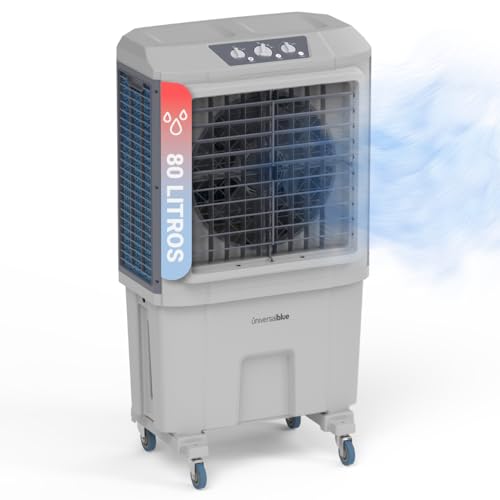 UniversalBlue Tulum 7080 view › UniversalBlue Tulum 7080 view › | Cardiff 66 per cent . Aberdeen 66 . Belfast 68 | 4.4 to 4.0 degrees | Open spaces only, or a fan | View › |
 Cecotec EnergySilence 5000 Cool Wave view › Cecotec EnergySilence 5000 Cool Wave view › | Plymouth 71 per cent | 3.6 degrees | A fan, at a tenth of the running cost | View › |
 M Confort Eolus 120 Pro view › M Confort Eolus 120 Pro view › | Stornoway 79 per cent . Tiree 81 . Lerwick 83 | 2.4 to 1.9 degrees | A fan. An air cooler is a fan that also dampens the room | View › |
July mean daily maximum temperature from the 1991-2020 station normals; July afternoon relative humidity, which is the lowest reading of the day, from the 1961-1990 station normals. Both read on 18 September 2026. The ceiling is the difference between the air temperature and its wet bulb temperature: a calculated physical limit, not a measurement. Two reference periods, and we say so rather than hide it. Because the humidity used is the afternoon minimum, every figure in this column is the best case, not the average.
The number that puts this in perspective. Valencia, on the Spanish Mediterranean coast, sits at 67 per cent humidity in July and its ceiling is about 4.8 degrees, which is why our Spanish guide tells readers there to buy a fan instead. Cardiff, Aberdeen, Belfast, Plymouth and everywhere north of them have less headroom than the Spanish city where we already say do not bother. London and Birmingham have a little more, and that is the whole British case for this appliance.
One caveat that works in the machine's favour: a monthly average is not a heatwave afternoon. When a plume of dry continental air arrives, the temperature goes up and the humidity comes down, and the ceiling on that particular day is higher than anything in this table. The way to check is the humidity reading on your own weather app, which is the second input in the calculator below.
Free air cooler calculator: how many degrees it can drop where you live, and what it costs to run
Free air cooler calculator: how many degrees it can drop where you live
This is the question that decides the purchase and that none of the pages Google puts ahead of us today answers: where this works and where it does not. Pick the nearest station and the calculator pulls the July afternoon humidity recorded there, the ceiling physics allows an air cooler in that air, the airflow in cubic metres per hour your room needs, and what it would use in electricity a month against a fan and against a portable air conditioner. London, 18 square metres and six hours a day come already filled in. It is a tool by m8d.io: free, no account, no ads.
London sits in the middle band: a ceiling of 5.4 degrees. An air cooler works for the spot you are sitting in, with the machine less than two metres away. If what you want is the temperature of the whole room to come down, this is not the machine.
41.18 pounds a month between the portable air conditioner and the air cooler at these hours. That is what you pay for bringing the temperature of the whole room down instead of cooling the spot you are in.
Where each number comes from, and what this sum does NOT tell you
The temperature is the July mean daily maximum from the 1991-2020 station normals. The humidity is the July afternoon relative humidity, which is the lowest reading of the day and so the most favourable moment an air cooler will ever get; it comes from the 1961-1990 station normals, because the Met Office climate averages publish temperature, frost, sunshine and rainfall and do not publish humidity. Two different reference periods, and we say so rather than paper over it. What it means in practice: every ceiling here is the best case, not the average one.
The ceiling is the difference between the air temperature and its wet bulb temperature, calculated with the approximation Roland Stull published in the Journal of Applied Meteorology and Climatology in 2011. It is a calculation, not a measurement, and it marks a physical limit: no evaporative cooler, however good, sends air out below that temperature. A real machine reaches a fraction of that ceiling, and the fraction depends on the thickness of the pad, the airflow and how clean the filter is.
The 20 air changes an hour used to work out the airflow come from the two figures declared by M Confort across its domestic range: in the twelve models that publish both maximum airflow and coverage area, the ratio between them runs from 19.2 to 24.0 air changes an hour with a 2.5 m ceiling (read on 16 September 2026).
The three wattages are the ones their manufacturers declare: 45 W for a tower fan (Orbegozo declares it in nine of the eleven in its catalogue), 120 W for an evaporative air cooler (UniversalBlue, on its 25 and 40 litre portables) and 1,000 W of cooling draw for a portable air conditioner (Orbegozo ADR 9000, class A). The sum multiplies watts by hours, by 30 days, and by the unit rate you entered.
What this sum does not tell you: how many degrees YOUR machine will take off YOUR living room. That depends on the model, on how much the room is ventilated and on the humidity of that particular afternoon, and there is no single figure that holds for every house. It also leaves out the water an evaporative cooler gets through and the cost of replacing its pad.
Do portable air conditioners need venting out of a window, and what to do with a casement
Yes, all of them. A portable air conditioner works by taking heat out of the room air and dumping it into the hose, and if that hose is not going outside, the heat is going back into the room along with the waste heat of the compressor. A unit running with the hose coiled in the corner makes a room hotter, not cooler. This is not a preference or an installation tip: it is where the heat has to go.
And this is the part of the decision that is genuinely different in Britain. Most venting kits supplied with portable units are made for a sliding or tilt window, because that is what the rest of Europe and North America fit. A large share of British homes have side hung casement windows, where there is no straight sash to slide a panel into, and a fair number of period properties have sash windows, where the kit works better. Before you buy the machine, look at the window in the room you want to cool and work out where a 13 centimetre hose is going to leave. An air cooler has no hose at all, and for a rented flat where you cannot touch the window that is a real advantage, as long as you have read the table above and know what you are getting.
UniversalBlue Izamal 8025W view ›
The one we would pick for a bedroom or a home office on the handful of genuinely dry afternoons Britain gets. Its manufacturer declares 120 W and 25 litres, and that wattage is the whole argument: you can leave it running all afternoon for less electricity than a single hour of a portable air conditioner.
- The wattage is the whole case for this machine: 120 W against the 1,000 W cooling draw Orbegozo declares for its ADR 9000 portable air conditioner. Six hours a day comes to 21.6 kWh a month for the cooler and 180 kWh for the air conditioner.
- The official UniversalBlue spec sheet declares 120 W and 25 litres and does not publish an airflow figure. The listing does claim 4,000 m3/h, the same number the manufacturer publishes for its 40 litre sibling: consistent, but worth knowing it is not on the spec sheet.
- The 25 litres are not runtime, they are capacity. How long a fill lasts depends on the fan speed and on how dry the air is, because the tank empties by evaporating.
- 120 W declared by the manufacturer: cheap enough to run all afternoon
- 25 litre tank, so it does not need refilling mid afternoon
- No installation, no hose out of the window, no fixed unit
- Its own spec sheet does not publish an airflow figure
- On a muggy British afternoon at 70 per cent humidity it cools the air by about 3 degrees at most
Cecotec EnergySilence 5000 Cool Wave view ›
The 28 W of its direct current motor are the lowest draw in this guide and in most of the catalogue. In exchange, its own spec sheet leaves the airflow field blank, so it is the only one of the five for which you cannot work out what size of room it covers.
- 28 W is less than a tower fan declares (45 W in nine of the eleven in Orbegozo's catalogue), which makes this the one you leave running by the bed all night.
- On its official spec sheet the airflow field reads zero (cecotec.es, 16 September 2026): it is not that we could not find it, it is that the brand does not publish it. Without that number there is no way to know what room it moves.
- Five litres is a night's worth, not a weekend's, and the tank is the thing that is evaporating: once it is empty it stops cooling and goes back to being a fan.
- 28 W: the lowest draw in the selection
- 12 speeds and a sleep mode for overnight use
- Narrow tower format, very little floor space
- Its official spec sheet does not publish an airflow figure
- Five litres is a night, not a weekend
Are air coolers worth it? The four drawbacks that show up in a British house
There are four, and all four come from the same thing: the machine is putting water into the air of your house. The first is that it does not lower the temperature of the room: it chills the stream of air coming out of the grille, and that sensation thins out as you move away from it. The second is the moisture it adds, which in a closed room comes back through its own intake: each pass cools a little less than the last, so you have to leave a window or a door open, which is the exact opposite of how you run an air conditioner.
The third is maintenance: a tank of standing water and a damp pad are somewhere things grow, so it gets emptied and dried when it is not in use and the filter gets rinsed. And the fourth is noise, because every bit of the cooling is produced by a fan pushing air through a wet pad: if the machine is quiet, it is not moving much air.
In a British house the second one matters more than it does in Spain. Our housing stock is the oldest in western Europe, and adding vapour to a room that is already at 65 per cent humidity is a different proposition from adding it to a room at 35 per cent. If there is condensation on your windows in winter, we would not put an evaporative cooler in that room at all.
- Close to the person, not in the middle of the room. What you feel is the stream of air, and the stream has lost most of its effect two metres away.
- With a window or a door open. This is the rule that gets broken most: the machine adds vapour, and if the air is not replaced, the humidity of the room climbs and every pass cools less.
- With the intake clear. If it is drawing in its own output, it is recycling air it has already dampened.
- In the room you are going to be in, not in the hall. An evaporative cooler does not condition a house: it cools a spot.
Is a portable air conditioner illegal in the UK, and what actually needs a qualified installer
No. A portable air conditioner is a plug in appliance: no planning permission, no notification, no qualified installer, and in a rented flat nothing that changes the building. It is the one form of air conditioning a tenant can use without asking anyone, which is most of why the question is asked so often.
What does need a qualified person is a fixed split system, the kind with a box on the outside wall. The refrigerant in it is an F gas, and UK law requires an F Gas certified engineer to install or service stationary units containing one. On top of that, an outdoor unit on a flat or an apartment almost always needs a planning application, because flats do not have the permitted development rights houses do and the equipment changes the appearance of a shared building. So the honest ranking for a British flat is: fan, then air cooler if you are in the dry half of the table above, then portable air conditioner, and a split system only if you own the place and are prepared for an application and a certified installer.
The figures to look for in an air cooler listing, and the one the catalogue actually publishes
On 16 September 2026 we read the evaporative cooler listings returned by six different searches in the Amazon catalogue we track, and there were 40 distinct products. Of those forty: 23 give the tank size, 15 give the wattage and only 10 give the airflow in cubic metres per hour. Nine give both the airflow and the power draw, which are the two figures you need to compare one machine against another. Two declare the floor area they cover. And not one of the forty promises a number of degrees in its headline, which is the one good thing about all of this.
Airflow is the figure that decides and it is the one least often published. The tank size, which nearly all of them show, does not tell you how long it runs: it tells you how much fits. How long a fill lasts depends on the fan speed and on how dry the air is, because the tank is evaporating.
When a listing says suitable for rooms up to 50 m2, that number does not come from a standard. It comes from dividing the machine's airflow by however many air changes an hour that manufacturer decided on. And each one picks a different figure, without publishing which.
m8d rule: Divide the airflow in m3/h by 50 and you have the floor area it refreshes at 20 air changes an hour with a 2.5 metre ceiling. If the listing does not give the airflow, it is not telling you what room it covers.
What an air cooler, a fan and a portable air conditioner use in a month at the price cap
What those kilowatt hours cost at the current cap. Ofgem's price cap sets the electricity unit rate for a standard variable tariff paid by direct debit at 26.32 p/kWh from 1 October to 31 December 2026, announced on 26 August 2026. At that rate, six hours a day for a month comes to about 2.13 pounds for the fan, 5.69 for the air cooler and 47.38 for the portable air conditioner. Your own tariff will differ, and the standing charge of 54.83 p a day is there whatever you run.
That ratio, roughly one to eight, is the real argument for an evaporative cooler in Britain, and it is worth being precise about what you are buying with it: you are not buying a cold room, you are buying a cool draught in one spot for a fraction of the electricity. Whether that is a good deal depends entirely on which row of the table above you live in.
The five air coolers in this guide, with what their spec sheets declare and what they leave out
UniversalBlue Izamal 8025W view ›
The one we would pick for a bedroom or a home office on the handful of genuinely dry afternoons Britain gets. Its manufacturer declares 120 W and 25 litres, and that wattage is the whole argument: you can leave it running all afternoon for less electricity than a single hour of a portable air conditioner.
- The wattage is the whole case for this machine: 120 W against the 1,000 W cooling draw Orbegozo declares for its ADR 9000 portable air conditioner. Six hours a day comes to 21.6 kWh a month for the cooler and 180 kWh for the air conditioner.
- The official UniversalBlue spec sheet declares 120 W and 25 litres and does not publish an airflow figure. The listing does claim 4,000 m3/h, the same number the manufacturer publishes for its 40 litre sibling: consistent, but worth knowing it is not on the spec sheet.
- The 25 litres are not runtime, they are capacity. How long a fill lasts depends on the fan speed and on how dry the air is, because the tank empties by evaporating.
- 120 W declared by the manufacturer: cheap enough to run all afternoon
- 25 litre tank, so it does not need refilling mid afternoon
- No installation, no hose out of the window, no fixed unit
- Its own spec sheet does not publish an airflow figure
- On a muggy British afternoon at 70 per cent humidity it cools the air by about 3 degrees at most
UniversalBlue Izamal 8040W view ›
Our pick for a living room, and for a reason you can check yourself: it is one of the few whose official spec sheet declares the airflow, 4,000 m3/h. At 20 air changes an hour with a 2.5 metre ceiling, that airflow moves the air of about 80 square metres.
- It declares the two figures that matter, which separates it from most of the catalogue: of the 40 distinct evaporative cooler listings we read on 16 September 2026, 23 give the tank size and only 10 give the airflow in cubic metres per hour.
- Its 4,000 m3/h are the same as the 25 litre model, so what changes between the two is the tank, not the air it moves. If you are happy refilling once a day, the extra 15 litres are the only thing you are paying for.
- The manufacturer does not publish a floor area for this model, and it is right not to: in its professional Tulum range it declares between 35 and 91 air changes an hour for the same airflow, so its own floor area figure is not comparable with another brand's.
- Airflow declared on the manufacturer spec sheet: 4,000 m3/h
- 40 litre tank and motorised vertical louvres
- 120 W: the same draw as the 25 litre model
- It moves the same air as its smaller sibling, which costs less
- 40 litres of water weigh 40 kilos: fill it where it is going to stay
UniversalBlue Tulum 7080 view ›
For an open space, which is where an evaporative cooler does its best work: the more the air is replaced, the less it saturates with the moisture the machine is adding. The spec sheet declares 210 W, 6,200 m3/h and 50 square metres, and those metres come from 50 air changes an hour, not 20.
- Outdoors and half open is where an evaporative cooler earns its keep. Evaporating water raises the humidity of the air, and in a closed room that moisture comes straight back through the machine's own intake: each pass cools a little less than the last. On a patio, or with a door propped open, it does not.
- It declares 6,200 m3/h for 50 square metres. Using the ratio in M Confort's domestic range, about 20 air changes an hour, that airflow would cover 124 square metres: the gap is not anybody's mistake, it is that every manufacturer picks a different criterion and none of them publishes which.
- 210 W is still a fifth of what a portable air conditioner of the same class declares, and there is no hose to run out of a window here.
- Airflow and floor area both declared on the spec sheet
- 80 litre tank, enough for a full day outdoors
- Multidirectional castors: it rolls full with one hand
- Far too much machine for a bedroom
- Bulky and heavy: not something you put away in a cupboard
M Confort Eolus 120 Pro view ›
The step up to the professional range, from the manufacturer that documents its catalogue better than anyone else in this category. It declares 450 W, 12,000 m3/h and 150 square metres. At 50 kilos empty and 135 centimetres tall, this is a machine for a workshop or a pub terrace, not a house.
- M Confort is the only manufacturer we read that declares both airflow and floor area across its whole domestic range: twelve models with both figures, and a constant ratio of 19 to 24 air changes an hour. That is where the rule in this guide comes from.
- Its 450 W are ten times the 45 W Orbegozo declares for a tower fan, and less than half what a portable air conditioner draws while moving an air volume no portable unit reaches.
- This is a working purchase: 135 by 83 by 57 centimetres and 50 kilos empty. If what you want to cool is a living room, the first two machines in this guide do the job for a fraction of it.
- 12,000 m3/h and 150 m2 declared by the manufacturer
- The best documented catalogue in the category
- Axial fan and a 50 litre tank
- 50 kilos and 1.35 metres: not a domestic appliance
- 450 W: at that draw the running cost stops being an argument against a fan
Cecotec EnergySilence 5000 Cool Wave view ›
The 28 W of its direct current motor are the lowest draw in this guide and in most of the catalogue. In exchange, its own spec sheet leaves the airflow field blank, so it is the only one of the five for which you cannot work out what size of room it covers.
- 28 W is less than a tower fan declares (45 W in nine of the eleven in Orbegozo's catalogue), which makes this the one you leave running by the bed all night.
- On its official spec sheet the airflow field reads zero (cecotec.es, 16 September 2026): it is not that we could not find it, it is that the brand does not publish it. Without that number there is no way to know what room it moves.
- Five litres is a night's worth, not a weekend's, and the tank is the thing that is evaporating: once it is empty it stops cooling and goes back to being a fan.
- 28 W: the lowest draw in the selection
- 12 speeds and a sleep mode for overnight use
- Narrow tower format, very little floor space
- Its official spec sheet does not publish an airflow figure
- Five litres is a night, not a weekend
When an air cooler is the wrong answer in a British home, whatever the price says
- If you are on the west coast, in Scotland or in the islands. At 71 per cent in Plymouth, 79 in Stornoway or 83 in Lerwick on a July afternoon, the ceiling is between 3.6 and 1.9 degrees: a fan costs less to buy and a quarter as much to run.
- If you want it to sleep with the door shut. It needs air to be replaced; with the room closed the humidity climbs and the effect switches itself off.
- If you expect the temperature of the room to come down. That is a portable air conditioner's job, and no evaporative cooler does it.
- If the room already gets condensation in winter. Adding vapour to a room that struggles with moisture is not a neutral thing to do, and the tank needs looking after too.
- If the listing does not give the airflow. Without that figure you cannot know what room it covers, and at these prices there are models that do publish it.
We start from the whole category: the evaporative cooler listings returned by six different searches in the Amazon catalogue we track, read on 16 September 2026, plus the references from the merchants whose feeds we read daily. That is where the count of what gets published and what does not comes from, and where the five machines here come from.
Then we read the manufacturers' own spec sheets, which is the only source we accept for a specification: M Confort's domestic and professional ranges, UniversalBlue's Izamal and Tulum ranges, the Cecotec EnergySilence 5000 Cool Wave sheet, Orbegozo's tower fan catalogue and the spec sheet for its ADR 9000 portable air conditioner. Every figure in this guide carries its source and its date.
The climate half is eleven British stations: July mean daily maximum temperature from the 1991-2020 normals and July afternoon relative humidity from the 1961-1990 normals. The two periods are different because the Met Office climate averages publish temperature, frost, sunshine and rainfall and do not publish humidity, and we would rather say that than paper over it. The wet bulb ceiling uses a published, cited approximation. Availability of individual models varies by country.
Do air coolers actually work in the UK?›
They work, but with much less headroom than the advertising suggests, because evaporative cooling runs on dry air and British summer air is not dry. Using the July afternoon humidity recorded at eleven stations, the physical ceiling runs from 5.4 degrees in London down to 1.9 in Lerwick, and a real machine only reaches part of its ceiling, and only in the stream of air coming out of the grille. Where one does earn its keep is as a replacement for a fan in the driest parts of England, at about a tenth of the electricity of a portable air conditioner.
What is the difference between an air cooler and a portable air conditioner?›
A portable air conditioner removes heat from the room and pushes it outside through a hose, so it lowers the temperature of the whole room and takes moisture out of it, and it draws around 1,000 W. An air cooler sends nothing outside: it chills the air it blows by evaporating water into it, adds moisture to the room, and draws around 120 W. If the machine has no hose, it is not removing heat from your room.
Is it worth buying a portable air conditioner in the UK?›
If what you need is the temperature of a room to come down on a muggy night, yes, and it is the only one of the three that does it. The cost is electricity: at six hours a day and the Ofgem price cap unit rate of 26.32 p/kWh for October to December 2026, a 1,000 W unit comes to about 47 pounds a month against under 6 for an air cooler. Before you buy one, check where the hose is going to leave: it has to vent outside or it heats the room.
Do all portable air conditioners need to be vented out of a window?›
Yes. The heat taken out of the room air has to go somewhere, and in a portable unit it goes into the hose. Running one with the hose left in the room puts that heat straight back, along with the waste heat of the compressor, and the room ends up warmer. The practical British complication is the window: most kits are built for sliding or tilt windows, and a side hung casement has no sash to slide a panel into.
Is a portable air conditioner illegal in the UK?›
No. A portable unit is a plug in appliance and needs no permission, no notification and no qualified installer, which is why it is the usual answer for a rented flat. What needs an F Gas certified engineer is a fixed split system, because it contains an F gas refrigerant, and an outdoor unit on a flat almost always needs a planning application as well.
How much does an air cooler cost to run?›
At the 120 W UniversalBlue declares for its 25 and 40 litre models, six hours a day for a month is 21.6 kilowatt hours. At the Ofgem price cap unit rate for October to December 2026, 26.32 p/kWh, that is about 5.69 pounds a month, against roughly 2.13 for a tower fan and 47.38 for a portable air conditioner on the same hours. The calculator in this guide does the sum with your own hours and your own unit rate.
The manufacturer spec sheets and official data behind the numbers above, with the date we read them.
- Met OfficeLocation specific long term averages, 1991-2020July mean daily maximum temperature by station. The available variables are temperature, frost, sunshine and rainfall: relative humidity is not among them, which is why the humidity column uses a different source and a different period. Read on 18 September 2026
- Current Results, compiled from station normalsJuly relative humidity and July average temperature for UK cities and townsJuly morning and afternoon relative humidity for sixteen UK stations, from 1961-1990 data; July average high and low temperatures from the 1991-2020 normals. The eleven towns in this guide are the ones that appear in both tables. Read on 18 September 2026
- Roland Stull, Journal of Applied Meteorology and Climatology, 2011Wet-Bulb Temperature from Relative Humidity and Air TemperatureThe approximation used to calculate the ceiling in the table and in the calculator
- OfgemEnergy price cap unit rates and standing chargesElectricity unit rate of 26.32 p/kWh and standing charge of 54.83 p a day for a standard variable tariff paid by direct debit, 1 October to 31 December 2026, announced on 26 August 2026
- M ConfortEvaporative coolers, domestic rangeThirteen models with power draw, maximum airflow and coverage area. Read on 16 September 2026
- UniversalBlueIzamal and Tulum evaporative coolersPower, airflow and floor area declared by range. Read on 16 September 2026
- CecotecEnergySilence 5000 Cool Wave28 W, 5 litres, 12 speeds; the airflow field reads zero. Read on 16 September 2026
- OrbegozoTower fans, and the ADR 9000 portable air conditioner45 W declared in nine of the eleven tower fans in the catalogue; 1,000 W of cooling draw in the ADR 9000, class A. Read on 16 September 2026
- US Department of EnergyEvaporative CoolersWhy evaporative coolers are only suited to low humidity climates and are not used in humid ones
If you are in London, Birmingham, Manchester or Edinburgh and what you want is a cool draught over the sofa for a tenth of the electricity of an air conditioner, we would take the UniversalBlue Izamal 8025W for a bedroom and the Izamal 8040W for a living room, and the reason is not the price: they are among the few whose official spec sheets declare the airflow, which is the figure that tells you what room they move. For a patio, a workshop or a garage, the Tulum 7080, because open air is where an evaporative cooler works as it should.
And if you are west of Bristol, north of Manchester or anywhere on the coast, we would not buy any of the three. It is not a question of brand or budget: at 71 per cent humidity in Plymouth or 79 in Stornoway the air already carries most of the vapour this machine needs to add, and what you will get is an expensive fan that also dampens the room. Buy the fan, or buy the portable air conditioner and work out where the hose goes.
Comments
Be the firstNo sign-up: just a name. Every comment is reviewed before it is published.