Best car hoover 2026: eight car vacuums compared, 12 V or cordless, and what the 30,000 Pa on the box really measures
 m8d.ioUpdated on
This guide contains affiliate links. As an Amazon Associate, m8d.io earns from qualifying purchases, at no extra cost to you.

The best car hoover for most drivers is the Black+Decker NVB12AV: it runs off the 12 V socket with a 5 metre cable, and its maker publishes its suction in air watts, 8.8, the unit a 30,000 Pa claim never gives. For spills on a cable, the Casals VAC-100; without a cable, the Cecotec Conga Immortal.
- The figure on the box is not the one that cleans. Pascals are measured with the nozzle sealed, when no air moves. What carries dirt away is airflow, measured in litres per minute or in air watts.
- Apart from the machine advertising 30,000 Pa, no maker in this comparison publishes more than 4,000. Black+Decker publishes air watts for its two corded models. Bosch and Cecotec publish no pascals. The 30,000 Pa machine publishes neither airflow nor air watts.
- A car's 12 V socket cannot take 1,050 watts. It is protected by a fuse of 10 to 15 amps, so the ceiling sits between 120 and 180 watts.
- A petrol-station vacuum costs from £1 for a 4 minute programme at a UK self-service car wash, read on 27 September 2026: the calculator below turns that into the number of visits a car hoover replaces.
- Corded or cordless is not about power, it is about where the machine lives. In the boot, corded. In the garage and shared with the house, cordless.
Are car hoovers any good? What the 30,000 pascals on the box mean, and the figure that really picks up dirt
Search for a car hoover and you will keep seeing the same kind of number: 25,000 Pa, 28,000 Pa, 30 kPa. It is the figure this category competes on, and there is a reason it goes up every season while the machines stay the same size.
A pascal measures pressure, and that pressure is measured in the worst possible situation for the user: with the mouth of the tube sealed. At that moment no air moves at all. What is measured is how hard the machine grips, not how much dirt it carries off. The second is measured by airflow, in litres per minute, and by air watts, which combine pressure and airflow in one number. The UK's consumer association makes the same point from its own lab: its handheld buying guide, updated in July 2026, says claimed suction did not consistently translate into better cleaning.
- Publish air wattsBlack+Decker NVB12AV and PD1200AV225%
- Publish only pascalsCasals 2,500 · Baseus 4,000 · Piarhlie 30,000338%
- Publish no suction figureBlack+Decker WDC215WA, Bosch and Cecotec338%
Across the eight machines in this comparison, from the spec sheets each maker publishes, read on 26 July 2026, with Black+Decker's UK and French pages re-read on 27 September 2026. Publishing only pascals is not lying: it is giving the number that cannot be used to compare.
Car hoover suction figures by maker: pascals, air watts and airflow
The two units that turn up in this category do not measure the same thing, and the table below shows which maker publishes each one. A tool from m8d.io, with every figure from the maker's own spec sheet: free, no account and no ads.
Pressure measured with the mouth of the tube sealed. At that instant no air moves and the machine has not picked up a single speck. It is how hard it grips, and it is the figure that gets advertised because it comes out biggest.
Measured with the air flowing, which is how the machine is used. They combine pressure and airflow, so they are what matches the dirt that ends up in the bin. It is the figure published by the makers that measure airflow.
| Machine | Power | Air watts | Airflow | Pascals |
|---|---|---|---|---|
| Black+Decker PD1200AV Flexi | 12 V cable | 12.5 | 1,014 L/min | not published |
| Black+Decker NVB12AV | 12 V cable | 8.8 | not published | not published |
| Black+Decker WDC215WA | 7.2 V battery | not published | not published | not published |
| Casals VAC-100 | 12 V cable, 100 W | not published | not published | 2,500 |
| Bosch Move Lithium BHN16L | 16 V battery | not published | not published | not published |
| Cecotec Conga Immortal | 22.2 V battery | not published | not published | not published |
| Baseus Mini A1 | 2,000 mAh battery | not published | not published | 4,000 |
| Piarhlie 30 kPa | battery | not published | not published | 30,000 |
There is no need to believe anything. It is enough to look at which figure each maker publishes on its own spec sheet, which is what was done on 26 July 2026 with the eight machines in this comparison.
A small battery machine sold as a car gadget advertises 30,000 pascals of maximum suction. Others in the same results advertise 28,000 and 27,000. None of the three publishes how many litres of air it moves per minute or how many air watts it delivers.
Black+Decker publishes 8.8 air watts on one of its models and 12.5 air watts with an airflow of 16.9 dm³/s, about 1,014 L/min, on another, and no pascals at all. Casals publishes 2.5 kPa on a 100 watt corded machine. Baseus publishes 4,000 Pa. Bosch and Cecotec publish no pascals. Leaving that machine aside, the highest pascal figure in this comparison is Baseus's 4,000, seven and a half times less than 30,000.
From the product spec sheets published by each maker, read on 26 July 2026, with Black+Decker's French product pages re-read on 27 September 2026 (its Spanish site has no page for either model). The 30 kPa machine's own sheet adds the detail that explains it: its motor spins at 100,000 revolutions per minute. A small motor at those revs builds a lot of pressure with the mouth sealed and moves little air with it open. What could not be checked is the method each maker uses for its pascals, because none of those that publish them declares the standard it applies.
m8d rule: If a car hoover's spec sheet gives only pascals and not a single air watt or litre per minute, that figure was measured with the nozzle sealed. Check it yourself: open the spec sheet of any Black+Decker, Bosch or Cecotec and look for a pascal figure.
What type of vacuum is best for a car: a 12 V cable or cordless, decided by where it will live
It is one of the questions Google shows British searches for a car hoover, and it is often framed wrongly. The question is not which one is stronger, but where the machine is going to live, and we recommend settling that before looking at any power figure: of the eight here, the two that publish air watts are both on a 12 V cable.
Corded, if it stays in the boot. There is no battery to drain while it waits for months or to wear out in three years, it is always ready, and its power does not fade as anything runs down. In exchange you depend on the 12 V socket and the cable gets in the way between the seats.
Cordless, if it lives in the garage or the house and comes out to the car when needed. You gain freedom to walk round the vehicle and can use it on the sofa too. In exchange you get counted minutes, and the advertised runtime is always the soft mode's, not the strong one, in this and every other battery machine.
And one check that saves money after three years: see whether the battery is removable. On machines with a sealed battery, the day the cell tires the whole machine is thrown away.
The best 12 V car vacuum is limited by your socket: why 120 to 180 watts is the ceiling and 1,050 W cannot fit
The other figure that circulates in this category's comparisons is watts, and there the ceiling depends not on the maker but on the car. The 12 volt socket is protected by a fuse that in most vehicles is 10 to 15 amps. Multiply voltage by current and the most that can pass through that socket sits between 120 and 180 watts.
The corded machines in this comparison sit exactly in that band: the Casals declares 100 watts. When a list of car vacuums shows 1,050 watt models, either it is mixing in mains machines on 230 volts, or the number is not the power they draw.
Check it on your own car before buying anything. Open the fuse box cover: the fuse for the 12 V socket has its amps printed on it, and the car's handbook lists it too. Multiply it by 12 and that is your socket's real ceiling. It is the ten-second check that decides whether a corded machine will work for you or blow the fuse.
Which car hoover fits the mess in your car, in one tap
For normal use, a spec sheet you can compare: 8.8 air watts published and a 5 metre cable that reaches the boot. No battery to die halfway.
See it on Amazon ›The eight car hoovers compared by what each maker publishes
| Car hoover | Power | What it publishes | Bin | Weight | |
|---|---|---|---|---|---|
| Black+Decker dustbuster NVB12AV view › | 12 V cable | 8.8 AW · airflow not published | 370 ml | no reliable figure | View › |
 Black+Decker PD1200AV Flexi view › Black+Decker PD1200AV Flexi view › | 12 V cable | 12.5 AW · 1,014 L/min | 560 ml | no reliable figure | View › |
 Casals VAC-100 view › Casals VAC-100 view › | 12 V cable, 100 W | 2.5 kPa | not published | 900 g | View › |
 Cecotec Conga Immortal ExtremeSuction view › Cecotec Conga Immortal ExtremeSuction view › | 22.2 V battery | not published | 500 ml | ~1.9 kg | View › |
 Black+Decker dustbuster Wet & Dry WDC215WA view › Black+Decker dustbuster Wet & Dry WDC215WA view › | 7.2 V battery, 10.8 Wh | 10 min · no suction figure | not published | no reliable figure | View › |
 Bosch Move Lithium BHN16L view › Bosch Move Lithium BHN16L view › | 16 V battery | 80 dB · 40 min | 400 ml | ~1.1 kg | View › |
 Baseus Mini A1 view › Baseus Mini A1 view › | 2,000 mAh battery | 4,000 Pa | not published | 360 g | View › |
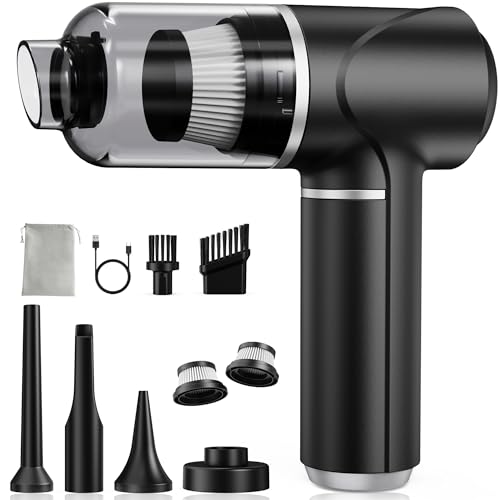 Piarhlie 30 kPa handheld vacuum view › Piarhlie 30 kPa handheld vacuum view › | Battery | 30,000 Pa | not published | 370 g | View › |
Figures published by each maker on its product spec sheet, read on 26 July 2026; Black+Decker's from its UK and French pages, re-read on 27 September 2026. Black+Decker's own pages give weights for these three models that do not add up (0.23 kg for the NVB12AV against 1 kg packed, 1 kg packed or not for the PD1200AV, 0.00061 kg for the WDC215WA), so no weight is shown for them. Where it says not published, it is not published: nothing has been filled in by estimate.
The eight car vacuums, one by one, with what each maker publishes and what it leaves out

Black+Decker dustbuster NVB12AV view ›
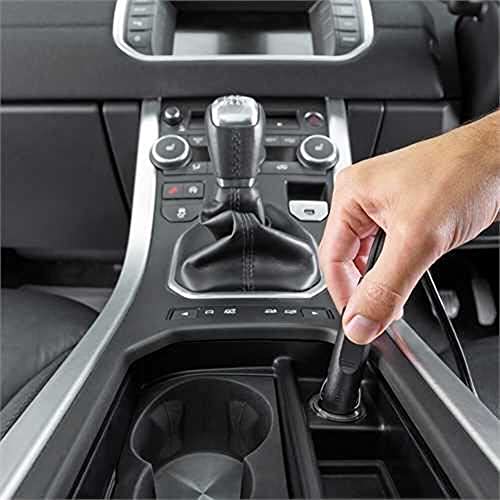
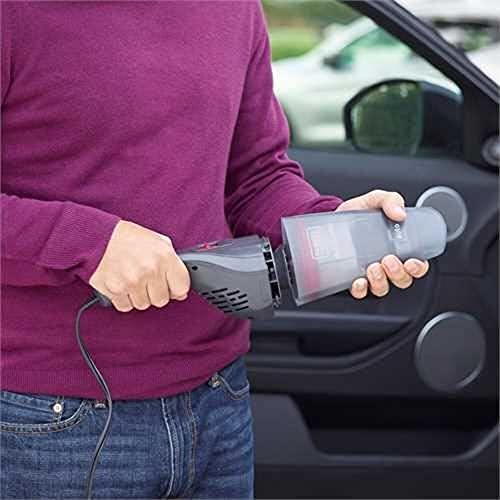
One of the two machines on this list whose maker publishes its suction in air watts: 8.8, on Black+Decker's page. It plugs into the car's 12 V socket, so there is no battery to die halfway or wear out in three years, and the 5 metre cable reaches the boot from the dashboard.
- The 5 metres of cable are the difference between cleaning the whole car and cleaning only the front seats. In a supermini it is more than enough; in a van or an estate it is exactly what you need.
- Black+Decker UK lists six attachments in the box, among them a flexible hose and a long crevice tool: they are what reaches between the seats and under them.
- The bin holds 370 ml, the smallest of the machines that publish one. For a normal car you empty it once; with beach sand or a dog that sheds, two or three times.
- Publishes 8.8 air watts: it can be compared with another machine
- No battery to wear out or give up halfway
- 5 metre cable, reaches the boot
- Six attachments, a flexible hose among them (Black+Decker UK)
- 370 ml bin, the smallest of those published
- Depends on the 12 V socket: useless away from the car
- The cable gets in the way between the seats


Black+Decker PD1200AV Flexi view ›
12.5 air watts and an airflow of 16.9 dm³/s, about 1,014 litres per minute, on Black+Decker's page: the highest airflow figure in the comparison, and the only one above a thousand. The hose, extending to 1.2 metres, is what solves the real problem, which is the seat rails and the gap between seat and centre console.
- The flexible hose, which extends to 1.2 metres, plus the 5 metre cable give a reach no compact handheld matches: the body stays on the floor and only the tube moves.
- With the hose, the body stays on the floor and only the nozzle is in your hand, so its weight matters less than on a compact hand vacuum.
- 560 ml bin, the largest of those published on the list, and triple-action cyclonic filtration, which is what stops the suction halving as the filter fills.
- 12.5 air watts and about 1,014 litres per minute published: the highest airflow in the comparison
- 1.2 m hose plus 5 m cable: reaches under the seats
- 560 ml bin
- Triple-action cyclonic filtration
- Hose and cable: two things to put away
- Takes more room in the boot than a cordless mini


Casals VAC-100 view ›
The only corded machine in the comparison that publishes a pascal figure, and it publishes a low one: 2.5 kPa with a 100 W motor on a 12 V cable. Put that figure next to the 30,000 Pa a small battery gadget advertises, and it is the whole case this guide makes.
- It picks up liquids as well as solids, which is not usual in the simplest machines of the comparison. The nozzle it brings for that stops the liquid escaping at the sides.
- 4 metre cable, a metre shorter than the Black+Decker ones. In a supermini it reaches; in an MPV you will need another socket for the boot.
- It is 36 centimetres long and weighs 900 grams: long rather than compact, and it will not go in the glovebox.
- Publishes its suction figure, and it is consistent with its 100 watts
- Picks up liquids, with its own nozzle
- Removable, washable fabric filter
- Publishes neither airflow nor air watts
- 4 metre cable, the shortest of the 12 V ones
- 36 centimetres long: it takes room


Cecotec Conga Immortal ExtremeSuction view ›
The cordless machine with the most battery in the comparison, 22.2 volts and 25 declared minutes, with a 500 ml bin and a removable battery, which is what decides whether the machine lasts three years or seven.
- The removable battery changes the long-term sum. In sealed-battery minis, the day the cell tires the whole machine is rubbish.
- Solids and liquids with cyclonic technology and a 500 ml bin, second on the list after the Flexi's 560 ml.
- With a charging base: if it will live in the garage rather than the boot, you always pick it up charged. If it will live in the car, the base is surplus.
- Removable 22.2 V battery: you replace it instead of throwing the machine away
- 25 minutes of declared runtime
- 500 ml bin, solids and liquids
- Publishes neither air watts, nor airflow, nor pascals
- About 1.9 kg: the heaviest in the comparison
One of the few machines here that really picks up liquids, with a washable bin and filter, and its maker publishes the battery in full: 10.8 Wh and 10 minutes, with a ten-hour charge. If the car carries children, a fizzy drink spilt on the mat is the case that justifies this machine and not another.
View ›Its 40 declared minutes are the longest of the cordless machines on the list, where the Conga Immortal declares 25, and it is the only one of the eight that publishes how loud it is: 80 decibels. It is a house machine that also does the car, not the other way round.
View ›The glovebox mini from a brand with a name to lose, and that is why the figure it publishes means something: 4,000 pascals with 2,000 mAh. Machines of the same size from lesser-known sellers advertise seven times that figure. That contrast is the one worth reading.
View ›It is in the comparison because it is the machine that best explains the category, not because it goes first. It advertises 30,000 pascals, publishes neither airflow nor air watts, and its own spec sheet gives the explanation: a motor spinning at 100,000 revolutions per minute. As a glovebox gadget it does the job; as the most powerful vacuum on the list, which is what its number suggests, it is not.
View ›Car hoover or the petrol-station vacuum: after how many visits your own one pays for itself
The self-service vacuums on a British forecourt are sold by time, not by clean. At the self-service car wash centre of Platts in Marlow, a single vacuum programme costs from £1 and lasts 4 minutes, according to its own price page read on 27 September 2026, and other UK sites price it their own way. Four minutes is enough for the front footwells; the whole cabin with the boot usually needs two or three programmes, and that is where a machine of your own starts to add up.
The other side of the sum matters too: the forecourt vacuum runs on the mains and moves far more air than any 12 V or battery machine, so for a deep clean twice a year it still wins. The calculator below takes how often you clean and what your forecourt charges per use, in pounds, and tells you how long each machine in this guide takes to pay for itself.
Car hoover payback calculator: petrol-station visits against your own vacuum
The question the round-ups do not answer with numbers. Enter how often you clean the car and what your petrol station or car wash charges per vacuum, and see how many visits each machine takes to pay for itself. A tool from m8d.io: free, no account and no ads.
That is £4.00 a month and £48.00 a year spent vacuuming the car away from home.
At that rate, a car vacuum costing under £48.00 pays for itself within a year, and one under £96.00 within two. Compare those figures with what each machine below costs in your Amazon shop.
| Machine | |
|---|---|
| Black+Decker dustbuster NVB12AV | See it › |
| Black+Decker PD1200AV Flexi | See it › |
| Casals VAC-100 | See it › |
| Cecotec Conga Immortal ExtremeSuction | See it › |
| Black+Decker dustbuster Wet & Dry WDC215WA | See it › |
| Bosch Move Lithium BHN16L | See it › |
| Baseus Mini A1 | See it › |
| Piarhlie 30 kPa handheld vacuum | See it › |
A warning so the number does not mislead: the forecourt vacuum runs on the mains and moves far more air than any of these. Paying one off is not matching it. What the money buys is having it in the boot, not waiting for the machine to be free or finding the right coins or card, and for crumbs, sand and loose hair it is more than enough. For a deep clean twice a year, the forecourt hose still wins.
What vacuum do car detailers and valeters use? A mains wet and dry, and when it beats any car hoover
“What vacuum do professional car detailers use?” comes up in the British searches for this machine, and the answer is not in the car hoover aisle. Valeters work with mains wet and dry vacuums: a drum of 10 to 30 litres, a hose of 1.4 to 4 metres and a motor on a 230 volt socket. The comparison of car vacuum cleaners that Auto Express published on 26 September 2025 is made up of exactly that kind of machine, from Vacmaster, Nilfisk, Draper, Evolution and Henry, and almost all of them are corded.
That is the same ceiling explained above seen from the other side: a 12 V socket stops at 120 to 180 watts, and a workshop vacuum is not bound by it. If you valet several cars, have a drive with a socket, or need to pull water out of a wet carpet, a mains wet and dry does a job no car hoover can. If the vacuum has to live in the boot and deal with crumbs, sand and hair between two visits to the forecourt, a car hoover is the right size, and the machines in this guide are chosen for that.
The watts on a car vacuum's box mean different things depending on what feeds it while it cleans, and the plug settles it in a second.
m8d rule: If a car vacuum with a 12 V plug declares more than 180 W, that is not what it draws from the socket; if it has a three-pin plug, it is a mains machine for the drive or the garage.
If a car hoover does not do what its listing says: your 30 days under the Consumer Rights Act 2015
A car vacuum bought for its headline figure and found wanting on the first clean is covered by UK law, not by the seller's goodwill. The Consumer Rights Act 2015 requires goods to be of satisfactory quality, fit for a purpose you made known and as described (sections 9, 10 and 11), and a description includes what the listing says about the product.
If it falls short, the short-term right to reject gives you 30 days for a full refund, counted from the first day after ownership passes and the goods are delivered (section 22). And for six months from delivery, a fault that shows up is taken to have been there on the day it arrived unless the seller proves otherwise (section 19). We suggest keeping a screenshot of the listing when you buy: the headline figure you bought on is part of the description the law refers to.
Every figure in this guide carries its source and its date. This is what was done.
- The specifications come from the spec sheet each maker publishes, not from rewording a seller's description, read on 26 July 2026; Black+Decker's three models were re-read on its UK and French sites on 27 September 2026, because its Spanish site has no page for them. Where a maker does not publish a figure, the cell says so, and it stays that way.
- The criterion puts what can be checked above what is advertised: a machine that publishes airflow and air watts can be compared with another, and one that only publishes pascals cannot.
- The UK figures, the petrol-station price, the Auto Express comparison, the Which? buying guide and the Consumer Rights Act 2015, were read on 27 September 2026 from the sources listed below.
- What we do not know: the method each maker uses for the pascals it publishes, because none declares the standard it applies; and how long the batteries of unbranded models really last, because there is no public figure.
- Availability changes from country to country: the button takes you to the Amazon shop of your country.
What's the best hoover for a car?›
For most drivers, one on a 12 V cable that publishes its figures: the Black+Decker NVB12AV declares 8.8 air watts, and its 5 metre cable reaches the boot. For spills on a cable, the Casals VAC-100; without a cable, the Cecotec Conga Immortal, with a removable 22.2 V battery.
What type of vacuum is best for cars?›
It depends on where it will live. Corded on 12 V if it stays in the boot, because it is always ready and has no battery to age. Cordless if it lives in the house or garage and comes out to the car. A mains wet and dry if you valet several cars or need to lift water from a carpet.
Are car hoovers any good?›
The ones that publish air watts or airflow can be judged; the rest are a guess. Two of the eight here publish air watts, both corded Black+Decker models, and apart from the 30,000 Pa gadget the highest pascal figure published is 4,000. A 30,000 Pa claim is measured with the nozzle sealed and says nothing about the air that carries dirt away.
What vacuum do professional car detailers use?›
Mains wet and dry vacuums with 10 to 30 litre drums and hoses of 1.4 to 4 metres, the kind of machine in the Auto Express comparison of 26 September 2025. They are not bound by the 12 V socket's 120 to 180 watt ceiling, which is why no car hoover matches them for a deep valet.
How much power can a car's 12 V socket take?›
The socket is protected by a fuse that is usually 10 to 15 amps, so the ceiling is between 120 and 180 watts. Your car's figure is printed on the fuse and listed in the handbook: multiply the amps by 12.
Is it worth buying a car hoover or using the one at the petrol station?›
It depends on how often you clean. A self-service vacuum programme costs from £1 for 4 minutes at a UK car wash centre (27 September 2026), and a full clean usually takes two or three. The calculator on this page turns your own figures into visits. For a deep clean twice a year, the forecourt vacuum, on the mains, still moves more air.
Can you vacuum liquids with any car hoover?›
No, and doing it with one that is not built for it damages it. It has to be declared for solids and liquids, and the bin and filter have to be washable. In this comparison the Black+Decker WDC215WA, the Cecotec Conga Immortal and the Casals VAC-100 meet that.
Can you return a car hoover that does not match its listing?›
Yes. Under the Consumer Rights Act 2015 goods must match their description, and you have 30 days from delivery to reject faulty goods for a full refund (section 22). Within six months of delivery, a fault is presumed to have been there from the start unless the seller proves otherwise.
The UK sources behind the forecourt price, the valeting machines and your rights, with the date they were read. The machine specifications come from each maker's spec sheet, read on 26 July 2026.
- Black+Decker France, maker's pageNVB12AV-XJ car vacuum, 12 V, 8.8 air watts, 370 ml8.8 air watts and a 370 ml bin in the product title. Read on 27 September 2026
- Black+Decker France, maker's pagePD1200AV-XJ Dustbuster Flexi car vacuum, 12 V, 12.5 air watts, 1.2 m hose, 560 ml12.5 air watts, a hose extending to 1.2 m and a 560 ml bin in the product title; airflow of 16.9 dm³/s in its text. Read on 27 September 2026
- Black+Decker UK, maker's page12V DC dustbuster Auto Car Hand Vacuum, NVB12AV-XJ5 m cable and six attachments, a flexible hose among them; no airflow or bin published. Read on 27 September 2026
- Black+Decker UK, maker's page12V DC dustbuster flexi Auto Car Hand Vacuum, PD1200AV-XJIntegrated hose and 5 m cable; no airflow or bin published. Read on 27 September 2026
- Black+Decker UK, maker's page7.2V 1.5Ah Wet and Dry Cordless dustbuster Hand Vacuum, WDC215WA-GB7.2 V, 1.5 Ah, 10.8 Wh, 10 minutes of runtime and a 600-minute charge; no airflow or air watts published. Read on 27 September 2026
- PlattsMarlow self-service car wash centre: pricesVacuum from £1, single programme of 4 minutes. Read on 27 September 2026
- Auto ExpressBest car vacuum cleanersPublished 26 September 2025: mostly mains wet and dry vacuums with 10 to 30 litre drums and 1.4 to 4 metre hoses. Read on 27 September 2026
- Which?How to buy the best handheld vacuum cleanerClaimed suction did not consistently translate into better cleaning in its tests. Updated July 2026, read on 27 September 2026
- legislation.gov.ukConsumer Rights Act 2015, section 22: time limit for short-term right to reject30 days from the first day after ownership passes and the goods are delivered. Read on 27 September 2026
- legislation.gov.ukConsumer Rights Act 2015, section 19: consumer's rights to enforce terms about goodsStandards in sections 9, 10, 11, 13 and 14; the six-month presumption in subsections (14) and (15). Read on 27 September 2026
If you ask us, the Black+Decker NVB12AV, because it publishes what it delivers and lives in the boot with no battery to age. For spills on a 12 V cable, the Casals VAC-100, which states its suction figure without inflating it. And if a cable does not fit your plans, the Cecotec Conga Immortal, with a removable battery that decides whether it lasts three years or seven.
Comments
Be the firstNo sign-up: just a name. Every comment is reviewed before it is published.