Under cabinet lighting in the UK: which kitchen light to fit, plug-in, rechargeable or wired, and what Part P allows
 m8d.ioUpdated on
This guide contains affiliate links. As an Amazon Associate, m8d.io earns from qualifying purchases, at no extra cost to you.
Under cabinet lighting lights the worktop from in front of you, removing the shadow a ceiling light casts. For most UK kitchens: a plug-in 4,000 K bar near the cabinet's front edge, or rechargeable magnetic lights without a socket. Two 8 W bars on three hours a day cost about £4.60 a year at the October 2026 price cap.
- GENERAL (the ceiling): the fitting that lights the room. Neutral white, and ideally with a choice of colour. It is the one you already have, even if it is old.
- TASK (under the wall cabinets): the light that hits the worktop IN FRONT of you and kills the shadow when you chop. It is the layer most kitchens lack and the one that changes daily use most.
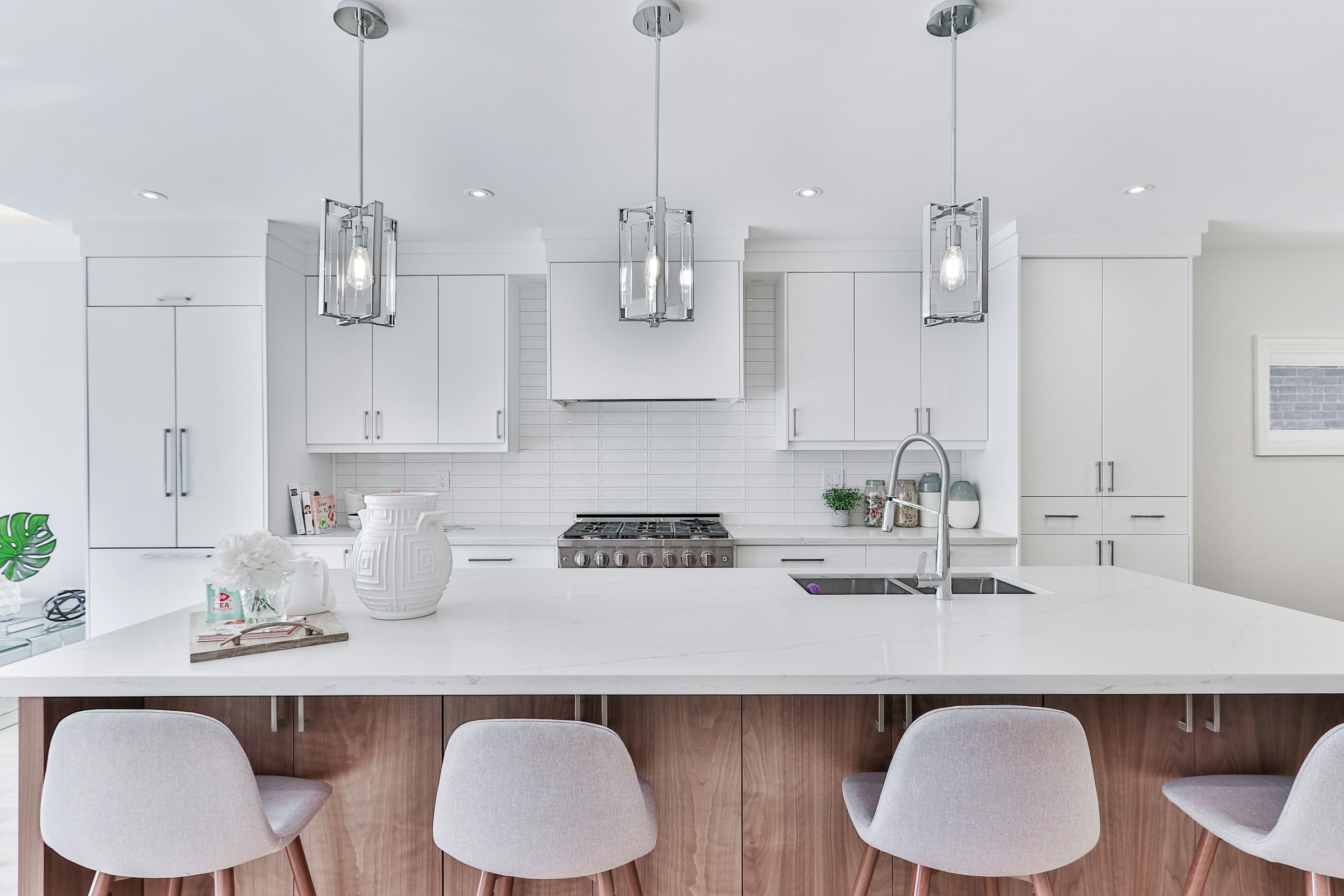
- ACCENT (above cabinets or in a glass cabinet): the warm line of light in the photos. Pure taste, done last, and where a high CRI shows.
Which under cabinet light your kitchen is missing: the kitchen lighting checker, by symptom and by what you can change
Kitchen lighting checker by symptom: which light your kitchen is missing
Choose your kitchen's symptom and what you can change (plug in, wire, or nothing), and the checker names the missing layer and the light that fixes it. Free, no sign-up, no ads. Default example: if your shadow falls on the worktop and you do not want any wiring, the missing layer is the task one, and the answer is a pair of bars under the cabinet, in front of you.
The shadow is there because the light comes from the ceiling, behind you. Bars fixed under the cabinet light the worktop from in front and the shadow goes. The Briloner pair comes with a 1 m supply cable and a rocker switch on each bar, according to Briloner: check on the listing that it ends in a UK plug, because in the UK a mains appliance for the home has to come with one or with an approved conversion plug.

The nine answers come from the lights in this guide and what each maker declares on its spec sheet, and two advise against buying anything yet. The buttons take you to Amazon in your country.
Plug-in, rechargeable or wired: the three ways to power under cabinet lighting in a UK kitchen
The shadow on the chopping board exists because the ceiling light is behind you. The fix is not more ceiling: it is light IN FRONT, fixed under the wall cabinet, as close to its front edge as the fitting allows, so the worktop is lit and the light source stays out of sight. How you power it is the real decision, and it comes in three forms. Plug-in: bars or strips that screw or stick on and go to the worktop socket, with no work on the wiring. Rechargeable: magnetic lights charged by USB, for rented flats and runs with no socket. Wired: a strip or bars fed from a fused spur with the driver hidden in a cabinet, the refit version.
Briloner Set of 2 bars, 4,000 K view ›
Two 58.5 cm bars with their own switch and 800 lumens each, in the 4,000 K neutral that suits a worktop. It is the answer for kitchens where the cabinets are not one run: one bar each side of the hood, each with its own switch, and the shadow gone. We recommend this pair first in most UK kitchens: it fixes the worst lighting fault of a worktop, and each bar draws 8 W.
- Two separate bars solve the hood in the middle: most worktops are not one continuous run, and a single long strip would leave one side dark or cross the extractor.
- Its maker declares 800 lumens and 4,000 K per bar, and Briloner's own page gives 8 W, a rocker switch on the front and IP20 for the 58.5 cm bar: the figures that matter, published.
- Briloner's page lists a 1 m supply cable and a 10 cm extension cable. In the UK a mains light for the home has to come with a UK plug or an approved conversion plug: check the listing says so before counting on it as plug-in.
- IP20 means it has no protection against water: fine under a wall cabinet, not where it can be splashed.
- Two bars with their own switch, for a worktop split by the hob
- 4,000 K neutral declared, the right colour for a worktop
- A German lighting brand that publishes watts, lumens and IP rating
- No sensor: clean hands to switch on
- 800 lumens per bar: task light for a stretch, not a long worktop
- Check the UK listing for a UK plug before buying it as plug-in

EZVALO Pack of 3 lights with magnet and sensor view ›
The answer with no cables at all: three 20 cm bars with a magnet, motion sensor and three colour temperatures to choose from, rechargeable by USB. They go under the cabinet, inside the larder or in the cupboard with the lunchboxes, and come down to charge like a phone. They do not compete with a plugged-in bar on output and do not try to: they go where the socket does not reach.
- The three selectable colour temperatures avoid the category's factory mistake: neutral for the worktop, warm inside a glass cabinet.
- The magnet on an adhesive plate lets you take each one down to charge without unsticking anything: in a rented flat it is exactly the right format.
- A motion sensor in a larder is one of those things you stop noticing within a week. On the worktop, a fixed light or a wave sensor works better.
- Three magnetic units in one pack
- Three colour temperatures to choose from
- Magnet and plate: they come down to charge without unsticking anything
- The battery sets the limit: output and run time are modest
- 20 cm per unit: light for a stretch, not a whole worktop
Can you fit under cabinet lighting yourself? What Part P of the Building Regulations allows in England
In England, Approved Document P (2013 edition, in force since 6 April 2013) makes three kinds of electrical work notifiable: installing a new circuit, replacing a consumer unit, and any addition or alteration to existing circuits in a special location, which it defines as a room with a bath or shower, a swimming pool or a sauna. A kitchen is not a special location. So a plug-in under cabinet light is not installation work at all, a wired light fed from the existing kitchen circuit is not notifiable, and a new circuit from the consumer unit is: it has to be done by a registered competent person or notified to building control. In every case, Approved Document P expects the work to follow BS 7671, the wiring regulations. Wales, Scotland and Northern Ireland publish their own rules.
Do under cabinet lights use a lot of electricity? What they cost to run at the October 2026 price cap
Very little. From 1 October to 31 December 2026, Ofgem's price cap puts electricity at 26.32p per kWh on average for Direct Debit customers in England, Scotland and Wales. The two Briloner bars in this guide declare 8 W each: 16 W for three hours a day is 17.5 kWh a year, about £4.60. The 36 W ceiling panel for the same three hours is 39.4 kWh, about £10.40 a year. And an 8 W bar left on for 24 hours uses 0.19 kWh, about 5p. The sum works with your own tariff: watts times hours, divided by 1,000, times the price of a kWh on your bill.
4,000 K on the worktop, warm for the accent, and the CRI most kitchen lights leave out
CRI (colour rendering index) measures from 0 to 100 how faithfully a light shows colours. Under a poor CRI a tomato looks dull, meat looks doubtful and wood looks grey; with a high CRI each thing shows its colour. In a kitchen you judge whether fruit is ripe or a steak is done by looking: it is the room where CRI works. The specialist lighting shops that top the UK search explain kelvin and leave the CRI to each product page, so we counted how often a catalogue gives it.
Stays silent. Of the 5,542 kitchen lighting references in the kitchen and lighting catalogue of a large Spanish DIY chain, read on 21 August 2026, only 222 declare the CRI in their name or description: 4%. And none of the first nine kitchen ceiling panels on Amazon Spain declares it in its title. They publish watts and lumens, which sound big, and leave out the colour figure.
Publish it. The accent strip in this guide writes CRI90+ in its own title. The pattern is textbook: a maker with a good figure shows it, and a maker without one does not lie, it simply leaves it out.
m8d rule: If the spec sheet does not declare the CRI, assume the basic one (around 80). For the light that falls on the worktop or into a glass cabinet, we recommend 90 or more: it is the difference between seeing the food and seeing it grey.
The other two kitchen lighting layers: a ceiling panel with a choice of colour, and an accent strip with true colour
The general layer usually exists and is usually wrong: an old fitting, short on lumens or yellowish. The buying criterion is double: enough lumens and, above all, avoiding the fixed 6,500 K of the chart above. The accent layer goes last, above the cabinets or in a glass cabinet, and it is where a continuous COB line and a high CRI show.

LED Atomant CCT ceiling panel 60 x 30 view ›
The general layer done right: 4,000 lumens from the surface and, above all, CCT adjustable from 3,000 to 6,500 K. That colour switch is what separates this panel from much of its category, which comes fixed at a workshop-cold 6,500 K: here you choose neutral for cooking and warm for dinner.
- The CCT is chosen at installation: 4,000 K neutral is the point for a working kitchen, and having it adjustable avoids the category's most common mistake.
- If your ceiling already has its light point, swapping the fitting is not notifiable work in England under Approved Document P: switch off at the consumer unit first, or have an electrician do it in minutes.
- The 60 by 30 rectangle spreads light better than a small round fitting in a long, narrow kitchen.
- Adjustable colour: 3,000 to 6,500 K in one fitting
- 4,000 lumens for the general light
- A rectangle that suits long, narrow kitchens
- Fitting it means switching off and connecting to the ceiling point
- The general light alone does not remove the shadow on the worktop

PAUTIX COB wifi strip CRI90, 5 m view ›
The accent light that makes the kitchen in the photos: above the wall cabinets or in a glass cabinet, a warm 2,700 K COB line with a declared CRI 90, the figure almost no sheet in this category publishes. With a high CRI, wood, fruit and ceramics look their colour; with the basic one, everything turns greyish. And it is wifi: it can be set to come on at dusk.
- The declared CRI 90 is the figure on this sheet: most strips do not publish it, and a sheet that leaves a figure out gives you no way to check it.
- Its 480 LEDs per metre make a real continuous line: above the cabinet you see no row of dots, not even in the reflection.
- It is 2,700 K warm: ambient light for the accent layer, not task light. The worktop wants neutral, and the bars in this guide cover that.
- CRI 90 declared on the sheet, rare in the category
- COB at 480 LEDs per metre: a true continuous line
- Wifi with schedules: the accent comes on by itself
- 2,700 K warm: not task light for the worktop
- Its power supply needs hiding, like any 24 V strip
The claims in this guide come from what the spec sheets declare and from what they leave out, which is information too. The kitchen lights were read from Amazon Spain's catalogue, part of Amazon's shared European catalogue, on 21 August 2026, keeping those whose sheet publishes the figures that matter (lumens, kelvin, CRI where given); on 27 September 2026 each was checked for a listing on sale on Amazon UK, and the ones without one are out of this guide. The UK layer comes from UK sources: Approved Document P for what you can fit yourself, Ofgem's price cap for the running cost, the Plugs and Sockets etc. (Safety) Regulations 1994 for the plug, and Briloner's own page for its bars. Availability varies by country, and the buttons take you to Amazon in yours.
The four kitchen lights compared: which layer each covers, the colour its sheet declares and how it is powered
| Kitchen light | Layer | Declared colour | Power | What sets it apart | |
|---|---|---|---|---|---|
| Briloner Set of 2 bars, 4,000 K view › | Task (under cabinet) | 4,000 K neutral | 1 m supply cable, rocker switch (Briloner) | Two bars for a worktop split by the hob | View › |
| EZVALO Pack of 3 lights with magnet and sensor view › | Task stretch and cupboards | 3 to choose from | Rechargeable by USB, magnet | No cables, three units | View › |
| LED Atomant CCT ceiling panel 60 x 30 view › | General (ceiling) | CCT 3,000 to 6,500 K | Existing ceiling point | The colour is yours to choose | View › |
| PAUTIX COB wifi strip CRI90, 5 m view › | Accent (glass cabinet) | 2,700 K warm | Adhesive, 24 V supply to hide | CRI 90 and 480 LEDs per metre declared | View › |
Figures are those each maker declares on its spec sheet, read on 21 August 2026, with the Briloner bar's cable, switch and IP rating from Briloner's own page, read on 27 September 2026. Where a sheet says nothing, the table says so.
Under cabinet lighting questions asked in the UK
What is the best option for under cabinet lighting?›
It depends on what you can change. For most kitchens, plug-in LED bars at 4,000 K fixed near the front edge of the wall cabinet: no wiring, and the shadow on the worktop goes. With no socket nearby or in a rented flat, magnetic rechargeable lights with a sensor. In a refit, a strip or bars fed from a fused spur with the driver hidden in a cabinet.
What type of lighting is best for under kitchen cabinets?›
LED bars or a COB strip in neutral white, 4,000 to 4,500 K, which neither yellows the food nor looks like a workshop, and CRI 90 or more where you judge the colour of food. Warm 2,700 to 3,000 K is for the accent above the cabinets. The typical mistake is a single fixed 6,500 K ceiling light for everything.
What are the best rechargeable under cabinet kitchen lights?›
Ones with a magnet on an adhesive plate, so they come down to charge without unsticking anything, a motion or wave sensor, and a choice of colour temperature: the EZVALO pack in this guide has all three, in three 20 cm units charged by USB. The limit is the battery: they light a stretch of worktop, not a whole run, and output is modest next to a plugged-in bar.
Do under cabinet lights use a lot of electricity?›
No. At Ofgem's price cap for October to December 2026, 26.32p per kWh on Direct Debit, two 8 W bars on for three hours a day cost about £4.60 a year, and an 8 W bar left on for 24 hours costs about 5p a day. The sum with your own tariff: watts times hours, divided by 1,000, times your price per kWh.
Can you fit under cabinet lights yourself?›
In England, a plug-in light needs no paperwork, and a wired light fed from the existing kitchen circuit is not notifiable under Approved Document P, because a kitchen is not a special location; a new circuit from the consumer unit is notifiable, so a registered competent person or building control has to be involved. The work still has to follow BS 7671, the wiring regulations.
Do under cabinet lights need to be hardwired?›
No. Plug-in bars and strips go into the worktop socket, and rechargeable ones need no supply at all. Hardwiring is the tidy option in a refit, with no socket taken and no cable in sight, and in England it is not notifiable as long as it does not need a new circuit.
What is CRI and what should it be in a kitchen?›
CRI measures from 0 to 100 how faithfully a light shows colours. In a kitchen it matters because food is judged by its colour. If the sheet does not declare it, assume the basic one, around 80; for the worktop or a glass cabinet, look for 90 or more. In this guide, the accent strip declares CRI 90 on its own sheet.
If you do one thing, do the task layer: the Briloner Set of 2 bars, 4,000 K view › under the cabinet kill the worktop shadow, one bar each side of the hob, and we would start there in most UK kitchens. The ceiling is fixed with the LED Atomant CCT ceiling panel 60 x 30 view ›, which escapes the 6,500 K workshop cold of its category, and where there is no socket the EZVALO Pack of 3 lights with magnet and sensor view › covers the stretch where you chop. The accent with CRI 90, the PAUTIX COB wifi strip CRI90, 5 m view ›, completes the three layers.
The figures in this piece come from each product's official spec sheet and from UK official documents, read on the date shown.
- UK government, Building Regulations 2010, for use in England, in force from 6 April 2013Approved Document P: Electrical safety, dwellings, 2013 editionNotifiable work: a new circuit, the replacement of a consumer unit, and any addition or alteration to existing circuits in a special location (a room with a bath or shower, a swimming pool or a sauna). Installations designed and installed to BS 7671. Read on 27 September 2026.
- OfgemEnergy price cap unit rates and standing charges1 October to 31 December 2026, Direct Debit, average for England, Scotland and Wales: electricity 26.32p per kWh and 54.83p a day standing charge; no VAT on electricity from 1 October 2026 to 31 March 2027. Read on 27 September 2026.
- UK Statutory Instrument 1994 No. 1768The Plugs and Sockets etc. (Safety) Regulations 1994Mains appliances for domestic use supplied fitted with a standard plug to BS 1363 or an approved conversion plug. Read on 27 September 2026.
- Briloner, maker's pageLED under cabinet light 58.5 cm, 8 W, 800 lm, model 237908658.5 cm, 8 W, 800 lumens, a colour temperature of 4,000 K, a rocker switch at the start of the lamp, a 1 m supply cable and a 10 cm extension cable, IP20, 25,000 hours; the page does not say whether the cable ends in a plug. Read on 27 September 2026.
- Leroy Merlin Spain, kitchen, bathroom and lighting catalogue, read on 21 August 2026The CRI countPopulation: the 5,542 references whose name contains kitchen and a lighting word (LED, bar, strip, panel, spotlight). Of them, 222 declare CRI in their name or description: 4%. The count can be repeated on the same catalogue.
- The first nine kitchen ceiling panel results on Amazon Spain, read on 21 August 2026The cold ceiling panel patternThree declare a fixed 6,500 K in their title, three offer adjustable colour temperature and none declares the CRI. It is the red bar in the colour chart: the category pattern, not products in this guide.
- The PAUTIX COB strip's listing (CRI90+ in its own title)The CRI declared, where there is oneRead on 21 August 2026, against the 96% of the category that leaves the figure out.

Comments
Be the firstNo sign-up: just a name. Every comment is reviewed before it is published.