Glass air fryer UK: which ones really cook in glass, what the plate inside is coated with, and where a halogen oven fits
 m8d.ioUpdated on

This guide contains affiliate links. As an Amazon Associate, m8d.io earns from qualifying purchases, at no extra cost to you.
A glass air fryer cooks food inside a glass bowl, but the food usually sits on a plate that is not glass: Ninja's UK support page lists the CRISPi Pro's crisper plates as aluminium with a nano-ceramic coating, declared PFAS-free. Our pick is the CREATE Air Fryer Studio Crystal, whose maker declares a SUS 304 stainless steel rack.
Are glass air fryers better for you? What touches your food inside a glass air fryer, part by part
Google's “People also ask” box for glass air fryer in the UK, read on 27 September 2026, opens with three health questions: whether glass air fryers are better for you, which is the least toxic air fryer and which is the best non-toxic one in the UK. The answer starts one layer down. Inside the glass bowl sits a crisper plate or a rack, and in most recipes that is what the food rests on. What that part is made of decides the answer, and most listings do not say.
m8d rule: If a glass air fryer listing does not say what the plate inside is made of, the glass only tells you half.
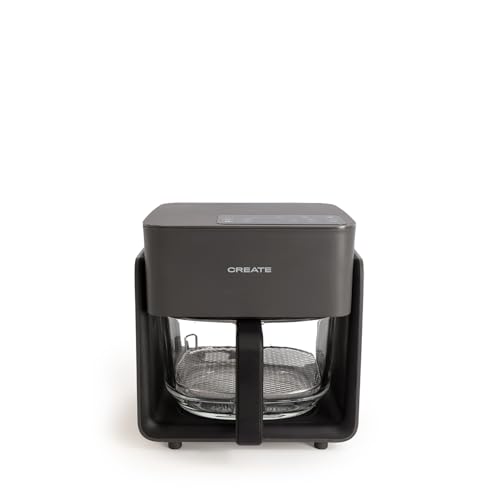
Its maker publishes the power, a top temperature of 200 °C, a dishwasher-safe bowl and a SUS 304 steel rack.
See it on Amazon ›Is PTFE banned in the UK? What the 2026 PFAS Plan says about non-stick air fryers
No. The UK government's first PFAS Plan (Defra, published on 3 February 2026 and updated on 17 August 2026) lists “non-stick products (such as cookware)” among the consumer goods that contain PFAS, names the fluoropolymer sub-group, the family PTFE belongs to, as an area of emerging concern that needs more research (action 1.7), and commits to “work to consider potential restrictions or regulatory measures on PFAS use in specific consumer product groups” (action 3.19), starting with a joint Defra and Office for Product Safety and Standards roundtable. Nothing in it restricts a coated air fryer basket today. What it does set out is sampling: the Food Standards Agency is to strengthen its capability to detect PFAS in food contact materials, starting with those where PFAS use is prevalent (action 3.2).
Glass air fryer checker: glass bowl or just a window, and what the food sits on
A listing answers both questions in two phrases: what it calls the see-through part and what it says about the rack. The checker reads those two phrases the way we read 54 listings in our own sweep of the glass family on Amazon Spain, part of Amazon's shared European catalogue, on 3 September 2026. The models are the ones sold in the UK too, so the two phrases to look for are the same.
Glass air fryer checker: glass bowl, window or coated plate
The figure that separates one appliance from the other is not a number, it is a word: whether the listing names the bowl or only a window. Of the 44 air fryer listings in our Amazon Spain sweep of 3 September 2026, 18 named the part and 10 said window. Free, no sign-up, no ads. Default example: a listing that says glass bowl and nothing about the rack is a real glass container missing half its spec, because the part the food rests on is not the glass.
The food cooks inside the glass, so the glass is what surrounds it and what you wash. It is what people mean when they search for a glass air fryer, and in our Amazon Spain sweep of 3 September 2026, 18 of the 44 listings say so in their title.
This is the category's gap. The glass is the container, not the surface the food sits on: inside goes a rack or a plate, and almost no listing says what it is made of. If it does not say, the glass only tells you half.
Amazon Spain sweep of 3 September 2026: eight searches of the glass family, 54 different listings, of which 44 are air fryers and ten are glass accessories that come up in the same search. And of the 24 listings with a glass container, none says in its title what glass it is made of.
The checker sorts what a listing SAYS, not what is in the box: it reads the wording, and every declaration it quotes comes from the maker's own page. The counts come from m8d's own sweep of the Amazon Spain catalogue, part of Amazon's European catalogue, on 3 September 2026, by the title each listing sells under. Ninja's plate is quoted from its UK support page, read on 27 September 2026, and Dreame's tray from its spec sheet, both in the sources. The buttons take you to Amazon in your country.
m8d rule: If the listing does not name the part, the glass may be only a window: 10 of the 44 air fryer listings in the sweep.
Halogen oven or glass air fryer: why glass containers stop at six litres, and the 17-litre glass bowl the UK already knew
In the catalogue sweep, no glass container went past six litres, while window models reached nine and twelve. A glass container thick enough to take the jumps in temperature weighs and costs in proportion to its volume, so the format grows another way. The UK has an older answer to the size question, and it shows up in UK searches for glass air fryers: the halogen oven, a large glass bowl with the heater in the lid. Daewoo's manual for its 17 litre halogen air fryer (model SDA1032, dated 11 April 2024) reaches that size by sitting an extension ring on the glass bowl, rates it at 1,200 to 1,400 watts and tells you not to use metal utensils because they may damage the glass. The same division that separates the models in this guide puts it at about 82 watts per litre at full size, a quarter of the 310 of our pick, and its manual places each food on a high or low rack under the lamp.
We started from our own sweep of the glass air fryer family on Amazon Spain, part of Amazon's shared European catalogue: eight searches, 54 different listings and 44 air fryers, read on 3 September 2026 and classified by what each title declares. We kept the models whose listing names a glass container and read each maker's spec sheet for the glass, the part inside, the power and the temperature range. On 27 September 2026 each one was checked for a listing on sale on Amazon UK, and the four without one are out of this guide.
Every figure in this guide carries its source and its date. The UK layer comes from UK sources: Ninja's UK support page for the CRISPi Pro's parts, the government's PFAS Plan for the rules, and Daewoo's user manual for its 17 litre halogen air fryer. Watts per litre is a division anyone can repeat with the two figures on the box. When a maker does not publish a figure, the table says “Not stated” instead of filling the gap. Availability varies by country, and the buttons take you to Amazon in yours.
The five glass air fryers with a UK listing, compared by what each maker declares
| Glass air fryer | Glass declared | Capacity | Watts | Heat per litre | What the food sits on | |
|---|---|---|---|---|---|---|
| CREATE Air Fryer Studio Crystal, 4.2 L and 1,300 W declared view › | Glass, type not stated | 4.2 L | 1,300 W | 310 W/L | Stainless steel 304 rack | View › |
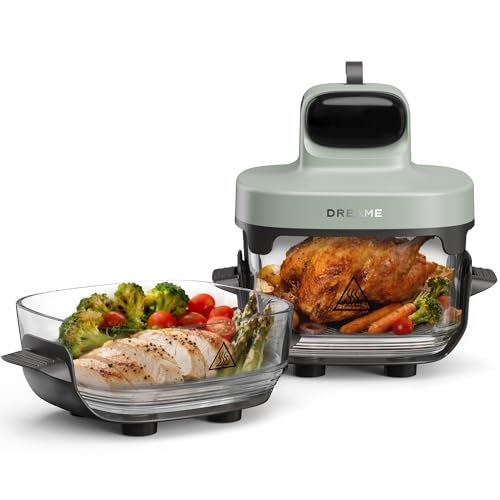 Dreame Tasti PT60, 6 mm borosilicate and a steel tray view › Dreame Tasti PT60, 6 mm borosilicate and a steel tray view › | Borosilicate, 6 mm on average | 4.5 L and 2.5 L | 1,500 W | 333 W/L | 304 stainless steel tray, uncoated | View › |
 Ninja CRISPi PRO XL, 5.7 and 2.3 L with 2,050 W view › Ninja CRISPi PRO XL, 5.7 and 2.3 L with 2,050 W view › | Borosilicate (Ninja UK) | 5.7 L and 2.3 L | 2,050 W | 360 W/L | Aluminium plate, nano-ceramic coating | View › |
 Glass air fryer with a 6 L bowl and 1,200 W view › Glass air fryer with a 6 L bowl and 1,200 W view › | Not stated | 6 L | 1,200 W | 200 W/L | Not stated | View › |
 Adler Oven with a 3 L glass bowl view › Adler Oven with a 3 L glass bowl view › | Not stated | 3 L | Not stated | Cannot be calculated | Not stated | View › |
Figures are what each maker publishes: CREATE's and Dreame's pages and Ninja's page for the PRO range, read on 27 September 2026, with Ninja's materials from its UK support page; the other two from their listings, read on 3 September 2026. Heat per litre is those two figures divided, a working figure rather than an industry standard: for two-container models the large one is used. Three of the five do not name the type of glass and two do not say what the food sits on.
The five glass air fryers, with what each one declares and who it is not for
CREATE Air Fryer Studio Crystal, 4.2 L and 1,300 W declared view ›
It is not here for its size, but because its maker publishes the power, the top temperature and the dishwasher-safe bowl, and declares a stainless steel rack under the food. In a category where most listings do not even say which part is glass, that is the recommendation.
- CREATE's page lists the build as ABS plus glass, with the container and the basket dishwasher-safe, and its UK page adds that the glass is heat-resistant. What neither says is the glass family or its thickness, which only one brand in this guide publishes, and it is not this one.
- 1,300 watts over 4.2 litres is 310 watts per litre. In practice: the band where a tray for two or three browns without running short of heat, without paying for power a four-litre bowl cannot use.
- Its maker publishes a top temperature of 200 °C, the one air fryer recipes are written for, so recipe times work as printed.
- CREATE's page declares a SUS 304 stainless steel rack and 5.5 kg of weight. Both matter: an uncoated rack is what people come to glass for, and five and a half kilos is the price of glass, not an appliance to lift out and put away every day.
- Its maker publishes power, top temperature and a dishwasher-safe bowl, more than most of the category
- A stainless steel 304 rack declared: nothing coated under the food
- Up to 200 °C, so recipe times need no adjusting
- Does not say the glass family or its thickness, the gap this guide finds across the category
- 4.2 litres feeds two or three; beyond that, cook in two batches
- 5.5 kg: not an appliance to lift out and put away every day
Dreame Tasti PT60, 6 mm borosilicate and a steel tray view ›
It answers the question this guide keeps asking: it publishes the glass family, its thickness and the material of the part inside. If what you wanted from glass was that nothing coated touches the food, this is the one that puts it in writing.
- It declares high-borosilicate glass 6 mm thick on average, from 5 to 7 mm depending on the shape: family and thickness. Borosilicate is the glass that withstands jumps in temperature, which is what you ask of a pot that goes from the fridge to hot air.
- Its crisping tray is 304 stainless steel, with no coating. Over the years: nothing to scratch or wear on the part the food rests on, which is what people are really after when they leave non-stick for glass.
- 1,500 watts over the 4.5 litre pot is 333 watts per litre, the middle band, over a declared range of 60 to 200 °C. And it comes with two pots, 4.5 and 2.5 litres, so the size is chosen per meal instead of heating the big one every time.
- A water chamber in the base releases steam while it cooks. It helps what dries out, like yesterday's bread or chicken, not what you want crisp.
- Publishes glass family and thickness: borosilicate, 6 mm on average
- An uncoated 304 stainless steel tray: nothing to wear where the food sits
- Two pots of 4.5 and 2.5 litres and a built-in steam chamber
- Among the dearer ones here, and its large pot stops short of five litres
- Steam helps what dries out, not what should come out crisp
- 6.11 kg net: heavy to move around the kitchen
Ninja CRISPi PRO XL, 5.7 and 2.3 L with 2,050 W view ›
It is as close as this category gets to a glass air fryer for four, and it shows how: not with a bigger container but with two. It is the CRISPi most UK searches lead to and the one whose maker publishes the clearest parts list; buy it for the format, because in litres for the money it competes with nothing here.
- Its large container holds 5.7 litres, the biggest from a known brand in the sweep. With the small 2.3 litre one it feeds four, and that is the key to the format: glass does not grow, it multiplies.
- 2,050 watts over 5.7 litres is 360 watts per litre, and Ninja's UK support page gives Air Fry from 150 to 240 °C. In practice: the only one here that can finish a gratin without changing appliance.
- Ninja's UK support page lists borosilicate glass containers and crisper plates of aluminium with a nano-ceramic coating, the set declared free from PFAS and PTFE, with rubber feet on the plate that are not removable. The glass is the bowl; the coated plate is what holds the food.
- Its lids are for storage and the containers go in the dishwasher. It is the big version of the same idea: cook, serve and store without changing dish.
- 5.7 litres in the large container, the biggest from a known brand in the sweep
- Up to 240 °C, the highest top temperature in this guide
- Two containers with storage lids, dishwasher-safe
- By some distance the dearest in this guide, and the weakest in litres for the money
- For four you need both containers: there is no single big bowl
- The plate the food sits on carries a nano-ceramic coating, declared PFAS-free
Glass air fryer with a 6 L bowl and 1,200 W view ›
It is here because it answers a question many people type and no guide answers: yes, a six-litre glass one exists, and it is the only one in the sweep. It is also the example of what that size costs in heat, so read the cons before the pros.
- Six litres in a single glass container is the ceiling of the drawer-style category: in the whole sweep no other glass container reaches it, while window models reach nine and twelve.
- 1,200 watts over 6 litres is 200 watts per litre, the lowest in this guide. In practice: it holds much more and the same dish takes longer, because the same element is spread over more volume.
- The listing states no brand and no type of glass, and it is one of the few here without a maker's spec sheet to check against.
- What you pay for here is litres in glass, which the drawer format offers nowhere else in the sweep.
- The only six-litre glass container in the sweep: a whole tray fits
- Declares its watts and its temperature control in the listing itself
- Panoramic view of the bowl while it cooks
- 200 watts per litre, the lowest here: the same dish takes longer
- No brand or glass family declared, and no maker's sheet to check
- Nothing published about the rack the food sits on
Adler Oven with a 3 L glass bowl view ›
It is the smallest format in the guide and the most straightforward about what it is: a glass bowl with a lid that heats. For one person cooking single portions it does the job; for anything else it runs out of room in the first week.
- Three litres of bowl: portions for one, not a meal for two. In the sweep it is the smallest glass container of all.
- The bowl-and-lid format shows the whole cook from above, glass taken to the extreme: there is no metal around the food.
- The listing does not declare the watts, so its heat per litre cannot be calculated. It is the spec gap this whole guide is about.
- Nor does it say what the food sits on, which in a bowl format matters less, and is still worth asking before you buy.
- Bowl format: the whole cook in view, with no metal around it
- The smallest glass container in the sweep: single portions without the oven
- A brand with its own small-appliance catalogue behind it
- Does not declare its watts: heat per litre cannot be calculated
- Three litres is short for two people
- No rack or base material declared
Glass air fryer questions asked in the UK
Are glass air fryers better for you?›
They remove one thing: a non-stick coating on the container. What they do not remove by themselves is the plate inside, which is what the food rests on. Ninja's UK support page lists the CRISPi Pro's crisper plates as aluminium with a nano-ceramic coating, declared free from PFAS and PTFE; Dreame declares an uncoated stainless steel tray for its Tasti. If the aim is that nothing coated touches the food, read what the plate is made of, not only the bowl.
What is the least toxic air fryer?›
The UK's 2026 PFAS Plan restricts no air fryer, so the answer comes from what each maker declares for the parts that touch food. In this guide, the Dreame Tasti declares borosilicate glass 6 mm thick on average with an uncoated 304 stainless steel tray, and CREATE declares a SUS 304 stainless steel rack for its Air Fryer Studio Crystal. A glass bowl with a coated plate is a different answer, even when both are sold as PFAS-free.
Is the Ninja CRISPi non-toxic?›
Ninja's UK support page for the CRISPi Pro (updated 25 May 2026) lists borosilicate glass containers with BPA-free plastic handles, a base of BPA-free plastic and stainless steel, crisper plates of aluminium with a nano-ceramic coating and BPA-free plastic lids, all free from PFAS and PTFE. So the food cooks in glass and rests on a coated plate its maker declares PFAS-free. Whether that fits your idea of non-toxic depends on whether a ceramic coating is acceptable to you.
What are the disadvantages of the Ninja CRISPi?›
Three, from what its maker publishes and the limits of the category: the plate that holds the food is coated, not bare glass; the original CRISPi's containers are 3.8 and 1.4 litres, so it is not a machine for four; and glass is heavy and breaks with a knock, as Spain's consumer organisation OCU notes for the whole category. The CRISPi Pro adds a 5.7 litre container and cooks up to 240 °C, and Ninja's UK support page says it has no built-in cooking light.
Is a halogen oven the same as a glass air fryer?›
No, although both cook in glass. A halogen oven heats from a lamp in its lid over a large glass bowl: Daewoo's 17 litre model reaches that size with an extension ring and is rated at 1,200 to 1,400 watts, according to its manual. A glass air fryer has its element and fan in the lid or the body above a smaller glass container. At full size the halogen bowl works out at about 82 watts per litre, against 200 to 360 for the air fryers in this guide.
Do glass air fryers take longer to heat up?›
Spain's consumer organisation OCU says so in its April 2025 note: glass does not conduct heat as well as metal, and some models take a little longer to heat. Makers make up for it with power, which is why three of the four models in this guide that publish both figures are above 300 watts per litre. You can do the sum with the box in front of you: watts divided by litres.
Can the glass container go in the dishwasher and the fridge?›
Where the maker declares it, yes: CREATE, Ninja and Dreame publish dishwasher-safe containers, and the CRISPi range comes with storage lids for the fridge. Ninja's UK support page also says its glass containers can stand on granite, laminate, quartz, wood and marble worktops. For listings that do not declare it, which are most of the catalogue, the title cannot tell you.
m8d pick · The one that publishes the full spec sheetCREATE Air Fryer Studio Crystal, 4.2 L and 1,300 W declaredSee it on Amazon ›The one that names its glass and its trayDreame Tasti PT60, 6 mm borosilicate and a steel traySee it on Amazon ›The ones behind the specific figures in this piece, with the date each was read.
- SharkNinja UK support, updated 25 May 2026AS100UK Series Ninja CRISPi Pro, frequently asked questionsContainers of borosilicate glass with BPA-free handles, crisper plates of aluminium with a nano-ceramic coating, lids of BPA-free plastic, “free from PFAS and PTFE”; Air Fry from 150 to 240 °C; non-removable rubber feet on the plate; no built-in cooking light. Read on 27 September 2026.
- SharkNinja UKNinja glass air fryers, UK range pageCRISPi Portable, CRISPi PRO and CRISPi DualZone models, sold with “Dishwasher-Safe PFAS-Free Glassware”. Read on 27 September 2026.
- Defra, UK government, published 3 February 2026, updated 17 August 2026PFAS Plan: building a safer future togetherLists non-stick cookware among consumer goods containing PFAS; action 1.7 on fluoropolymers, action 3.2 on the Food Standards Agency's PFAS analysis of food contact materials, action 3.19 on considering restrictions for specific consumer product groups. Read on 27 September 2026.
- Daewoo Electricals, 11 April 202417 Litre Halogen Air Fryer, model SDA1032, user manualGlass bowl with an extension ring to increase capacity, rated power 1,200 to 1,400 W, high and low racks, no metal utensils because they may damage the glass. Read on 27 September 2026.
- CREATE, maker's UK storeCREATE glass air fryers, UK range pageAir Fryer Studio Crystal in 4.2 and 6 litres, with glass described as heat-resistant. Read on 27 September 2026.
- CREATE, maker's storeAir Fryer Studio Crystal, product page4.2 litres, 1,300 W, a cooking temperature of 200 °C, ABS and glass, a SUS 304 rack, 5.5 kg and “Teflon FREE”, with the container and the basket dishwasher-safe; no glass family or thickness published. Read on 27 September 2026.
- Dreame, maker's Spanish siteDreame Tasti air fryer, product pageTemperature range 60 to 200 °C, 1,500 W rated power, 6.11 kg net, high-borosilicate glass 6 mm thick on average (from 5 to 7 mm depending on the shape, as its own footnote says) and a crisping tray of 304 stainless steel. Read on 27 September 2026.
- SharkNinja, Ninja's Spanish storeNinja CRISPi PRO XL glass air fryer (AS101 range), product page2,050 W, PFAS-free glass containers of 5.7 and 2.3 litres, rated for air frying up to 240 °C. Read on 27 September 2026.
- OCU, Spain's consumer organisation, 22 April 2025Glass air fryers: pros and consGlass does not conduct heat as well as metal and some models take longer to heat; they weigh more, break with a knock and cost more. Read on 3 September 2026.
- Hostelería Salamanca, on the analysis by the Dutch consumer association Consumentenbond, February 2026Is there PFAS in my air fryer? On the Consumentenbond analysisFive models analysed for fifty kinds of PFAS; two large makers confirmed a PTFE coating, “a PFAS that is not banned”. Read on 3 September 2026.

Comments
Be the firstNo sign-up: just a name. Every comment is reviewed before it is published.