Best air fryers UK 2026: what up to 75% less than an oven measures, and why the watts decide and litres do not
The first and the fourth results for this search both promise an energy saving against an oven, one of them up to 75% and the other up to 65%, and neither publishes the one figure that would let you check it: the wattage. Litres are the space and watts are the heat, so here are both, the division between them, and what the official advice on browning has to do with the window in the drawer.
This guide contains affiliate links. As an Amazon Associate, m8d.io earns from qualifying purchases, at no extra cost to you.
The best air fryer for most people is the one whose listing tells you what you are buying, and that is rarer than it sounds. An air fryer is a fan with a heating element: litres are the space and watts are the heat. The two biggest names in this search publish litres on every product and the wattage on none, while promising up to 75% and up to 65% less energy than an oven.
Jump to what you came for: what the energy percentage is measured against, why the watts decide and the litres do not, the watts per litre calculator, the browning advice and what the window is for, the eleven at a glance or the eleven, one by one.

The only listing of the fifty-three we counted that gives litres, watts, coating material and the absence of PFAS together.
See it on Amazon ›Up to 75% less than an oven: what that claim is actually measured against
The first thing a British buyer meets in this category is a percentage, and it is worth reading it slowly because it is doing a lot of work. On 16 September 2026 the first organic result for this search said, on its own shop: Cooking with a Ninja air fryer can cost up to 75% less than an oven, costing as little as 8p for 15 minutes, with a dagger on the first claim and four asterisks on the second. The fourth result said use up to 65% less energy than a conventional oven, and its footnote reads, in full: Versus using a conventional Energy Class A oven. The eighth result said air fryers are generally more energy-efficient than traditional ovens with no figure and no footnote at all.
None of those is a lie. They are all comparisons against an oven, which is a different appliance doing a different job, and every one of them carries an up to. What none of them gives you is the number that would let you check any of it, or compare two air fryers with each other: the wattage. Ninja publishes litres on every product on that page and the watts on none of them. Tefal lists capacities from 4.5 to 15 litres and no wattage. Morphy Richards publishes neither.
There is one thing you can do with the claim, and it is the sort of arithmetic this guide is for. Run the 8p for 15 minutes backwards at the Ofgem price cap of 26.32p per kWh for 1 October to 31 December 2026 and it implies an appliance drawing about 1.2 kilowatts. That derivation only holds if that 8p was worked out at the same unit rate; if it was not, the implied wattage moves with it. Which is exactly the point: the watts should have been on the page instead of the percentage.
All three pages were open on 16 September 2026. They are the first, fourth and eighth organic results for this search in this country.
Up to 75% less than an oven, with a dagger, and as little as 8p for 15 minutes, with four asterisks. The footnote text for either marker was not on the page. No wattage is published anywhere on it; capacities in litres appear on every product.
Up to 65% less energy than a conventional oven, and the footnote in full is Versus using a conventional Energy Class A oven. No dish, no quantity, no time, no model. Capacities from 4.5 to 15 litres are published for every product; the wattage for none.
Air fryers are generally more energy-efficient than traditional ovens. Their compact size and ability to cook quickly mean less energy consumption. No percentage, no footnote, no wattage, no coating material and no cost. It is the same claim with the evidence removed.
m8d rule: An energy percentage is a comparison against an oven, not a specification of the air fryer. It cannot be used to compare two air fryers with each other, and it changes completely with what you were going to cook and in what. The figure that does compare them is the wattage, and it is the one that is missing.
Litres are the space and watts are the heat: why almost every listing sells you the first one
An air fryer is a fan with a heating element inside. The litres tell you how much fits; the watts tell you how much heat there is to fill it. The same tray of chips in a bigger space, heated by the same element, takes longer. That is not an opinion, it is a division, and it is the one thing this whole category leaves out.
Of the 53 air fryer listings in the catalogue m8d tracks, counted on 28 August 2026, 49 declare the litres and only 15 declare the watts. Ten name the basket material and five give the temperature range. The British shop pages read today match that pattern exactly: litres on every product, wattage on none.
So the question to take into a shop is not how many litres, it is how many watts per litre, and it is a division you can do on any listing in front of you, whatever the badge on it.
Watts per litre calculator for an air fryer: how much heat yours has per litre of space
The calculator below takes the two figures from whatever listing you are looking at, including one that is not in this guide, and does the division in front of you. It also turns the watts into kilowatt hours for a normal batch and for the same dish in an oven with its preheat, so you can multiply by your own unit rate instead of ours.
And it has a result that matters more than the others: the watts are not declared. That is not a hole in the tool, it is the most common case in the catalogue and the honest answer is that with that listing the sum cannot be done. A tool that only worked with the good listings would hide the problem.
Watts per litre calculator for an air fryer: how much heat yours has per litre of space
Watts per litre calculator for an air fryer, from m8d.io: pick the litres and the watts from the listing in front of you, from any brand, and it returns the heat per litre with the division on show, plus the kilowatt hours of a normal batch against the same dish in an oven with its preheat. Free, no sign-up, no ads. Worked example: 1,800 W across 6 litres is 300 watts per litre, the balanced band; 1,900 W across 4 litres is 475, which browns sooner in a smaller tray; and 2,600 W across 12 litres is 217, which is the most powerful machine here and the slowest per tray.
litres declared: 6.5 · watts declared: none · division: impossible
It is the most common case in the catalogue: of the 53 air fryer listings in the catalogue m8d tracks, counted on 28 August 2026, 38 do not say how many watts they have. Without that figure you cannot tell whether it cooks quickly or what it uses, and those are half the appliance. The litres only tell you how much fits.
Watts per litre is a division of what each listing declares, not an industry standard: it compares two machines with each other, it does not predict exact minutes. The 20 minutes of a batch and the 40 of an oven with its preheat are stated reference figures, and the price of a kilowatt hour is yours to supply because every tariff is different. Availability and models vary by country, and the button takes you to your local Amazon store.
How many litres you need for how many people, and why buying big costs you minutes
The expensive mistake in this category is not buying cheap: it is buying big. Every extra litre is space the same element has to heat, so unless the wattage goes up with the size, a bigger machine cooks the same tray more slowly. The arithmetic is on this page rather than in a warning: the four litre machine here runs at 475 watts per litre and the twelve litre one at 217, and the twelve litre one is the most powerful of the eleven.
As a working rule from the machines that do declare both figures: two litres is one portion, four litres is one or two people, six to six and a half is the size most people buy and covers two or three, eight is three or four in one batch, and twelve is a machine you should only buy if you genuinely cook for a crowd. And a twin basket of nine litres is two of four and a half, not one of nine, which matters the day you want to put a whole chicken in. If there are two of you we would not go past six and a half litres, and the reason is in the chart below rather than in taste: the twelve litre machine on this page is the most powerful of the eleven at 2,600 watts and the slowest per tray of all of them at 217 watts per litre.
Golden yellow, not brown: the official cooking advice for starchy foods, and what the window in the drawer is really for
Chips are what an air fryer gets bought for, and there is official advice in this country about cooking starchy foods that almost no buying guide in this category mentions. Government guidance on acrylamide, the substance that forms when starchy foods such as potatoes and bread are cooked above 120C, tells consumers to aim for a golden yellow colour or lighter when frying, baking, toasting or roasting starchy foods. Not a temperature, not a time: a colour.
That is the argument for the window, and it turns a styling feature into a functional one. A colour judgement means looking, and in an air fryer looking means pulling the drawer out, which lets the hot air go and makes the machine climb back to temperature. A window lets you judge the colour without paying for it in heat. It is also why the glass-fronted machines that have taken over the British listings this year are not just a look: what changes is that you can see the food while it is cooking.
The same guidance has a second piece of advice that has changed and that most people still repeat the old version of. Keeping raw potatoes in the fridge used to be advised against for this reason; the current position is that home storage of potatoes in the fridge does not materially increase their acrylamide forming potential compared with a cool, dark cupboard, so you can choose either and cut waste. If you have been keeping potatoes out of the fridge because of something you read years ago, that is the current advice, with its source below.
The guidance quoted here is the government publication on acrylamide, read on 16 September 2026.
Acrylamide is formed when starchy foods, such as potatoes and bread, are cooked at high temperatures, above 120C, whether they are baked, fried, grilled, toasted or roasted. That covers an oven and an air fryer equally.
Aim for a golden yellow colour or lighter when frying, baking, toasting or roasting starchy foods. It is a target you can only hit by looking, which is what a window is for and what preset programmes cannot do for you.
The old advice against keeping raw potatoes in the fridge has been revisited: current guidance says home storage in the fridge does not materially increase acrylamide forming potential against a cool dark place, so either is fine and the fridge wastes less.
m8d rule: The advice for starchy foods is about the colour you cook to, not about the appliance you cook in. An air fryer is neither exempt from it nor especially guilty of it: what changes the outcome is how far you take the browning, which is why being able to see the food matters more than the number of preset programmes.
The eleven air fryers at a glance, by what each listing actually declares
Ordered by what each listing declares, not by what its name promises. The columns are exactly the four figures that decide, and the empty cells are the finding: not stated is literal, and it is the most common entry in this table.
Every figure is the one the maker declares on its own listing, read on 16 September 2026. Cells reading not stated are literal: that figure does not appear. Watts per litre is the division of the two preceding columns, not an industry standard. The highlighted row is the only one that declares all four.
The eleven air fryers, one by one, with what each maker declares
MasterPro ROCKET 600, 6 L and 1,800 W declared view ›
It is not here for being the cheapest or the biggest, but because it is the only one that lets you know what you are buying before you buy it. In a category where nine listings out of ten hide half the spec sheet, that is the recommendation.
- It is the only listing of the fifty-three that declares all four figures at once. It sounds like a small thing and it is the whole difference: with litres and watts you can work out the heat per litre, and with the material you know what is touching the food. In the catalogue we track today, only fifteen of fifty-three give the watts and only ten name the material.
- 1,800 W spread across 6 litres is 300 watts per litre. Translated into what you will do with it: it reaches temperature without dawdling and browns a tray for two or three properly, which is what most people actually use one for. Put any other listing's two figures into the calculator above and you can compare it.
- The coating is ceramic and named. That matters because of what almost nobody publishes: of the fifty-three listings we counted, only ten say what the basket is made of, so the one thing that genuinely separates one basket from another is the one thing usually missing.
- Declares litres, watts, coating material and the absence of PFAS on the same listing, which nothing else in the sweep does
- 300 watts per litre: the band where the size covers a whole meal without running short of heat
- A ceramic coating with a name, rather than an unidentified non-stick
- Six litres is tight from four people upwards
- Its listing shows a struck-through previous figure that cannot be checked against any series

NARVI NF29, 6.5 L with a window view ›
The same arithmetic as the pick with a bit more room and a window that earns its keep. We would take it over the pick itself if you cook a lot of chips or anything baked, because the advice that matters here is about the colour of the food and the window is how you judge it without letting the heat out. It only sits second because it does not say what the basket is made of.
- The window looks like a styling detail and it is functional twice over. Every time you pull the drawer out to look, the hot air leaves and the machine has to get back up to temperature. And the official cooking advice for starchy foods in this country is about colour, aiming for golden yellow rather than brown, which is a judgement you can only make by looking.
- 277 watts per litre: practically the same as the pick of this guide, in half a litre more capacity. It is the direct alternative if you would rather have the most common size in the category.
- And the part worth separating out: the window is doing the work here, not the glass. Glass drawers are appearing across this category, and what they change for the cooking is the same thing a window changes, which is that you can see the food without opening it.
- Declares litres and watts: 277 watts per litre, inside the balanced band
- A viewing window, so you do not have to open the drawer to check the colour
- Six and a half litres, the most common size in the category
- Does not declare the coating material
- The window only earns its place if you keep it clean

MasterPro Rocket Duo 900, 9 L twin basket view ›
The right buy if you cook a main and a side rather than just chips, and the shape the British market has moved to. If what you want is to put one big tray in at once, look at the single-drum ones instead.
- Twin baskets solve the real problem of cooking in one of these: the main dish and the side want different temperatures, and with a single basket one of them is going cold while the other finishes. With two, they arrive together. It is also why dual is now one of the most searched shapes in this category here.
- And the qualifier to know before buying: nine litres split between two baskets is not nine litres. For a whole chicken or one big tray you need a single drum, not two halves.
- 267 watts per litre, which keeps it in the balanced band despite the total volume, because the output goes up with the size instead of staying still.
- Declares 2,400 W, the second highest output in the selection
- Two independent baskets: different temperatures and times at the same time
- 267 watts per litre despite the nine litres of total capacity
- Two baskets of four and a half litres are not the same as one of nine for a big tray
- Does not declare the coating material

Cecotec Cecofry&Grill Duoheat 4000, 4 L and 1,900 W view ›
If there are one or two of you, this is where the money sits best in the whole selection: it buys heat rather than space. If there are more of you, the same money in litres will have you cooking twice anyway.
- 1,900 W in 4 litres is 475 watts per litre, and that is the exact opposite of what the category sells. While almost everyone competes on putting litres on the box, this one puts heating element into a small space. Translated: the same tray of chips browns sooner, and the machine takes less time to get going.
- The price of that density is the size. Four litres is two portions, not a meal for four. That is a design choice rather than a fault, and it is why it is here as the one or two option and not as the general recommendation.
- It does not declare the basket material, which is the gap it shares with forty-three of the fifty-three listings in the sweep.
- 475 watts per litre: the highest figure in the sweep among those declaring both numbers
- Declares its watts, which only fifteen of fifty-three listings do
- At that heat density it browns better and gets up to temperature sooner
- Four litres is a small tray: from two people up you are cooking in batches
- Does not say what the coating is made of

Taurus Air Fry 360 XL, 8 L and 2,100 W view ›
The family size without the time penalty almost every big one carries. If there are four of you and you do not want to cook in two batches, it is the one that solves the equation best.
- What separates it from the other big ones is the arithmetic: 2,100 W in 8 litres is 262 watts per litre, while a twelve litre machine with 2,600 W comes out at 217. Translated: a meal for four fits in both, but in this one it is ready sooner.
- The declared twin elements are not catalogue decoration. In an eight litre space, a single element on top leaves the bottom cooler and forces you to shake halfway through; with heat from both sides that stops being compulsory.
- Its listing does not give the basket material. That is the recurring gap of the whole category and the reason the pick of this guide is another machine.
- Declares its watts and they are 2,100, among the highest in the sweep
- Twin heating elements declared, which is what holds the heat up in a big space
- 262 watts per litre: it keeps a mid-size machine's heat density at a big machine's size
- Does not say what the coating is made of
- One of the bulkiest on the worktop in its price bracket

Cosori Dual Blaze TwinFry Compact, 8.6 L, no PFAS or Teflon view ›
If the basket coating is your priority and you want a big name behind it, this is the one that puts it in writing. If you also want to know what power you have bought, that figure is not here.
- It is in this guide for one concrete, checkable reason: it is the only listing here from a major name that says what its coating is not made of. The rest sell litres, modes and speed.
- And at the same time it shows the asymmetry of the category: it declares the material but not the power. With the listing in front of you there is no way to know how long it takes or what it uses, which is half the information. That a leading brand does not publish it either says more about the sector than about them.
- It is the same gap the two biggest names in this search have: on their own UK pages, litres appear on every product and the wattage appears nowhere.
- Explicitly declares that the coating has no PFAS and no Teflon, which ten of fifty-three listings do
- Twin baskets in a compact footprint, with 8.6 litres
- An established brand with service and spares behind it
- Does not declare its watts, so its heat per litre and its consumption cannot be worked out
- Costs several times what the pick of this guide does, and the pick declares all four figures

Emphsism 12 L with twin elements view ›
The right one if you genuinely need twelve litres and cook big meals. Bought on an impulse about size, it is more machine than you will use and slower than you expect.
- It is the perfect example of why this guide is built on the division rather than on a single figure. It is the most powerful of the eleven and at the same time the one with the least heat per litre: 2,600 W spread over 12 litres is 217 watts per litre, against 475 for the four litre one. The same tray of chips takes longer here than in a small one.
- That does not disqualify it: you buy it for the volume, and the volume is real. But it is worth buying it knowing that the size is paid for in minutes, which is exactly what no listing tells you.
- 2,600 W declared, the highest output in the whole selection
- Elements top and bottom, and a window to see inside
- Twelve litres, usable as one zone or two
- 217 watts per litre: the lowest heat density in the selection despite being the most powerful
- Takes up as much worktop as a small microwave

Ufesa Sparrow, 6 L with a declared temperature range view ›
The reference for anyone who wants the machine to do more than brown things, because it is one of the very few that tells you where its heat starts. For ordinary use, the pick of this guide declares more.
- The temperature range is the forgotten figure of this category: only five of the fifty-three listings declare it. And it decides more than it looks, because the minimum is what separates an air fryer from a small oven. With a minimum of 80 degrees you can prove dough or dehydrate fruit; with a minimum of 120 or 150, you cannot.
- 283 watts per litre puts it in the balanced band, though with the lowest output of those declaring watts in this selection.
- Its stock readings in our register have been dead for a long stretch, which is why it sits here as the reference for that figure rather than as a pick. The link is left exactly where it was; availability varies by country.
- Declares the full range, 80 to 200 degrees, which only five of fifty-three listings do
- Litres and watts on the listing: 283 watts per litre
- 1,700 W is among the lowest outputs of those that do declare it
- Does not say what the coating is made of
- Our stock readings for it have been dead for a long run, so it is not a recommendation here
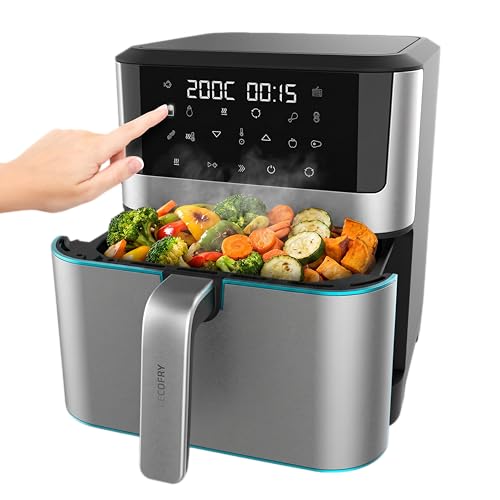
Cheap volume with the sum done up front. For a little less, the four litre machine from the same maker cooks considerably faster in small batches.
View ›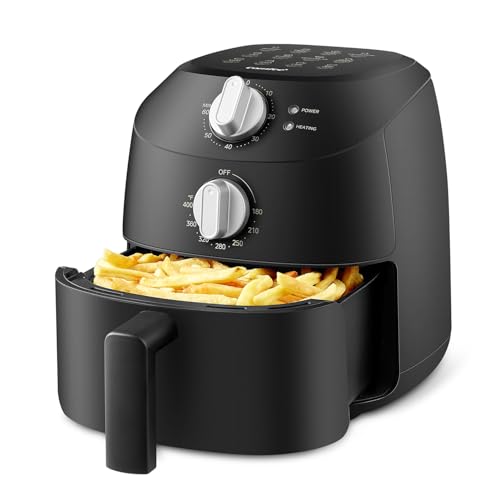
Right for one person and for kitchens where space decides. For two it is already short, and there the four litre one costs much the same.
View ›
If the budget decides everything, at least here you know how hot it goes. One step up, the four litre machine that declares its watts is a different appliance.
View ›The questions people actually ask about air fryers
Is it really worth buying an air fryer?›
It is if you cook small trays often, and it is not if you were going to use it once a month. The saving the brands advertise is against an oven, and it is an up to: one of them qualifies its claim as being versus a conventional Energy Class A oven, with no dish and no quantity attached. The real gain is that you are heating a small space instead of a large one and skipping most of the preheat. If what you cook is a whole roast for six, the oven was the right appliance anyway.
What is the downside of an air fryer?›
Three, and the listings tend not to mention any of them. Capacity: a family size still cooks a thin single layer, so a big meal is still two batches. Speed against size: the same element spread over more litres is slower, which is why the most powerful machine in this guide, at 2,600 watts, has the lowest heat per litre of all eleven at 217 watts per litre. And information: most listings do not tell you the wattage or what the basket is coated with, so you cannot compare two machines on anything except litres and price.
What should you not cook in an air fryer?›
Anything wet-battered, anything very light that the fan will throw around, and anything you want steamed rather than dried. The more useful version of this question is about how far to cook what you do put in: government guidance on starchy foods such as potatoes and bread says to aim for a golden yellow colour or lighter when frying, baking, toasting or roasting, because the substance it is concerned with forms above 120C. That is a target you judge by looking, which is a point in favour of a machine with a window.
Should I buy a 6 litre or a 9 litre air fryer?›
Six to six and a half litres is the size most people buy and it covers two or three people in one batch. Nine litres is usually two baskets of four and a half, which is excellent for a main and a side at different temperatures and no use at all for one big tray. Before you decide on litres, do the division: watts divided by litres. Anything around 260 to 300 watts per litre is the balanced band; much below 230 and you are buying space that the element has to heat slowly.
How much does an air fryer cost to run?›
Its wattage times the time, at your own unit rate, and that is why it matters that so few listings publish the wattage. As a reference point, the biggest brand in this search advertises as little as 8p for 15 minutes on its own shop. Run that backwards at the Ofgem price cap of 26.32p per kWh for 1 October to 31 December 2026 and it implies an appliance of roughly 1.2 kilowatts, but only if that 8p was calculated at the same rate. The calculator above gives you the kilowatt hours of a batch so you can multiply by the rate on your own bill.
Which is better, a single drawer or a dual air fryer?›
It depends on whether you cook one thing or two. A dual gives you two independent baskets with their own temperatures and timers, which solves the problem of the side going cold while the main finishes, and it is the shape the market here has moved towards. A single drum gives you one uninterrupted space, which is the only way to fit a whole chicken or one large tray. Nine litres of dual is two of four and a half, and the listings very rarely say so.
Do air fryers have non-stick coatings, and does it matter?›
Most do, and the useful thing to know is that most listings do not say what kind. Of the 53 listings in the catalogue we track, counted on 28 August 2026, only ten name the coating material at all. So if the material matters to you, the practical filter is simple: buy from a listing that names it, whether that is a ceramic coating with a name on it or an explicit statement of what it does not contain. Both exist in this guide, and between them they are a minority of the category.
What is the most important figure on the box?›
The watts, and it is usually the one that is missing. Litres tell you how much fits, and every listing gives them: 49 of the 53 we counted. Watts tell you how much heat there is to fill that space, and only 15 of 53 give them. Divide one by the other and you get the figure that actually compares two machines, which no listing publishes and no shop calculates for you. That division is what the calculator on this page does, for any machine, including one that is not in this guide.
With the declared spec sheets and a counted catalogue, not with the product name. Every figure here carries its source and its date.
(1) The census. On 28 August 2026 we went through the 53 air fryer listings in the catalogue m8d tracks and recorded what each one declares: 49 give the litres, 15 give the watts, 10 name the basket material and 5 give the temperature range. That is our own count of that catalogue, and it is named as such rather than presented as a survey of the British market.
(2) The British pages. On 16 September 2026 we opened the shop pages ranking first, fourth, eighth and ninth for this search in this country and recorded their energy claims, their footnotes and what they publish. Two of them advertise a percentage saving against an oven; none of the three manufacturer pages publishes a wattage.
(3) The arithmetic. Watts per litre is a division of two declared figures, not an industry standard: it compares two machines with each other and does not predict exact minutes. The unit rate used to read the 8p claim backwards is the Ofgem price cap of 26.32p per kWh for 1 October to 31 December 2026.
(4) The official guidance on cooking starchy foods is the government publication on acrylamide, linked below. Availability and models vary by country, and the buttons take you to your local Amazon store so you can check yours. One machine in this guide has had dead stock readings in our register for a long stretch and is listed as a reference rather than as a pick.
If you came here for a number that ranks the category, it is not the litres, and the brands know it: they publish litres on every product and the wattage on none, and then compare themselves against an oven with an up to in front of the percentage.
What does decide: if you want to know what you are buying, the MasterPro ROCKET 600, 6 L and 1,800 W declared view ›, the only one of the fifty-three listings we counted that declares litres, watts, coating and the absence of PFAS together. If you cook chips or anything baked, we would take the NARVI NF29, 6.5 L with a window view ›, and not for the look: the official advice on starchy foods is about the colour you cook to, and a window is how you judge colour without pulling the drawer out and losing the heat. And if the meal is a main and a side, the MasterPro Rocket Duo 900, 9 L twin basket view ›, because two baskets at two temperatures is the one thing a single drum cannot do. Whatever you end up looking at, including a machine that is not on this page, put its two figures into the calculator first: if the listing cannot give you the watts, that is the answer.
m8d pick · The only one that declares all fourMasterPro ROCKET 600, 6 L and 1,800 W declaredSee it on Amazon ›Manufacturer and retailer pages and government guidance, all consulted on 16 September 2026, plus our own catalogue census of 28 August 2026.
- SharkNinjaNinja air fryers, United KingdomCooking with a Ninja air fryer can cost up to 75% less than an oven, costing as little as 8p for 15 minutes, both claims carrying footnote markers whose text was not on the page. Litres published for every product, wattage for none.
- TefalAir fryers, United Kingdom shopUp to 65% less energy than a conventional oven, with the footnote in full: versus using a conventional Energy Class A oven. Capacities from 4.5 to 15 litres published; wattage not published.
- Morphy RichardsAir fryers collectionAir fryers are generally more energy-efficient than traditional ovens, with no percentage, no footnote, no wattage and no coating material.
- Which?Air fryers advice hubCarries an air fryer versus oven energy comparison and brand reliability work; its hub pages publish no wattage and no watts-per-litre comparison.
- GOV.UKAcrylamideAcrylamide forms when starchy foods such as potatoes and bread are cooked above 120C; the advice is to aim for a golden yellow colour or lighter when frying, baking, toasting or roasting, and current guidance is that home storage of potatoes in the fridge does not materially increase acrylamide forming potential.
- OfgemEnergy price cap unit rates and standing chargesElectricity at 26.32p per kWh for 1 October to 31 December 2026, direct debit, national average with regional variation. Used only to read the 8p per 15 minutes claim backwards.
- m8d's own count of the catalogue it tracksCensus of air fryer listings53 listings counted on 28 August 2026: 49 declare litres, 15 declare watts, 10 name the basket material and 5 give the temperature range.
Comments
Be the firstNo sign-up: just a name. Every comment is reviewed before it is published.