Best wireless headphones for TV 2026: which work with your TV, which have no lip-sync delay, what is not a hearing aid
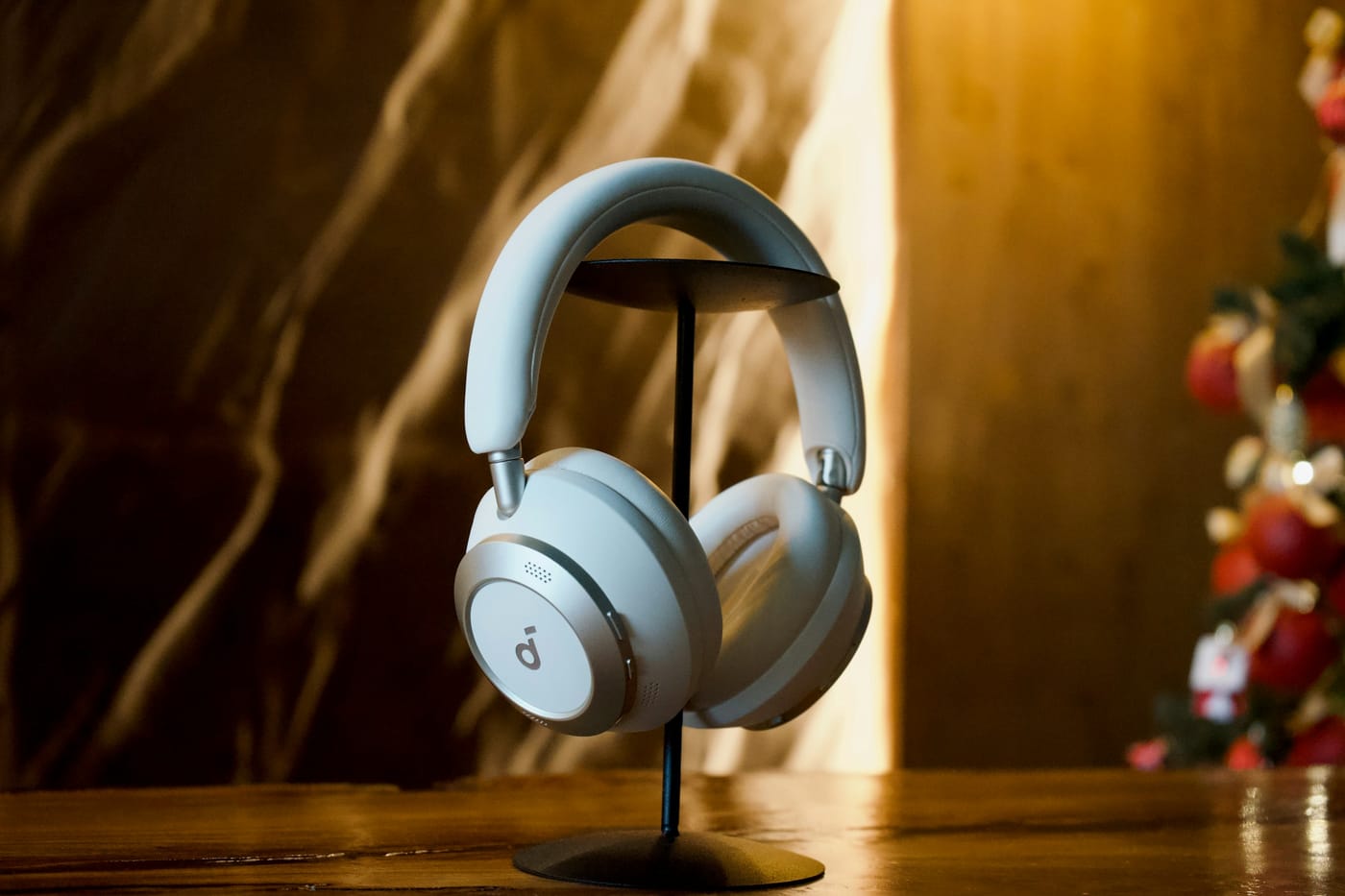
Six wireless headphones for watching TV without disturbing anyone, sorted by what is on the back of your TV rather than by price, plus three transmitters for when the TV will not cooperate. With what Samsung's UK support says about Bluetooth pairing, why an amplifier is not a hearing aid in the UK, and when HMRC lets a TV listener be sold VAT-free.
This guide contains affiliate links. As an Amazon Associate, m8d.io earns from qualifying purchases, at no extra cost to you.

The best wireless headphones for TV are not the ones that sound best: they are the ones your TV accepts. Samsung's UK support says Bluetooth headphones made only for phones cannot connect to its Smart TVs. Our pick, the PROW JFH-580TV, brings its own transmitter base and never needs the TV's Bluetooth.
- The TV is in charge here, not the headphones. Before choosing, look at the sockets on the back. The checker below settles it in two taps.
- Sets with a transmitter base do not depend on the TV: they connect to it by cable and ask nothing of it.
- Phone Bluetooth headphones may not pair with your TV. Samsung's own UK support says so.
- If the problem is hearing, not the TV, this is not the answer. Hearing aids are free on the NHS after a GP referral, and a TV listener for hearing loss can be VAT-free.
Which wireless headphones work with your TV: the TV headphone compatibility checker
TV headphone compatibility checker
Headphones for a TV go wrong before you choose the headphones: what decides is the TV, not the headset. Two questions about the back of your set give you what you can connect, whether you need a transmitter and which model fits your case. Free, no sign-up, no ads. Default example: with a headphone socket, any set with a transmitter base works without depending on anything else.
With that socket any set with a transmitter base works, which is what we suggest by default: nothing depends on the TV agreeing to pair.
| What is on the back of the TV | What you can connect | Does the TV speaker keep playing? |
|---|---|---|
| Headphone socket (small round socket) | Any set with a transmitter base | Not on most TVs: plugging in mutes it |
| Optical (small square port with a red light) | A base with optical input, or a transmitter | Yes, it can usually stay on |
| Red and white sockets | Any set with a transmitter base | Yes, it can usually stay on |
| HDMI only | The TV's Bluetooth, if it accepts headphones, or a transmitter on the optical port | Depends on the model and the year |
Which sockets your TV has, and what it lets you do with them, is decided by its maker, not by the headphones: Samsung's UK support says only one Bluetooth device at a time can be paired to its Smart TVs, two on sets made from 2022, and that Bluetooth headphones made exclusively for mobile devices cannot connect. Before buying, check the back panel and the manual of your model.
Does your TV have Bluetooth, and will it pair with any headphones? What Samsung's UK support says
Four of the questions Google shows in the UK for this search are really one: how to know if a TV has Bluetooth, whether all smart TVs support it, which TVs have it and whether it can be added. The answer starts with the TV maker, not the headphones. Samsung's UK support page says three things plainly: that Bluetooth headphones made exclusively for mobile devices cannot be connected to its Smart TVs; that only one Bluetooth device can be paired to the TV at a time; and that Samsung Smart TVs made from 2022 can connect to two. So the same headphones that work perfectly with a phone can refuse to pair with the TV, and buying other headphones does not fix that.
The check takes a minute on a Samsung: Home, then Settings, Sound, Sound Output and Bluetooth Speaker List, the path its UK support gives. If the list is there, the set sends sound over Bluetooth; on other brands the equivalent usually sits in the sound output menu, and the manual says whether headphones are accepted. If there is no such list, or the headphones never appear in it, Bluetooth can be added from outside with a transmitter on the optical or headphone socket, which is what the last section of this guide covers.
RF, Bluetooth or a transmitter base: the three kinds of wireless TV headphones, and the lip-sync delay
The word wireless covers three systems that behave very differently in front of a TV. It is the decision that most weighs on whether the headphones get used or end up in a drawer.
A box that plugs into the mains and connects to the TV by cable, then transmits on its own frequency. It asks the TV for nothing and gets through walls, and it is the format in which a maker writes zero delay into its title. Five of the six headphones in this guide come with a transmitter of their own, and it is what we suggest by default.
The classic system of TV headphones, with the receiver locking on to the transmitter's channel by itself. It is what removed the background hiss older sets had. It works well and reaches far; in exchange, it does not work with a phone.
The one almost everybody assumes, and the only one that can fail before you start. It depends on your TV agreeing: Samsung's UK support says it pairs one device at a time, and two on sets made from 2022. When it works it is the most convenient; when it does not, a small transmitter is needed.
m8d rule: If you do not want to depend on what your TV allows, buy headphones with a transmitter base: they connect to the TV by cable and work with any set that has an audio output.
The delay is why ordinary Bluetooth headphones tire you during a series. Sound takes time to travel over Bluetooth, and when the delay passes a fraction of a second the voice arrives after the lips move. The brain notices even if you cannot say what is wrong. And there is proof that buyers in this category care: PROW writes zero delay into the title of its own listing on the European catalogue we track, Ainostone advertises a low-latency mode in its, and SIMOLIO's own page promises no lip-sync delay. Nobody puts in a title something buyers do not worry about. The Sony, the one ordinary Bluetooth set on this list, says nothing about it.
TV headphones for hard of hearing: an amplifier is not a hearing aid, and NHS hearing aids are free
Much of this category is sold with older buyers in mind, and several sets use the word amplifier. In the UK two sources separate what a hearing aid is from what a TV headset is: the NHS and the advertising rules.
A medical device, and on the NHS a free one: it is provided on long-term loan, with batteries and repairs free, after a GP refers you to an NHS hearing aid provider. The advertising guidance adds that any assessment of someone's hearing or prescription of a hearing aid must be done by a registered hearing aid dispenser.
A listening aid: the CAP advertising guidance describes a hearing amplifier as a device that works by amplifying surrounding sound and needs no assessment. It is sold to make sound louder, not to treat hearing.
According to the CAP guidance of 6 May 2025, ads that claim a device alleviates hearing loss, or that present it as an alternative to a hearing aid, will likely be treated as medicinal claims, acceptable only if the device carries the appropriate conformity marking and is registered with the MHRA.
m8d rule: If you are buying for someone who hears less, a TV headset lets them watch at their own volume without disturbing anyone. It does not treat hearing loss, and in the UK the route for that is a GP referral, which is free.
That said, not everyone who reaches this page has a hearing problem: often it is a living-together problem. Many want to watch TV at night without waking anyone, or follow a film while someone reads next to them, and for that any of the six in this guide does its job. And if the difficulty is catching the words rather than the volume, RNID, the UK charity for people with hearing loss, also lists two options that are not headphones: subtitles, which Freeview, Sky, Virgin and BT boxes offer from the remote, and a hearing loop that streams the TV straight into hearing aids set to the loop setting.
VAT-free TV headphones: when HMRC lets a TV listener be zero-rated
There is a UK rule that specialist shops advertise and the reviews we read do not explain, and it changes what a TV listener costs for the people who need one. HMRC's VAT Notice 701/7 excludes standard hearing aids from relief, but lists, among the specialist equipment designed for people with severely defective hearing that may be zero-rated, TV hearing aids: amplifiers and earpieces which may be connected to a TV set, radio or hi-fi to enable a person with hearing loss to hear the sound without turning up the volume. The relief is for someone with that condition buying for their personal or domestic use, and whether a given set qualifies depends on it being specialist equipment of that kind: general wireless headphones sold for anyone are not the same thing as a TV listener designed for hearing loss.
How it works in practice, according to Age UK's factsheet of March 2026: ask whether you can receive the VAT exemption before buying or ordering; the supplier has to be VAT-registered, and you sign a form declaring your chronic illness or disability, or, if you cannot sign, a GP or another responsible person signs it for you. The decision is the seller's, made with your declaration, so the question goes before paying, not after.
Wireless TV headphones compared: the six side by side
| Headphones | How it connects | Transmitter included? | Declared delay | Who it is for | |
|---|---|---|---|---|---|
| PROW JFH-580TV view › | 2.4 GHz base | Yes, with charging | Yes, zero | The general pick | View › |
 Aiwa WHF-880 view › Aiwa WHF-880 view › | RF with PLL | Yes | Not declared | Anyone who wants a known audio brand | View › |
 SIMOLIO SM-823D Pro view › SIMOLIO SM-823D Pro view › | Base: optical, RCA or 3.5 mm | Yes | Yes, none (maker's page) | Anyone who loses the dialogue | View › |
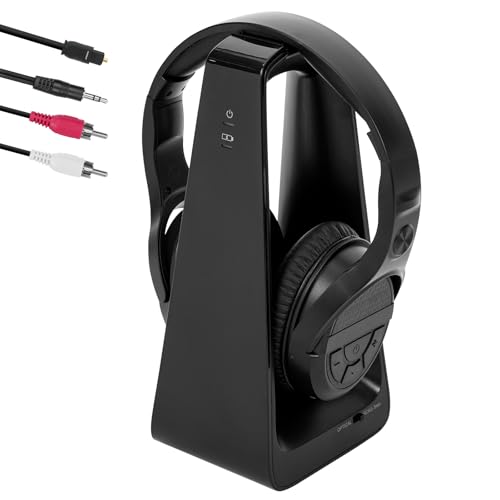 Evodiger Transmitter base view › Evodiger Transmitter base view › | 2.4 GHz base | Yes, with charging | Not declared | The same format as the first | View › |
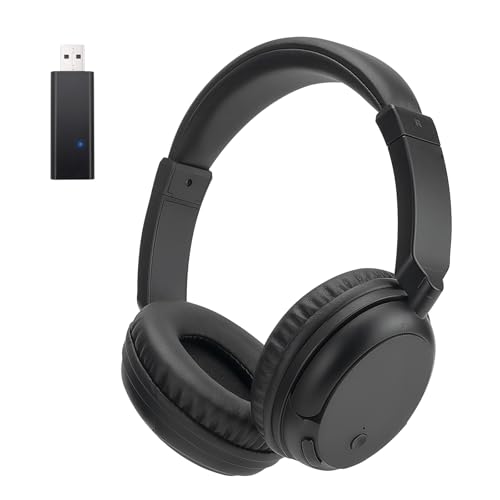 Boannice KST-900 view › Boannice KST-900 view › | 2.4 GHz and Bluetooth | Yes | Not declared | TV and phone in one set | View › |
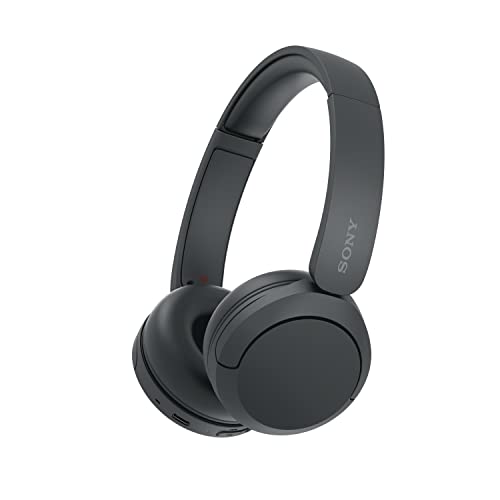 Sony WH-CH520 view › Sony WH-CH520 view › | Bluetooth only | No | Not declared | Only if your TV pairs without trouble | View › |
The features are those each manufacturer declares on its own listing, read on 11 August 2026 on the European catalogue m8d tracks; the SIMOLIO row adds its maker's own page, read on 23 September 2026. Not declared means the brand does not publish that figure, not that the product lacks it. Availability varies by country, and the buttons take you to Amazon in yours.
The six TV headphones, one by one
PROW JFH-580TV view ›
It is the one that least depends on what your TV wants to do. It brings its own transmitter base, so it connects to the TV by cable and works even if the set has no Bluetooth or pairs only one device. The big buttons and the volume on the headphones themselves are the difference between being used by the person it is for and ending up in a drawer. And it is one of the few that declares its delay on the listing.
- The base plugs into the mains and connects to the TV by cable, and it doubles as the charging stand: it stays there and there is no charger to look for.
- The big buttons on the headband matter more than they seem. Hunting for a small remote in the dark is why many of these sets stop being used.
- Its maker writes zero delay into the title of the listing. It is the maker's own declaration, and it is one the Bluetooth models on this list do not make.
- Its own transmitter base: does not depend on the TV's Bluetooth
- Big buttons and volume on the headphones, no separate remote
- The base is the charger, so there are no loose cables
- Needs room for the base next to the TV and a free socket
- Useless away from home: the base stays in the living room
A catalogue finding worth knowing before reading more listings. In this category the same device is sold under different brands. Read on Amazon's API on 11 August 2026: the PROW on this list and a RETRADEKING set declare the same model number, JFH-580TV, on two listings from two brands. It is nobody's trick: it is how the accessories market works, where one factory sells the same product to several brands. For you it means one practical thing: if your model sells out, search for the model number rather than the brand, because it is probably still on sale under another name.
Aiwa WHF-880 view ›
Aiwa has made home audio for decades and here it does not sell inflated figures: it sells radio frequency with PLL, the system that tunes itself to the channel and avoids the background noise of old analogue radio. It is the most reasonable balance on this list between a brand you recognise and a plain, reliable connection.
- Radio frequency gets through walls, so you can go to the kitchen without the sound cutting out. Bluetooth is made for the same room.
- PLL means the receiver locks on to the transmitter's channel by itself. Without it, these sets used to whistle and fill with noise whenever something moved.
- It declares neither battery life nor delay on its listing, and it is worth knowing before buying: what you buy here is the connection system and the brand.
- A long-standing home audio brand
- Radio frequency gets through walls and does not depend on the TV
- A classic headband, with no app and no pairing
- Publishes neither battery life nor delay on the listing
- No modern extras: there is no Bluetooth for the phone here
Boannice KST-900 view ›
It brings both connections: the 2.4 GHz transmitter for the TV, which asks nothing of the set, and Bluetooth for the phone. It is the sensible start for anyone who does not yet know whether they will use them every day, because the same headphones still have a use away from the TV.
- The dual mode is the interesting part: one headset for the TV through its transmitter and for the phone over Bluetooth, without having to choose.
- Its listing declares no delay, so what you are buying here is the dual connection, not a figure.
- It brings its own transmitter, so it does not depend on the TV agreeing to pair anything.
- Both connections in one set
- Transmitter included: works with almost any TV
- Also works with the phone and the tablet
- Does not declare its delay on the listing
- A brand with no track record and no battery figures that can be checked
SIMOLIO SM-823D Pro view ›
What you buy here is voice processing: it lifts the band where speech sits and lowers the rest, which is what makes a series understandable without the TV at a volume that bothers anyone. Before paying for it, read the section on amplifiers and hearing aids in this guide: if the problem is hearing and not the TV, this set is not the right answer.
- Dialogue enhancement is not the same as turning up the volume: it changes the balance between voice and music, which is where the conversation gets lost.
- The volume is set on the headphones, separately from the TV, so two people can watch the same thing at different levels.
- It is not a cheap set, and what justifies it is the voice processing, not overall sound quality.
- Its maker's page says the base works with a TV's optical, RCA or 3.5 mm output, with the three cables in the box, and declares no lip-sync delay, read on 23 September 2026.
- Dialogue enhancement, the specific problem of this category
- Volume separate from the TV's
- Transmitter base included: does not depend on the TV's Bluetooth
- Among the dearer sets on the list
- If the difficulty is hearing, the answer is a check-up, not this set
Evodiger Transmitter base view ›
It does the same as our first pick: a base that transmits and charges, big buttons and its own volume. It is here because in this category devices sell out and come back under another brand, and it is worth having the equivalent alternative of the same format at hand, so as not to end up buying something that looks nothing like it.
- The same approach as the first on the list: a base connected to the TV by cable, with no dependence on the TV's Bluetooth.
- Big buttons and volume on the headband are the pattern of this category when it is done well.
- It does not declare its delay on the listing, unlike the first pick.
- The same format as the first pick
- A base that transmits and charges at the same time
- Big buttons, made to be used in the dark
- Does not declare its delay on the listing
- A brand with no known track record in audio
Those two are the alternatives with a reason: one works hardest on voices, the other is the same base-and-charger format as the first pick, for when that one runs out. The last set is the only one on the list with no transmitter at all, and it is worth it only if your TV already pairs Bluetooth headphones.
Sony WH-CH520 view ›
It is the only one on the list not designed for TV, and it is here on purpose: if your TV pairs Bluetooth headphones without trouble, this one comes from a major audio brand, declares the longest battery on this page and you can take it out with you. The condition is a big one, because the TV maker itself may not let you, and it has to be checked before, not after.
- Fifty hours declared and fast charging: the longest battery figure declared on this list.
- It has no transmitter. If your TV will not pair it, you need a separate one, and they are at the end of the guide.
- Being generic Bluetooth, the delay between voice and lips depends on the TV and the codec, and it is not declared.
- A major audio brand
- Fifty hours of declared battery and fast charging
- Also works with the phone, the laptop and on the street
- Depends on your TV agreeing to pair it
- No transmitter included and no declared delay
The Bluetooth transmitter for a TV: when you need one, and which of the three
If you already have headphones you like and your TV will not pair them, you do not need new headphones: you need a transmitter. It is a small box that plugs into the TV's audio output and sends the sound over Bluetooth to whatever you choose. These three cover the three cases: a set with a headphone socket, a newer set with an optical port and no headphone socket, and two people listening at once.

A small box that turns any TV with a headphone socket into a TV with Bluetooth. It is the missing piece when the TV refuses to pair headphones that work perfectly with the phone.
View ›
It is the one you need when the TV is recent and the back has only optical and HDMI. Through the optical input it plugs in where there is signal, and from there it sends to any headphones you like.
View ›
It solves the case hardly any headset with a base solves: two people watching the same thing, each with their own headphones and their own volume. And it declares a low-latency mode, which is exactly what keeps the voice from trailing behind the lips.
View ›We started from the TV headphones on the European catalogue m8d tracks (Amazon Spain, part of Amazon's shared European catalogue), kept those in stock on 11 August 2026 and ordered them by the criterion that decides the purchase: how they connect to the TV. That gave six that cover different gaps, plus three transmitters for when the TV will not cooperate. Sets that do not declare their connection system, which in this category are the majority, were left out. On 23 September 2026 each one was checked for a listing on sale on Amazon UK, and a set that had none was taken out.
Every figure in this guide carries its source and its date. The connection limits come from Samsung's UK support and the SIMOLIO base's inputs from its maker's page; the line between a hearing aid and an amplifier from the NHS and the CAP advertising guidance; the VAT rule from HMRC's VAT Notice 701/7 and Age UK; the subtitles and hearing loop advice from RNID; and the model number shared by two brands from Amazon's API, read on 11 August 2026. Availability of each model varies by country, and the buttons take you to Amazon in yours.
Do wireless headphones work with a TV?›
Yes, but which ones depends on the back of your TV. With a headphone socket or red and white sockets, any set with its own transmitter base works, and those are most of the sets made for TV. With only HDMI and optical, you need a set with optical input or a transmitter on the optical port. And ordinary Bluetooth headphones need the TV to accept them: Samsung's UK support says Bluetooth headphones made exclusively for mobile devices cannot connect to its Smart TVs.
How can you tell if a TV has Bluetooth?›
Look for a Bluetooth list in the TV's sound output menu. On a Samsung the path its UK support gives is Home, Settings, Sound, Sound Output and Bluetooth Speaker List. If the list is not there, or your headphones never appear in it, the set either has no Bluetooth audio out or will not accept that pair, and a transmitter on the optical or headphone socket adds it.
How can you watch TV without disturbing others?›
With headphones that have a transmitter base, the simplest way and the one that does not depend on the TV. The base connects to the TV by cable and transmits to the headphones, and the volume is set on the headphones, separately from the TV. On many sets, plugging into the headphone socket mutes the speaker; over optical or the red and white sockets it can usually stay on.
Why is the sound behind the lips?›
Because Bluetooth takes time to send the audio, and when that delay passes a fraction of a second the brain notices the mismatch. Dedicated TV systems, radio frequency and 2.4 GHz bases, do not go through the TV's Bluetooth, which is why a maker can write zero delay into the title of its listing. If the listing says nothing about delay, the maker has not committed to a figure.
Are TV headphones a hearing aid for an older person?›
No. In the UK a hearing aid is a medical device fitted after a hearing assessment, and the NHS provides hearing aids free on long-term loan after a GP referral. The advertising rules say a claim that a device alleviates hearing loss is likely to be treated as a medicinal claim. What these headsets do solve is letting someone watch at their own volume without turning up the TV for the whole house.
Can two people use headphones on the same TV?›
Yes, but hardly any set with a base does it on its own. The simple route is a transmitter that sends to two pairs at once, like the Ainostone in this guide, which works with two different pairs. Samsung Smart TVs made from 2022 can also connect to two Bluetooth devices at the same time, according to its UK support.
Do headphones switch off the TV speaker?›
It depends on how you connect them. Through the headphone socket, most TVs switch off their own speaker when they detect the plug. Through the optical output or the red and white sockets, many models can keep the sound in both places, which is what you want when one person needs more volume and the other does not.
Can you buy TV headphones without VAT?›
If you have severely defective hearing and buy a TV listener designed for it, for your personal use, it may be zero-rated: HMRC's VAT Notice 701/7 lists TV hearing aids, amplifiers and earpieces connected to a TV so that a person with hearing loss can hear without turning up the volume. Ask the seller before paying, check it is VAT-registered and sign its eligibility declaration.
If you take one idea from this page, make it this: in this category the purchase is decided by looking at the TV, not the headphones. A set with a transmitter base works with any TV that has an audio output, because it asks nothing of the TV; a Bluetooth one depends on your TV agreeing, and the TV maker itself publishes that it may not.
With that clear, the PROW JFH-580TV is the one we would put in most homes, the Aiwa WHF-880 if you prefer a long-standing audio brand over RF, and the Boannice KST-900 if you want one set for both the TV and the phone.
What this guide rests on, who publishes it and when it was read.
- Samsung UK support, updated 8 April 2022How to connect Bluetooth headphones to my Samsung Smart TVBluetooth headphones made exclusively for mobile devices cannot be connected to a Samsung Smart TV; only one Bluetooth device at a time can be paired, and sets made from 2022 can connect to two. Menu path: Home, Settings, Sound, Sound Output, Bluetooth Speaker List. Read on 23 September 2026.
- NHS, page last reviewed 18 October 2023Hearing aids and implantsNHS hearing aids are provided free on long-term loan; batteries and repairs are free; a GP can refer you to an NHS hearing aid provider. Read on 23 September 2026.
- CAP and ASA, AdviceOnline, 6 May 2025Hearing amplifiers and hearing aidsClaims that a device alleviates hearing loss, or that present it as an alternative to a hearing aid, are likely to be medicinal claims, acceptable only with appropriate conformity marking and MHRA registration; any assessment of hearing or prescription of a hearing aid must be done by a registered hearing aid dispenser. Read on 23 September 2026.
- HM Revenue and Customs, updated 31 December 2020Reliefs from VAT for disabled and older people (VAT Notice 701/7)Paragraph 4.7: specialist equipment for people with severely defective hearing that may be zero-rated includes TV hearing aids, amplifiers and earpieces connected to a TV set, radio or hi-fi so a person with hearing loss can hear without turning up the volume; paragraph 4.5.5 excludes most hearing aids. Read on 23 September 2026.
- Age UK, March 2026Factsheet 42: Disability equipment and home adaptationsSection 7.3: ask whether you can receive a VAT exemption before buying; the supplier must be VAT-registered and you sign a form declaring a chronic illness or disability, and if you are unable to sign, a GP or other responsible person can sign for you. Read on 23 September 2026.
- RNID, updated 10 March 2026TV, radio and musicTV listeners let you listen at a comfortable volume at the same time as the TV speaker; a hearing loop streams the TV into hearing aids set to the loop setting; Freeview, Sky, Virgin and BT boxes have subtitles. Read on 23 September 2026.
- SIMOLIO, maker's product pageSIMOLIO Wireless TV HeadSet for TV (SM-823D Pro)Compatible with optical, RCA and 3.5 mm audio out connections; optical fibre cable, 3.5 mm to RCA cable and 3.5 mm cable in the box; no lip-sync delay and voice enhancement, according to the maker. Read on 23 September 2026.
- Product listings on the European catalogue m8d tracksConnection system and delay declared by each makerPROW writes zero delay and Ainostone low latency in the titles of their own listings; the Sony, the one ordinary Bluetooth set on the list, declares nothing about it. Read on 11 August 2026.
- Amazon API, m8d readingModel number shared by two brandsThe PROW and RETRADEKING listings return the same model number, JFH-580TV. Read on 11 August 2026.
 Best soundbar for dialogueThe same problem, solved without wearing anything.
 Best budget over-ear headphonesFor the street and the phone, which is another category.
 Best budget open ear headphonesEars left free, so you still hear what goes on at home.
 Best PS5 headsetIf the console sits under the same TV.
Comments
Be the firstNo sign-up: just a name. Every comment is reviewed before it is published.