Best pet camera in 2026: when a dog camera earns the premium, and when an ordinary indoor camera does exactly the same job
 m8d.ioUpdated on
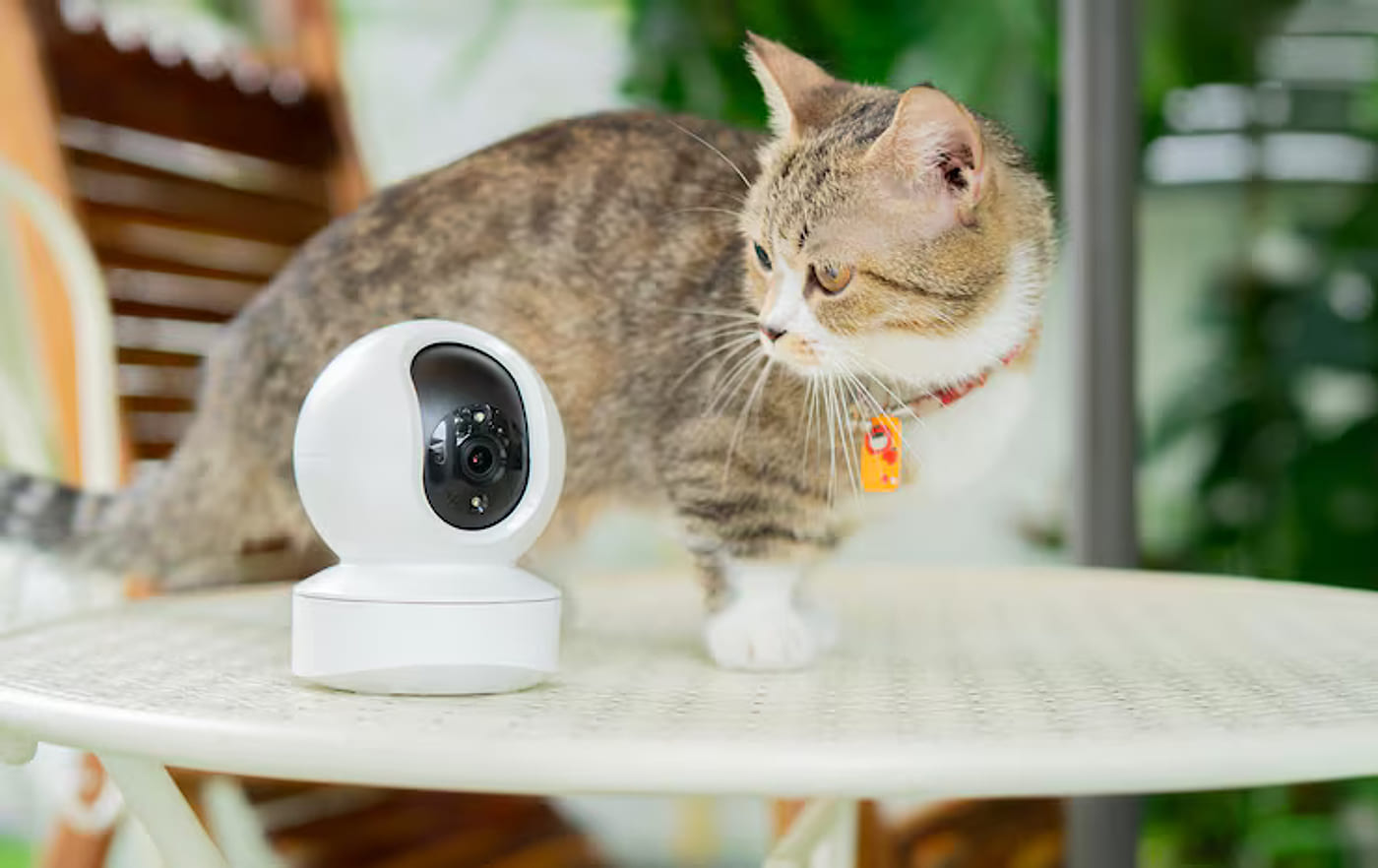
This guide contains affiliate links. As an Amazon Associate, m8d.io earns from qualifying purchases, at no extra cost to you.
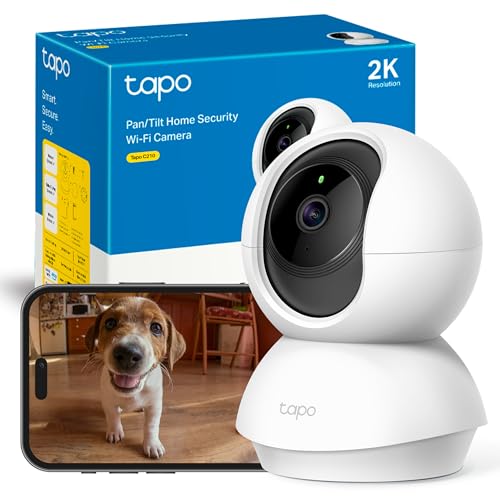
The best pet camera for most people is an ordinary indoor camera that pans a full circle, sees in the dark and lets you talk, and our pick is the Tapo C210. The pet-branded ones cost between two and four times as much, and only three things justify that: throwing a treat, dispensing food, or moving through the house. Before any of it, one number worth knowing: the RSPCA says 8 out of 10 dogs find it hard to cope when left alone, and half of those show no obvious signs at all. That is the actual reason to point a camera at your dog.
Pans 360 degrees, sees in the dark and lets you talk to him. No subscription of any kind.
See it on Amazon ›What the RSPCA actually says about leaving a dog alone
Every guide in this category opens with the product. It is worth opening with the reason, because the RSPCA publishes it and almost nobody quotes it. Its guidance on separation-related behaviour states that "research suggests that 8 out of 10 dogs find it hard to cope when left alone" and, in the next sentence, "yet, half won't show any obvious signs". On how long: "we recommend that you don't leave your dog alone for more than four hours; for puppies much less".
Read those two sentences together and the case for a camera writes itself. If half of the affected dogs show nothing you can see when you get home, then coming home to an undisturbed room tells you very little. The RSPCA reaches the same conclusion and says so directly: to check whether your dog is coping, "you can do this by installing a camera to monitor your pet while you're out".
The RSPCA's own list, split by whether a camera pointed at an empty room will actually show it to you. This is the part that decides whether you need a 360 degree pan or a fixed lens.
The RSPCA lists destructive behaviour near exits, doors or windows, howling, barking and whining, toileting, excessive excitement when you return, and signs of anxiety before you leave. Several of those you would find when you got home. Two of them, the barking and the anxiety before you go, only exist while you are not there.
Trembling, panting, excessive salivation, repetitive circling and pacing, not eating while you are out. These are the ones that leave no trace in the room, and they are the reason a fixed lens pointed at the sofa is not enough: a dog that paces is a dog that leaves the frame. A full 360 degree pan is not a luxury here, it is the difference between seeing the behaviour and missing it.
This is the claim the category is sold on, and it is mostly published by the people selling the cameras. The counter-argument, that hearing you without you appearing can reinforce the dependence and make it harder for him to learn to be alone, appears in behaviour writing. We have not found a veterinary study that settles it either way, so we do not present it as a benefit of any product on this page. What is clear is that if the dog already barks or destroys things when left, that is a behaviour problem and a camera will not fix it.
This one holds up exactly as advertised, and it is the feature that gets used most. Every camera here has it, and an animal alone in a house spends most of the day in poor light with the curtains half drawn. It is also the feature nobody checks, because it is the one that always works.
m8d rule: Set the camera up for a week before you change anything. If the dog settles within about fifteen minutes and stays settled, you have your answer and you can stop worrying. If he paces, barks or stands at the door for an hour, that is a behaviour problem and the camera has done its job by finding it. What the camera cannot do is fix it.
The duty the law already puts on you, and what a camera does about it
In England and Wales the Animal Welfare Act 2006 puts a positive duty on whoever is responsible for an animal. Section 9 says a person commits an offence if he does not take "such steps as are reasonable in all the circumstances to ensure that the needs of an animal for which he is responsible are met to the extent required by good practice", and it lists five needs: a suitable environment, a suitable diet, "its need to be able to exhibit normal behaviour patterns", any need to be housed with or apart from other animals, and protection from pain, suffering, injury and disease.
The third one is the one that matters here. A dog shut in a room pacing for six hours is not exhibiting normal behaviour patterns, and the four-hour figure the RSPCA publishes is the practical reading of what good practice looks like. To be clear about what this does and does not mean: owning a camera is not compliance with anything, and no camera on this page will discharge a legal duty. What a camera does is give you the only evidence you can actually get about whether the animal is coping, which is the thing the duty is about. That is a different and much better reason to buy one than the marketing reason.
The subscription question, and where to find the answer on the listing
Some pet cameras will not do what they are sold for unless you keep paying. It is not a suspicion and it is not buried in a contract: on some listings the requirement is written into the product title itself, in square brackets, next to the model name.
This is the category on this site where the most money is paid for things that sound like features and are conditions of use. All four apply to any pet camera you are looking at, on any listing.
On the Spanish listings for both Furbo models on this page, that phrase appears literally in the product title, in square brackets. That is not an optional plan for storing video: it is the condition for the device to switch on. The same listing does not publish what the subscription costs, so the total price of the purchase is unknown at the moment of buying it. Subscription structures differ by country and by model, so read the title on the listing in front of you rather than trusting a guide, this one included.
Half the time this is the same indoor camera as always with a different photograph on the box. What actually distinguishes a pet camera is the treat launcher, the feeder or the ability to move. If it has none of those three, you are paying for the label and the app.
Almost always trained to detect people, not animals. With a dog in the house that means fewer alerts than you expect, or none at all. Furbo is the exception on this list: it recognises barking, which is the sign the RSPCA lists and the one a motion sensor will never catch.
This one is worth actively looking for. A camera that writes to its own memory card keeps working, and keeps its recordings, whatever happens to a subscription. Five of the seven here do it, and it is the single specification that decides whether the camera you buy today still works the same way in three years.
m8d rule: If a pet camera does not throw treats, does not dispense food and does not move, it is an indoor security camera with a different picture on the box. Compare it against an ordinary one before you pay several times the price. And before you pay for any of them, read the product title to the end and open the app's own terms: those two places are where the recurring cost lives, and neither of them is the marketing copy.
- Work with no plan at allthey record to their own card571%
- Do not activate without a subscriptionthe two Furbos, per their own listing229%
Our own count over the seven cameras in this comparison, made on 1 September 2026 by reading the title of each listing. The two that state a subscription requirement are the Furbo Mini and the Furbo 360, and they state it in their own product title in square brackets on the Spanish listing. Neither publishes the cost of that subscription on that listing, which is why no figure appears here. Subscription terms vary by country: check the listing you are buying from.
The cameras that watch a dog without a monthly fee
Tapo C210 indoor 360 degree view ›
It does the three things a camera watching a dog is actually asked to do: turn far enough to find the animal, see it in the dark, and let you speak to it. It does not throw treats and it does not move around the house, which is why it costs a fraction of the pet-branded ones. If what you want is to know whether the dog has settled or has got onto the sofa, this is the straight answer.
- The 360 degree pan is the specification that matters with an animal: a fixed frame loses the dog the moment it moves to another corner.
- It records to its own memory card, so nothing you want to keep depends on paying a monthly fee.
- There is no treat dispenser. If that is precisely what you are after, the cameras further down have one, and the section below sets out what it costs.
- Works with no subscription of any kind
- A full 360 degree pan, which is what finds a moving animal
- A fraction of the price of the pet-branded cameras
- No treat dispenser
- Does not move around the house

Imou 4 MP for pets view ›
Its own maker markets it for pets, and it has more resolution than our main pick for less money. The difference is the detail the listing does not put in the headline: its detection is trained on people, so with an animal it will raise fewer alerts. For watching, it is perfect. For being told every time the dog walks past, the other one is better.
- Four megapixels is more resolution than our main recommendation, and it sits lower in the range.
- Its detection is declared for humans, so with a dog it generates fewer alerts. Whether that is good or bad depends on what you want from it.
- It is the floor of the whole category while keeping the full pan and the night vision, which is the pair that actually matters here.
- The lowest entry point on this list
- 4 megapixels, the highest resolution among the subscription-free cameras
- The manufacturer positions it explicitly for pets
- Detection is built for people, not animals
- No dispenser and no mobility
What a pet-specific camera genuinely adds
There are three things an indoor camera cannot do however far it pans and however good its picture is: throw a treat, dispense food and move after the animal. If one of those three solves your problem, the premium is justified. If none of them does, it is not.
The four below are the ones that add something, each with one of those three functions. They are ordered by what they solve, not by what they cost.

Furbo 360 degrees with treat tossing view ›
It does the one thing no ordinary camera can do: throw a treat from your phone. For a dog that struggles on its own, that interaction is worth something that watching the picture is not. What you have to check before you pay is what its app costs to keep running, because the answer is not the same on every listing and on some of them it is written in the product title itself.
- The treat launcher is the only thing on this list an ordinary indoor security camera cannot replicate.
- Its app is the part you are paying for, so read what the listing says about it in the title and in the app's own terms before you buy.
- Check the treat size it takes before you commit: it is the recurring complaint about every launcher of this type.
- A treat launcher, which is the feature that justifies the category existing
- A 360 degree pan and the most complete app here
- Barking recognition instead of alerts every time a curtain moves
- Check what its app requires on the listing you are buying from
- Close to three times an ordinary indoor camera before anything else

ARENTI automatic feeder with a camera view ›
It is the only thing here that solves a problem rather than a curiosity: if you are out for twelve hours, the animal still eats. The camera is the accessory and the feeder is the product, and that is the right way round to look at it. Bought as a camera it is expensive. Bought as a feeder with a camera in it, it beats buying the two separately.
- It replaces two devices, and that is the only arithmetic in which its position on this list makes sense.
- It is the one that fits a long day out, which is exactly when watching on its own stops being enough.
- The camera sits at bowl height, so it sees the feeding area rather than the whole room.
- Solves the feeding as well as the watching
- No subscription declared to make it work
- Cheaper than buying a feeder and a camera separately
- As a camera alone it is expensive and the frame is narrow
- It only watches the area around the bowl

HUAJUN robot with two cameras view ›
A fixed camera has a problem with animals that nobody mentions: the animal goes into another room. This one moves, so the frame follows you instead of the other way round. It is also the one with most that can go wrong, because it needs clear floors and it needs the animal not to decide it is a toy. With a calm dog it is the most complete answer at this level.
- It solves the underlying problem with fixed cameras and animals, which is that the animal changes room.
- It needs clear floors: thick rugs or toys in the way and it beaches itself.
- Some dogs decide to chase it, at which point it stops being a camera and becomes a toy.
- It moves through the house instead of waiting for the animal to walk past
- Two cameras and night vision
- No subscription declared
- Depends on the floor being clear
- 1080p only, the lowest resolution here

Enabot EBO SE mobile robot view ›
This is the robot that is finished: it takes itself back to charge, which is exactly where the cheap ones in this category fail when you have been away three days. It costs several times our main recommendation and that gap is only justified if you are genuinely going to use the movement. If what you want is to look in now and again, it is a great deal of machine for the job.
- It returns to its charging base by itself, which is what separates a usable robot from one that strands itself mid-morning.
- It is the top of this list and the one that asks you to be sure you will use the movement.
- Like the other robot here, it needs clear floors to get around.
- Returns to charge on its own, without needing anyone at home
- The best-finished of the robots here
- No subscription declared
- The most expensive here by a distance
- 1080p, below what fixed cameras a fraction of the price manage

Furbo Mini 360 degrees view ›
Furbo is the brand that created this category and its app is the one genuinely built for animals: it recognises barking and tells you when something happens rather than when something moves. What you are buying is the app, not the sensor, so the thing to read twice is what the listing says the app requires. On some listings that requirement is written into the product title itself.
- What it adds over an ordinary camera is behaviour recognition, not image quality.
- On the Spanish listing for this model the subscription requirement is written inside the product title, in square brackets. Check the title on the listing in front of you.
- It is the entry point to the brand, and the argument for it is the software rather than the hardware.
- The app best built for animals on this whole list
- Recognises barking rather than only movement
- The cheapest way into the brand
- Read what the listing says its app requires before you buy
- Around twice an ordinary indoor camera, for a sensor that is not better
The seven side by side
| Camera | Needs a plan? | Throws treats | Feeds | Moves | Why you would buy it | |
|---|---|---|---|---|---|---|
| Tapo C210 indoor 360 degree view › | No | No | No | No | Seeing him and speaking to him | View › |
| Imou 4 MP for pets view › | No | No | No | No | Spending the minimum | View › |
| Furbo 360 degrees with treat tossing view › | Its listing says so | Yes | No | No | Genuine interaction | View › |
| Furbo Mini 360 degrees view › | Its listing says so | No | No | No | Its app, not its picture | View › |
| ARENTI automatic feeder with a camera view › | No | No | Yes | No | Long days out | View › |
| HUAJUN robot with two cameras view › | No | No | No | Yes | An animal that changes room | View › |
| Enabot EBO SE mobile robot view › | No | No | No | Yes | Movement with no upkeep | View › |
The columns come from what each manufacturer declares on its own listing, read on 1 September 2026. "Needs a plan" records only the cases where the listing itself states that a subscription is required to activate the product. Subscription terms and model names vary by country.
We started from the pet and indoor cameras available in the Amazon catalogue we track and kept the ones in stock on 1 September 2026. We separated them by the only thing that justifies the premium of a pet-specific camera: whether it throws treats, dispenses food or moves. We deliberately left out models on delayed delivery, because a camera that arrives in a fortnight does not solve this week's problem.
Every figure in this guide carries its source and its date. What we do is read what each listing declares and repeat it, including what the manufacturer writes in square brackets in its own product title. The welfare figures come from the RSPCA's published guidance and the legal wording from the Act itself, both cited with the date we read them. Availability, model names and subscription terms vary by country, so treat the listing in front of you as the authority, not this page.
Is a pet camera worth it, or will an ordinary camera do?›
An ordinary indoor camera does the whole job if what you want is to see the animal, hear it and speak to it, and it costs a fraction of a pet-branded one. The premium is only worth paying for something an ordinary camera physically cannot do: throw a treat, dispense food, or move around the house. If none of those three is what you are after, buy a 360 degree indoor camera and put the difference towards a dog walker.
How long can I leave my dog alone?›
The RSPCA's published recommendation is that you do not leave a dog alone for more than four hours, and much less for a puppy. It also says 8 out of 10 dogs find it hard to cope when left alone and half of those show no obvious signs, which is the reason it suggests using a camera to check rather than assuming a quiet room means a settled dog.
Do Furbo cameras need a subscription?›
On the Spanish listings for both Furbo models on this page the requirement is written by the brand itself in the product title, in square brackets: subscription required to activate. That is not an optional plan for storing recordings, it is the condition for the camera to work, and that listing does not publish what the subscription costs. Subscription structures differ by country and by model, so read the product title and the app's own terms on the listing you are buying from.
What can a camera tell me that coming home cannot?›
The signs that leave no trace. The RSPCA's list of less common signs is trembling, panting, excessive salivation, repetitive circling and pacing, and not eating while you are out. None of those is visible when you walk through the door, and a dog that paces is a dog that leaves a fixed frame, which is why the pan matters more here than the resolution.
Which camera is best for watching a cat?›
The same criteria as a dog with one difference: cats move vertically and get up on high things, so how far the camera tilts upwards matters more than how far it pans. The 360 degree models here all cover the full horizontal circle; check the vertical range before deciding where to mount it, because a camera at head height pointing level will lose a cat on top of a wardrobe.
Does talking to my dog through the camera help?›
There is no consensus, and the people who publish the case for it are mostly the people selling the cameras. The counter-argument, that hearing you without you appearing can reinforce the dependence and make it harder for a dog to learn to be alone, appears in behaviour writing. We have not found a veterinary study that settles it, so we do not present it as an advantage of any product. What is clear is that if the dog already barks or destroys things when left, that is a behaviour problem and a camera does not fix it.
What height should I mount a pet camera at?›
Lower than most people put it. A camera at human eye height sees the room but frames the animal from above, and with a dog lying down it sometimes loses him entirely. Mounting it at coffee-table or low-sideboard height gives a far more useful frame, and it puts the speaker closer to where the animal actually is.
Do I need WiFi for a pet camera?›
Every camera in this guide works over WiFi, so yes. If the animal stays somewhere without a router, such as a stable or an outbuilding, none of these will work and you need a camera with a SIM card, which uses the mobile network instead of your home one.
The question in this category is not which is the best dog camera. It is whether you need a dog camera at all, and for most people, who simply want to know whether the animal has settled, an ordinary indoor camera does the entire job with no monthly fee.
If you are genuinely going to throw him treats, the Furbo 360 does it best, with the subscription check above done first. If you are out for twelve hours, the ARENTI feeder solves a problem rather than a curiosity. And if the animal changes room, that is where a robot earns its place. Whichever you pick, do the RSPCA's week of watching before you change anything: it is free, and it is the only thing here that tells you whether there is a problem to solve.
What holds up the specific claims on this page.
- RSPCA, official guidanceSeparation-related behaviour in dogs: the 8 in 10 figure, the half with no obvious signs, the four-hour recommendation and the suggestion to use a cameraRead on 1 September 2026. The list of common and less common signs used in this guide is theirs, quoted as published.
- Animal Welfare Act 2006, section 9, legislation.gov.ukThe duty of care and the five needs, including the need to exhibit normal behaviour patternsRead on 1 September 2026. Applies to England and Wales; Scotland and Northern Ireland have their own equivalent legislation. This is a citation of the statute, not legal advice.
- Furbo, on its own Amazon listingsThe subscription requirement, declared in the product titleBoth references on this list carry the requirement written into the title in square brackets on the Spanish listing, read on 1 September 2026. Neither publishes the cost of the subscription there, which is why no figure is quoted. Subscription terms vary by country and by model.
- Each manufacturer's own product listingFeatures, resolution and functions of each modelRead on 1 September 2026. The count of how many require a plan is our own, made over these seven. Availability and model naming vary by country.
- No conclusive sourceWhether talking to a dog through a camera helpsDeclared deliberately. The arguments in favour come overwhelmingly from manufacturers of pet cameras and those against from behaviour writing; we have not located a veterinary study that resolves it, so it is not asserted in either direction.
Comments
Be the firstNo sign-up: just a name. Every comment is reviewed before it is published.