Best gaming keyboards 2026: eleven read spec sheet by spec sheet, and how to spot a UK layout in the photo
 m8d.ioUpdated on
This guide contains affiliate links. As an Amazon Associate, m8d.io earns from qualifying purchases, at no extra cost to you.

The best gaming keyboards of 2026 are decided by the switch, not the RGB, and by one thing every other guide skips: the layout. Our all-round pick is the KROM Kernel Pro, a hot-swap mechanical TKL with three ways to connect. But before you pay, do the check in this page: not one of these eleven keyboards declares an ISO-UK layout, and knowing whether that matters to you is worth more than any polling rate.
ISO-UK or ANSI-US: the decision no gaming keyboard guide makes for you
We read the manufacturer spec sheet of all eleven keyboards in this guide on 31 August 2026, looking for one thing: does the maker write down which country's layout it is? Then we went to the makers' own catalogues to see how many British boards they build at all. The answer is the most useful thing on this page.
The category sells itself on speed: rapid trigger, 8000 Hz, 0.01 mm. Magnetic boards have fallen from enthusiast money to budget money in a year, and that is the story every guide tells. Almost none of them mentions the layout at all, and the ones that do write "QWERTY" as though that settled it. QWERTY is the order of the letters. It is not a country.
The British layout is the rarest ISO layout there is. EPOMAKER is a maker that genuinely does build ISO boards, and its own layout filter, read on 31 August 2026, lists 56 models in ANSI-US against 7 in ISO-DE, 3 in ISO-ES, 3 in JIS, 2 in ISO-FR and exactly 1 in ISO-UK. Not one of the eleven keyboards in this guide is that one. If you have been wondering why the British layout is so hard to find on an enthusiast keyboard, that ratio is the answer, and it comes from the maker's own shop rather than from us.
And when a keyboard does declare a layout, people assume the country is a detail. In this guide, four boards declare Spanish, one declares ISO-ES in its own product name, and four say nothing at all about a country.
ISO-ES, ISO-DE, ISO-FR and ISO-UK are the same physical keyboard. Same key count, same L-shaped Enter, same extra key to the left of the Z, same short left Shift. What changes is what is printed on three or four keycaps and what the operating system decides to send. That is why a Spanish-legend ISO board set to English (UK) in Windows will give you a correct pound sign and a correct hash: the keys are in the right places and the wrong letters are painted on. An ANSI board set to English (UK) will not, because the key simply is not there.
So the order of the decision is: shape first, letters second. If you touch type and you want the L-shaped Enter and the pound key, an ISO board with foreign legends is a keyboard you can live with, and a keycap set fixes the cosmetics. If you look at the keys while you type, foreign legends will bother you every day and no software fixes that. And if you are happy with ANSI, which plenty of people in the UK deliberately are because it is the layout every keycap set and every enthusiast board is built around, then this whole problem disappears and you should buy on the switch.
m8d rule: The Enter key shape is physical and permanent. The letters printed on the keys are neither. Decide the shape first, because that is the half you cannot change later.
How to tell a keyboard's layout from the photo in the listing
Pick the format of the keyboard you are looking at and the checker tells you how many keys it should have in ANSI and how many in ISO, plus the two signals that are visible in any product photo: the shape of the Enter key and what sits immediately to its left. It opens on TKL, which is the most bought format. When we have no board in this guide that declares your layout, it says so instead of selling you one that does not.
The trick that works in every format: an ISO board always has exactly one key more than an ANSI board, because it adds the key to the left of the Z and splits the Enter across two rows. Count the keys in the photo. Then check the legends, because the count tells you the shape and the shape does not tell you the country.
The key counts come from the physical difference between the two layouts rather than from any one brand: an ISO board adds one key to an ANSI board in every format, in the same two places. The layout availability figures come from EPOMAKER's own shop filter, read on 31 August 2026 and cited in the sources at the foot of this guide.
Which switch to choose in 2026: mechanical, hall-effect magnetic or hybrid
A mechanical switch closes a physical contact at a fixed depth. It does not matter how you press it: the keyboard registers the key at the same point every time, and to register it again you have to let it come nearly all the way back up. It has been the standard for thirty years and it is still what most people buy, because the feel is good and the outlay is small.
A hall-effect magnetic switch closes nothing. It uses a magnet to measure how deep the key is, continuously. That allows two things a mechanical switch cannot do. The first is choosing the millimetre at which each key activates. The second is rapid trigger: the key is ready again the instant you start releasing it, without waiting for it to come back up. In a shooter, that means cleaner changes of direction.
And the translation, which is the part that matters: if you play in the evenings to whatever is on, a thirty-pound mechanical is not holding you back and a magnetic board is not going to win you matches. If you play shooters seriously and you counter-strafe until your fingers hurt, rapid trigger is noticeable from day one. The hybrid H-Mech type is neither of those things: it is a membrane with a better feel, and it is fine that it exists at the bottom of the range.
| Keyboard | Switch | Format | Layout the maker declares | Who it is for | |
|---|---|---|---|---|---|
| KROM Kernel Pro view › | Mechanical, hot-swap | TKL | ISO, Spanish legends | Most people: it does everything well | View › |
 ATTACK SHARK X68 HE view › ATTACK SHARK X68 HE view › | Hall-effect, 8000 Hz | 60% | Not declared, ANSI key count | Competitive play, where latency matters | View › |
 EPOMAKER Ajazz AK820 Pro ISO-ES view › EPOMAKER Ajazz AK820 Pro ISO-ES view › | Mechanical, gasket | 75% | ISO-ES, in the product name | Gaming and typing on the same board | View › |
 The G-Lab Keyz Elite 400 HE view › The G-Lab Keyz Elite 400 HE view › | Hall-effect, 8000 Hz | 96% | ISO, Spanish legends | Rapid trigger with a number pad | View › |
 KROM KASIC TKL view › KROM KASIC TKL view › | Mechanical, red linear | TKL | ISO, Spanish legends | The cheapest way into a real mechanical | View › |
 Rii RK802 view › Rii RK802 view › | Mechanical, red linear | 60% | ISO, Spanish legends | A clear desk for the mouse | View › |
 Mars Gaming MK023 view › Mars Gaming MK023 view › | Hybrid H-Mech | TKL | ISO, Spanish legends | A first keyboard or a spare | View › |
Switch type, format and layout are what each maker declares on its own spec sheet, read on 31 August 2026. "Not declared" means exactly that: not that it is certainly American, but that the maker does not say and you have to check the photo. "ISO, Spanish legends" means the physical shape is the European one you want and the printing is not: see the section above on what software can and cannot fix.
The seven main gaming keyboards reviewed
KROM Kernel Pro view ›
Still the sensible buy of this guide, and nothing we read today takes its place at this level. A mechanical board with switches you can change yourself and three ways to connect it. For most people looking for a gaming keyboard, the search ends here. It only falls short if you compete seriously, and that is what the magnetic tier is for.
- It puts into one keyboard the three things this category usually sells separately: a European ISO shape, switches you can swap without soldering, and three ways to connect. That is what keeps it as our pick.
- Hot-swap means that if a switch fails or you do not like the feel, you pull it out with the tool and put another one in. That is the difference between a keyboard that lasts three years and one that lasts eight, and almost nothing at this level offers it.
- Bluetooth 5.3 for the laptop, a 2.4 GHz receiver for playing and a cable when the battery runs out. The switch between them is a physical slider, not a key combination you have to remember.
- On the layout: KROM declares a Spanish layout, so the legends are Spanish while the physical shape is the standard European ISO one. Set your operating system to English (UK) and you get the British mapping, the pound sign included, with three keycaps painted wrong. If you touch type that is a cosmetic issue and a keycap set fixes it. If you look at the keys, buy something else.
- Hot-swap and tri-mode connection in the same board
- TKL format with 18 RGB effects
- Bluetooth 5.3, the current version
- Not hall-effect: it sits behind a magnetic board for high-level competitive play
- ISO shape with Spanish legends, not a British layout
- RGB by effect rather than per key
ATTACK SHARK X68 HE view ›
If you play competitively and latency genuinely matters to you, this declares more muscle than anything else here at its level. Eight thousand hertz, rapid trigger down to a hundredth of a millimetre and Snap Tap, in a format that leaves half the desk free for the mouse. Two warnings up front: it needs calibrating before you use it, and its spec sheet does not name a country for the layout, so you check that in the photo.
- The figures its maker publishes are the highest here: 0.01 mm of rapid trigger precision, 8000 Hz polling, 128 kHz scanning and a declared 0.125 ms of latency. On a magnetic board that means the key is ready again before your finger is all the way up.
- ⚠ Its own spec sheet opens with a warning worth reading before you buy: it requires a mandatory calibration before first use, through software or a browser. That is not a defect, it is how these keyboards work, but do not expect to plug it in and play.
- ⚠ And the warning this guide exists for: the listing says "QWERTY design" and never names a country. QWERTY is the order of the letters, not the layout: there is Spanish QWERTY, American QWERTY, British QWERTY. Its keycaps are described as ANSI profile, which points one way, but that is a description of the keycaps rather than a declaration of the layout. Count the keys in the photo before you order.
- For a UK buyer that undeclared line is less of a problem than it is in Spain, and it is worth saying why: ANSI is a layout a lot of people here choose deliberately, because it is the arrangement every enthusiast keycap set is cut for. If ANSI is what you want anyway, this board's silence on the subject costs you nothing.
- The highest declared speed figures in this guide
- Snap Tap and dynamic actuation for cleaner changes of direction
- Hall-effect at the budget end of the range
- The layout is not declared: check the photo before ordering
- Mandatory calibration before first use
- 60% format: no arrow keys and no F row
EPOMAKER Ajazz AK820 Pro ISO-ES view ›
The one to buy if the board has to be typed on as much as it is played on: a gasket mount you feel on every keystroke and three ways to connect it. The little screen changes nothing, and we say so because it is the first thing you see in the photos. What does change is how it types, and it types better than anything below it on this list.
- Gasket mount means the plate is not bolted to the case, it is suspended on gaskets. Typing on it has less bounce and less plastic noise. That is what separates a mid-range mechanical from a cheap one, far more than the RGB does.
- The 75% keeps the function row and the arrows and drops the number pad. It is the format most people end up preferring when a keyboard has to both play and work, because it does not make you learn Fn combinations.
- On the layout, and this is the useful part: EPOMAKER puts ISO-ES in the product name, which tells you the physical shape is the European one, with the L-shaped Enter and the extra key. The same maker's own catalogue lists exactly one ISO-UK model, and it is not this one. So this is an ISO board with Spanish printing: set the language to English (UK) and the mapping is British, with a few keycaps that are not.
- Gasket mount and south-facing RGB
- Three modes: cable, 2.4 GHz and Bluetooth 5.1
- The ISO physical shape, stated in the product name
- Not hall-effect: it will not match a magnetic board for competitive play
- ISO-ES legends, not British ones
- The TFT screen is more toy than tool
The format decides more than the brand, and almost nobody explains it. A 60% drops the arrow keys and the F row: it plays beautifully and works badly. A TKL only drops the number pad and is the sweet spot for most people. A 75% gets the function row back in the same footprint. A 96% packs the numbers up against the rest with none of the gaps of a full-size board. The short rule: if the keyboard also has to do work, do not go below TKL.
The G-Lab Keyz Elite 400 HE view ›
The one to take if you want rapid trigger without giving up the number pad. It is a hall-effect board with hot-swappable magnetic switches in a 96% that takes about as much desk as a TKL. It is also the clearest illustration of the point this guide makes: The G-Lab publishes this board in French and Spanish ISO versions, and not in a British one.
- A 96% format puts the number pad up against the rest with none of the gaps of a full-size board. It takes roughly the space of a TKL and keeps the number keys, which is what someone who both games and works with figures needs.
- Hot-swap magnetic switches with actuation from 0.01 to 3.4 mm at 8000 Hz. Translated: you can set the movement keys to fire at a tenth of a millimetre and the space bar to need a full press, so you do not jump when you did not mean to.
- The layout, plainly: The G-Lab is a French brand and it publishes this model in ISO-FR and in a Spanish QWERTY version. We found no declared ISO-UK version. The physical shape is European either way, so the software route works, but if you want British legends printed on the keys this is not where you will find them.
- 96%: a number pad without losing the desk
- Hot-swappable magnetic switches and 80 million declared keystrokes
- Actuation adjustable from 0.01 to 3.4 mm at 8000 Hz
- Among the priciest here
- The configuration software is essential to get anything out of it
- Published in French and Spanish ISO versions, not British
KROM KASIC TKL view ›
The step where a genuine mechanical board stops being expensive. Red switches, a TKL format and the European ISO shape. What it does not have is everything else: no wireless, no hot-swap, no full anti-ghosting. It is the right buy when the budget is the constraint and you do not want to give up mechanical feel.
- Red linear switches: they go straight down with no bump and no click. It is the feel most people prefer for gaming and the quietest of the three classic types, so it also works if you share a room.
- Twenty-five anti-ghosting keys, not the 104 of a full board. Translated: gaming combinations work, but this is not a full N-key rollover keyboard and the maker says so with the number in front.
- Its spec sheet declares a Spanish layout, which tells you the shape is the European ISO one. Same story as the rest of the KROM range: the shape is right for a UK reader, the printing is not.
- Red linear mechanical switches, not hybrids
- The lowest entry point to a mechanical board here
- TKL: it leaves room for the mouse
- Wired, with no hot-swap
- Anti-ghosting limited to 25 keys, not full
- ISO shape with Spanish legends
Rii RK802 view ›
The smallest board here that still has the European Enter key. A 60% clears the desk for the mouse, which is exactly what a lot of competitive players want, and it does it without dropping to a membrane. The trade is the one every 60% makes: no arrow keys and no function row, so everything happens through Fn.
- A 60% drops the arrows and the whole function row. You gain a genuinely large amount of desk, which in a shooter with a low sensitivity is the difference between being able to turn and not.
- It is a real mechanical board with red linear switches, not a membrane pretending. At this size that is not a given.
- It declares a Spanish layout, so it has the ISO shape: 62 keys rather than the 61 an ANSI 60% has. That single key is the checker's whole argument, and this board is a good place to see it.
- 60%: the most desk space for the mouse
- Red mechanical switches and wireless
- Keeps the European ISO shape at the small end
- No arrow keys and no F row: Fn for everything
- Spanish legends rather than British ones
- Small boards are the hardest to touch type on at first
Mars Gaming MK023 view ›
The floor of this guide, and it is here for one reason: it is the cheapest board we found that declares its layout at all rather than leaving you to guess. It does not claim to be mechanical and neither does its maker, so nobody gets a surprise. As a first keyboard or a spare for the living room, it does the job.
- H-Mech is not mechanical: it is a membrane with a plunger that imitates the travel. You feel it when you type a lot, and the maker does not hide it, it calls the technology hybrid. For casual shooters it is fine; for typing all day it is not.
- TKL means no number pad. You gain around ten centimetres of desk to move the mouse in, which on a small desk is the difference between being able to turn and not.
- It writes the layout language into its own product title, which at this level is the exception rather than the rule. That does not make it British, but it does mean you know what you are getting instead of finding out.
- The lowest outlay here that still declares a layout
- TKL format: it leaves room for the mouse
- Anti-ghosting and RGB that work
- Not mechanical: it is a membrane with a plunger
- No wireless and no hot-swap switches
- Spanish legends
The variant trap: the same keyboard sold in four layouts, one click apart
This is the failure this guide exists to prevent, and it does not happen at the checkout. It happens in the variant dropdown. A single popular model routinely appears in a marketplace listing in Spanish, German and US layouts at effectively the same level, sitting one line apart in the same menu, with photographs that are sometimes shared across all of them. Choose the wrong line and nothing warns you: the order goes through, the box arrives, and what you have is exactly what you asked for.
For a UK buyer there is a second half to it, and it is worse: the variant that is usually missing from that dropdown is the British one. So the risk is not only picking the wrong line. It is assuming that because the listing offers several ISO options, one of them must be yours.
The one-minute routine before you order. 1. Zoom the main photograph and find the Enter key: wide and flat is ANSI, tall and L-shaped is ISO. 2. Look at what sits immediately to the left of Enter: a hash means British. 3. Look at the 2 key: a quote mark above it means British, an @ means American. 4. Read the variant name itself, not the product title, because the title is usually written once for every variant. 5. If the photo is shared across variants and none of them says a country, treat the layout as unknown and decide whether you can live with either answer.
If the wrong layout arrives: what UK law actually gives you
A keyboard with the wrong layout does not arrive faulty. It arrives exactly as you ordered it, which puts it in a completely different part of consumer law from a broken one, and that difference costs money.
For anything bought online you have a cancellation right under the Consumer Contracts (Information, Cancellation and Additional Charges) Regulations 2013, and the usual window is 14 days from delivery to tell the trader you are cancelling. The catch is who pays to send it back. Regulation 35(5) says "the consumer must bear the direct cost of returning goods... unless the trader has agreed to bear those costs, or the trader failed to provide the consumer with the information about the consumer bearing those costs". In plain terms: if the seller told you up front that returns are on you, they are, and a keyboard is a heavy, awkward parcel.
What that means in practice: the ten seconds you spend on the photo check are worth more than the entire returns process, because the returns process is the one where you pay. And it is a different situation from a headset advertised as console compatible that turns out not to be: that is a description problem. A keyboard sold as an ISO-ES board that arrives as an ISO-ES board is not. You can read regulation 35 on legislation.gov.uk yourself. We are not a legal service and this is not legal advice: it is the reason the layout section is at the top of this page and the switch section is not.
Four more gaming keyboards worth knowing about
Not everyone wants the same thing, and these four solve specific cases: trying hall-effect for very little, the cheapest board here with arrow keys, the one that shows what happens when a maker does publish a British layout and the listing you find is not it, and the combo for kitting out a desk in one go.
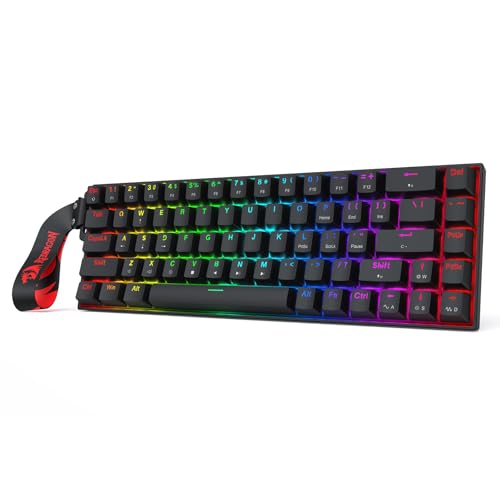
The magnetic board to try the technology on without spending much, and it keeps the arrow keys. Its own title tells you the layout: 68 keys is the ANSI count for a 65%, because the ISO version would have 69. If ANSI is what you want, that is a straight answer rather than a warning.
View ›
A good magnetic board for the money, and one that UK outlets have already picked out at the budget end. It sits in this block rather than the podium for a method reason rather than a product one: it does not declare a layout anywhere, and a guide built on checking the layout cannot rank it above the boards that do.
View ›
This one is here as an illustration rather than a recommendation, and it is the clearest one on the page. Keychron is among the very few makers that does publish British layouts across its range. The version that turns up in this catalogue is the ISO-ES one. Same board, same excellent QMK firmware, wrong country, and nothing in the listing shouts about it.
View ›
For kitting out a desk in one go without thinking about it twice. If you already have a mouse, the money goes considerably further on a keyboard alone.
View ›A keyboard does not play on its own: the mouse next to it
A good keyboard next to a throwaway mouse is a lopsided desk, and in a shooter the mouse is the peripheral you feel most. It is also the one place where the arithmetic is genuinely counter-intuitive, because the number on the box is not the number that matters.
We started from the gaming keyboards on sale in the Amazon Spain catalogue that m8d tracks and kept the ones that on 31 August 2026 were in stock and had their switch technology declared by the maker. That gives eleven boards covering hybrid membrane, mechanical and hall-effect, ordered by the two things that decide the purchase: the switch and the format. Availability, variant names and layouts vary by country, so what your local Amazon lists may not match this page model for model, and the layout offered on your version may not be the one described here. That is precisely why the photo check exists.
The criterion that governs this guide is the layout, and we applied it by reading each maker's own spec sheet one at a time rather than guessing from the brand, and then by going to the makers' own shops to count how many boards they build in each layout at all. When a maker declares a country, we say which. When it does not, we say that too, and we do not translate it into "it is American": we say it is not declared, which is the only checkable statement.
This version differs from the Spanish original in its conclusion, and that is deliberate. The Spanish guide treats an undeclared layout as a mark against a keyboard, because in that market an ANSI board is a board without the letter people need. For a UK reader that logic does not hold: ANSI is a layout plenty of people choose on purpose, and the four boards this guide can rank most confidently on their own merits are not the four with Spanish legends. So the ranking here is built on switch, build and connection, with the layout handed back to you as a decision rather than a score.
Every figure in this guide carries its source and its date. What we do is contrast what each maker declares with what can be checked: the speed figures come from official spec sheets, the layout availability counts come from a manufacturer's own shop filter, and the physical key counts come from the difference between the two layout standards, which is arithmetic rather than opinion.
What is the best value gaming keyboard in 2026?›
Of the eleven we read, the KROM Kernel Pro: a mechanical board with hot-swappable switches, a TKL format and three ways to connect, which is a hard combination to match at its level. If you play competitively and latency is the point, the ATTACK SHARK X68 HE declares the highest speed figures here. If the keyboard also has to be typed on for hours, the EPOMAKER Ajazz AK820 Pro has the best typing feel on this page thanks to its gasket mount.
Do any of these gaming keyboards have a UK layout?›
No. Not one of the eleven declares an ISO-UK layout on its maker's own spec sheet, and we checked each one individually on 31 August 2026. That is not unusual, it is the state of the market: EPOMAKER's own layout filter lists 56 ANSI models against 7 German, 3 Spanish, 2 French and one British. What several of these boards do have is the ISO physical shape, which is the half you cannot change later.
What is the difference between an ISO-UK and an ANSI-US keyboard?›
Physically, one key. An ISO board adds a key to the left of the Z and splits the Enter into a tall L shape across two rows; an ANSI board has a wide flat Enter with a long backslash above it. That is why an ISO board always has exactly one key more than an ANSI board in the same format: 62 against 61 on a 60%, 88 against 87 on a TKL, 105 against 104 on a full-size. The rest is legends and mapping: a British board puts # and ~ on the key beside Enter, moves the pound sign onto Shift and 3, and swaps @ and the quote mark against the US positions.
Can I use a Spanish or German ISO keyboard in the UK?›
Yes, with one caveat that decides it for you. ISO-ES, ISO-DE, ISO-FR and ISO-UK are the same physical keyboard, so setting the language to English (UK) in Windows or macOS gives you the British mapping, including a correct pound sign and a correct hash beside Enter. What it does not do is repaint the keycaps, so three or four keys will have the wrong letters on them. If you touch type, that is a cosmetic problem and a keycap set solves it. If you look at the keys, it will annoy you daily. What no software can do is turn an ANSI board into an ISO one, because the extra key is not there.
How do I tell a keyboard's layout from the listing photo?›
Three checks, ten seconds each. First, the Enter key: a wide flat rectangle is ANSI, a tall L shape is ISO. Second, the key immediately to the left of Enter: on a British board that key is # and ~. Third, the 2 key: a quote mark above it means British, an @ means American. And the count that works in any format: an ISO board has one key more than the ANSI version of the same format.
What is a hall-effect keyboard and is it worth it in 2026?›
It is a keyboard whose switches use a magnet to measure how deep each key is, rather than closing a contact at a fixed depth. That lets you choose the millimetre at which each key activates and enables rapid trigger, which makes the key ready again as soon as you start releasing it. It is worth it if you play shooters seriously, where changes of direction come out cleaner. If you play casually, a mechanical board is not holding you back.
Which gaming keyboard format is best: 60%, TKL or full-size?›
It depends on whether the keyboard also has to do work. A 60% drops the arrows and the function row: it leaves half your desk free for the mouse and plays beautifully, but it makes you use Fn for everything. A TKL only drops the number pad and is the sweet spot for most people. A 75% gets the function row back without taking more space. A 96% packs the numbers in if you work with figures. The short rule: if you are going to work on it, do not go below TKL.
What is the difference between red, blue and brown switches?›
Reds are linear: they go straight down with no bump, and they are the quietest of the three. Blues have an audible click and a pronounced bump, they are lovely to type on and they will annoy anyone in the room. Browns sit in between: you feel a small bump without the click. For gaming most people prefer reds; for a lot of typing, browns; blues only if you live alone.
If I order the wrong layout, can I send it back?›
You can cancel an online order under the Consumer Contracts (Information, Cancellation and Additional Charges) Regulations 2013, and the usual window is 14 days from delivery. But a keyboard with the wrong layout is not faulty, it is what you ordered, so this is a cancellation rather than a fault. Regulation 35(5) says the consumer bears the direct cost of returning the goods unless the trader agreed to cover it or failed to tell you about it. A keyboard is a heavy parcel, which is why the photo check at the top of this page is worth more than the returns policy.
If you take one idea away, take this one: in this category the shape of the Enter key is permanent and the letters printed on the keycaps are not. Decide the shape first. If you want the L-shaped Enter and the pound key, buy an ISO board and set the language in your operating system, whatever the legends say. If you are happy with ANSI, and plenty of people here are, ignore the whole question and buy on the switch. What you should not do is assume that a listing offering several ISO variants must include a British one, because on the numbers it usually does not.
With that settled, the KROM Kernel Pro is the sensible buy for most people, the ATTACK SHARK X68 HE is the one to take if you play competitively and the polling rate is the point, and the EPOMAKER Ajazz AK820 Pro is the one to take if the board has to be typed on as much as it is played on.
The numbers and conditions behind this guide, with who publishes them and when we read them.
- EPOMAKER, own shop layout filterHow many keyboards a maker builds in each layoutANSI · US 56 models, ISO-DE · German 7, ISO-ES · Spanish 3, JIS · Japanese 3, ISO-FR · French 2, ISO-UK · British 1. Read 31 August 2026. The single ISO-UK model in that catalogue is the TH87, which is not one of the keyboards in this guide.
- ISO/IEC 9995 keyboard layout specification and the ANSI arrangementThe physical difference between the ISO and ANSI layoutsThe European layout adds a key to the left of the Z and turns the Enter into a two-row L. That is why it always has one key more than the American layout in the same format: 62 against 61 on a 60%, 88 against 87 on a TKL and 105 against 104 on a full-size board.
- Product spec sheets from KROM, Mars Gaming, Rii, EPOMAKER, Redragon, Attack Shark, The G-Lab and KeychronLayout declared by each makerRead one by one on 31 August 2026. Declaring a Spanish layout: Mars Gaming MK023, KROM KASIC TKL, KROM Kernel Pro, Rii RK802, EPOMAKER Ajazz AK820 Pro (ISO-ES), The G-Lab Keyz Elite 400 HE (QWERTY ES), Keychron K3 MAX (ISO-ES) and RedThunder K62. Declaring nothing about a country: Redragon K631 HE, EPOMAKER Aula WIN60 HE and Attack Shark X68 HE. Declaring ISO-UK: none of them.
- Technical spec sheets from Attack Shark, EPOMAKER, Redragon and The G-LabSpeed figures for the magnetic keyboardsAttack Shark X68 HE: 0.01 mm rapid trigger, 8000 Hz polling, 128 kHz scanning and a declared 0.125 ms latency, with mandatory calibration before first use according to its own spec sheet. EPOMAKER Aula WIN60 HE: declared 0.3 ms latency and 32 kHz scanning. Redragon K631 HE: 68 keys and 8000 Hz polling declared in its own title. The G-Lab Keyz Elite 400 HE: 0.01 to 3.4 mm actuation, 8000 Hz and 80 million declared keystrokes. Read 31 August 2026.
- legislation.gov.ukConsumer Contracts Regulations 2013, regulation 35The consumer bears the direct cost of returning goods unless the trader agreed to bear them or failed to give the information about it. Read 31 August 2026.
- Amazon Spain catalogue, read via APISpec sheets for the eleven keyboardsRead on 31 August 2026. Availability, variant names and the layout offered vary by country.
 Best gaming mouse 2026The peripheral you feel most in a shooter, with DPI turned into centimetres of mousepad.
 Best 27-inch monitors 2026The screen that completes the desk, and the USB-C wattage rule decoded.
 Best PS5 headset 2026If the same desk also has a console on it, its audio rules are nothing like a PC's.
Comments
Be the firstNo sign-up: just a name. Every comment is reviewed before it is published.