Best wireless lavalier microphone in 2026: which one fits your iPhone, Android or camera, how long the transmitter really lasts, and whether it needs an Ofcom licence
 m8d.ioUpdated on
This guide contains affiliate links. As an Amazon Associate, m8d.io earns from qualifying purchases, at no extra cost to you.

- For a phone, without complicating it: the DJI Mic Mini phone pack.
- If you record every day: the Mic Mini 2 with the case, which is the new generation at the old one's level.
- iPhone 14 or earlier: the pack with the Lightning adapter. Nothing else here includes one.
- Camera and phone at once: the Hollyland Lark M2 Combo, with three receivers.
- The hours on the box are the case's, not the microphone's. DJI publishes 11.5 h for the transmitter and 41.4 h with the case. Divide by three or four.
- The percentage means nothing: the same RØDE Wireless Micro appeared in three listings at once, and the one shouting the biggest discount was the dearest of the three.
- And the one only a UK buyer has to think about: 2.4 GHz needs no licence. Channel 38 in the UHF band does, and Ofcom issues it.
Which wireless microphone fits your phone or your camera
These microphones sound far more alike than their connectors do, and the connector is what gets returned. Before you look at anything else, check which one actually fits what you already own.
It is the cheapest kit here that already comes with a USB-C receiver and two transmitters. You record with one and the other stays charged as a spare, which is what stops an interview ending halfway through.
See it on Amazon ›Check the receiver's connector on the listing before you orderDo you need a licence for a wireless microphone in the UK?
Short answer for everything on this page: no. Every microphone here transmits on 2.4 GHz, which is a licence-exempt band in the UK exactly as it is everywhere else, and you can use it on a street, in a hall or in a school without telling anybody. That is worth knowing rather than assuming, because the moment you step up from these to a UHF system the answer changes, and it changes differently here than in most of Europe.
Ofcom is the regulator that decides it, and the map is short enough to hold in your head. Licence exempt: 2.4 GHz, the VHF slice at 173.8 to 175 MHz, and one narrow UHF slice, Channel 70, at 863.1 to 864.9 MHz, limited to 10 mW, which fits roughly four frequencies at once. Needs a licence: the main UHF range, and in particular Channel 38, 606.5 to 613.5 MHz, which is the UK-wide shared band Ofcom licenses for wireless microphones and which fits ten to twelve frequencies. That is the band a school hall or a wedding videographer with several radio mics ends up in, and it is the one people buy second-hand without realising it comes with paperwork.
Switch between the two views. The 2.4 GHz one is physics and explains why the audio drops out at a wedding and never at home. The UHF one is regulation, and it is the view that changes when you cross a border.
In a normal house there is one WiFi network and not much else: the microphone has room to spare and you will not hear a single dropout. Press the button to see what happens somewhere with a crowd.
| Band | Who else uses it | What it means for you |
|---|---|---|
| 2.4 GHz | WiFi, Bluetooth, microwave ovens, remotes | Licence exempt, and what every microphone in this guide uses. Rock solid at home; in a room full of people, dropouts appear. |
| 470 to 694 MHz (UHF) | Digital television and professional stage equipment | Usable here, but Ofcom licenses it. Channel 38, 606.5 to 613.5 MHz, is the UK-wide shared band, and Channel 70 at 863.1 to 864.9 MHz is the only UHF slice that is licence exempt, at 10 mW. |
| 694 to 790 MHz | Mobile networks | Cleared for mobile. A microphone transmitting here cannot legally be used, however well it works. It is where imported and second-hand UHF gear catches people out. |
The second figure that misleads is the range. Hollyland publishes both: 300 metres with line of sight and 60 metres without it. Same device, five times the difference. When a listing advertises 400 metres and stops there, it is giving you the open-field number, which is the one you will never have indoors, because a wall is worth about five to one and a room full of bodies is worse.
The eight compared, on their makers' own figures
| Microphone | Receiver connector | Published transmitter runtime | Published range | Who it is for | |
|---|---|---|---|---|---|
| DJI Mic Mini, phone pack (2 TX + 1 RX) view › | USB-C | 11.5 h | 400 m in the open | A phone, and almost everybody | View › |
 DJI Mic Mini 2 (2 TX + 1 RX + case) view › DJI Mic Mini 2 (2 TX + 1 RX + case) view › | USB-C | not published separately | not published separately | Recording daily, with a case | View › |
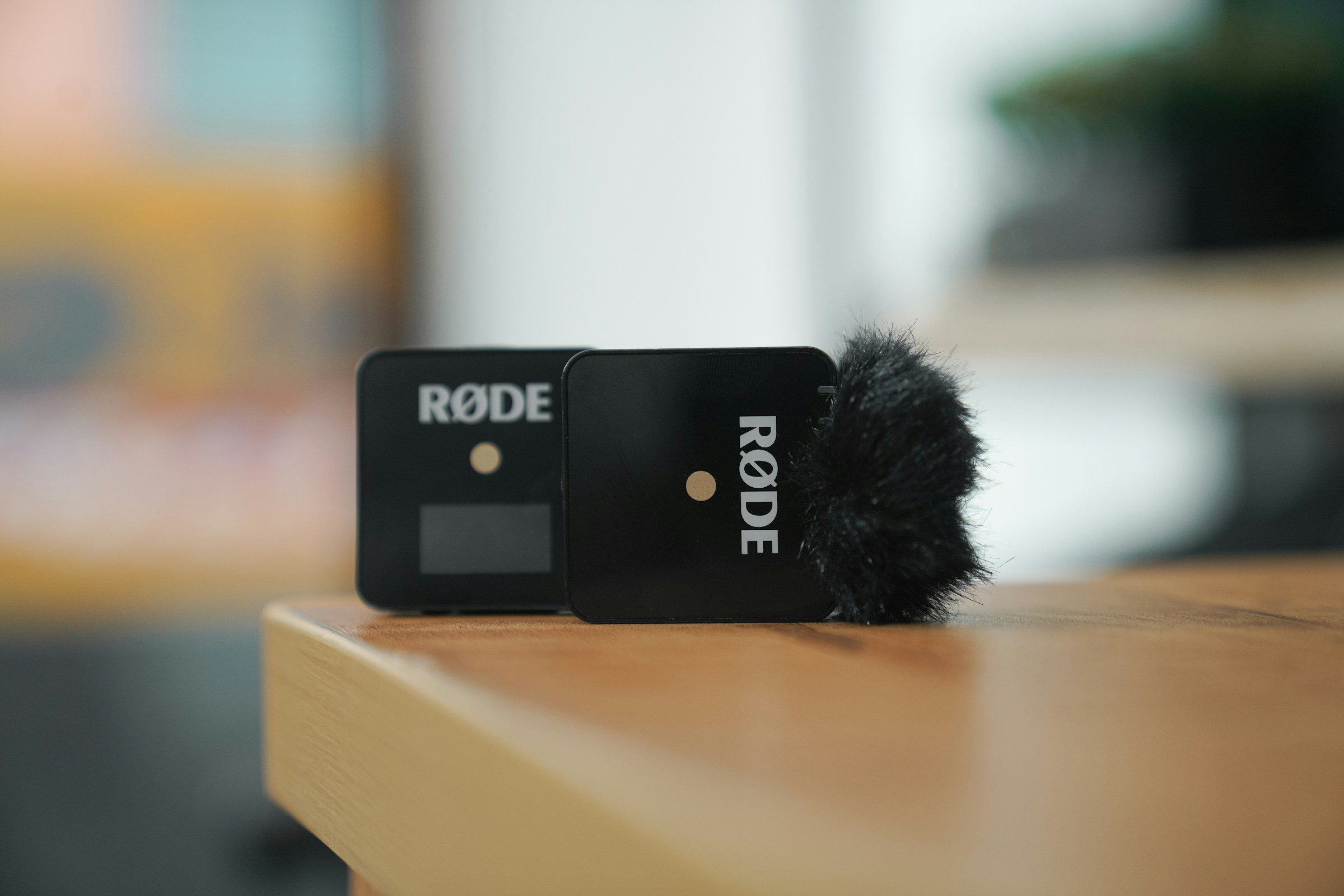
 RØDE Wireless Micro view › RØDE Wireless Micro view › | USB-C | 7 h | around 100 m | Anyone who wants a brand with support | View › |
 Hollyland Lark M2 for phones view › Hollyland Lark M2 for phones view › | USB-C | around 10 h | 300 m line of sight / 60 m with obstacles | Fine fabric, magnetic attachment | View › |
 DJI Mic Mini with a Lightning adapter view › DJI Mic Mini with a Lightning adapter view › | Lightning + USB-C | 11.5 h | 400 m in the open | An iPhone 14 or earlier | View › |
 Hollyland Lark M2 Combo (2 TX + 3 RX) view › Hollyland Lark M2 Combo (2 TX + 3 RX) view › | Camera + USB-C + Lightning | around 10 h | 300 m line of sight / 60 m with obstacles | Camera and phone at once | View › |
 RØDE Wireless GO (Gen 3) view › RØDE Wireless GO (Gen 3) view › | Camera and USB-C | not verified | not verified | Work that cannot be repeated | View › |
 ULANZI A100 view › ULANZI A100 view › | Camera and phone | not verified | not verified | The entry level, knowingly | View › |
Figures from each manufacturer's official documentation, read on 26 July 2026. The highlighted row is our pick. Where a manufacturer does not publish a figure separately the cell says so rather than guessing.
What a discount is legally allowed to claim here
The Spanish edition of this guide made this point with three price tags. The UK version can make it with a statute, which is better, because it turns an observation into a check you can do on any listing in the country.
Since 6 April 2025 the Competition and Markets Authority has had direct enforcement powers over unfair commercial practices under the Digital Markets, Competition and Consumers Act 2024, which replaced the Consumer Protection from Unfair Trading Regulations 2008. It can now fine a business up to 10% of global turnover without going to court first. Misleading reference pricing sits squarely inside what those powers cover, and the CMA published its price transparency guidance on 18 November 2025, having reviewed more than 400 businesses across 19 sectors.
The rule the guidance sets out is short, and once you know it you cannot unsee it on a listing page.
On 26 July 2026 the same RØDE Wireless Micro appeared in three listings at once. Two of them shouted large percentages off a high anchor. One carried no percentage at all. The listing with the biggest discount on it was the most expensive of the three.
Under the DMCC Act the previous price must be "a realistic, meaningful and attainable price", and it must have been offered for a sufficient period on the same website, immediately before the discount begins. An anchor picked from a launch price two years ago, or from a price nobody paid, is what the CMA's new powers exist to deal with. Which does not mean every large percentage is unlawful: it means the percentage is not evidence of anything, and the amount is.
m8d rule: A struck-through price has to be one the product was genuinely offered at, on the same website, for a meaningful period immediately before the reduction. It has to be, in the guidance's words, a realistic, meaningful and attainable price. So the check before you buy anything in this category is not to compare percentages: it is to open two or three listings of the same model and compare the actual amounts being asked. The percentage is chosen by the seller. The amount is not.
How long the battery of a wireless lavalier microphone really lasts
Almost every lapel microphone advertises a big hours figure. That figure is the transmitter's battery plus the recharges the case gives it. What the thing clipped to your shirt actually lasts is three to four times less. The proof comes from the manufacturers themselves, because the good ones publish both numbers separately.
21 hours for the RØDE Wireless Micro.
40 hours on a nameless generic.
7 hours for the RØDE.
The generic does not publish that figure anywhere.
m8d rule: If a wireless microphone advertises more than 15 hours, it is adding the case. Look for the transmitter's own runtime: if the manufacturer does not publish it separately, treat the headline figure as unverifiable and buy accordingly.
Our rule for the bottom of this category, and it is about disclosure rather than money: we only recommend brands that publish a spec sheet where the transmitter's own runtime can be checked. That is not snobbery. Below a certain point the pattern is consistent: 40 hours advertised with no transmitter figure anywhere, noise cancellation that in practice eats the ends of words, and no published documentation to check anything against. Complete kits exist far below anything on this page and we do not link to them, and it is worth explaining that rather than staying quiet about it. Without the transmitter figure there is no way to know whether the microphone outlasts your recording, and that is the only specification that decides whether the thing works.
The six picks, one by one
DJI Mic Mini, phone pack (2 TX + 1 RX) view ›
Two transmitters and a USB-C receiver, and it is the point at which a wireless microphone stops being an indulgence. If you are recording with a phone, this is the one we would buy, and the only thing that would stop us is an iPhone old enough to still use Lightning.
- It is the same microphone as the version with the charging case. The difference is literally a box that recharges it: if you record for less than eleven hours at a stretch, you do not need one.
- DJI publishes 11.5 hours of transmitter runtime and 400 metres of range in open ground with no obstacles. It is one of the few manufacturers that separates those two figures on its own spec sheet.
- It comes with two transmitters. In practice you use one and the other sits charged as a spare, which is what stops an interview ending halfway through.
- Its listing shows a modest reduction against a previous price, rather than one of the enormous ones the section on discounts explains.
- The best value per transmitter on this list
- 11.5 hours published by the manufacturer, not by a seller
- A USB-C receiver that plugs straight in, with no loose cables
- No charging case: when it runs out, that is it until you find a socket
- The receiver is USB-C, so it is no use on an iPhone with a Lightning port
DJI Mic Mini 2 (2 TX + 1 RX + case) view ›
If you are going to pay for a charging case, make it this one. The new generation sits at the same level as the previous generation with a case, so buying the older one today has no defence.
- Checked on 26 July 2026: the Mic Mini 2 with a case and the previous generation Mic Mini with a case sat at exactly the same price. Same money, one generation apart.
- The case is what the extra money buys over the phone pack: it recharges the transmitters without you having to find a socket.
- USB-C receiver. For an iPhone 14 or earlier you need the pack with the Lightning adapter, which is a different reference.
- We do not attribute the first-generation Mic Mini's runtime figures to it: they are different models and we only publish what the manufacturer declares for each one.
- The 2026 generation at the same level as the previous one with a case
- Two transmitters plus a case that recharges them
- The most complete pack in its bracket
- You are paying roughly double the phone pack purely for the case
- USB-C receiver: not compatible with a Lightning iPhone without an adapter
RØDE Wireless Micro view ›
The same model that appears elsewhere with a large percentage shouted across it. This listing carries no percentage at all and sits below them. It is the clearest example on this page of why a discount figure is not a reason to buy.
- On 26 July 2026 the same Wireless Micro appeared in three different listings at once: one with no discount at all, and two shouting large percentages off a much higher anchor. The one shouting the biggest percentage was the most expensive of the three.
- RØDE publishes 7 hours of runtime per transmitter and two more charges from the case, which is where the 21 hours on the box comes from.
- Its published range is around 100 metres, a quarter of what DJI declares for the Mic Mini. On paper it is the shortest here.
- The transmitters pair themselves when you take them out of the case, with no menus and no buttons.
- The lowest real price of its own model across the listings we compared
- The transmitters pair themselves as they come out of the case
- A brand with support and spare parts
- 7 hours per transmitter: the shortest runtime of the three big names
- Published range of around 100 metres, below its rivals
Hollyland Lark M2 for phones view ›
It is the only manufacturer here that publishes the range with obstacles as well as the ideal range. That kind of transparency tells you more about a product than any marketing figure does.
- Hollyland publishes 300 metres with line of sight and 60 metres without it. Same device, and the difference is five to one: that is what a wall does.
- It declares around 10 hours per transmitter and around 30 hours in total with the case, in the phone version.
- The transmitter weighs about 9 grams according to the manufacturer and attaches with a magnet rather than a clip, so it does not deform fine fabric.
- It works on 2.4 GHz with adaptive frequency hopping, which is what lets it hunt for a gap when the band is busy.
- Publishes the real range with obstacles, not only the open-field one
- Magnetic attachment: it does not mark a shirt or a dress
- 10 hours per transmitter, among the best here
- Positioned above the DJI phone pack for broadly similar capability
- The phone version does not include a camera receiver
DJI Mic Mini with a Lightning adapter view ›
If your iPhone is still Lightning, this is the pack that prevents the return. Buying the USB-C receiver and adding a loose adapter works sometimes, and sometimes it does not, and you find out on the day you are recording.
- Apple moved to USB-C with the iPhone 15. Everything before that is Lightning, and a USB-C receiver simply does not fit.
- It is the only pack here that includes the Lightning adapter from the factory, already paired with the receiver.
- The premium over the phone pack buys compatibility, not sound: the microphone is identical.
- Its listing shows a small single-figure reduction, and a small anchor is usually the sign of a credible one.
- Solves the connector problem for older iPhones out of the box
- The same microphone and the same runtime as the phone pack
- The reduction on its listing is modest and therefore plausible
- You are paying a premium you do not need if your phone is already USB-C
- One more adapter to lose
Hollyland Lark M2 Combo (2 TX + 3 RX) view ›
Three receivers in the same box: camera, USB-C and Lightning. If you record with more than one device, it works out below buying two separate kits, and it removes the connector gamble entirely.
- The pack includes, according to the manufacturer, two transmitters and three receivers (camera, USB-C and Lightning), a case, two windshields and a 3.5 mm jack cable.
- It is the answer to the connector problem without having to get the purchase right first time: all three cases are covered.
- Same published figures as the Lark M2: around 10 hours per transmitter and 300 metres with line of sight against 60 without it.
- With two transmitters it records two voices on separate tracks, which is what an interview actually needs.
- Covers a camera, an older iPhone and a modern phone with nothing else to buy
- A 3.5 mm jack cable included for a camera or a recorder
- Works out below two separate kits
- Roughly twice the DJI phone pack
- More kit than you need if you only ever record with the phone
The other two on the list cover the extremes: professional work that cannot be repeated, and the bottom of what we are willing to recommend.
The point at which the microphone stops being an accessory for a phone. Its argument is the internal backup recording: if the link drops, the audio is still being written inside the transmitter, and for a recording you cannot repeat that is the whole ballgame.
View ›It sits right at the line where this category stops being a lottery. Do not expect the hours or the range of the three big names, but it is a brand with a published spec sheet, and that alone separates it from most of what sits below it.
View ›The transmitter that is not a microphone, and how to count the pieces
If you sort by price, sooner or later a DJI Mic Mini appears at a fraction of the kit price. It exists, it is genuine and it works. What it is not, is a kit: it is sold as a bare transmitter, meant for adding a second voice to a system you already own. Without a receiver it records nothing at all. It gets recommended as though it were the complete kit in guides published by large retailers, which is how people end up with a clip and no way to hear it.
DJI Mic Mini, at a fraction of the kit. The same name and the same photograph as the complete kit, sorted to the top of the page by price.
One transmitter. The part that clips to your clothes. Without the receiver the sound goes nowhere, and the receiver is sold separately at a price that erases the saving.
m8d rule: Before you buy, count the pieces in the title. A usable kit always has at least 1 TX and 1 RX. If it only says TX, it is a spare part. And the same counting trick catches the opposite case: a pack listing 2 TX and 3 RX is covering three connectors, which is worth knowing before you decide it is overpriced.
When you do not need a wireless microphone
If you always record sitting in the same spot, less than a metre from the phone, a wireless microphone will not give you anything you do not already have: the phone's own microphone holds up perfectly well at that distance, and what you have gained is one more thing to charge. A wireless system wins when there is distance (you move away from the camera), background noise (a street, a room with people in it) or movement (you walk, you cook, you demonstrate something). If none of those three applies, save the money and spend it on something that does change the recording, such as somewhere quieter to make it.
How we chose these wireless microphones
Questions about wireless lavalier microphones
Do I need a licence to use a wireless microphone in the UK?›
Not for anything in this guide. All of these transmit on 2.4 GHz, which is licence exempt. The answer changes if you move up to a UHF system: the main UHF range is licensed by Ofcom, with Channel 38 at 606.5 to 613.5 MHz as the UK-wide shared band for wireless microphones, and the only licence-exempt UHF slice is Channel 70 at 863.1 to 864.9 MHz, limited to 10 mW. The VHF slice at 173.8 to 175 MHz is also exempt.
Which wireless microphone works with an iPhone?›
It depends on the year. From the iPhone 15 onwards the connector is USB-C, so any kit with a USB-C receiver works. On the iPhone 14 and earlier the connector is Lightning, and you need a pack that includes one: the DJI Mic Mini with the Lightning adapter, or the Hollyland Lark M2 Combo, which brings all three receivers. The compatibility checker at the top of this page answers it in two taps.
How long does a wireless microphone battery last?›
Between 7 and 11.5 hours for the transmitter, which is the part you actually wear. The 21, 30 or 40 hour figures on the boxes add the recharges from the charging case. DJI publishes 11.5 hours for the transmitter and 41.4 with the case; RØDE publishes 7 hours and 21 with the case. If a manufacturer does not publish the transmitter figure separately, that is the answer to your question.
Why does my wireless microphone keep cutting out?›
Almost always because the 2.4 GHz band is congested. It is the same band as WiFi, Bluetooth and microwave ovens, so in a place with many networks and many phones the microphone runs out of gap to sit in. That is why dropouts happen at weddings, fairs and in classrooms and never in your living room. Moving away from the router and shortening the distance to the receiver both help.
Is a big discount percentage a good sign?›
No, and since April 2025 there is a rule you can hold it against. Under the Digital Markets, Competition and Consumers Act 2024 a struck-through price has to be a realistic, meaningful and attainable price that was offered on the same website for a sufficient period immediately before the reduction. On the day we checked, the same RØDE Wireless Micro sat in three listings and the one advertising the biggest percentage was the dearest of the three. Compare the amounts, not the percentages.
Is a very cheap wireless microphone worth it?›
As a spare or to try the idea, possibly. As a working tool, no: at that level the transmitter runtime is not published separately, there is no spec sheet to verify anything against, and the noise reduction tends to eat the ends of words. Our rule is that below a certain point we only recommend brands with public specifications, because without the transmitter figure there is no way to know whether it outlasts your recording.
What is the difference between a lavalier microphone and a wireless one?›
They are not opposites. Lavalier, or lapel, describes where it goes; wireless describes how it transmits. The ones in this guide are both: they clip to your clothes and send the sound over radio to a receiver. Wired lavaliers also exist, cheaper and with no dropouts, but tethered to the device.
Do I need the receiver, or is the transmitter enough on its own?›
You need the receiver. The transmitter is the part that clips to your clothes and on its own it sends the sound nowhere. It matters because bare transmitters are sold as spare parts under the same name and the same photograph as the complete kit, and they sort to the top of a page ordered by price. Count the pieces in the title: a usable kit always has at least 1 TX and 1 RX.
m8d pick, the one that suits almost everybodyDJI Mic Mini, phone pack (2 TX + 1 RX)See it on Amazon ›The newest generation, at the older one's levelDJI Mic Mini 2 (2 TX + 1 RX + case)See it on Amazon ›