Best wireless charger in 2026: Qi2 explained, the genuinely fast pad for iPhone, Samsung and Xiaomi
 m8d.ioUpdated on
This guide contains affiliate links. As an Amazon Associate, m8d.io earns from qualifying purchases, at no extra cost to you.
- For most iPhone owners: the Belkin BoostCharge Qi2 at 15W with magnets, which also takes an Apple Watch and AirPods on the same base.
- Best value: the Iniu two-pack of 15W stands. Two charging points for what most brands charge for one.
- If you travel: the folding Anker MagGo does the same three jobs and flattens into a suitcase.
- A newer 25W tier of Qi2 exists and it is genuinely faster, but supply of those pads comes and goes: the section on watts explains what it changes and when it is worth waiting for.
- The house rule: if the charger does not say Qi2 (with magnets), your iPhone will draw 7.5W no matter how big the number on the box is.
The watts on the box are not the watts your phone gets: the small print of wireless charging
m8d rule: If the charger does not say Qi2 (magnetic), assume your iPhone will charge at 7.5W however loudly the box says 15W. Brands that deliver more always write it down.
Qi versus Qi2: what changed in wireless charging and why it decides your purchase
Qi is the classic standard: coil against coil, alignment by eye, and theoretical maximums that real life trims back. Qi2 adds the ring of magnets inherited from MagSafe: the phone lands on the exact spot every time, efficiency rises and 15W stops being a lottery. The recent revision of the standard certifies up to 25W. The buying consequence is simple: a Qi2 charger does everything a Qi charger did, but not the other way round, and the price gap is now small. In 2026, buying classic Qi only makes sense for a basic bedside pad.
One thing to check before you order, because it is the question that sends most people to a search engine: Qi2 needs magnets on the phone as well as on the charger. Recent iPhones have them built in. Most Android handsets do not, and get them from a magnetic case or a stick-on ring, which costs very little and works. If you are buying for an Android phone, budget for the case rather than assuming the pad will do it alone.
A quirk of the UK market worth knowing. The EU rule that made USB-C the common charging port, Directive 2022/2380, has applied since 28 December 2024, and it does not apply in Great Britain. It does apply in Northern Ireland, through the Windsor Framework, under the Radio Equipment (Amendment) (Northern Ireland) Regulations 2024. The UK government has run a call for evidence on whether to introduce a similar requirement across the whole country. In practice most manufacturers have moved to USB-C anyway to keep one supply chain, but it explains why you can still find new devices here with other ports, and it is one more reason a magnetic pad that does not care which cable came in the box is a sensible buy.
Wireless charger comparison 2026: declared watts, magnets and who each one is for
| Charger | Declared watts | Magnetic | Who it is for | |
|---|---|---|---|---|
 Ugreen MagFlow Pro Qi2 25W view › Ugreen MagFlow Pro Qi2 25W view › | 25W (Qi2) | Yes | The 25W tier, when you can get one | View › |
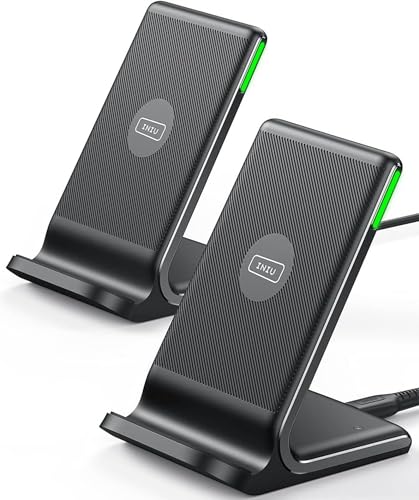 Iniu Stand 15W (two-pack) view › Iniu Stand 15W (two-pack) view › | 15W x2 (Qi) | No | Bedside table and desk in one pack | View › |
 Belkin BoostCharge Qi2 3-in-1 view › Belkin BoostCharge Qi2 3-in-1 view › | 15W (Qi2) plus watch | Yes | The complete Apple bedside table | View › |
 Anker MagGo 3-in-1 folding view › Anker MagGo 3-in-1 folding view › | 15W (Qi2) plus watch | Yes | The same idea, folded for travel | View › |
 Xiaomi Stand Pro 50W view › Xiaomi Stand Pro 50W view › | 50W (Xiaomi's own) | No | Compatible Xiaomi phones, unmatched | View › |
 Lamicall MagSafe car charger view › Lamicall MagSafe car charger view › | 15W (MagSafe) | Yes | The car, with the sat nav running | View › |
 Amazon Basics 10W stand with Qi certification view › Amazon Basics 10W stand with Qi certification view › | 10W (Qi certified) | No | Reliable overnight charging | View › |
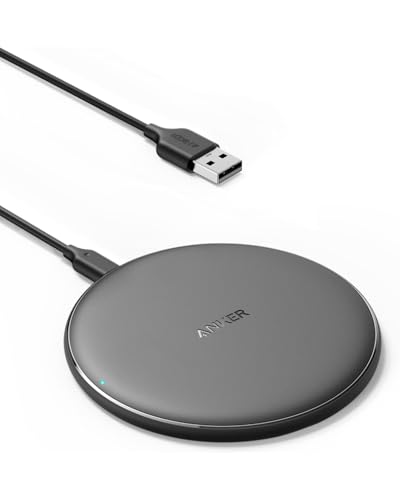 Anker 313 Pad 10W view › Anker 313 Pad 10W view › | 10W (Qi) | No | Trying the category without commitment | View › |
Watts and magnets as declared by each manufacturer on its own spec sheet or store listing, read on 31 August 2026. What each phone actually receives is in the decoder above. Availability and the exact model on sale vary by country: the buttons take you to your local Amazon store.
Best wireless charger for iPhone in 2026: Qi2 or nothing
The search that brings most readers to this guide has a short answer: for an iPhone, the magnets decide everything. On classic Qi an iPhone caps itself at 7.5W. On Qi2 it draws the full 15, and that is the jump worth paying for. If your Apple Watch and AirPods also live on the bedside table, Belkin BoostCharge Qi2 3-in-1 view › covers all three on one base, and Anker MagGo 3-in-1 folding view › does the same job folded into a suitcase. There is a newer certified 25W tier of Qi2, and Ugreen MagFlow Pro Qi2 25W view › is the pad on this list that carries it: it is the fastest thing here when it is in stock, and worth a look before you settle. In the car, Lamicall MagSafe car charger view › turns the magnets into a safety feature rather than a convenience.
Belkin BoostCharge Qi2 3-in-1 view ›
The Apple bedside table, solved by the reference brand: iPhone on Qi2 magnets at 15W, a watch slot and a cradle for the AirPods. Belkin is the maker Apple itself stocks in its own stores, and that pedigree shows in the materials and the stability.
- The Apple Watch slot is a fast-charging one, which is the detail cheap stations usually cut.
- The discount anchor on its listing is a high one. Judge it on the day's price rather than on the percentage next to it.
- For travelling it is heavy and bulky: that half of the head-to-head goes to the folding model in the next card.
- Qi2 with magnets at 15W for the iPhone
- Apple Watch fast charging included
- The reference brand in Apple accessories
- Built to stay on a bedside table, not to go in a suitcase
- Only fully makes sense inside the Apple ecosystem
- The declared discount anchor is worth ignoring
Anker MagGo 3-in-1 folding view ›
The complete station that folds down to the size of a bar of soap: iPhone at 15W on Qi2 magnets, watch and earbuds, in your luggage. For anyone who travels with the Apple ecosystem in their bag, it is the purchase that removes three cables and two plugs.
- Folded it fits in a suitcase pocket, which is the real difference from a desktop station.
- The phone cradle tilts, so you can watch something in a hotel room while it charges.
- Anker, Belkin and Ugreen are the three brands fighting over this category. Here Anker takes the travelling half.
- Qi2 at 15W that genuinely folds flat
- Watch and earbuds covered in the same unit
- A reference brand in charging
- Priced as a full station
- A powerful mains plug is worth adding
- Only pays off completely inside the Apple ecosystem
Ugreen MagFlow Pro Qi2 25W view ›
The fastest pad on this list, and the one that shows what the newer tier of the standard does: certified Qi2 at 25W, with magnets and active cooling to hold that speed instead of throttling. It is worth checking before you settle for 15W. Supply of this one has been coming and going, so if it is not available where you are, the Belkin above is the Qi2 buy that is always there.
- Qi2 at 25W is the recent revision of the standard: on a compatible iPhone it charges at a level that used to require a cable.
- Active cooling matters more than it sounds. Without it, fast pads throttle their watts the moment they warm up.
- The magnets align the coil for you, which is the end of waking up to a half-charged phone because you left it a finger's width off centre.
- Certified Qi2 at 25W: the current ceiling of the standard
- Active cooling to hold that speed instead of throttling
- MagSafe-style magnets for perfect alignment every time
- Your phone has to support Qi2 to get the most from it
- A thick case with no magnets undoes the point of it
- A powerful mains plug is a separate purchase
Best wireless charger for Samsung and Android in 2026
Samsung handsets charge without drama on any decent Qi pad and draw their own fast wireless charging on compatible ones. For most people Iniu Stand 15W (two-pack) view › is the sensible buy, two stands at 15W for the price of one, with Amazon Basics 10W stand with Qi certification view › as the certified basic for a bedside table. The MagSafe-style magnet ring is not standard on Android: with a stick-on metal ring or a magnetic case, the Qi2 pads on this list work for those phones too.
Iniu Stand 15W (two-pack) view ›
Two 15W stands for what other brands ask for one: bedside table and desk solved in a single purchase. The upright format lets you see the screen while it charges, and the indicator dims itself so it does not light up the bedroom.
- The two-pack is the best sum on this list: rarely do watts and cost per unit line up this well.
- In stand format the screen stays readable for video calls and recipes while it charges.
- Its 15W is the ceiling of the classic standard. The small print on what each phone actually receives is in the decoder above.
- Two units for what most brands charge for one
- Stand format keeps the screen visible
- Indicator that dims itself at night
- No magnets: you align it by hand
- An iPhone caps its charging on classic Qi
- Mains plug not included
Best wireless charger for Xiaomi: the 50W only its own brand delivers
Xiaomi Stand Pro 50W view ›
The special case on this list: Xiaomi runs its own protocol, and with a compatible Xiaomi handset this stand charges at 50W without a cable, a speed the open Qi standard does not touch. With any other phone it drops to ordinary speeds. It is a brand charger for its own brand.
- The 50W figure only appears with Xiaomi handsets that support the brand's proprietary charging. That is what makes this listing unique.
- With an iPhone or a Samsung it works, but at ordinary pad speeds, and then it is not worth what it costs.
- Stock runs thin fairly often. If you are its intended buyer and you see it available, it is not a purchase to think about for a month.
- A real 50W with compatible Xiaomi phones: unmatched here
- Stand format with built-in ventilation
- The complete first-party experience
- Outside Xiaomi it loses its entire point
- Needs its own powerful mains plug
- Intermittent availability
The car mount, the certified basic and the way in: the other three chargers
The gap almost every guide forgets: in a car, the magnet is not a convenience, it is a safety feature. The phone snaps on with one movement, charges while it navigates, and comes off with another when you get out. It is worth remembering that holding a phone at the wheel costs 6 penalty points and a fixed fine here, even while you are queuing in traffic.
View ›The stand with no story attached: 10W, a genuine Qi certification and the backing of Amazon's own-label returns. For the bedside table of someone who charges overnight, where speed is irrelevant and reliability is everything, it does the job without charging for a name.
View ›The entry-level pad from a serious brand: the cheapest way to find out whether cable-free charging suits you. Ideal as a second charging point at the office, or as a gift you can give without any risk.
View ›If the watts never turn up: what the Consumer Rights Act actually gives you
m8d rule: You have 30 days from delivery to reject goods that are not as described and get a full refund, and for the first six months a refund cannot be reduced for the use you have had. On a marketplace, the trader you claim against is the seller named on the listing, not the marketplace itself.
Wireless charger checklist: the five points that prevent a disappointing purchase
1. Your phone decides. iPhone: look for Qi2 or MagSafe. Samsung: 15W Qi suits it well. A Xiaomi with the brand's own fast charging: only its own charger reaches 50W. 2. A declared Qi certification. If the listing does not mention one, it is a coil in a plastic shell: move on. 3. The mains plug. Almost none of these include one, and a fast charger plugged into an old 5W cube charges slowly no matter what it cost. 4. Your case. Up to about 3 millimetres (an eighth of an inch) is usually fine; metal plates and pop-sockets never are. 5. Where it is going to live. A bedside table wants a stand or a 3-in-1, a desk wants a stand, a sofa wants a pad, a car wants magnets. The wrong format gets abandoned within a fortnight, and that is the only charger that is genuinely expensive.
Every figure in this guide is the one each manufacturer declares on its own spec sheet or store listing, read on 31 August 2026, cross-checked against what each standard permits a given phone to draw, which is public information published by the wireless charging industry itself. The watts decoder comes from that cross-check and from nothing else. Our product catalogue is read from the Amazon Spain listings that m8d tracks daily, which is part of Amazon's shared European catalogue: availability, the exact model on sale and the seller vary by country, so treat the line-up as a shortlist to check in your own store rather than a stock report. The legal section cites the Consumer Rights Act 2015 directly and links to the text.
What is the fastest wireless charger?›
The genuinely fast one in 2026 is a Qi2 pad certified at 25W, such as the Ugreen MagFlow Pro. It is the newer tier of the standard and it needs a compatible handset. Be careful with the 15W printed on classic Qi boxes: that is the pad's theoretical ceiling, not what your phone receives, and an iPhone without magnets stops at 7.5W.
Which wireless charger should I buy for an iPhone?›
One with magnets: Qi2 or MagSafe. It is the only way an iPhone will charge at 15W or more, because on classic Qi pads it limits itself to 7.5W. Our pick is the Belkin BoostCharge Qi2 3-in-1, which also takes an Apple Watch and AirPods, with the folding Anker MagGo as the travel version. If you want the newer 25W tier and can find one in stock, the Ugreen MagFlow Pro is the faster pad here.
What is the best wireless charger for Samsung?›
Any serious 15W Qi pad suits it, and the best value on this list is the Iniu two-stand pack. Samsung handsets use their own fast wireless charging on compatible pads. With a stick-on magnetic ring or a magnetic case they can also use the Qi2 chargers here.
What is the best wireless charger for Xiaomi?›
If your Xiaomi supports the brand's own wireless fast charging, Xiaomi's 50W Stand Pro is in a class of its own and no open standard comes close. If your model does not support it, any Qi pad on this list will do and the premium is not worth paying.
What is the difference between Qi and Qi2?›
The magnets. Qi2 adds a MagSafe-style magnetic ring: perfect alignment every time, a guaranteed 15W on compatible phones, and a recent revision certifying 25W. Classic Qi still works everywhere, but its real speed depends on you centring the phone properly, and on an iPhone it is capped at 7.5W. Note that Qi2 needs magnets on the phone too, which most Android handsets get from a case rather than built in.
Does a wireless charger damage your phone battery?›
No more than a cable does: phones manage charging and temperature themselves. The honest caveat is heat, because wireless charging runs a little warmer. That is why serious chargers include thermal management, why our top pick uses active cooling, and why it is worth avoiding uncertified generic pads, which save money in exactly that place.
Can I charge with the case on?›
With most slim cases, up to roughly 3 millimetres, yes. With cases carrying metal rings, card holders or loose magnets, no: they block the coil or heat up. MagSafe-compatible magnetic cases are the good exception, because they improve grip on Qi2 chargers instead of getting in the way.
Does the EU USB-C charging rule apply in the UK?›
No. The EU common charger directive, which has required USB-C on many devices since 28 December 2024, applies in Northern Ireland through the Windsor Framework but not in Great Britain, where the government has only consulted on whether to introduce something similar. Most manufacturers have adopted USB-C anyway to avoid running two supply chains, so in practice you will find it on nearly everything new.
The data in this piece comes from the manufacturers' own declared spec sheets, from the charging standard, and from the primary legal text, each with its date of consultation.
- AmazonAmazon product listingsDeclared watts, certifications and magnets for the eight chargers, read via API on 31 August 2026 from the shared European catalogue that m8d tracks daily. The certified 25W Qi2 rating of our top pick appears in its own product title.
- Wireless Power ConsortiumThe Qi2 standardThe specification for the alignment magnets and the power profiles of the standard. Consulted on 31 August 2026: it is the basis of the watts decoder.
- legislation.gov.ukConsumer Rights Act 2015, sections 22 to 24The short-term right to reject within 30 days (s.22), repair or replacement (s.23), and price reduction or final right to reject with no deduction for use in the first six months (s.24). Consulted on 31 August 2026.
- GOV.UKCommon charger for electrical devices: call for evidenceConfirms that Directive (EU) 2022/2380 applies in Northern Ireland under the Windsor Framework and not in Great Britain, and that the UK government sought views on whether to introduce equivalent requirements. Consulted on 31 August 2026.
The purchase, reduced to its rule: your phone first, the format second, and the watts on the box last of all. With that in front of you, Belkin BoostCharge Qi2 3-in-1 view › is the choice for an iPhone that shares its bedside table with a watch and earbuds, Iniu Stand 15W (two-pack) view › is the sensible sum for any Android, and Anker MagGo 3-in-1 folding view › is the one to take away with you. And if you only take one sentence away: without magnets there is no 15W for your iPhone, however big the number on the box.
Comments
Be the firstNo sign-up: just a name. Every comment is reviewed before it is published.