Best MagSafe power bank for iPhone 2026: how many charges each really gives, by its own maker
 m8d.ioUpdated on
This guide contains affiliate links. As an Amazon Associate, m8d.io earns from qualifying purchases, at no extra cost to you.
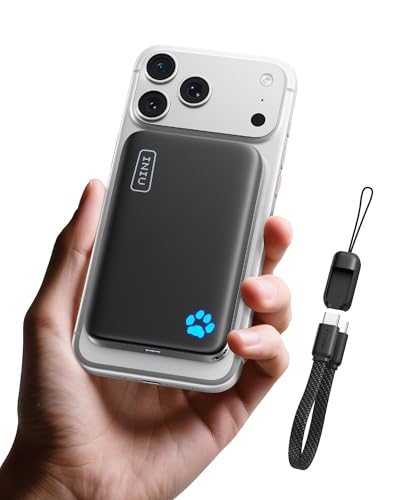
The best MagSafe power bank for an iPhone in 2026 is the INIU MagSafe Qi2.2 at 10,000 mAh: it is the only one of the ten that charges at 25 watts without a cable, and its manufacturer declares 1.8 full charges. If your iPhone is older than the 16, those 25 watts are not available to you and the Anker MagGo Qi2 does the same job. And if a cable does not bother you, the INIU 45-watt delivers more charge for less.
- The mAh on the box are not the mAh that reach the phone. A 10,000 mAh pack delivers between 5,900 and 7,100. That is not our estimate: it comes from dividing the charges each manufacturer declares by the official capacity of the iPhone that same manufacturer names.
- If the listing does not say Qi2, it is 7.5 watts. Half a certified Qi2 pack and a third of what a cable gives you. The magnets are the same; the speed is not.
- The 25 watts of Qi2.2 exist only on the iPhone 16 and later, and not even on the 16e or the 17e. The manufacturer says so on its own listing.
- Since 27 March 2026 you cannot recharge a power bank on board an aircraft, and you may carry only two. It came from ICAO and applies across its member states; the CAA sets it out for flights here, along with the requirement to keep them in the cabin and individually protected.
How many charges a 10,000 mAh pack actually gives
An iPhone 15 Pro has 3,274 mAh. That is an official figure: Apple does not publish it in its technical specifications, but it does publish it on the European Union energy label it has been required to show in its European store since June 2025.
If a 10,000 mAh power bank delivered 10,000 mAh, that phone would charge three times. Take the listing of any magnetic power bank and look at the second-to-last bullet: it says 1.8 charges.
There is no argument to have and no third party to trust. It is the manufacturer publishing the number that dismantles its own headline, on the same page as the headline. And they all do it.
One of them even explains why. INIU's own support pages put the conversion loss at an industry-standard 30% to 40%, and work an example through: a 27,000 mAh pack, they say, typically provides about 16,200 to 18,900 mAh of usable power. That is the arithmetic of this entire guide, published by a manufacturer in the category.
These are the six listings, with the quote as written and the arithmetic done. The bar draws what each manufacturer's own declaration implies about the total it advertises.
providing 1.8 full charges for an iPhone 15 Pro
1.8 × 3,274 mAh of the iPhone 15 Pro = 5,893 mAh delivered out of 10,000. Over the magnets.
can be charged approximately 2 times for iPhone 15 Pro
2 × 3,274 mAh of the iPhone 15 Pro = 6,548 mAh delivered out of 10,000. Over the magnets.
up to two full charges for an iPhone 15, or 1.5 charges for an iPhone 15 Pro Max
1.5 × 4,441 mAh of the iPhone 15 Pro Max = 6,662 mAh delivered out of 10,000. Over the magnets.
the 20,000 mAh can charge your iPhone 16 up to 4 times
4 × 3,561 mAh of the iPhone 16 = 14,244 mAh delivered out of 20,000. Over a cable.
get up to 1.8 charges from this compact magnetic power bank
does not name the model, so the sum cannot be done and we do not do it.
delivers almost 2 full charges for your smartphone
does not name the model, so the sum cannot be done and we do not do it.
The four that name a model declare between 59% and 71%. The magnetic ones sit at the bottom of that range and the only cable-only pack is the one that wastes least.
Quotes taken from each product's listing on Amazon Spain on 31 August 2026, which is the catalogue m8d reads daily. Where we could check the same claim in the manufacturer's own English-language material it matches: Anker publishes the same 1.8 full charges for an iPhone 15 Pro. iPhone capacities: the European Union energy label, which Apple has published in its European store since June 2025. Apple's own technical specifications do not give the capacity, so it is the only official figure that exists. Where a manufacturer does not name the phone model, the cell says so.
The rule, and you can check it in ten seconds. Divide the mAh on the box by the mAh of your iPhone and take off forty per cent. That is what you are going to charge. If you want to verify it without trusting us, find the bullet on the product listing that begins up to X charges: the manufacturer has already written the answer.
Calculator: how many charges for your iPhone
Choose your model and the capacity you are looking at. The sum uses the efficiency the manufacturers themselves declare, not the mAh in the headline.
10,000 mAh advertised × 60% efficiency = 6,000 mAh usable ÷ 3,561 mAh of the iPhone 16 = 1.7 charges.
It is the only one of the ten with Qi2.2, the 25-watt wireless standard. Its listing declares that it reaches 50 per cent of an iPhone 17 Pro in 33 minutes, and that this is 18 minutes less than with 15-watt Qi2. The same listing warns that it only runs at that speed on an iPhone 16 or later, and that the 16e and 17e are excluded.
See it on Amazon ›The efficiency comes from dividing the charges each manufacturer declares on its own listing by the official capacity of the iPhone that same manufacturer cites. The full working, with all six listings, is in the table above. iPhone capacities: the European Union energy label published by Apple, consulted on 31 August 2026.
7.5 or 15 watts: what MagSafe compatible actually means
This is the confusion that costs most money in this category, and it is settled by one word.
MagSafe is Apple's magnet system. Qi2 is the open standard that copied those magnets and also the speed: 15 watts. A product can have the magnets without the speed, and then it is advertised as MagSafe compatible and charges at 7.5 watts, which is half.
What is interesting is that the brands do not entirely hide it. They declare it, just in bullet point four.
The three cases below are taken from the listings of three products in this same line-up, read on 31 August 2026.
The same bullet says: supports 15W Qi magnetic power and, six words later, for fast 7.5W wireless charging. Both figures, in one sentence.
It says it plainly: options of up to 7.5W wireless or a high-speed 30W wired connection. A factor of four between removing the cable and putting it back.
And this one sells on it: 2x faster than other 7.5W MagSafe chargers. A manufacturer in the category confirming which number the rest do not highlight.
m8d rule: If the listing does not say Qi2 or Qi2.2, it is 7.5 watts. The magnets are the same, the speed is half, and the word that tells them apart is always written down: find it before you pay.
Put another way: the whole category fits into three steps, and which one you land on is decided by the phone you already own.
- Anker Zolo
- UGREEN Zapix
- Baseus Ultra Slim
Ratio declared by INIU when comparing its Qi2 pack against 7.5W chargers. No manufacturer publishes an exact minute figure for this step.
- Anker MagGo 10K
- Anker MagGo with stand
- Anker Nano
- INIU Qi2 5K
Figure published by Anker for its 10,000 mAh MagGo on an iPhone 15 Pro.
- INIU MagSafe Qi2.2
Figure published by INIU for its Qi2.2 pack on an iPhone 17 Pro, which it states is 18 minutes less than with 15W Qi2.
The two cable-only packs in this guide do not appear here because they do not charge without a cable, and they are precisely the fastest ones: 45 watts. Any of the three steps above is slower than plugging in.
- Qi2 at 15Wcertified4 packs40%
- Compatible, 7.5Wmagnets without the speed3 packs30%
- Cable onlyno magnets2 packs20%
- Qi2.2 at 25WiPhone 16 or later1 packs10%
How the ten power banks in this analysis divide up according to their own listings, read on 31 August 2026. Availability and the exact model on sale vary by country.
Which speed your iPhone accepts, and where the cut-off is
Magnetic charging has three steps and your phone decides which one you get. From the iPhone 12 to the 15, the ceiling is Qi2 at 15 watts: a 25-watt pack will not go any faster on those models. From the iPhone 16 onwards, Qi2.2 at 25 watts opens up, with two exceptions that INIU takes the trouble to write on its own listing: the iPhone 16e and 17e are excluded.
In terms of what you will notice: on an iPhone 15 Pro, going from 7.5 to 15 watts is the difference between about half an hour and well over an hour to reach half a battery. Going from 15 to 25, on an iPhone that supports it, is roughly 18 minutes less to 50 per cent, according to the figure INIU publishes. And any of the three steps is still slower than plugging in a cable.
If you have an iPhone 15 or older, do not pay for Qi2.2. The 25 watts do not exist on your phone. The premium over a Qi2 pack buys you nothing at all, and the manufacturer says so in the small print of the same listing where it advertises the 25.
Which one suits what you need
The only one here that uses the 25 watts of Qi2.2 that your phone accepts.
See it on Amazon ›The ten iPhone power banks, compared
| Power bank | Capacity | Wireless | Wired | Magnets | Declared charges | |
|---|---|---|---|---|---|---|
| INIU MagSafe Qi2.2 25W 10,000 mAh view › | 10,000 mAh | 25W Qi2.2 | 45W | yes | 1.8 | View › |
 Anker MagGo 10K Qi2 15W ultra-slim view › Anker MagGo 10K Qi2 15W ultra-slim view › | 10,000 mAh | 15W Qi2 | 30W | yes | 1.8 | View › |
 Anker MagGo 10K Qi2 with stand view › Anker MagGo 10K Qi2 with stand view › | 10,000 mAh | 15W Qi2 | 30W | yes, with a stand | not published | View › |
 Anker Nano MagSafe Qi2 15W 5,000 mAh view › Anker Nano MagSafe Qi2 15W 5,000 mAh view › | 5,000 mAh | 15W Qi2 | 20W | yes | not published | View › |
 INIU Qi2 5,000 mAh 20W view › INIU Qi2 5,000 mAh 20W view › | 5,000 mAh | 15W Qi2 | 20W | yes | not published | View › |
 Anker Zolo MagSafe 10,000 mAh view › Anker Zolo MagSafe 10,000 mAh view › | 10,000 mAh | 7.5W | 30W | yes | 2 on an iPhone 15 | View › |
 UGREEN Zapix 10,000 mAh view › UGREEN Zapix 10,000 mAh view › | 10,000 mAh | 7.5W | 20W | yes | 2 on a 15 Pro | View › |
 Baseus MagSafe Ultra Slim 5,000 mAh view › Baseus MagSafe Ultra Slim 5,000 mAh view › | 5,000 mAh | 7.5W | 20W | yes | not published | View › |
 INIU 10,000 mAh 45W with a cable view › INIU 10,000 mAh 45W with a cable view › | 10,000 mAh | none | 45W | no | almost 2 | View › |
 INIU 20,000 mAh 45W for travel view › INIU 20,000 mAh 45W for travel view › | 20,000 mAh | none | 45W | no | 4 on an iPhone 16 | View › |
Figures taken from each manufacturer's listing on 31 August 2026. Where it says the maker does not publish a figure, that is exactly what it means: nothing has been estimated. Availability and the exact model on sale vary by country.
The five we would recommend
INIU MagSafe Qi2.2 25W 10,000 mAh view ›
It is the only one of the ten with Qi2.2, the 25-watt wireless standard. Its listing declares that it reaches 50 per cent of an iPhone 17 Pro in 33 minutes, and that this is 18 minutes less than with 15-watt Qi2. The same listing warns that it only runs at that speed on an iPhone 16 or later, and that the 16e and 17e are excluded.
- The manufacturer declares 1.8 full charges from its 10,000 mAh, which is the figure to look at rather than the one in the headline.
- Over a cable it rises to 45 watts through a detachable USB-C, so it will charge an iPad too.
- On an iPhone 15 or older it behaves like an ordinary 15-watt Qi2 pack: still good, but you are paying for something that phone cannot use.
- The only Qi2.2 pack at 25 watts here
- 45 watts over a cable, enough for an iPad
- The USB-C cable can be replaced if it breaks
- Three-year warranty declared by the manufacturer
- The 25 watts only arrive on an iPhone 16 or later, and not on the 16e or 17e
- At 10,000 mAh it will not fit in a shirt pocket
Anker MagGo 10K Qi2 15W ultra-slim view ›
The most balanced combination here: certified Qi2 at 15 watts, 10,000 mAh and the slimmest body at that capacity. Anker publishes that it takes an iPhone 15 Pro from empty to half in 41 minutes and that it gives 1.8 full charges, and it is one of the few brands that publishes both numbers. Its English-language material states the same figure, which is a small thing that matters: the claim does not change between markets.
- It is the one that documents what it does best: speed, charges and temperature, all on its own listing.
- The USB-C port delivers 30 watts, so it doubles as a desk charger for the iPhone if you forget the adapter.
- It weighs what a 10,000 mAh pack weighs. Stuck to the phone, you notice it in a trouser pocket.
- Certified Qi2, a real 15 watts without a cable
- 1.8 charges declared by the manufacturer itself
- 30 watts over a cable
- Metal frame and declared thermal insulation
- One of the pricier packs here
- It is still a 10,000 mAh brick attached to the back of the phone
Baseus MagSafe Ultra Slim 5,000 mAh view ›
Seven and a half millimetres, thinner than an iPhone 16 itself, with a charge display and 20 watts over a cable. It declares its 7.5 watts wireless without embellishment. For what it costs it is the one that best delivers what it promises, as long as you understand that here the magnets are there to hold, not to hurry.
- Baseus publishes 7.5 watts wireless and 55 per cent in 30 minutes over a cable on an iPhone 16.
- 107 grams (3.8 oz), the lightest of the ten.
- The five-dot display removes the guessing game about how much is left in it.
- The lightest here, and the least expensive
- Thinner than the phone itself
- It declares its real watts without dressing them up
- 7.5 watts wireless: for a fast charge you have to plug it in
- 5,000 mAh will not complete a charge on a Pro Max
INIU 10,000 mAh 45W with a cable view ›
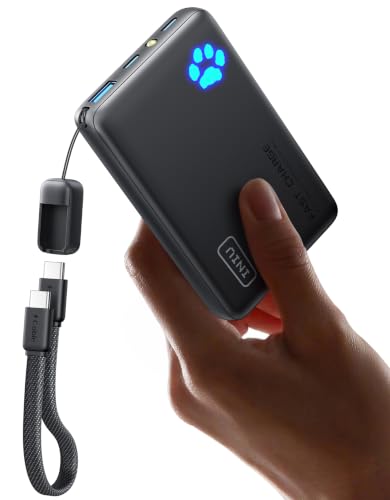
No magnets and no wireless charging, and that is exactly why it wastes less: it delivers the most charge of the 10,000 mAh packs, and it costs about half what the magnetic ones of the same capacity cost. Its manufacturer declares that it takes an iPhone 17 Pro Max to 76 per cent in half an hour. If a cable does not bother you, this is the rational purchase.
- 45 watts over a cable, which is about as high as you will find in a 10,000 mAh pack.
- The short USB-C cable is attached but detachable, so a broken cable does not write off the battery.
- It does not stick to the phone. In a bag that makes no difference; in your hand it does.
- The most charge delivered per pound spent here
- 45 watts, enough for an iPad too
- Built-in and replaceable cable
- No magnets and no wireless charging
- You have to remember that the cable goes with it
INIU 20,000 mAh 45W for travel view ›
20,000 mAh with 45 watts and a built-in cable. Its manufacturer declares up to four charges of an iPhone 16, which is the most honest figure in the whole table: it works out to about 71 per cent efficiency, and that is why it sits at the top. For a weekend away from a socket it is the one that does the job, and at 74 watt-hours it goes through security without a conversation.
- 20,000 mAh at 3.7 volts is about 74 watt-hours, comfortably below the 100 that mark the cabin limit without asking permission.
- The USB-C cable is built in, so it is one less thing to forget.
- It is the heaviest here. It goes in a rucksack, not a pocket.
- Four charges declared for an iPhone 16
- 45 watts over a cable
- Below the 100 watt-hour cabin threshold
- No magnets and no wireless charging
- The weight and bulk of a 20,000 mAh pack
The other five, and who they are for
Seven millimetres thick (about a quarter of an inch) and genuine Qi2. It is the answer for anyone who wants the phone to reach the evening without carrying a brick. With 5,000 mAh you will not complete a full charge of an iPhone Pro Max, and that is worth knowing before you pay.
View ›The same technical base as the ultra-slim MagGo, with a folding stand that holds the phone upright while it charges. It makes sense if you will use it on a table, on a train, or to watch something while it charges, and it makes no sense if you only want it for a pocket.
View ›The cheapest certified Qi2 here, and its listing is the one that explains best why that matters: it says, in these words, that it charges twice as fast as other 7.5-watt MagSafe chargers. That is a manufacturer using the number the rest of the category keeps quiet about.
View ›It is not Qi2 and it does not pretend to be: its listing declares 7.5 watts wireless and 30 with a cable, in the same sentence. That is why it is here. If you are going to use it plugged in and the magnets are only there to stop it falling off in the meantime, it is the most sensible purchase on this list for what it costs.
View ›It is a competent power bank for what it costs, and it is also the best example of the trap in this category: its listing says 15 watts and 7.5 watts in the same bullet, six words apart. What you will get is 7.5. It is recommended knowing that, and on its price rather than on the larger number.
View ›You can no longer recharge it in the air, and you may carry two
Several of these listings advertise themselves as flight approved or airline safe. That is still true, and it is still incomplete.
On 27 March 2026 new specifications from the International Civil Aviation Organization came into force. Its announcement says two things in as many words: that these devices are limited to two per passenger and that passengers will be prohibited from recharging them during flight. It was approved by the 36 states of the Council and applies across its 193 member states.
For flights here, the Civil Aviation Authority sets out the same package and adds the detail that matters at the gate: they must be in carry-on baggage and never in the hold, they must be individually protected (original packaging, taped terminals or a separate bag), and they should not be used to charge other devices during the flight either. You may also be asked to keep the pack in the seat pocket rather than the overhead locker.
The capacity limit did not change and is the same as ever: up to 100 watt-hours travels with no permission needed, 100 to 160 requires the airline's approval, and above 160 does not fly. None of the ten here comes close: the largest, at 20,000 mAh, is about 74 watt-hours.
And here is a distinction worth holding on to, because not everything published about this says the same thing. The ICAO announcement is about recharging the pack on board and about a maximum of two per passenger. Several airlines have gone further and also prohibit using it during the flight and storing it in the overhead locker. Those are two different things, and the one that applies to you is your airline's: it is a one-minute check on their electronic devices page, and it is worth doing before you get to the airport.
When not to buy a magnetic power bank
There are three situations where the magnets are money wasted, and no guide in this category says so.
If you are going to use it on a bedside table or a desk. For that you do not want a battery, you want a charger plugged into the wall: it is faster, it does not run down, and it does not sit warm against the phone. Our charger guide covers that case.
If you use a thick case or one with a card holder. The magnet has to reach through it. With a thin silicone case nothing happens; with one over three millimetres, or with cards inside, the pack peels off in your pocket and you discover mid-afternoon that it has charged nothing at all.
If what you want is the most charge per pound. Then the magnets work against you twice: wireless charging wastes more energy, and the same money buys less capacity. The two cable packs in this line-up deliver more and cost less.
We went through the catalogue of magnetic and cable power banks for iPhone in the Amazon listings that m8d tracks daily, across six separate searches, and kept ten models with availability verified on 31 August 2026. We read each one's full manufacturer listing.
What has been checked and what has not. The watt, capacity and charge figures are the ones each manufacturer publishes on its own listing, quoted as written where it matters. Those listings are the Amazon Spain ones, part of Amazon's shared European catalogue: availability, the exact model and the seller vary by country. Where we could check the same claim in the manufacturer's own English-language material it matched. iPhone capacities come from the European Union energy label, which is the only official figure that exists because Apple does not publish it in its technical specifications. The flight rules come from the International Civil Aviation Organization announcement of 27 March 2026 and from the Civil Aviation Authority, which sets out how they apply here.
What this guide contributes is having read all ten listings in full, cross-referenced what they declare against the official capacity of each phone, and published the arithmetic so that anyone can repeat it. Where a manufacturer does not publish a figure, the table says so rather than estimating it.
How many charges does a 10,000 mAh power bank give an iPhone?›
Between 1.5 and 2.2 full charges depending on the iPhone model and on what the power bank's own manufacturer declares. It is not three, which is what you would get if all 10,000 mAh reached the phone. Between 30 and 40 per cent is lost to voltage conversion, a figure INIU itself publishes as the industry standard, and more again if you charge through the magnets rather than a cable.
What is the difference between MagSafe and Qi2?›
MagSafe is Apple's magnetic system. Qi2 is the open standard that adopted that ring of magnets and also the 15-watt speed. A product can have the magnets without the speed: it is advertised as MagSafe compatible and charges at 7.5 watts, which is half. If the listing does not say Qi2, assume 7.5 watts.
What is Qi2.2 and which iPhones support it?›
Qi2.2 is the 25-watt version of the standard. According to INIU's listing, it is supported only by the iPhone 16 running iOS 26 and later models, with the exception of the iPhone 16e and the iPhone 17e. On an iPhone 15 or older, a Qi2.2 pack behaves exactly like a 15-watt Qi2 one.
Can I take a MagSafe power bank on a plane?›
Yes, in hand luggage and never in the hold. Since 27 March 2026 the International Civil Aviation Organization limits you to two per passenger and prohibits recharging them during the flight, and the Civil Aviation Authority sets out the same package for flights here, adding that they must be individually protected and should not be used to charge other devices in the air. The capacity limit remains 100 watt-hours without permission, 100 to 160 with the airline's approval, and nothing above 160. A 20,000 mAh pack is about 74 watt-hours. Individual airlines can be stricter, so check yours.
How do I work out the watt-hours of a power bank?›
Multiply the mAh by 3.7 and divide by 1,000, because the cells run at 3.7V. A 5,000 mAh pack is 18.5 Wh, 10,000 mAh is 37 Wh and 20,000 mAh is 74 Wh. All ten in this guide are comfortably under the 100 Wh threshold, so none of them needs the airline's permission on capacity grounds.
Will it work through a phone case?›
It depends on the case. A thin silicone case is no obstacle. A case thicker than about three millimetres, one with a metal plate, or one with cards in it will weaken the magnet enough that the pack works loose in a pocket, and you find out hours later that nothing charged. MagSafe-compatible cases are designed to keep the hold and are the safe option.
The sources behind the specific figures in this guide. The manufacturer listings were consulted on 31 August 2026 and are the ones quoted as written in the text.
- International Civil Aviation OrganizationNew power bank restrictions will safeguard international aviationThe origin of the two-per-passenger limit and the prohibition on recharging in flight, in force since 27 March 2026.
- Civil Aviation AuthorityChanges to the rules on the carriage of lithium cells, batteries and power banksHow the same rules apply to flights here: carry-on only, a maximum of two per person, individual protection, no recharging on board, and the 100 Wh and 100 to 160 Wh thresholds. Consulted on 31 August 2026.
- INIUHow many times can I charge my device with this power bank?A manufacturer in this category putting the conversion loss at an industry-standard 30% to 40%, and working an example through. It is the arithmetic of this whole guide, published by a maker rather than by us. Consulted on 31 August 2026.
- AppleEuropean Union energy label for each iPhoneThe only official source for battery capacity in mAh: Apple's technical specifications do not publish it.
- AnkerListings for the MagGo 10K Qi2, Nano Qi2 and Zolo MagSafeThe source of the certified 15 watts, the Zolo's 7.5, and the declared charges per iPhone model. Anker's own English-language material states the same 1.8 full charges for an iPhone 15 Pro.
- INIUListings for the MagSafe Qi2.2 25W, the Qi2 5K and the 45-watt cable packsThe source of the Qi2.2 compatibility cut-off and of the comparison against 7.5 watts that the manufacturer itself makes.
- UGREENListing for the Zapix MagSafe Power Bank 10,000 mAhThe listing that states 15 watts and 7.5 watts in the same bullet, six words apart.
If you have an iPhone 16 or 17, the INIU Qi2.2 is the only one that uses what your phone accepts, and its manufacturer is among the few that publishes real charge counts. If your iPhone is older than the 16, those 25 watts do not exist for you and the Anker MagGo Qi2 does exactly the same job. And if a cable does not bother you, the INIU 45-watt delivers more charge than any of the magnetic packs for considerably less: it is the rational purchase, even if it is the least glamorous.
Whichever you choose, read the listing before you pay and look for the word Qi2. If it is not there, it is 7.5 watts.
Comments
Be the firstNo sign-up: just a name. Every comment is reviewed before it is published.