Best reverse osmosis system UK 2026: which to buy by the water it wastes, the pressure it needs and your water bill
 m8d.ioUpdated on

This guide contains affiliate links. As an Amazon Associate, m8d.io earns from qualifying purchases, at no extra cost to you.
The best reverse osmosis system for a UK home is chosen by what goes down the drain, a figure few listings print: the US EPA puts ordinary units at 4 to 9 litres per litre. Our pick: the Waterdrop X8, certified to NSF/ANSI 58. With published figures: the BWT MO575MBWT. For low pressure: the Hidrowater Nereo.
Is a reverse osmosis water filter worth it in the UK? What tap water already meets, and what the membrane adds
Start with what already comes out of the tap. The Drinking Water Inspectorate's report on 2025, published on 7 July 2026, found that 99.97% of regulatory samples from public supplies in England met the standards set to protect public health, and water companies ran more than 635,000 individual PFAS analyses in England that year, with two results at or above the 0.1 µg/L guidance value. So in most homes in England reverse osmosis is not a safety purchase. What it buys is different and concrete: drinking water with almost none of the dissolved salts behind kettle limescale, and a membrane that holds back most of what is dissolved in water. Waterdrop, for instance, lists PFOA and PFOS among what its X8 reduces on its product page.
What it costs is just as concrete, and it is the part almost nobody puts in pounds: the water that goes down the drain. Around 60% of households in England and Wales have a water meter, according to WaterSafe, the approved plumbers' scheme, and those homes pay for that water twice, once coming in as clean water and again leaving as wastewater. The other 40% are on a fixed bill and will not see it on paper, although the water goes all the same.
Reverse osmosis waste water on a UK water bill: the waste water and cost per litre calculator
Reverse osmosis waste water and cost per litre calculator
The question behind reverse osmosis in the UK is whether it pays, and the People Also Ask box puts it bluntly: does a reverse osmosis system increase your water bill? This calculator answers both at once, with what is exact (the water that goes in, the water that goes down the drain and what a metered cubic metre costs) and with the published price of what you drink now. Free, no sign-up, no ads. Example with the starting values: two people drinking and cooking with 4 litres a day and a unit that does not state its ratio send 5,840 to 13,140 litres a year down the drain, and filters plus water cost 9.4p to 11.5p a litre, against 40p for supermarket bottled water: about £36 a month you stop spending.
2 people at 2 litres a day make 1,460 litres of drinking and cooking water a year. Without a declared ratio the sum splits in two. At 20% efficiency, 7,300 litres go in and 5,840 go down the drain; at 10%, 14,600 go in and 13,140 go down the drain. That difference is £31 a year of water and nothing more, yet it is the same kind of unit with two different sheets.
With that ratio, the unit falls below the only published efficiency bar. The WaterSense specification of the US Environmental Protection Agency, in force since 14 November 2024, asks for a minimum efficiency of 30%, which is at most 2.3 litres down the drain for every litre out of the tap. With what you have picked, 5.7 litres go down the drain per litre you drink. It is not illegal and not a fault in the unit: it is where most of the market still sits, which is why it is worth checking before choosing.
Against supermarket bottled water, you save £437 a year. Each litre costs 10.1p to run, counting filters and water. With the dearer of the two published filter bills we read (the two run from £106 to £150 a year for filters and membrane), it would rise to 13.1p, still far below the cost of buying it.

Drain water is arithmetic: if a unit keeps a fraction r of the water that goes in, for every litre that reaches the glass 1/r go in and (1 − r)/r go down the drain, which is the efficiency definition NSF/ANSI 58 uses and the formula the EPA publishes in its WaterSense specification. The 2 litres per person a day are this guide's working ration, deliberately conservative and set between two official figures: the NHS advice to drink 6 to 8 cups or glasses of fluid a day, and the EPA's WaterSense specification, which counts 940 gallons per household a year for drinking and cooking, 3.8 litres per person a day at 2.57 people per household. The cubic metre of water, Thames Water's metered household charges from 1 April 2026, £2.7346 per cubic metre of clean water plus £1.4721 per cubic metre of wastewater, added together because a metered home pays for every litre the unit takes in and the waste leaves as sewage; your own company's rates are on your bill, and a home on a fixed, unmetered bill pays nothing per litre. The price per litre of supermarket bottled water, the supermarket own-brand still water price Discover Water publishes for January 2026, 80p for 2 litres from a national supermarket's online prices; a premium brand was 145p for the same 2 litres. The filters, the lower of the two filter bills published by makers on their UK stores that we read on 23 September 2026: UK Water Filters sells a five-filter pack for its own under-sink system at £39.95 every six months and a membrane at £79 every two to three years, £106 to £119 a year; the range from £106 to £150 a year, the two published filter bills we read on 23 September 2026: UK Water Filters for its own under-sink system, and Waterdrop's UK store for the X8, whose F1G filter at £29.99 every 12 months, F2 filter at £29.99 every 6 months and X8-F3 membrane at £119.99 every 24 months come to £150 a year. The 10 to 20% range when the sheet does not say, the range where three independent sources agree: the supporting statement of the EPA's WaterSense specification of November 2024, the 2011 water filter report of OCU, the Spanish consumers' association, and BWT's own sheet for the MO575MBWT. The 30% bar, the WaterSense specification for point-of-use reverse osmosis systems, version 1.0, published by the US Environmental Protection Agency and in force since 14 November 2024.
How much water a reverse osmosis system sends down the drain, and why 3:1 can mean opposite things
A reverse osmosis system pushes water against a membrane. Part of it gets through and reaches the tap; the rest carries away what did not get through and goes down the drain. The ratio between the two has a name in the standard that certifies these units, efficiency, and it decides whether your home sends five thousand litres a year down the drain or fifteen thousand.
The US Environmental Protection Agency measured it across the market to write its WaterSense specification, and put it this way in the supporting statement of November 2024: typical home units operate at efficiencies between 10 percent and 20 percent, meaning that they send approximately four to nine gallons of water down the drain for every gallon of treated water produced. BWT's own sheet for the MO575MBWT, one of the six in this guide, declares recovery: 10 - 20 %, and OCU, the Spanish consumers' association, published the same range back in 2011. Three kinds of source, fifteen years apart, one figure. On a Thames Water meter in 2026-27, that waste costs a household of two about £25 to £55 a year, charged as clean water on the way in and as wastewater on the way out.
Reverse osmosis waste is sold with a colon in the middle and hardly ever with the word that says what sits on each side. The same pair of numbers, 3:1, describes today a unit that keeps 75% of the water and another that keeps 25%, and the only way to tell them apart is the manufacturer's own sheet.
Three litres out for one down the drain: 75% efficiency. That is how the AQUALTRA USF-AR-600 writes it in its listing on the European catalogue we track, and another AQUALTRA model spells the word out: purified to waste water ratio 3:1. Read that way, the big number is the good part.
Three litres down the drain for every one out: 25% efficiency. That is how the maker of the iSpring RCC7AK declares it on its own site: the system uses three gallons to produce one. The same pair of numbers, the order reversed, and three times the water on your bill.
Efficiency and recovery are not synonyms, and the difference is the tank. The efficiency rating is the share of incoming water that ends up available to you in conditions close to daily use, tank back-pressure included. The recovery rating is the same thing measured without the tank or with it bypassed. The EPA says plainly that the second will always be higher than the first, which is why it called the term recovery rating confusing and potentially misleading and kept it off its label. A tankless unit and a tank unit cannot be compared with those two numbers.
30%, which is 2.3 litres down the drain for every litre out. The WaterSense specification for point-of-use reverse osmosis systems, version 1.0, in force since 14 November 2024, sets a minimum efficiency of 30% for its label. The industry standard ASSE 1086 of 2020 asks for 40% recovery, and NSF/ANSI 58, the product standard, requires a certified unit to remove at least 75% of total dissolved solids. The ordinary market sits at 10 to 20%.
m8d rule: A waste figure without the word that defines it is not data. Before comparing two units, ask whether that 3:1 is efficiency or recovery and which side the three is on, because the same pair of numbers describes both a unit that keeps 75% of the water and one that keeps 25%.
Do you have to tell your water company before fitting a reverse osmosis system? Yes, under the Water Fittings Regulations
In England and Wales, yes, and before the work starts. Regulation 5 of the Water Supply (Water Fittings) Regulations 1999 lists the installations you must notify to your water company, and item 4(e) of its table reads, word for word, a unit which incorporates reverse osmosis. The company then has ten working days to refuse or to attach conditions; if it says nothing in that time, consent is treated as given. The exemption for approved contractors covers three other items on that list, not this one, so the notice is needed even when an approved plumber fits the unit. South East Water's guidance adds the part nobody likes to read: breaching these Regulations is a criminal offence and can lead to prosecution.
The other thing the regulations care about is the drain side. WRAS, the Water Regulations Approval Scheme, describes its approval as an easy way to show a fitting complies, and one of its installation requirement notes, R510, reads: This unit must discharge via a backflow protection device which gives fluid category 5 protection, for example a type AA or AB air gap or an air break to drain that complies with BS EN 1717. In plain terms, the unit's drain line must never be able to push dirty water back towards the drinking supply. Scotland and Northern Ireland have their own versions of these rules, so there the question goes to Scottish Water or NI Water.
The two questions to ask before paying, and both are about paperwork. First, the performance data sheet: NSF/ANSI 58 requires it to exist and to be available to buyers, with the verified efficiency and the daily output in it. If the seller has it, the number is there and the doubt is over; if not, the ratio in the listing is a promise nobody outside has checked. Second, whether the unit and its drain fitting meet the Water Fittings Regulations: WRAS approval is the easy answer, and the notice to your water company comes before the plumber, not after.
What water pressure a reverse osmosis system needs, and why the UK minimum is only about 1 bar
Low pressure can make a newly fitted reverse osmosis system disappoint with nothing broken, and none of the four guides we read from the UK top ten mentions the UK minimum. The minimum standard water companies work to, as published by Discover Water, the site backed by Water UK, Ofwat, the Drinking Water Inspectorate and the Consumer Council for Water, is 10 metres head at the boundary stop tap with a flow of 9 litres a minute, roughly 1 bar, the same as filling a 15-litre bucket in 100 seconds. In March 2025, 42,783 properties in England and Wales were below even that.
Now the spec sheets. BWT's MO575MBWT asks for 3 to 6 bar and has no pump. The Bbagua EUR-50, 3 to 5. The iSpring RCC7AK, 45 to 70 psi, which is 3.1 to 4.8 bar. The Hidrowater Nereo asks the least, 2.5 to 4.2. So three of the four systems in this guide that publish their pressure need at least three times the UK minimum. The sheets are not lying: they are written for mains that deliver more than the minimum, and on an upper floor or at the end of a long supply pipe, the minimum is exactly what you get.
“Works on mains pressure” is the phrase that sells units without a pump. What it does not say is which mains pressure, and the gap between the sheet and the standard is three to one.
3 bar minimum for the BWT, the Bbagua and the iSpring, and 2.5 bar for the Hidrowater. None of the four has a booster pump.
A reference level of 10 metres head, about 1 bar, at the boundary stop tap with 9 litres a minute flowing, according to Discover Water. Anything above that is a bonus of your street, not a right.
m8d rule: Before buying a unit without a pump, measure your pressure: if a tap-mounted gauge reads below the minimum on the sheet, you need the pumped version of the same range.
How to find your pressure before buying, and what to do with the result. Before any other step, we recommend a tap-mounted pressure gauge: screw it onto the washing machine or outside tap, open it fully with the rest of the house off, and read the needle. Discover Water's own rough check is a 4.5-litre container filled from a ground-floor tap in 30 seconds; if it takes longer, your supply is below that minimum. Below 2.5 bar, none of the four systems here that state their pressure is for you, and the answer is a pumped unit. Between 2.5 and 3 bar, the only one that declares it works there is the Hidrowater. From 3.1 bar, all four. And low pressure does not only slow the tank: it makes the membrane perform worse, because the flow through it is proportional to the net pressure pushing it and the salt passage is not. Less pressure means less water and worse water, both at once.
What reverse osmosis takes out of water, what the WHO suggests putting back, and what a remineraliser really does
A reverse osmosis membrane does not tell apart what you want from what you do not: it removes salts, and calcium and magnesium are salts. The sheets in this guide say so plainly, the Hidrowater between 96% and 97.5% of dissolved salts and the Bbagua between 85% and 95%. That is why so many units are sold with a remineraliser, and a few are sold with exactly the opposite, low-mineral water, as the selling point. The same shelf, two opposite promises.
The source that settles it is the chapter on demineralised water in the WHO book Nutrients in Drinking Water. On page 155 it describes low-mineral water as unstable and aggressive towards the materials it touches, dissolving metals from pipes, coatings, tanks and fittings more easily. On page 157 it puts numbers on what should go back: at least 10 mg/L of magnesium, 20 to 30 at best; at least 20 mg/L of calcium, around 50 at best; and total hardness of 2 to 4 millimoles per litre.
And the figure that changes the conversation about remineralisers. The BWT MO575MBWT is sold with its remineraliser in the product name, and its maker publishes on the official sheet what comes out of the tap after that stage: a balanced pH ranging from 6.5 to 7.5... a total mineral content of 20-30 mg/L, with calcium levels below 10 mg/L and magnesium less than 1 mg/L. Set next to the WHO figures, calcium stays below half the minimum and magnesium below a tenth. Publishing it counts in the brand's favour: it is the only one of the six that lets you make this comparison. It also explains why the maker of the Bbagua EUR-50 argues the opposite in writing, that it has no remineraliser because it considers it unnecessary when everything is obtained from food. The useful reading: the remineraliser in a home reverse osmosis unit corrects pH and taste and makes the water less aggressive, but it does not put back the minerals the membrane took out. If your drinking water comes from the membrane, calcium and magnesium come from food. And one detail from the same WHO chapter that almost nobody mentions: cooking in very soft water draws minerals out of food, with losses of up to 60% of calcium and magnesium. For boiling vegetables, tap water does the better job.
Tank or tankless reverse osmosis: space under the sink, the wait, and what sits in the tank
The obvious difference is space and waiting. A tank system is a filter block plus a pressurised tank of 8 to 15 litres that has to fit in the cupboard under the sink, and it produces slowly: the BWT in this guide declares 8 litres an hour and a 12-litre tank, so it fills in an hour and a half. A tankless unit has no tank, fits in a narrow body and gives water on demand, but almost always needs a plug socket under the sink, and in many UK kitchens that means calling an electrician.
The difference listings do not mention is inside the tank. The WHO chapter on demineralised water records a finding of the Czech National Institute of Public Health, which assesses products that come into contact with drinking water: the pressure tanks of reverse osmosis units are prone to bacteria growing back, mainly because treatment removes the residual disinfectant, and the rubber bag inside them offers a surface bacteria like. It is not a reason to avoid a tank system, which is half the market and has worked for decades. It is the reason to drink the water rather than leave it standing for weeks, and why a unit that is used little is better off tankless.

Runs on mains pressure alone, declares seven stages with remineralisation and two litres out for every one down the drain.
See it on Amazon ›The six reverse osmosis systems in this guide, with what each maker declares
| System | Water to drain | Pressure it needs | Tank | Standard in its listing | |
|---|---|---|---|---|---|
| Waterdrop X8 view › | 2 out for 1 · 67% | not stated | tankless | NSF/ANSI 42, 58 and 372 | View › |
| Waterdrop T3-T view › | 2 out for 1 · 67% | not stated | not stated | NSF/ANSI 372 | View › |
 iSpring RCC7AK view › iSpring RCC7AK view › | 1 out for 3 · 25% | 3.1 to 4.8 bar | yes, pressurised | NSF/ANSI 58 | View › |
 BWT MO575MBWT view › BWT MO575MBWT view › | recovery of 10 to 20% | 3 to 6 bar | 12 litres | none cited | View › |
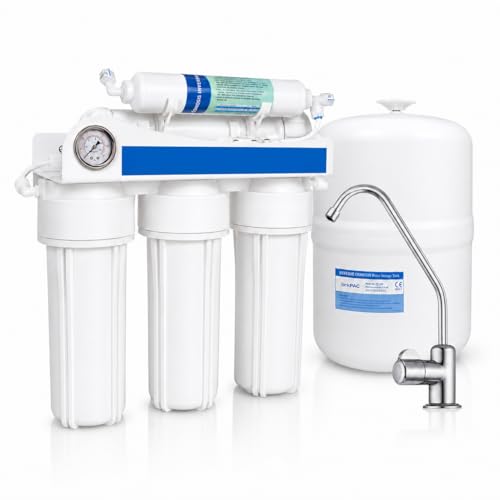 Bbagua EUR-50 view › Bbagua EUR-50 view › | says low waste, no figure | 3 to 5 bar | 8 usable litres | none cited | View › |
 Hidrowater Nereo RO-0206-12 view › Hidrowater Nereo RO-0206-12 view › | not declared | 2.5 to 4.2 bar | about 15 litres | none cited | View › |
The water and pressure columns come from the manufacturer's sheet where there is one and from the listing where there is not, read on 6 September 2026; the Waterdrop X8's figures were read again on its UK store on 23 September 2026. The standard column counts only what the listing says, which is what you read before buying. The 67% and the 25% turn the declared ratio into efficiency: a unit that says 2:1 with the two on the good side keeps two litres of every three. Ordered from most to least water kept.
Waterdrop X8 view ›
It is the unit in this guide that does well what the guide measures, and proves it: it declares two litres out for every one down the drain and holds certification to NSF/ANSI 58, the product standard for home reverse osmosis, which requires at least 75% of dissolved solids removed and the verified efficiency published in the instructions and data sheet. What you have to accept is the price: it is the most expensive of the six by a distance, and the difference is not in the water but in the flow, the tap and the certificates.
- Its UK store page lists certification to NSF/ANSI 42, 58 and 372, read on 23 September 2026. Standard 58 is the one that matters here: it requires a certified unit to remove at least 75% of total dissolved solids and obliges the maker to state its verified efficiency in the instructions and in the performance data sheet, which has to be available to buyers.
- The range sheet declares 800 gallons a day and a ratio of two litres out for every one down the drain, 67% efficiency: more than double the 30% the EPA's WaterSense specification asks for its label.
- Waterdrop's own site writes, in the details of its 600-gallon model, that in use the real ratio may be lower than the labelled one, depending on water quality, pH, pressure and temperature. It is the most candid warning in this category, and it comes from the maker itself.
- Nine stages and filters rated up to 24 months. Its UK store lists the life and price of each: the F1G every 12 months, the F2 every 6 months and the X8-F3 membrane every 24 months, which is the dearer of the two filter bills used in the calculator.
- It is the most expensive unit in this guide by a distance, and it is worth saying where the money goes: the flow, the tap with its display and the certifications. The water out of the membrane is not better for costing more; what changes is how long a jug takes and how much you know about what you bought.
- Certified to NSF/ANSI 58, the standard that verifies what a reverse osmosis unit does
- Two litres out for one down the drain: 67% efficiency
- 800 gallons a day: fills a jug with no tank and no wait
- The maker publishes each filter's life in months and gallons
- The most expensive in this guide, by a distance
- Needs a plug socket and a drain connection under the sink
- Its UK page does not state the inlet pressure it needs
BWT MO575MBWT view ›
Its official sheet is the most candid of the six, which is why it is here even though the number it publishes is not the best: it says, in those words, that its recovery is between 10 and 20%. It also publishes the inlet pressure it needs, the working temperature and, what hardly anyone publishes, the composition of the water after its remineraliser. With those figures you can do the whole sum before buying, which is exactly what this guide asks for and what almost no rival lets you do.
- Its official sheet declares recovery between 10% and 20%. It is the only one of the six to publish that number on its data sheet, and it matches exactly what the US environmental agency measured across the market in November 2024.
- At that efficiency, a household of two drinking and cooking with 4 litres a day sends 5,840 to 13,140 litres a year down the drain. On a water meter that waste is charged twice, as clean water in and as wastewater out, and the calculator in this guide prices it at your household's size.
- The same sheet publishes what comes out of the tap after the remineraliser: pH 6.5 to 7.5, total mineral content of 20 to 30 mg per litre, calcium below 10 and magnesium below 1. Publishing that composition is rare, and what those three figures mean is explained above, in the minerals section.
- It declares the inlet pressure it needs, 3 to 6 bar with no pump. That matters: the UK reference minimum is about 1 bar at the stop tap, so this three-bar floor is the first check of the purchase.
- There is a gap between the listing and the maker, and it is worth knowing which one counts: the listing states 11.8 litres an hour and the official sheet for the same model code states 130 millilitres a minute, which is 8 litres an hour. When the two disagree, the manufacturer's sheet wins.
- Publishes its recovery: the only one of the six that does
- States the inlet pressure it needs
- Publishes what the water contains after the remineraliser
- 12-litre tank with five stages and remineraliser included
- European water treatment brand with a downloadable data sheet
- That 10 to 20% recovery is the low end of the market
- No pump: needs at least 3 bar of inlet pressure
- The listing and the maker's sheet give different flows
Hidrowater Nereo RO-0206-12 view ›
It is the one that asks for the least pressure: its maker declares 2.5 to 4.2 bar, half a bar below the rest at the low end. In a country where the water company's reference minimum is about 1 bar at the stop tap, that half bar can decide whether the unit works or spends the day refilling its tank; measure first all the same, because 2.5 bar is still more than twice the minimum. Its sheet does not declare its waste water, and its listing and technical catalogue do not count the same stages, which says a lot about what that figure is worth across the category.
- The maker's sheet declares a working pressure of 2.5 to 4.2 bar, the lowest of the six. It matters more than it seems: the UK reference minimum is 10 metres head, about 1 bar, at the boundary stop tap, and a unit that asks for three bar may not get going on an upper floor.
- Its listing says six stages and the maker's own technical catalogue says five: 5-micron filter, granular carbon, carbon block, membrane and post-filter. It is not a one-brand problem: it is what happens to a figure nobody has defined, because no standard says what counts as a stage.
- The maker declares it removes between 96% and 97.5% of dissolved salts, above the 75% NSF/ANSI 58 requires as a minimum of a certified unit. And it sets an inlet ceiling of 1,000 parts per million of dissolved solids: above that water, this is not the unit.
- A four-gallon tank, about 15 litres, and just over 11 kilos. It is the classic filter block and tank under the sink: it takes room, so measure the cupboard and the position of the drain before ordering.
- Its catalogue also sets a working temperature of 5 to 35 °C. An unheated utility room in a British winter can sit near the bottom of that range, and colder water means less output from any membrane.
- The lowest working pressure of the six: from 2.5 bar
- Removes 96% to 97.5% of salts according to its maker
- Published technical catalogue with each stage named
- Works with incoming water up to 1,000 ppm of dissolved solids
- Does not declare its waste water or its efficiency
- Its listing counts six stages and the maker's catalogue five
- Filter block plus tank: the format that needs most room
Waterdrop T3-T view ›
It solves the problem that puts off many kitchens: there is often no socket under the sink, and adding one means calling an electrician. This one runs on mains pressure alone, declares seven stages with remineralisation and two litres out for every one down the drain. With no pump, everything depends on your pressure, so that is the check to make before ordering it, not after.
- It works without electricity, and that is its real argument. Under a UK kitchen sink there is often no socket, and adding one near water is a job for an electrician. Here you do not need it.
- Its sheet declares 220 gallons a day, seven stages with remineralisation and two litres out for every one down the drain, 67% efficiency, above the 30% of the WaterSense specification.
- With no pump it depends entirely on mains pressure. That is the first check before buying, because the UK reference minimum is about 1 bar at the stop tap, and a membrane gets little done with that.
- The standard it states is NSF/ANSI 372, the one about the lead content of materials. As with most of this category, it is not the standard that measures what the unit does to the water.
- The brand publishes the filter life of its range: pre-filter at 6 months, combined filter at 12 and membrane at 24. With those intervals the maintenance cost can be worked out before buying, which is what the calculator in this guide needs.
- Needs no socket: runs on mains pressure
- Two litres out for one down the drain declared
- Remineralisation included in the seven stages
- The brand publishes the change interval of each filter
- No pump: everything depends on your home's pressure
- 220 gallons a day, about a quarter of the X8's declared flow
- Its listing does not say whether it has a tank
iSpring RCC7AK view ›
It is the classic tank format done properly: six stages, an alkaline remineralisation filter, 75 gallons a day and, what almost nobody has, certification to NSF/ANSI 58. It is also the perfect example of this category's trap: its maker declares a three-to-one ratio, but here the three sits on the other side, three litres down the drain for every good one. The same pair of numbers another listing uses to say exactly the opposite.
- The maker declares a three-to-one ratio, and here the three is on the drain side: three litres wasted for every good one, 25% efficiency. It is the same pair of numbers another listing uses to say the opposite, and the reason a 3:1 without the word that defines it is not data.
- It is certified to NSF/ANSI 58, the standard that measures what a reverse osmosis unit does, not what it is made of. Only one other of the six is.
- Its sheet asks for 45 to 70 psi of inlet pressure, 3.1 to 4.8 bar: more than three times the UK reference minimum at the stop tap, which is why the pumped version of the same range exists.
- Six stages with an alkaline remineralisation filter and a pressurised tank. It is the classic format: it fills on its own, takes its time, and needs room under the sink for the filter block and the tank.
- The same maker sells the range without the alkaline filter and separates the two in writing. A brand keeping both versions and explaining the difference is a sign the remineralisation decision is real and not a premium trim.
- Certified to NSF/ANSI 58, the efficiency standard
- Six stages with an alkaline remineralisation filter
- States its working inlet pressure
- Pressurised tank: a good flow with no booster pump
- Its declared ratio is three litres to drain for every good one
- The tank takes space: count it when measuring the cupboard
- Needs at least 3.1 bar of inlet pressure
Bbagua EUR-50 view ›
It is here for one reason of substance: its sheet argues in writing the opposite of the many listings that sell remineralisation. It has no remineraliser, and its maker explains that it considers it unnecessary because minerals come from food. Both positions share the same shelf, and knowing the argument exists is half the decision. It also publishes what most listings hide, its inlet pressure and its maintenance intervals; its waste ratio, however, it only calls low.
- Its official sheet says, in so many words, that the unit has no remineralisation system and that its maker considers it unnecessary because everything is obtained from food. It is the opposite of the many listings that sell a remineraliser or an alkaline pH as the main argument.
- It declares an inlet pressure of 3 bar minimum and 5 maximum, at least three times the UK reference minimum at the stop tap. If your pressure is low, the same brand sells a pumped version.
- Five stages with a 50 gallons a day membrane that its sheet puts at 85% to 95% of dissolved salts removed. A tank of 8 usable litres out of 19 in total, and a declared output of 225 litres a day.
- It publishes its maintenance: cartridges every year and the membrane every two to four years. That is where to look for the running cost that listings rarely print.
- Its listing sells low-mineral purified water, and that is not trim: it is literally what reverse osmosis does. What matters is what it means for the water you drink, and that is covered in the minerals section with what the WHO recommends.
- Publishes its maintenance intervals and its inlet pressure
- Explains in writing why it has no remineraliser
- Removes 85% to 95% of dissolved salts according to its sheet
- A tank unit with a published data sheet
- Does not publish its waste ratio: only says low waste
- Needs at least 3 bar of pressure, or the pumped version
- The tank and the filter block need room under the sink
The catalogue was read on 6 September 2026 with fifteen searches of the family through our Amazon API, on the European catalogue m8d tracks (Amazon Spain, part of Amazon's shared European catalogue), and on 23 September 2026 each of the six was checked for a listing on sale on Amazon UK. The technical figures come from each manufacturer's own sheet: BWT's official page for the MO575MBWT, Waterdrop's pages for the X8 (including its UK store) and for its 600-gallon range, the Bbagua EUR-50 sheet, the iSpring RCC7AK page and Hidro-Water's technical catalogue for the Nereo. Where a sheet does not publish a figure, the table says so instead of filling it in with an average.
The UK framework is quoted from the original: the Water Supply (Water Fittings) Regulations 1999 on legislation.gov.uk, WRAS installation requirement note R510, the pressure standard and the bottled water prices published by Discover Water, Thames Water's 2026-27 metered charges, WaterSafe on water meters, and the Drinking Water Inspectorate's report on 2025. The efficiency framework comes from the EPA's WaterSense specification and its supporting statement, NSF/ANSI 58 and 372 through NSF's own documentation, and the WHO chapter by Frantisek Kozisek on demineralised water. Every figure carries its source and date in the list below.
The order is not decided by price or by commission: it is decided by what you can know about each unit before buying it and by what it will cost the home that fits it. Availability of each model varies by country, and the buttons take you to Amazon in yours.
Reverse osmosis questions asked in the UK before buying
Which reverse osmosis system is best in the UK?›
For most homes, the Waterdrop X8: it declares two litres out for every one down the drain, 67% efficiency against the 30% minimum of the EPA's WaterSense label and the 10 to 20% of an ordinary home unit, and it is certified to NSF/ANSI 58, the standard that verifies that figure. If you want to work out the running cost before paying, the BWT MO575MBWT is the only one of the six whose sheet publishes its recovery. And if your pressure is low, the Hidrowater Nereo declares it works from 2.5 bar, although the UK minimum is about 1 bar, so measure first.
Does a reverse osmosis system increase your water bill?›
Only if you are on a water meter, as around 60% of homes in England and Wales are, according to WaterSafe; on a fixed bill the water still goes down the drain but the bill does not move. On a meter it is charged twice, as clean water and as wastewater: Thames Water's 2026-27 rates are £2.7346 and £1.4721 per cubic metre. A household of two drinking and cooking with 4 litres a day and an ordinary unit sends 5,840 to 13,140 litres a year down the drain, about £25 to £55 a year at those rates. The calculator in this guide does the sum with your numbers.
Does a reverse osmosis system have to be notified to the water company?›
In England and Wales, yes. Item 4(e) of the table in regulation 5 of the Water Supply (Water Fittings) Regulations 1999 lists a unit which incorporates reverse osmosis among the installations that must be notified before work starts. If the company does not reply within ten working days, consent is treated as given, and the exemption for approved contractors does not cover this item.
What are the disadvantages of reverse osmosis water?›
Four, each with a number. It wastes water: the EPA puts an ordinary home unit at 4 to 9 litres down the drain per litre produced. It demineralises: the sheets here declare 85% to 97.5% of dissolved salts removed, and the WHO describes low-mineral water as aggressive to the materials it touches. It needs pressure: three of the four units here that publish it ask for at least 3 bar, against a UK minimum of about 1 bar at the stop tap. And it needs filters and a membrane: £106 to £150 a year in the two published filter bills we read.
Is reverse osmosis water good for you?›
What the WHO chapter on demineralised water flags is not something in the water but what it lacks: it recommends at least 20 mg/L of calcium and 10 mg/L of magnesium, and BWT's own sheet shows that after its remineraliser the water still has calcium below 10 and magnesium below 1. In a normal diet those minerals come from food, and the same chapter notes that cooking in very soft water draws minerals out of food, so tap water is better for boiling vegetables.
Is there anything better than reverse osmosis?›
It depends on the problem. For limescale all over the house, a water softener on the rising main, not a unit under the sink. For chlorine taste and sediment, a carbon or ultrafiltration filter is enough and sends nothing down the drain: an ultrafiltration membrane works at about 0.01 microns and holds back particles and bacteria but not dissolved salts, while a reverse osmosis membrane works at about 0.0001 microns and also takes out salts, nitrates and metals. The ten-second check: if the unit has no drain outlet, it is not reverse osmosis.
Tank or tankless reverse osmosis: which is better?›
Tankless gives water on demand and frees the tank space, and the tankless unit here declares the better ratio: the Waterdrop X8 publishes 67%, against 25% for the iSpring and a recovery of 10 to 20% for the BWT, both tank units. The catch is that almost all tankless units need a plug socket under the sink for their pump; on this list, the unit that needs no socket is the Waterdrop T3-T, which runs on mains pressure alone. And the WHO chapter on demineralised water records that pressurised tanks are prone to bacteria growing back, so with a tank, drink the water rather than leave it for weeks.
What does 75 GPD mean on a reverse osmosis system?›
Gallons per day, US gallons: 75 GPD is about 284 litres a day. It is the membrane's output in laboratory conditions: NSF/ANSI 58 works at 50 psi, 25 °C and incoming water with 750 mg/L of salts. A UK kitchen in winter usually has less pressure and colder water, and the flow through a membrane follows the net pressure pushing it, so real output is lower. The figure compares two units with each other; it does not tell you how many litres you will have at nine in the morning.
If you want the unit that wastes least and can prove it, the Waterdrop X8 is the one we would fit: it declares two litres out for every one down the drain and is certified to NSF/ANSI 58, the standard that checks that figure. If you want to do the whole sum before paying, the BWT MO575MBWT is the only one of the six whose sheet publishes its recovery, its inlet pressure and the composition of the water it gives. And if your pressure is low, the costliest mistake in this category and a real one in a country whose minimum is about 1 bar, the Hidrowater Nereo declares it works from 2.5 bar. One question is worth this whole guide and takes ten seconds: ask for the unit's performance data sheet before paying, because the standard that certifies these systems requires it to exist.
Everything stated above comes from one of these, with the date it was read.
- legislation.gov.ukThe Water Supply (Water Fittings) Regulations 1999, regulation 5Item 4(e) of the table: a unit which incorporates reverse osmosis must be notified to the water company before installation. Ten working days to reply, after which consent is treated as given; the approved contractor exemption covers items 2, 4(b) and 4(g). Read on 23 September 2026.
- South East WaterNotification of proposed worksLists a unit which incorporates reverse osmosis among the works to notify and warns that breaching the Regulations is a criminal offence that could result in prosecution. Read on 23 September 2026.
- WRAS, Water Regulations Approval SchemeInstallation requirement note IRN R510Discharge via a backflow protection device giving fluid category 5 protection, such as a type AA or AB air gap or an air break to drain complying with BS EN 1717. WRAS describes its approval as an easy way to demonstrate compliance with the water fittings regulations. Read on 23 September 2026.
- Discover Water (Water UK, Ofwat, DWI, CCW and others)Water pressureMinimum standard of 10 metres head at the boundary stop tap with a flow of 9 litres per minute, a 15-litre bucket in 100 seconds or a 4.5-litre container in 30 seconds from a ground-floor tap; 42,783 properties below it in March 2025. Read on 23 September 2026.
- Discover WaterPrice comparison: tap water and bottled water2 litres of water: tap 0.7p, supermarket brand 80p, premium brand 145p. Bottled prices as of January 2026, from the online prices of a national supermarket. Read on 23 September 2026.
- Thames WaterMetered customers: charges from 1 April 2026£2.7346 per cubic metre for clean water and £1.4721 per cubic metre for wastewater, household metered charges 2026-27. Read on 23 September 2026.
- WaterSafeDoes every house have a water meter?Around 60% of households in England and Wales have a water meter; the rest are billed at a fixed rate rather than by use. Read on 23 September 2026.
- Drinking Water Inspectorate, 7 July 2026Chief Inspector's Annual Report 2025, England99.97% of regulatory samples from public water supplies met the standards; more than 635,000 individual PFAS analyses in England in 2025, with two results at or above the 0.1 µg/L guidance value. Read on 23 September 2026.
- U.S. Environmental Protection Agency, in force since 14 November 2024WaterSense Specification for Point-of-Use Reverse Osmosis Systems, Version 1.0Criterion 3.4: efficiency verified to NSF/ANSI 58 of at least 30%, which is 2.3 litres down the drain for every litre produced.
- U.S. Environmental Protection Agency, November 2024WaterSense Specification for Point-of-Use Reverse Osmosis Systems · Supporting Statement“Typical POU RO systems operate at efficiencies between 10 percent and 20 percent, meaning that they send approximately four to nine gallons of water down the drain for every gallon of treated water produced”. And the finding that, reviewing the market, the agency found systems whose efficiency was missing from their documentation or whose marketing claims did not seem supported by NSF/ANSI 58 certification data.
- U.S. Environmental Protection Agency, 17 December 2024Point-of-Use Reverse Osmosis Systems: Specification Overview and Certification ProcessDefinitions of efficiency rating and recovery rating, the note that the second is always higher because it leaves out tank back-pressure, and the view that the term recovery rating is confusing and potentially misleading. Also records the NSF/ANSI 58 minimum of 75% reduction of total dissolved solids and the 40% minimum recovery of ASSE 1086-2020.
- NSFNSF/ANSI 58: Reverse Osmosis Drinking Water Treatment SystemsThe product standard for home reverse osmosis: materials, structural integrity, contaminant reduction and verification of efficiency and recovery claims. It measures total dissolved solids reduction at 50 psi, 77 °F and 750 mg/L of salts.
- NSFNSF/ANSI/CAN 372: Drinking Water System Components, Lead ContentMaximum lead content of 0.25% weighted average across wetted surfaces. “NSF/ANSI/CAN 372 addresses lead content only”: it certifies what the unit is made of, not what it does to the water.
- Frantisek Kozisek, National Institute of Public Health, Czech Republic, for the World Health Organization, 2005Health risks from drinking demineralised water, chapter 12 of Nutrients in Drinking WaterPage 155: low-mineral water is unstable and aggressive towards the materials it touches. Page 157: at least 10 mg/L of magnesium and 20 mg/L of calcium, and total hardness of 2 to 4 mmol/L. Losses of up to 60% of calcium and magnesium when cooking in soft water, and the Czech finding on bacteria in the pressure tanks of reverse osmosis units.
- NHSWater, drinks and your healthAim to drink 6 to 8 cups or glasses of fluid a day. Read on 23 September 2026.
- OCU, the Spanish consumers' association, updated 1 January 2011Filtros para el aguaReverse osmosis units only make use of 10 to 20% of the water. Spanish-language page.
- BWTBWT Standard Reverse Osmosis MO575MBWT“Recovery: 10 - 20 %”; inlet pressure 3 to 6 bar; flow of 130 ml/min, 8 l/h; 12-litre tank; working temperature 5 to 30 °C. And the water produced: “a balanced pH ranging from 6.5 to 7.5... a total mineral content of 20-30 mg/L, with calcium levels below 10 mg/L and magnesium less than 1 mg/L”. Read on 6 September 2026.
- WaterdropWaterdrop X8 reverse osmosis system, UK store2:1 pure to drain ratio, 800 GPD, nine stages, NSF/ANSI 42, 58 and 372. Replacement filters: F1G at £29.99 for up to 12 months, F2 at £29.99 for up to 6 months, X8-F3 membrane at £119.99 for up to 24 months. Read on 23 September 2026.
- WaterdropWaterdrop X8 reverse osmosis system, product pageReduces TDS, PFOA, PFOS, chlorine, fluoride, lead and more, according to the maker; system certified by IAPMO R&T against NSF/ANSI 42 and 58, and NSF/ANSI 372 for low lead. Read on 23 September 2026.
- WaterdropWaterdrop G3P600 reverse osmosis systemDeclared ratio of 2:1 and the brand's own warning: “During the use of RO water filter, the actual ratio might be lower than the labeled, depending on many factors such as water quality, pH, pressure and temperature”. Filter lives of 6, 12 and 24 months. Read on 6 September 2026.
- UK Water FiltersUnder-sink reverse osmosis water filter systemFor its own system: a five-filter pack at £39.95 every six months and a membrane at £79 every two to three years; inlet pressure of 2.7 to 6 bar. Read on 23 September 2026.
- BbaguaBbagua EUR-50Five stages with a 50 GPD membrane removing 85% to 95% of salts; 8 usable litres out of a 19-litre tank; inlet pressure of 3 to 5 bar; 225 litres a day declared; cartridges every year and membrane every 2 to 4 years; no remineraliser, which the maker considers unnecessary. Spanish-language page, read on 6 September 2026.
- iSpring Water SystemsiSpring RCC7AK75 gallons a day, six stages with an alkaline remineralisation filter, certified to NSF/ANSI 58, inlet pressure of 45 to 70 psi and a declared ratio of 3 gallons to drain for every gallon produced. Read on 6 September 2026.
- Hidro-Water SLU, technical catalogueReverse osmosis RO-0206-12, Nereo modelFive stages (5-micron filter, granular carbon, carbon block, membrane and post-filter), working pressure of 2.5 to 4.2 bar, temperature of 5 to 35 °C, maximum inlet of 1,000 ppm of dissolved solids, 96% to 97.5% of dissolved salts removed and a 4-gallon tank. Spanish-language page, read on 6 September 2026.
Comments
Be the firstNo sign-up: just a name. Every comment is reviewed before it is published.