Best water softeners in the UK 2026: salt, water and sodium a year at your hardness, and the 100 mg/l floor to work to
 m8d.ioUpdated on

This guide contains affiliate links. As an Amazon Associate, m8d.io earns from qualifying purchases, at no extra cost to you.
The best water softener is chosen on what it gets through every year, not on what it costs the day you buy it. Of the 51 machines in our count, not one publishes its kilos of salt per regeneration, which is half the sum. And in Britain there is no legal hardness limit to work to: the Drinking Water Inspectorate publishes the bands and warns that water at 100 mg/l of calcium carbonate or less is more corrosive to pipework. That is the floor, and this guide does the arithmetic from it.
Hard water in the UK: the bands the DWI uses, and why there is no legal hardness limit
Before any machine, get your own number. British hardness is measured in milligrams per litre of calcium carbonate, written mg/l CaCO3 and often as ppm, and the Drinking Water Inspectorate publishes the bands: soft up to 100, slightly hard 100 to 150, moderately hard 150 to 200, hard 200 to 300 and very hard above 300. Your water company publishes the figure for your own supply, and the DWI publishes a map of typical levels across England and Wales.
Now the part that changes how you should read every listing in this category. The DWI states it plainly: the Drinking Water Directive and the UK drinking water quality regulations do not specify standards for hardness, calcium or magnesium. There is no legal minimum and no legal maximum. Nothing stops an installer taking your water to zero, and nothing in the paperwork tells you not to.
What does exist is a warning, and it is the one number to hold on to: the DWI says that water with a value of 100 mg/l of calcium carbonate or less will be more corrosive to pipework, which could lead to dissolution of plumbing metals such as lead, copper, brass and nickel. That is the floor we work to in the calculator below, and it is why the blender on a softener is not an upsell: it is the part that stops the machine going past it.
| Band | Hardness in mg/l of calcium carbonate | What it means for a softener | Salt a year, four people, softened to 100 mg/l | |
|---|---|---|---|---|
 iSpring ED2000 view › iSpring ED2000 view › | Soft, up to 100 | You do not need one. This is already the DWI floor | None | View › |
 Uniprodo Water Softener 750 view › Uniprodo Water Softener 750 view › | Slightly hard, 100 to 150 | Marginal. A small machine, or nothing | About 20 kg, under one sack | View › |
 Ecosoft CUBE 100 view › Ecosoft CUBE 100 view › | Moderately hard, 150 to 200 | Worth it in a flat or a small house | About 40 kg, under two sacks | View › |
 Aqmos R2D2-72 view › Aqmos R2D2-72 view › | Hard, 200 to 300 | The majority case, and where the sums start to matter | About 60 to 80 kg, two to three sacks | View › |
 Bbagua Ceramic Pilot 2.5 view › Bbagua Ceramic Pilot 2.5 view › | Very hard, above 300 | Size up, and watch the sodium | 100 kg and more, four sacks and up | View › |
Hardness bands as published by the Drinking Water Inspectorate, read on 18 September 2026. The salt column is our own sum: average daily water use per person in England of 136.5 litres in 2024 to 2025 (Environment Agency, published 18 November 2025), four people, and the 2.00 kilos of salt per kilo of limescale that the Ecosoft CUBE 100 data sheet allows us to calculate. A 25 kilo sack is the usual tablet salt size.
Water softener or water conditioner: what each one does to the limescale, and what each maker writes
The word softener now covers two things on a listings page that do not do the same job, and the difference can be settled in ten seconds with a hardness test strip. Softening water means reducing, in a way you can measure, the calcium and magnesium in the water going in. If the reading does not move, that is not what the machine is doing.
It changes the hardness reading, and you can prove it by measuring. The resin holds calcium and magnesium and releases sodium; when it is full, it is washed with brine and starts again. In our count these were 11 of the 51 listings, and they are the only family that answers the question people are actually asking.
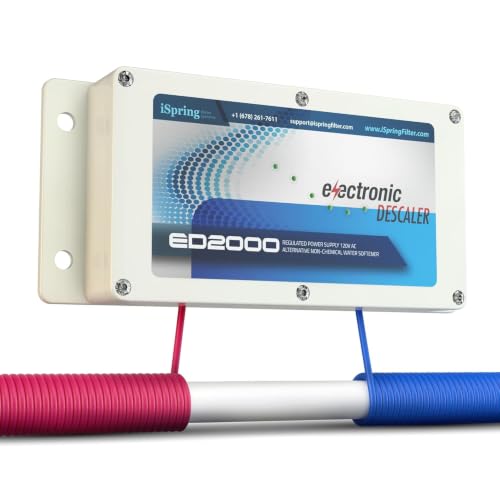
It does not change the hardness reading: what it claims is that the scale does not stick. The maker of the iSpring ED2000, one of the best selling electronic units, writes it on its own page: the ED2000 is NOT a water softener and does not remove calcium or magnesium; it can help treat hardness in water, but it is not a softener. The product name itself carries the phrase alternative water softener. That same maker also sells resin machines, and separates them in writing. In the count, 22 of the 51.
There is a published test procedure, and it has a name and a number. DVGW worksheet W 512, from the German gas and water body, sets out how to assess whether a water treatment device reduces scale formation: 21 days of testing, 130 litres of water a day and an efficacy factor f of 0.8 or better, meaning the scale built up in the heater is no more than 20 per cent of that in the untreated sample. Not one of the 51 listings in the count cites that test, or any other.
Softened water should not be taken to zero, and in Britain the reason is corrosion rather than a paragraph of law. The Drinking Water Inspectorate warns that water at 100 mg/l of calcium carbonate or less will be more corrosive to pipework, which could lead to dissolution of plumbing metals such as lead, copper, brass and nickel, and the same body states that the drinking water regulations do not specify standards for hardness, calcium or magnesium. So nothing external stops a machine being set to zero: the blender on the valve is what stops it, and setting it is part of the installation.
m8d rule: Put a hardness test strip on the tap before the machine and on a tap after it. If the reading does not change, that machine is not softening: it is doing something else, and that something else has its own published test method rather than the softener standard.
- Say they are salt free, magnetic or electronicthe cheapest group by far22 listings43%
- Do not state their technology in the headlinethe second most expensive group18 listings35%
- Say they use salt, resin or metered regenerationthe most expensive group11 listings22%
Our own count of 51 distinct domestic water treatment listings returned by thirteen searches of the family in the Amazon catalogue we track, read on 6 September 2026. What is counted is what the headline each one is sold under says, which is what a buyer reads before opening the page. Availability of individual models varies by country.
That block of 18 is the problem with the category, and it is not a problem with particular brands: it is a problem with headlines. They are the second most expensive group after the ones that declare resin, and someone buying one cannot tell from the listing whether it is going to lower the hardness of their water or protect the pipework without lowering it. Several of those brands do publish the technology inside the product page; what is missing is at the door.
The check that settles it costs a few pounds and two minutes, and it works just as well before buying as after installing. Take water from a tap before the machine, or the outside tap if it sits upstream, and note the reading. Take water from a tap after it, running it for half a minute first. Compare. On a properly set ion exchange machine the second strip should read somewhere around 100 to 150 mg/l, and never zero. If both strips read the same, that machine is not lowering your hardness, and that may be exactly what its manufacturer says it does.
The five numbers a water softener listing should give you, and how rarely you get them
On 18 September 2026 we read the page that ranks first in Britain for the phrase water softener. It publishes a star rating out of five, the number of reviews behind it, finance terms, a warranty length, how long the company has been trading and a hardness slider that runs from soft to hard. It publishes none of these five: salt per regeneration, water per regeneration, capacity per cycle, annual salt for a household, or running cost.
That is not a lapse by one company, it is what the whole category looks like. In our own count of 51 listings, not one published its kilos of salt per regeneration. Two manufacturers publish enough on their technical sheets for the sum to be done at all, and both of them are in this guide for exactly that reason. Everything else in this category is sold on a photograph of a cabinet and a promise about limescale.
So here is the rule we would take away from all of it, and you can use it without us: a machine whose sheet does not publish its capacity per cycle and its salt per regeneration is a machine whose running cost nobody can tell you, including the person selling it. Ask for those two numbers before you pay. If they arrive, the calculator below turns them into kilos and litres a year.
Free water softener salt calculator: the salt, water and sodium a year at your hardness
Free water softener salt calculator: the salt, water and sodium a year at your hardness
The figure that separates two softeners at the same price is what they get through every year, and it is in no listing: of the 51 we counted, not one publishes its kilos of salt per regeneration. This calculator does the sum with the parts that are exact (the limescale in your water, the minimum salt the chemistry demands and the sodium left in the tap) and with the figures published by the only two manufacturers in the count that publish them. Free and no account. Example: on water of 300 mg/l with three people, softened down to the 100 mg/l floor the Drinking Water Inspectorate warns about, that is 29.9 kilos of limescale a year, 59.8 of salt, about 5,980 litres to drain and 92 mg/l of sodium added to the water at the tap.
3 people at 137 litres a day come to 149 m3 a year. Taking it from 30 down to 10 means removing 200 mg/l of calcium carbonate, which is 29.9 kg of limescale. With the figures Ecosoft publishes for its CUBE 100 (2.0 m3 per cycle at 250 mg/l, 1.0 kg of salt and 100 litres of water per regeneration) that works out at 2.00 kg of salt and 200 litres of water for every kilo of limescale removed. Applied to your house: 59.8 kg of salt, 5,979 litres of water and about 60 regenerations a year, one every 6.1 days with a machine that size.
At that hardness the exchange adds 92 mg/l of sodium, well under the 200 mg/l figure. Sodium stops being the argument and the decision goes back to the usual one: what the machine costs and what it gets through every year.
The limescale and the sodium are arithmetic: the exchange leaves 0.46 mg of sodium for every mg/l of calcium carbonate it removes, which is what the molecular weights give. The minimum of 1.17 kilos of salt per kilo of limescale is the stoichiometry of the exchange, not a brand claim. The ratios of 2.00 kg of salt and 200 litres of water per kilo of limescale come from a third party sheet: the Ecosoft CUBE range technical data sheet published by the manufacturer, read on 6 September 2026; the 2.24 figure from the Aqmos R2D2-72 sheet on the manufacturer's site, read on 6 September 2026, which declares 7,200 litres of capacity at 10 degrees German hardness and 2.88 kg of salt per regeneration. The 137 litres per person per day is the Environment Agency figure for average daily water use per person in England, 136.5 litres in the 2024 to 2025 financial year, published on 18 November 2025. Salt comes in a 25 kilo sack, the size tablet salt is usually sold in, and the cost of water is left to you because every tariff is different.
Can you drink softened water? What the DWI says, and the kitchen tap to leave alone
Ion exchange swaps calcium and magnesium for sodium, so the answer depends on how hard your water was to start with. The arithmetic is fixed: 0.46 mg of sodium for every mg/l of calcium carbonate removed. Take water from 300 mg/l down to the 100 mg/l floor and the exchange adds about 92 mg/l of sodium to whatever the water already carried. Take it from 450 to zero and it adds 207, and the regulations use a sodium figure of 200 mg/l.
The Drinking Water Inspectorate's guidance is short and worth quoting rather than paraphrasing. It says that the drinking water regulations include a standard for sodium, and use of a softener may risk breaching this standard. It advises that consumers retain an unsoftened water supply to the kitchen tap for drinking and cooking purposes. And it says that artificially softened water should not be used to make up baby feeds.
That is not a reason not to fit one, and we would not read it that way. It is a reason to fit it properly, and in practice it is one decision made on the day of installation: the incoming main is teed off before the softener and that branch feeds the kitchen tap. If the quote you are given does not mention it, ask. The same DWI page also points to the Water Supply (Water Fittings) Regulations 1999 for how the machine itself has to be connected, which is the installer's responsibility rather than yours, but it is worth knowing the question exists.
Metered or timed: the word on the spec sheet that decides half your salt bill
A timed softener regenerates every so many days, set at installation. A metered one has a water meter inside and regenerates when it has treated the litres it can treat. The difference is not in the machine: it is in what happens when real use does not match the plan, which is always. A week away, a month with family staying, a summer of watering the garden all move the consumption, and a timed machine keeps to its calendar, spending the same salt and the same water regardless.
In our count, 6 of the 51 listings write the word metered in their headline and not one writes timed. Silence does not mean it is one or the other, but it does mean asking before paying, because this is what decides how many times a year the sum in the calculator above gets triggered.
And there is a third case almost nobody mentions: the machine that regenerates while you are away. The Aqmos R2D2-72 sheet states it without dressing it up: if the unit goes ten days without working, it starts a forced regeneration to keep the resin bed hygienic. That is a sound decision on health grounds, and it also means a month's holiday is three regenerations, with their salt and their water, in an empty house. Machines with a holiday mode, like the Ecosoft CUBE, handle it differently: they refill the brine with already softened water and tell you. Before you go away for a whole summer it is worth knowing which of the two the thing in your utility room does.
18 litres of resin, a metered valve and up to 7 people according to its manufacturer, with the capacity and the salt per regeneration published so the running cost can actually be worked out.
See it on Amazon ›The three things that have to be in the same square metre. A drain with an air gap, because every regeneration sends the rinse water to the waste: the Ecosoft CUBE 100 sheet declares 0.1 cubic metres per regeneration, a hundred litres. A socket with an earth, because the valve has electronics in it: the same machine declares 230 volts and 30 watts. And the space, which is not just the footprint but the headroom to lift the lid and tip in a sack of salt: the floor standing cabinet in this selection is 1,055 millimetres tall and the compact one is 543. If there is no drain there is a solution, but it is a pump and one more thing to go wrong, so it is worth checking before you buy rather than after.
The eight water softeners in this guide, with what each manufacturer's sheet declares
| Machine | Resin | Capacity per cycle | Salt per regeneration | Salt per kilo of limescale | |
|---|---|---|---|---|---|
| Ecosoft CUBE 100 view › | 10 L | 2.0 m3 at 250 mg/l | 1.0 kg | 2.00 kg | View › |
| Aqmos R2D2-72 view › | 18 L | 7,200 L at 10 degrees German | 2.88 kg | 2.24 kg | View › |
| Bbagua Ceramic Pilot 2.5 view › | 25 L | not declared | 3.75 kg | cannot be calculated | View › |
 TOODO 30 L Fleck 5600 SXT view › TOODO 30 L Fleck 5600 SXT view › | 30 L | not declared | not declared | cannot be calculated | View › |
 AcquaHOME Cabinado 20 L Clack WS1 view › AcquaHOME Cabinado 20 L Clack WS1 view › | 20 L | not declared | not declared | cannot be calculated | View › |
 Uniprodo Water Softener 1500 view › Uniprodo Water Softener 1500 view › | 15 L | not declared | not declared | cannot be calculated | View › |
| Uniprodo Water Softener 750 view › | 6.5 L | not declared | not declared | cannot be calculated | View › |
| iSpring ED2000 view › | no resin | does not lower hardness | uses no salt | not applicable | View › |
Everything in this table comes from each manufacturer's sheet or from its listing, read on 6 September 2026. The last column is a division of ours: the kilos of salt per regeneration divided by the kilos of calcium carbonate that cycle removes, and it can only be done when the manufacturer publishes both figures. The minimum the chemistry of ion exchange allows is 1.17 kilos of salt per kilo of limescale.
Aqmos R2D2-72 view ›
It is one of only two machines in the whole count whose spec sheet publishes both the capacity per cycle and the kilos of salt per regeneration, which are the two numbers that tell you what it will cost you every year. With its own figures, 7,200 litres at 10 degrees German hardness and 2.88 kg of salt, that works out at 2.24 kilos of salt for every kilo of limescale removed, against a chemical floor of 1.17. And it covers the majority case, the family house, which is where the other machine that publishes its figures runs out of room.
- Its official spec sheet declares 18 litres of resin, a capacity of 7,200 litres per cycle on water at 10 degrees German hardness and 2.88 kg of salt per regeneration. Divide those and you get 2.24 kilos of salt per kilo of limescale, which is the ratio that decides your salt bill for the next ten years and which almost no listing lets you calculate.
- The valve is metered, the BNT 1650, and it counts water with its own meter: it regenerates when the resin is genuinely exhausted rather than every so many days. That is the difference between spending salt on what you have used and spending it on the calendar.
- The manufacturer states which salt it takes: EN 973, food grade, type A. Having that standard named on the spec sheet saves you buying the wrong sack.
- It warns about something almost nobody mentions: if the machine goes ten days without working, it forces a regeneration to keep the resin bed hygienic. A month away is three regenerations, with their salt and their water, in an empty house.
- The store takes 50 kg of salt, so on medium hardness it gets refilled two or three times a year. The maximum inlet water temperature it declares is 38 degrees: it goes on the incoming cold main, never after the cylinder.
- Publishes its capacity per cycle and its salt per regeneration, so the running cost can be worked out
- Metered valve with a water meter: it regenerates on what you use, not on a calendar
- 18 litres of resin and up to 7 people according to the manufacturer
- States the salt standard it accepts, EN 973 food grade type A
- 50 kg salt store: few refills a year
- Uses 12 per cent more salt per kilo of limescale than the better of the two that publish their figures
- Its spec sheet does not publish the water it sends to drain per regeneration
- Needs a drain and a socket near the incoming main, which limits where it can go
Ecosoft CUBE 100 view ›
Its technical data sheet is the most complete in the count: resin, capacity per cycle, salt per regeneration and, the one nobody else publishes, the water it sends to drain each time. With those four numbers the whole sum can be done, and it comes out with the best salt ratio in the group: 2.00 kilos of salt per kilo of limescale. The trade off is size, because its own manufacturer places it in flats and in homes of up to three people.
- The range data sheet declares, for the CUBE 100, 10 litres of resin, 2.0 cubic metres of capacity per cycle on water at 250 mg/l of calcium carbonate, 1.0 kg of salt per regeneration and 0.1 cubic metres of water in each one. Dividing: 2.00 kilos of salt and 200 litres of water for every kilo of limescale removed.
- It is the same proportion across all three sizes in the range, because the CUBE 250 declares 25 litres of resin, 5.0 cubic metres, 2.5 kg of salt and 0.25 cubic metres of water. A brand that holds its salt ratio across a whole range is telling you how it regenerates, not just how much fits.
- It has a blender built into the valve, which is the part that sets the hardness leaving the machine instead of taking it to zero. That is exactly what you need in Britain, where the Drinking Water Inspectorate warns that water at 100 mg/l of calcium carbonate or less is more corrosive to pipework.
- The holiday mode and the low salt alarm belong to the same family of details: refilling the brine with already softened water, and telling you before the machine starts letting hard water through. Its sheet declares 230 V, 50 Hz and 30 W.
- It measures 543 by 450 by 320 millimetres and weighs 21.4 kg dry, so it fits under a worktop or in a utility cupboard. This is the format built for the flat, which is where a floor standing machine will not go.
- The only spec sheet in the count that also publishes the water per regeneration
- The best salt ratio in the group: 2.00 kilos of salt per kilo of limescale
- Built in blender to set the hardness that leaves the machine
- Compact at 543 mm tall, with a holiday mode and a low salt alarm
- Regeneration of 80 to 110 minutes at a declared 30 W
- Its manufacturer places it in homes of up to three people
- On very hard water with four people it would regenerate every few days: that is where the size above starts
- Costs more than machines with twice the resin
Uniprodo Water Softener 750 view ›
Of the 51 listings in the count, only four put the flow rate in the headline they are sold under, and this is one of them: 6.5 litres of resin and 1.4 to 2.8 cubic metres an hour. It stops short of publishing salt per regeneration, so the annual cost still cannot be worked out from its sheet, but at least it tells you what you are buying before you open the page.
- The headline declares 6.5 litres of resin, a flow rate of 1.4 to 2.8 cubic metres an hour and a range of 1 to 5 people. That is enough to keep it or rule it out without opening the page, and 14 of the 51 listings we counted manage it.
- 6.5 litres of resin is the small end of the category. On water above 300 mg/l with four people, the calculator in this guide shows why a tank that size ends up regenerating almost daily.
- A shower draws in the order of 0.2 litres a second, which is about 0.72 cubic metres an hour. Two showers and a kitchen tap together come to roughly 2.16, inside its upper figure but above its lower one.
- It declares neither the capacity per cycle nor the kilos of salt per regeneration, which are the two numbers the annual cost is made of. With this sheet that sum cannot be done, and it is better to know that before rather than after.
- Puts the litres of resin and the flow rate in the listing itself
- The cheapest ion exchange machine in the selection
- Range of people declared by the manufacturer
- Publishes neither the capacity per cycle nor the salt per regeneration
- 6.5 litres of resin is tight on hard water with more than three people
- The low end of its flow rate is marginal for two showers at once
Bbagua Ceramic Pilot 2.5 view ›
It publishes half a figure: its sales sheet shows 3.75 kg under a label that reads capacity and salt consumption at once, without saying whether that is what it uses per regeneration or what the store holds, and the capacity per cycle is missing altogether. With that, the annual salt cannot be worked out. What it does have, for a house of four or five with hard water, is 25 litres of resin and counter current regeneration, which is the method that uses the least salt.
- Its sheet declares 25 litres of resin and metered counter current regeneration, which is the method that uses the least salt. The salt figure it publishes, 3.75 kg, sits under a label that says capacity and salt consumption at the same time, so there is no telling which it measures; and without the capacity per cycle it could not be turned into kilos a year anyway.
- Counter current regeneration is not marketing: the technical bulletin for Purolite C100 resin puts the regenerant level at 50 to 150 grams of salt per litre of resin counter current, against 50 to 250 co current. That is half the top of the range.
- The manufacturer places it in homes of up to four bathrooms and eight people, and the unit measures 470 by 1,055 millimetres: this is a floor standing cabinet, not something that goes under a worktop.
- Its listing is sold on the phrase water without limescale, and that is worth reading next to the guidance from the Drinking Water Inspectorate: water at 100 mg/l of calcium carbonate or less is more corrosive to pipework and can dissolve plumbing metals. The machine is set with its blender, and that setting is part of the installation.
- 25 litres of resin, one of the biggest tanks in the selection
- Metered and counter current regeneration, the method that uses the least salt
- Declared range of bathrooms and people
- A 14 day returns guarantee stated in its own shop
- Does not publish the capacity per cycle, so the annual cost is not in its sheet
- Its salt figure sits under a label that does not say whether it is consumption or store
- A 1,055 mm floor standing cabinet: it needs its own space
- Its listing talks about water without limescale, when the health guidance sets a floor on how far you should go
TOODO 30 L Fleck 5600 SXT view ›
What you are buying here is not the badge on the cabinet, it is the valve: the Fleck 5600 SXT is the most widely fitted domestic valve there is, which is why its seal kits, its piston and its board are sold loose by any water treatment supplier. On a machine that stays plumbed in for ten years and whose typical failure is the valve, that is a maintenance decision rather than an aesthetic one.
- It declares 30 litres of resin and a Fleck 5600 SXT metered valve, and it is one of the 11 listings of the 51 counted that says in its headline how it regenerates. The word metered in a headline is information: it means it counts water rather than days.
- The 5600 SXT is the most common domestic valve on the market, and that is its real advantage: the seal kit and the piston are bought loose. An unusual valve turns a seal change into replacing the whole machine.
- It comes with an installation kit, which in this category is not an accessory: you need the flexible connections, the bypass with its blender and the drain hose with an air gap. Buying all of that separately is a cost of its own and belongs in the comparison.
- Like the rest of the cabinet and twin tank machines it publishes neither its capacity per cycle nor its salt per regeneration, so the annual figure has to be set at commissioning against the measured hardness of the house.
- Fleck 5600 SXT valve: the one with the most spares available
- 30 litres of resin, the biggest tank in the group
- Metered, declared in the listing itself
- Installation kit included
- Publishes neither capacity per cycle nor salt per regeneration
- The second most expensive ion exchange machine in this selection
- Its sheet does not declare the maximum inlet hardness it accepts
AcquaHOME Cabinado 20 L Clack WS1 view ›
The Clack WS1 is the other valve the trade treats as a reference, and it is fitted here on a cabinet machine with the salt and the resin in one housing. It is the most expensive in the selection and its argument is the mechanics rather than the spec sheet: it does not publish its capacity or its salt per regeneration either, so you are paying for the valve and the finish, not for knowing what it will use.
- It declares 20 litres of resin, a Clack WS1 metered valve and a cabinet format, which is the one that puts resin and salt in a single housing and takes up less room than a twin tank of the same capacity.
- The Clack WS1 shares with the Fleck 5600 the fact that its spares exist loose on the market. On a failure at year seven, that decides whether it is repaired or replaced.
- It is the most expensive in the selection and there are machines here with similar resin for considerably less, so the argument has to be the valve and the finish. If what you want is to know how much salt it will eat, neither of those answers it: ask the seller for the capacity per cycle before paying.
- On the day we read the catalogue, 6 September 2026, few units were showing as available. Stock moves slowly in this category, so check the state of the listing before deciding.
- Clack WS1 valve, the other reference with spares available
- Cabinet format: resin and salt in a single housing
- 20 litres of resin in a cabinet finish
- The most expensive in the group, and its sheet publishes neither capacity nor salt per regeneration
- At the same money there are two machines here with equivalent resin
- Few units showing as available on the day we read the catalogue
Uniprodo Water Softener 1500 view ›
The same approach as its smaller sibling with the tank a family house actually needs: 15 litres of resin and 1.6 to 2.9 cubic metres an hour, written into the headline. It still does not publish the salt per regeneration, so the annual figure has to come from the calculator in this guide rather than from its sheet.
- It declares 15 litres of resin, a flow rate of 1.6 to 2.9 cubic metres an hour and a range of 2 to 8 people. It is the step the calculator in this guide points to for water of 250 to 350 mg/l with four people.
- 15 litres of resin is more than twice the 6.5 of the model below it, and in this category price does not rise in proportion to the tank: going up a size almost always costs less than being undersized and regenerating twice as often.
- Two showers and a basin running together come to roughly 1.8 cubic metres an hour, inside its declared 2.9.
- On the day we read the catalogue, few units were showing as available. Like the rest, it publishes neither its capacity per cycle nor its salt per regeneration.
- 15 litres of resin and the flow rate declared in the headline
- More than twice the resin of the small model from the same brand
- Declared range of 2 to 8 people
- Publishes neither capacity per cycle nor salt per regeneration
- Few units showing as available on the day we read the catalogue
- Does not declare the maximum inlet hardness it accepts
iSpring ED2000 view ›
It is not a water softener and its own manufacturer says so in those words on the official sheet. It is here because it is the honest answer for anyone who cannot fit a resin machine, and because its sheet is the cleanest proof that the two families do different things: it does not lower the hardness reading, it does not remove calcium or magnesium, and what it claims is to reduce scale formation. If what you need is for the hardness test strip to change, this family will not do it.
- On its own frequently asked questions page, asked whether it is a water softener, iSpring answers: the ED2000 is NOT a water softener and does not remove calcium or magnesium; it can help treat hardness in water, but it is not a softener. The product name itself carries the phrase alternative water softener.
- The same manufacturer also sells ion exchange machines with resin and salt, and separates them in writing. When a brand sells both technologies and explains in its own sheet what each one does, that sheet is worth more than any comparison.
- Its sheet places the unit on water of 10 to 19 grains per gallon, which is roughly 170 to 325 mg/l of calcium carbonate, and recommends a conventional softener as well on harder water. That is the manufacturer saying that above a certain hardness it is not enough on its own.
- It fits by winding two coils round the pipe, with no water shut off, no drain and no plumbing work, and declares an electricity cost of a few pence a month. That is the real argument for this family: the rented flat where the plumbing cannot be touched.
- The official sheet declares a supply voltage of 110 to 120 volts, which is North American. Check what transformer comes with the unit sold into a 230 volt market before buying.
- Its manufacturer states plainly what it does and what it does not do
- Fits with no plumbing work, no water shut off and no drain
- Declared electricity use of a few pence a month
- Adds no sodium to the water and uses no salt
- It does not lower hardness: a test strip reads the same before and after
- Its own manufacturer recommends a softener as well on very hard water
- Its official sheet declares 110 to 120 V: check the transformer on the unit sold here
- Publishes no efficacy test against a named method
Questions people ask before buying a water softener in the UK
Is a water softener actually worth it?›
It depends on your hardness, and Britain spans the whole range. Below 100 mg/l of calcium carbonate you are already at the floor the Drinking Water Inspectorate warns about and there is nothing to take out. Between 200 and 300, which is the majority case, a house of four gets through roughly 60 to 80 kilos of salt a year and the limescale it takes out is around 30 to 40 kilos, which is what would otherwise end up in the boiler, the cylinder and the shower. Above 300 the case is strong and the sodium is worth checking. Get your own figure from your water company before deciding anything.
What is the downside of a water softener?›
Three things, and none of them is a secret. It adds sodium: 0.46 mg for every mg/l of calcium carbonate removed, which is why the Drinking Water Inspectorate advises keeping an unsoftened supply to the kitchen tap for drinking and cooking and says softened water should not be used to make up baby feeds. It uses salt and water for ever: in a hard water house that is two to three 25 kilo sacks a year and several thousand litres to drain. And taken too far it works against you, because the DWI warns that water at 100 mg/l or less is more corrosive to pipework and can dissolve lead, copper, brass and nickel.
How much salt does a water softener use in a year?›
It depends on your hardness and how many of you there are, not on the brand. The exact sum is this: every kilo of limescale removed needs at least 1.17 kilos of salt, because that is the stoichiometry of the exchange; in practice the two manufacturers in our count that publish their figures come out at 2.00 and 2.24 kilos of salt per kilo of limescale. In a house of four on water of 300 mg/l, softened to 100, that is about 40 kilos of limescale a year and around 80 of salt, or a little over three 25 kilo sacks. The calculator in this guide does it with your own hardness and your own household.
How hard is the water here, and where do you find the number?›
Your water company publishes it for your own supply, and the Drinking Water Inspectorate publishes a map of typical levels across England and Wales along with the bands: soft up to 100 mg/l of calcium carbonate, slightly hard 100 to 150, moderately hard 150 to 200, hard 200 to 300 and very hard above 300. A hardness test strip costs a few pounds and gives you the reading at your own tap in a minute, which is also how you check a machine is doing what it claims.
Can you drink water from a water softener?›
The Drinking Water Inspectorate advises keeping an unsoftened supply to the kitchen tap for drinking and cooking, because the drinking water regulations include a standard for sodium and using a softener may risk breaching it. It also says artificially softened water should not be used to make up baby feeds. The arithmetic behind the advice: the exchange adds 0.46 mg of sodium per mg/l of calcium carbonate removed, so going from 300 mg/l down to 100 adds about 92 mg/l on top of what the water already carried, and from 450 to zero adds 207 against a regulatory figure of 200. In practice it is one decision on installation day: tee the kitchen tap off before the machine.
What is the best salt free water softener?›
Before choosing one it is worth knowing what you are buying, because that family does not lower hardness. The maker of the iSpring ED2000, one of the best sellers, answers the question on its own site: it is not a softener and does not remove calcium or magnesium; it can help treat hardness, but it is not a softener. What these units claim is to reduce scale formation, and there is a published test for that, DVGW worksheet W 512, with a defined method: 21 days, 130 litres a day and an efficacy factor of 0.8 or better. Not one of the 51 listings in our count cites it. If what you need is something for a rented flat with no plumbing work, the ED2000 is the one that explains best what it does and what it does not.
Metered or timed, and does it matter?›
It matters more than the badge on the cabinet. A timed machine regenerates every so many days whatever you have used, so a week away or a month with visitors both cost you the same salt as a normal week. A metered one counts the water and regenerates when the resin is genuinely spent. Six of the 51 listings we counted write metered in their headline and none writes timed, so if the listing does not say, ask before paying.
How much water does a water softener send to drain?›
Only one manufacturer in the count publishes it: the Ecosoft CUBE 100 technical sheet declares 0.1 cubic metres, a hundred litres, per regeneration, with 10 litres of resin. That works out at about 200 litres for every kilo of limescale removed. In a house of four on water of 300 mg/l that is roughly 8,000 litres a year, around 4 per cent of what the household uses at the Environment Agency average of 136.5 litres per person per day.
Does a water softener replace a drinking water filter?›
No, and they are fitted in different places. A softener goes on the incoming main and treats the whole house so that limescale does not build up in the boiler, the cylinder, the washing machine and the taps. A filter or a reverse osmosis unit goes under the sink and treats only the water you drink and cook with. In a hard water house they sit together comfortably, and there is a technical reason to: the exchange adds sodium, so taking the drinking water off before the machine, or putting it through a separate unit, is how that sodium stays out of the glass.
The catalogue was gone through on 6 September 2026 with thirteen searches of the family in the Amazon catalogue we track: 51 distinct listings of machines for domestic use. For each one we noted what the headline it is sold under says, which is what a buyer reads before opening the page: the technology, the litres of resin, the flow rate, the type of regeneration and the number of people. Consumables and descalers for coffee machines were left out of the count.
The technical figures for the eight here come from their manufacturers' own sheets, read that same day: the Ecosoft CUBE range technical data sheet, the Aqmos R2D2-72 page, the Bbagua product page, the iSpring ED2000 questions page, and the listing headline itself for the ones that publish nothing more. Where a sheet does not publish something, the table says it does not declare it rather than filling the gap.
The British framing comes from the Drinking Water Inspectorate: the hardness bands, the statement that the regulations set no standard for hardness, calcium or magnesium, the warning about corrosion below 100 mg/l, the advice on keeping an unsoftened kitchen tap and on baby feeds. Water use per person is the Environment Agency figure for England. The chemistry, 1.17 kilos of salt per kilo of limescale and 0.46 mg of sodium per mg/l of calcium carbonate, comes from the molecular weights and does not change from country to country. The salt and water ranges of a regeneration come from the technical bulletin for Purolite C100 resin.
The order is not decided by price or by commission: it is decided by what can be known about each machine before buying it and by what it is going to cost whoever installs it.
If you live in a house with hard water and you want to be able to work out what it is going to cost you, we would take the Aqmos R2D2-72: it publishes its capacity per cycle and its salt per regeneration, and with those two numbers the sum can be done before you buy rather than after. If the problem is space, the Ecosoft CUBE 100, which fits under a worktop, has the best salt ratio in the group and is the only one that also publishes the water each regeneration sends to drain. And if the budget decides, the Uniprodo 6.5 litre, which at least puts its figures in the listing.
Two things to take away even if you buy none of them. Get your hardness figure from your water company first, because below 100 mg/l there is nothing here for you. And whatever you fit, do not let it be set to zero: the Drinking Water Inspectorate warns that water at 100 mg/l of calcium carbonate or less is more corrosive to pipework and can dissolve lead, copper, brass and nickel, and there is no law that will stop an installer taking it there.
m8d choice . The one that publishes the figures the running cost is made ofAqmos R2D2-72See it on Amazon ›The only one that also publishes the water each regeneration sends to drainEcosoft CUBE 100See it on Amazon ›The cheapest that puts its figures in the listing itselfUniprodo Water Softener 750See it on Amazon ›Everything asserted above comes from one of these.
- Drinking Water InspectorateWater hardness and hard waterThe hardness bands in mg/l of calcium carbonate: soft up to 100, slightly hard 100 to 150, moderately hard 150 to 200, hard 200 to 300, very hard above 300. And the statement that the Drinking Water Directive and the UK drinking water quality regulations do not specify standards for hardness, calcium or magnesium. Read on 18 September 2026
- Drinking Water InspectorateDomestic water filters and softenersThat the drinking water regulations include a standard for sodium and that use of a softener may risk breaching it; the advice to retain an unsoftened supply to the kitchen tap for drinking and cooking; that artificially softened water should not be used to make up baby feeds; and that water at 100 mg/l of calcium carbonate or less will be more corrosive to pipework, which could lead to dissolution of plumbing metals such as lead, copper, brass and nickel. Also its reference to the Water Supply (Water Fittings) Regulations 1999. Read on 18 September 2026
- Environment Agency, GOV.UK, 18 November 2025Water efficiency must become a national priority, says Environment AgencyAverage daily water use per person of 136.5 litres in the 2024 to 2025 financial year, against a 2019 to 2020 baseline of 140 litres and a target of 122 by 2038
- DVGW, German Technical and Scientific Association for Gas and WaterDVGW worksheet W 512, September 1996 editionThe published procedure for assessing whether a water treatment device reduces scale formation: 21 days of testing, 130 litres a day, efficacy factor f of 0.8 or better
- World Health Organization, 2003Sodium in Drinking-water (WHO/SDE/WSH/03.04/15)No health based guideline value; taste is affected above about 200 mg/l, and domestic softeners can leave water above 300 mg/l of sodium
- PurolitePurolite C100 Sodium Cycle technical bulletinMinimum total capacity of 2.0 eq/L; regeneration level of 50 to 250 g of salt per litre of resin co current and 50 to 150 counter current; 4 to 9 bed volumes of rinse water per regeneration co current and 3 to 6 counter current
- EcosoftEcosoft CUBE range technical data sheetFor the CUBE 100: 10 litres of resin, 2.0 m3 of capacity per cycle at 250 mg/l of calcium carbonate, 1.0 kg of salt and 0.1 m3 of water per regeneration, 80 to 110 minutes, 230 V and 30 W. Read on 6 September 2026
- AqmosAqmos R2D2-72 product sheet18 litres of resin, up to 7,200 litres of capacity at 10 degrees German hardness, 2.88 kg of salt per regeneration, 50 kg salt store, BNT 1650 metered valve, salt to EN 973 food grade type A, and a forced regeneration after 10 days of inactivity. Read on 6 September 2026
- iSpring Water SystemsiSpring ED2000 frequently asked questionsThe ED2000 is NOT a water softener and does not remove calcium or magnesium. It can help treat hardness in water, but it is not a softener. Designed for water of 10 to 19 grains per gallon; 110 to 120 V. Read on 6 September 2026
- BbaguaBBAGUA Ceramic Pilot 2.5 product page25 litres of resin, 2,500 l/h, 3.75 kg of salt per regeneration, metered counter current regeneration, up to 4 bathrooms and 8 people, 470 by 1,055 mm. Read on 6 September 2026
- Our own count, 6 September 2026Domestic water treatment catalogueThirteen searches of the family in the Amazon catalogue we track: 51 distinct listings; 22 declare they are salt free, magnetic or electronic, 11 declare resin, salt or metered regeneration and 18 do not state their technology in the headline; 6 write the word metered and none writes timed; not one publishes its kilos of salt per regeneration
Comments
Be the firstNo sign-up: just a name. Every comment is reviewed before it is published.