Best bean to cup coffee machines in 2026: what a cup really costs, the dose nobody publishes and your water hardness
 m8d.ioUpdated on

This guide contains affiliate links. As an Amazon Associate, m8d.io earns from qualifying purchases, at no extra cost to you.
The best bean to cup coffee machine for most people is the Philips Series 2200 view ›, the only one here whose maker publishes its running cost in cups. The Cecotec Cremmaet Cube view › is the only one of the nine that states how many grams go into the cup, and the Philips 2300 LatteGo view › is the one for milk. The figure that decides before the price: a kilo of beans makes between 83 and 142 cups depending on the dose, and almost no spec sheet publishes that dose.
A bean-to-cup machine is paid for once and used a thousand times. That is why the question that decides is not which one makes the best coffee, but what each of the coffees coming out of it is going to cost over the next few years. And that sum needs two numbers: the grams it puts in the cup, and what you pay for a kilo of beans.
Bean to cup or pods: what a cup costs each way, and why the same kilo of beans makes between 83 and 142 cups
A kilo of beans does not yield a fixed number of coffees: it yields whatever the machine decides to dose. The disciplinare of the Istituto Nazionale Espresso Italiano fixes the portion at 7 grams, with half a gram of tolerance, and the people who keep count at home talk about eighty cups to the kilo, which is around 12.5 grams. Between one end and the other there are fifty-nine coffees of difference in the same bag.
That is the whole of the pods comparison, and it is the reason the answer swings so widely. At 7 grams a kilo makes 142 cups; at 12 grams it makes 83. Nobody can tell you what your machine will cost to run without that one number, and that one number is the one a listing almost never carries. The calculator below takes it, along with what you pay per kilo and what you are drinking now, and does the division in the open.
Free cost per cup calculator for a bean to cup coffee machine
Free cost per cup calculator for a bean to cup coffee machine. What decides whether one is worth it is not the price of the machine, it is what each of the coffees coming out of it will cost over the next few years. And that sum depends on a figure that seven of the nine machines on this page do not publish: the grams per cup. Without it, the same kilo makes 142 cups at one dose and 83 at another, which at two coffees a day is a wide gap by the end of the year. Put in your own cups a day, your dose and your price per kilo, with the division shown. Free, no account, no ads.
a kilo makes 142 cups at 7 g and 83 cups at 12 g, which is 59 cups of difference in the same bag · £20 / 142 = 14 pence and £20 / 83 = 24 pence
The difference in your favour runs from £80 to £153 a year, and that spread is exactly the problem: seven of the nine machines in this guide do not say how many grams go into each cup. It is the only number that tells you in advance what the coffee of the next few years will cost, and almost no spec sheet publishes it.
The cost per cup is a division using the grams each spec sheet declares and the price per kilo each reader supplies, not a market average: it is for comparing two ways of drinking coffee in the same house. The 7 grams at the low end are the portion fixed by the disciplinare of the Espresso Italiano Tradizionale; the 12 come from the count kept by owners, around eighty cups to the kilo. The 625 cups per filter are published by Philips on the spec sheet of its AquaClean CA6903/10, with its note that the real number depends on the drinks selected and on rinsing.
The calculator does not multiply by an invented price of coffee: the kilo is yours to set, because everyone buys their own. What does come from a published source is the consumable. Philips writes on the spec sheet of its AquaClean filter that it lasts up to 625 cups and that 5,000 cups are reached without descaling by replacing it eight times. It is the only maintenance figure in this category published in cups rather than in months, and that is why it can be worked out before buying.
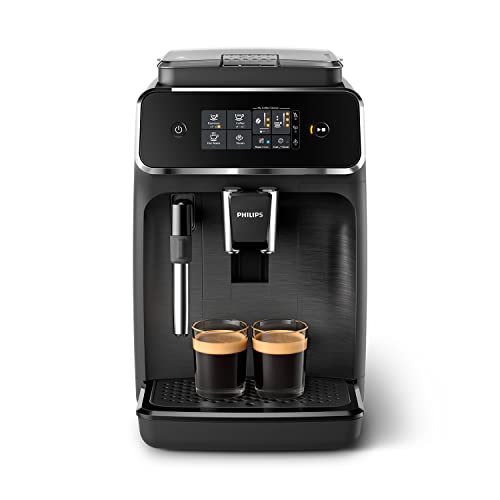
It is the pick because it is the only machine here whose maintenance can be priced before it is bought. Philips publishes that its AquaClean filter lasts up to 625 cups and that 5,000 cups are reached without descaling by replacing it eight times, which in a British kitchen with hard water is the difference between a known cost and a guess. Its sheet also declares the two parts that actually decide: a 100 per cent ceramic grinder with twelve settings, and a fully removable brew group, which is the piece that has to be cleaned.
View ›
It is on this page for one reason and it is the right one: it states how many grams of coffee go into the cup. Ten grams, written down, when seven of the other eight machines here do not publish that figure at all. That single number is what turns the running cost of a bean-to-cup machine from a guess into a division, and it is why this machine is the worked example inside the calculator above. Everything else about it is entry-level, and its listing leads with the bars, which tells you which tier it sits in.
View ›Are bean to cup machines worth it? The sum against a coffee shop, with the British average price on the table
It is the question typed most often next to this search, and it deserves a number rather than an opinion. The comparison most people are really making is not against a pod machine: it is against the cup they buy on the way to work.
Finder's 2026 survey of coffee prices across the United Kingdom, built from cost-of-living data collected in March 2026 across 24 British cities and towns, puts the average price of a coffee at £3.97, with London at £4.52 and Inverness and Perth the cheapest at £3.03. Put that next to a dose of beans and the arithmetic stops being an argument. The same is not true of a pod: a pod and a home-ground cup are close enough that the machine's own dose, and the price you pay per kilo, decide which way it falls, which is exactly what the calculator above is for.
So the honest answer to "is it worth it" has three parts. Against a coffee shop, almost always, and quickly. Against pods, it depends on two numbers you can now check. And against the filter machine already on the worktop, it is not a money decision at all, it is a decision about grinding fresh, and it should be argued on those terms.
If the machine is going to replace a cup bought on the way to work, we would stop comparing machines and compare that instead: a dose of beans against £3.97 is not a close enough sum to need a spreadsheet, and the thing worth spending the extra on is the part that keeps working, which is the grinder and the brew unit.
Hard water and a bean to cup machine: what your water company's hardness figure means for descaling
In Britain the thing most likely to end a bean-to-cup machine early is not the brand: it is the water. Every one of these machines boils water and pushes it through a narrow circuit under pressure, and every one of them has a hardness setting buried in its menu that decides how often it asks to be descaled. Almost nobody sets it, because almost nobody knows their own figure. It is published, it is free, and it takes a postcode.
The Drinking Water Inspectorate, the regulator for drinking water quality in England and Wales, publishes the bands: soft up to 100, slightly hard 100 to 150, moderately hard 150 to 200, hard 200 to 300 and very hard above 300, all measured in milligrams per litre of calcium carbonate. And it publishes the threshold that matters here, citing the World Health Organisation guidelines: "water with a hardness of value of 200 mg/l or higher (measured as CaCO3 calcium carbonate) will produce scale". Where a water company softens water before supplying it, the DWI recommends it keeps a minimum total hardness of 150 mg/l.
Your water company publishes your own figure by postcode, and it is the number the machine's menu is asking for. Setting it correctly is the difference between a descaling cycle the machine asks for when it needs one and a descaling cycle it asks for on a default schedule that has nothing to do with your tap. If you live above 200 and you ask us, we would treat the water filter as part of the purchase rather than an accessory, and the reason is a published number: Philips states 625 cups per filter and 5,000 cups without descaling by changing it eight times, which is the only maintenance figure in this category you can price before you buy.
This is the one variable of the category that is genuinely local, genuinely published and almost never mentioned by anyone reviewing these machines. The regulator gives the bands, the water company gives your figure, and the machine has a menu waiting for it.
m8d rule: Look up your water hardness by postcode before you set the machine up. Above 200 mg/l of calcium carbonate the regulator says scale will form, and that is the band where the filter stops being an accessory.
What counts as a bean to cup coffee machine, and the three words in a listing that say it is not one
The phrase is used loosely on a shelf, so it helps to have the test straight. A bean-to-cup machine does on its own the four things a manual machine makes you do, and the fastest sign that it does not is written into the listing itself.
We would not rule a portafilter machine out as a purchase, only as an answer to this search: it makes espresso perfectly well from ground coffee, and one of the nine here is exactly that. What it does not do is the thing that fixes your cost per cup, which is dose a measured amount of freshly ground beans on its own.
- It grinds the beans for every cup. If there is no grinder inside, it is not a bean-to-cup machine: it is an espresso machine for ground coffee, whatever it costs.
- It doses. It decides how many grams go into the cup. That is the figure that fixes your cost per cup, and only one of the nine machines here states it.
- It tamps. It compacts the coffee inside the brew unit. On a manual machine you do that yourself, by hand, with a tamper.
- It extracts. It passes the hot water through and stops on its own. This is where pressure applies, and where the Espresso Italiano standard puts 9 bar.
- The three words that rule it out in a listing: portafilter, pod and pump. If any of them appears, the machine is a manual one, even if the listing opens with the words bean to cup.
The bars a coffee machine advertises are the ceiling of its pump, not the pressure your coffee comes out at
It is the most repeated figure on the shelf and the one that separates one machine from another least. The check does not have to be looked for far: it is in the official spec sheets of the two most searched makers in the category, and in the standard that defines what an espresso is.
Machines that lead with bars and machines that do not lead with bars are, on this shelf, two different tiers. The number is real. What it measures is not what the headline implies.
m8d rule: If a coffee machine listing opens with the bars, that number is the ceiling of its pump and not the pressure at the puck. The standard for an espresso puts the water in at 9 bar, plus or minus one.
The nine bean to cup coffee machines in this guide, at a glance
| Machine | Best for | Bars it advertises | Grinder | Milk | Grams per cup | |
|---|---|---|---|---|---|---|
| Philips Series 2200 EP2220/10 view › | Knowing what the next few years cost | not advertised (15 on its sheet) | ceramic, 12 settings | steam wand | not declared | View › |
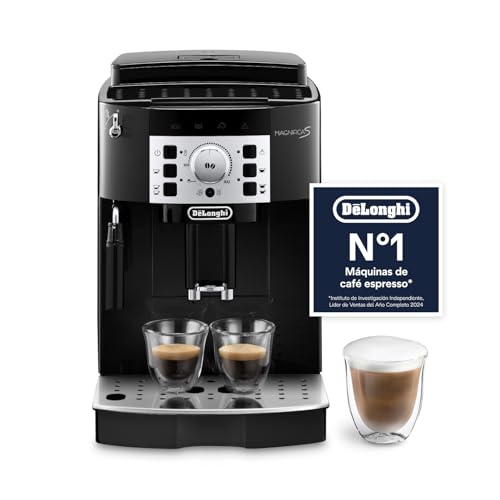 De'Longhi Magnifica S ECAM22.110.B view › De'Longhi Magnifica S ECAM22.110.B view › | Buying the most established one | not advertised (15 on its sheet) | conical | steam wand | not declared | View › |
| Cecotec Cremmaet Cube view › | Knowing the dose before you buy | 19 bar | 5 grind settings | steam wand | 10 grams | View › |
 Cecotec Cremmaet Latte Touch view › Cecotec Cremmaet Latte Touch view › | One-touch milk on a tighter budget | 19 bar | conical, 5 settings | 400 ml milk carafe | not declared | View › |
 Krups Roma EA810870 view › Krups Roma EA810870 view › | Physical controls and a short menu | 15 bar | conical metal | steam wand | not declared | View › |
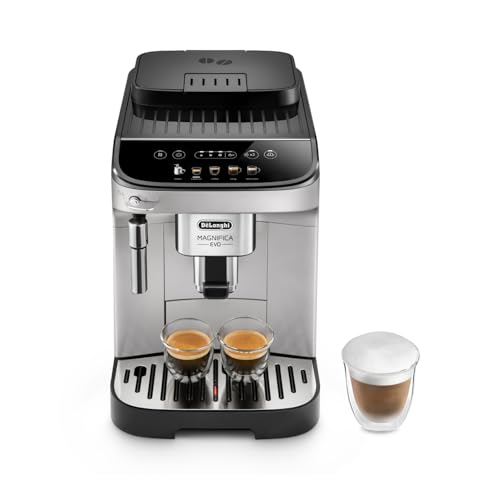 De'Longhi Magnifica Evo ECAM292.33.SB view › De'Longhi Magnifica Evo ECAM292.33.SB view › | Five drinks including americano | not advertised (15 on its sheet) | conical | steam wand | not declared | View › |
 Philips 2300 LatteGo EP2330/10 view › Philips 2300 LatteGo EP2330/10 view › | Cappuccino with a short clean-up | not advertised | ceramic | two-piece carafe | not declared | View › |
 Philips Series 5400 LatteGo EP5447/90 view › Philips Series 5400 LatteGo EP5447/90 view › | Several people in the house | not advertised | ceramic | two-piece carafe | not declared | View › |
 Cecotec Power Espresso 20 view › Cecotec Power Espresso 20 view › | Not a bean to cup machine | 20 bar | none | steam wand | you put them in | View › |
Every cell holds what the listing or the maker's official spec sheet declares. Where it says the figure is not declared, it means the sheet does not carry it, not that the machine lacks the feature. "Not advertised (15 on its sheet)" means the listing does not mention bars and the maker's official sheet publishes fifteen.
The nine machines, one by one, with what each one declares and what each one leaves out
Philips Series 2200 EP2220/10 view ›
It is the pick because it is the only machine here whose maintenance can be priced before it is bought. Philips publishes that its AquaClean filter lasts up to 625 cups and that 5,000 cups are reached without descaling by replacing it eight times, which in a British kitchen with hard water is the difference between a known cost and a guess. Its sheet also declares the two parts that actually decide: a 100 per cent ceramic grinder with twelve settings, and a fully removable brew group, which is the piece that has to be cleaned.
- Its official sheet declares "pressure: 15 bar", "100% ceramic grinders", 12 grind settings, a "fully removable brew group", 1,500 W and a 275 gram bean hopper (Philips, read on 3 September 2026).
- Philips publishes for the AquaClean CA6903/10 filter that it lasts up to 625 cups, and up to 5,000 cups without descaling by replacing it eight times, with its own footnote that the real number depends on the drinks selected and on rinsing (Philips, read on 18 September 2026).
- It is the only machine on this page whose consumable has a life published in cups rather than in months, which is what makes the running cost knowable before buying.
- Its sheet does not publish the grams it doses per cup, which is the figure the calculator on this page asks for.
- Its maker publishes the filter's life in cups, so the maintenance can be priced in advance
- 100 per cent ceramic grinder with twelve grind settings declared on its own sheet
- Fully removable brew group: it goes under the tap instead of depending on an internal cycle
- One dial and a short menu: nothing to learn before the first coffee
- A steam wand rather than a milk carafe: cappuccino takes a hand
- It does not state the grams per cup, like seven of the nine here
- No user profiles: settings are shared
- The bean hopper is modest at 275 grams
Cecotec Cremmaet Cube view ›
It is on this page for one reason and it is the right one: it states how many grams of coffee go into the cup. Ten grams, written down, when seven of the other eight machines here do not publish that figure at all. That single number is what turns the running cost of a bean-to-cup machine from a guess into a division, and it is why this machine is the worked example inside the calculator above. Everything else about it is entry-level, and its listing leads with the bars, which tells you which tier it sits in.
- Its listing declares 10 grams of coffee per cup, which is the figure the cost per cup calculator on this page needs and which seven of the nine machines here do not publish.
- It also declares 19 bar, which on this shelf is the ceiling of the pump: the standard for an espresso puts the water in at 9 bar plus or minus one.
- It declares five grind settings, against the twelve of the ceramic grinder on the Philips 2200.
- It publishes no life for its water filter, so its maintenance cost cannot be worked out before buying.
- It states the dose, 10 grams per cup, which no other machine here does
- Five grind settings on a compact body
- A steam wand rather than nothing, so milk drinks are possible
- The smallest footprint of the nine on a worktop
- Its listing leads with the bars, which is the pattern of the cheap end of this shelf
- No published filter life, so the maintenance cannot be priced in advance
- Fewer grind settings than the ceramic grinders here
- A brand with a thinner British service network than Philips or De'Longhi
De'Longhi Magnifica S ECAM22.110.B view ›
It is the machine most British kitchens with a bean-to-cup already have, and the reason it holds up is not a feature: it is that De'Longhi publishes what it is. Its own sheet carries the field pump pressure in bar and puts 15 in it, calls the brew unit removable and states the tank and the power. Nothing on its listing leads with a pressure number, which on this shelf is itself a signal about which tier it belongs to.
- De'Longhi publishes on its own sheet the field "pump pressure (bar): 15", 1,450 W and a 1.8 litre tank (De'Longhi, read on 3 September 2026).
- Calling the figure pump pressure rather than putting it in the headline is the distinction this guide is built around: the number is the ceiling of the pump, not the pressure at the puck.
- Its listing does not lead with bars, which on this shelf is the pattern of the more expensive tier rather than the cheaper one.
- Its sheet does not publish the grams it doses per cup.
- Its maker's sheet names pump pressure properly and publishes 15, rather than leading with a bigger number
- Removable brew unit, which is the part that collects grounds
- Conical grinder and a 1.8 litre tank declared on the official sheet
- The widest spare-parts and service network of the machines here
- A steam wand rather than a milk carafe
- It does not publish the grams per cup
- A dated interface next to the newer machines here
- No user profiles
Philips 2300 LatteGo EP2330/10 view ›
If one-touch cappuccino is the reason for the purchase, the thing that decides is not how many drinks are on the menu: it is how many parts the milk system splits into and how many tubes it has. This one has two pieces and no tubes, which is the shortest cleaning routine of the milk machines here. That matters more than it sounds, because a milk carafe that is a chore is a milk carafe that stops being used by February.
- Its milk system splits into two pieces and carries no tubes, which is the criterion that decides whether a milk carafe keeps being used.
- It uses the same ceramic grinder family and the same removable brew group approach as the Series 2200.
- Its listing does not advertise a bar figure, which on this shelf is the pattern of the more expensive tier.
- Its sheet does not publish the grams it doses per cup.
- Two-piece milk system with no tubes: the shortest clean-up of the milk machines here
- Ceramic grinder, like the Series 2200
- Removable brew group, so the grounds do not depend on an internal cycle
- One-touch cappuccino without a carafe full of narrow tubing
- It does not publish the grams per cup
- A carafe is still a part to wash daily if milk is used
- It does not advertise its pressure, which makes a like-for-like comparison harder
- More expensive than the Series 2200 for the milk system alone
Cecotec Cremmaet Latte Touch view ›
It is the machine that puts a milk carafe within reach of a budget that normally only buys a steam wand, and a carafe is the difference between making a cappuccino and deciding not to bother. What it does not do is publish a filter life or a dose, so both the maintenance and the cost per cup have to be worked out after the fact rather than before. If milk every morning is the reason you are buying at all, that trade is worth making with your eyes open.
- It declares a 400 ml milk carafe, a conical grinder and five grind settings on its own listing.
- It also declares 19 bar, which is the ceiling of its pump rather than the pressure at the puck.
- It publishes neither the grams per cup nor a filter life, so neither the cost per cup nor the maintenance can be worked out before buying.
- A milk carafe is the part owners abandon first when it is fiddly to clean, which is why the number of pieces it splits into matters more than the number of drinks on the menu.
- A 400 ml milk carafe of its own rather than a steam wand
- Conical grinder with five grind settings
- A touch panel with the drinks as buttons
- More drinks on the menu than anything else at this level here
- It does not publish the grams per cup
- No published filter life, so maintenance cannot be priced in advance
- A carafe is another part to wash, and that is what decides whether it keeps being used
- Its listing leads with the bars
Krups Roma EA810870 view ›
It is the one for a kitchen where nobody wants to learn a menu. Two physical dials, a short set of options and a metal conical grinder, and the declared pressure is 15 rather than a bigger number put there to impress. In a category where half the listings sell a touch panel and a list of drink names, a machine that does four things with a knob is a legitimate preference rather than a compromise.
- It declares 15 bar of pressure and a metal conical grinder on its own listing.
- Fifteen is the same figure De'Longhi and Philips publish as pump pressure on their official sheets, and it is the ceiling of the pump rather than the pressure at the puck.
- Its controls are physical rather than a touch panel, which is the reason it is here.
- It does not publish the grams per cup or a filter life.
- Physical controls and a short menu: nothing to learn
- Metal conical grinder rather than a plastic burr assembly
- Declares 15 bar rather than leading with a bigger figure
- A steam wand that behaves like a steam wand, with no carafe to wash
- No milk carafe: cappuccino takes a hand
- It does not publish the grams per cup
- Fewer options than the touch-panel machines here
- No published filter life
De'Longhi Magnifica Evo ECAM292.33.SB view ›
The Magnifica with the menu the original never had: five drinks on buttons, americano among them, which is the one British households actually order at home more than the espresso the machine is built around. De'Longhi publishes the same 15 bar of pump pressure and the same removable brew unit as the Magnifica S, so the maintenance story is identical and the difference is the front panel and the drinks.
- De'Longhi publishes on its own sheet the same 15 bar of pump pressure, a 14-puck grounds container and the phrase describing a removable brew unit for easy cleaning (De'Longhi, read on 3 September 2026).
- Its five drinks include americano, which is the long black most British households make at home.
- The mechanism is the Magnifica family's: what changes against the S is the interface and the drink list.
- Its sheet does not publish the grams it doses per cup.
- Five one-touch drinks including americano
- Removable brew unit, described as such on the maker's own sheet
- The same declared pump pressure and grinder family as the Magnifica S
- A 14-puck grounds container, so it is emptied less often
- A steam wand rather than a milk carafe
- It does not publish the grams per cup
- More expensive than the Magnifica S for a front panel rather than a mechanism
- No published filter life
Philips Series 5400 LatteGo EP5447/90 view ›
The feature that earns its place here is not the twelve drinks: it is the four profiles. In a house where one person takes a long weak coffee and another a short strong one, profiles are what stop the machine being re-set before every cup, and that is the difference between a machine everyone uses and a machine one person operates. The milk system is the same two-piece one with no tubes as the 2300.
- It declares four user profiles storing strength, volume and temperature, which is the feature that separates it from the 2300.
- It uses the same two-piece LatteGo milk system with no tubes.
- Its listing does not advertise a bar figure.
- Its sheet does not publish the grams it doses per cup.
- Four user profiles storing strength, volume and temperature per person
- Two-piece milk system with no tubes, like the 2300
- Twelve drinks, which is the widest menu here
- Ceramic grinder and removable brew group
- It does not publish the grams per cup either
- The most expensive machine in this selection by a distance
- Twelve drinks is more menu than most houses use
- A bigger footprint on the worktop
This is on the page on purpose, as the thing to recognise rather than the thing to buy. It is a pump machine with a portafilter, which means it does none of the four things that define the category: it does not grind, it does not dose, it does not tamp and it does not stop on its own. Its listing leads with 20 bar, the highest figure on this page, which is exactly the pattern the bars section is about. If a listing carries the word portafilter, the category question is already answered.
View ›The only one here whose consumable has a life published in cups by its maker.
See it on Amazon ›With the declared spec sheets, the standard and the regulator in front of us, not the marketing name. One. Every figure for bars, grinder, brew unit, power and tanks comes from the maker's own official spec sheet for the models selected: De'Longhi for the ECAM22.110.B and the ECAM292.33.SB, Philips for the EP2220/10 and for the AquaClean CA6903/10 filter. Where a maker does not publish a figure, the table says so instead of filling the gap.
Two. The two authorities cited are linked rather than paraphrased from somewhere else: the disciplinare of the Istituto Nazionale Espresso Italiano for the 9 bar, the 7 grams and the 25 seconds that define an espresso, and the Drinking Water Inspectorate for the water hardness bands and the threshold at which scale forms.
Three. The British price of a coffee out of the home comes from Finder's 2026 survey, built on cost-of-living data collected in March 2026 across 24 British cities and towns. It is a public national figure with its date, not a price of ours.
Four. The cost per cup is a division done in the open, with the grams and the price per kilo each reader puts in, so anyone can redo it with their own numbers. Five. No product price on this page: each button opens the Amazon store in your country.
Are bean to cup machines worth it?›
Against a coffee shop, almost always and quickly: Finder's 2026 survey puts the average price of a coffee in the United Kingdom at £3.97, from data collected in March 2026 across 24 cities and towns. Against pods it depends on two numbers, the grams your machine doses and what you pay per kilo, because a kilo makes between 83 and 142 cups depending on the dose. The calculator on this page does that division with your own figures. And against a filter machine it is not a money question at all: it is a question about grinding fresh.
What is better, a bean to cup or pod coffee machine?›
They fail in different places, so the honest comparison is not a winner. A pod machine has no grinder to clean, no dose to set and no descaling argument beyond its own schedule, and its running cost is fixed by the pod. A bean-to-cup machine grinds every cup, which is the whole point, and its running cost is decided by the dose it uses and the beans you buy. What makes the comparison hard is that only one of the nine machines here publishes the dose, and without it neither side of the sum can be worked out before buying.
What is the best bean to cup coffee machine for home?›
Of the nine compared here, the Philips Series 2200, and not because it is the dearest or makes the most drinks: it is the only one whose maintenance cost can be worked out before buying it, because its maker publishes that the AquaClean filter lasts up to 625 cups and that 5,000 cups are reached without descaling by replacing it eight times. Its official sheet also declares a 100 per cent ceramic grinder with twelve grind settings and a fully removable brew unit, which is the part that actually has to be cleaned.
What is the best bean to cup machine brand?›
The question is worth turning around: rather than a brand, look for the maker that publishes most about the machine you are considering. On this page that is Philips and De'Longhi, both of which put pump pressure, grinder type and brew unit on their own official sheets, and Philips additionally publishes the life of its filter in cups. A maker that publishes those figures is one whose claims you can check before paying, and that is a more useful test than a brand name.
How many bars of pressure does a bean to cup coffee machine need?›
Nine, at the point where the water meets the coffee. The disciplinare of the Istituto Nazionale Espresso Italiano fixes the water entry pressure at 9 bar plus or minus one, with a 7 gram portion and 25 seconds of percolation. Domestic machines use vibratory pumps, which need headroom above 9 to hold 9 steadily, so the fifteen, nineteen or twenty on the box is that headroom and not the pressure at the puck. De'Longhi and Philips both publish 15 on their own sheets and call it pump pressure.
What is the difference between a bean to cup machine and an espresso machine?›
The four things one does on its own and the other makes you do: grind the beans, dose the grams, tamp the coffee inside the brew unit and extract, stopping on time. The fastest sign is in the listing itself: if the words portafilter, pod or pump appear, it is a manual machine, even if the headline opens with bean to cup. One of the nine machines on this page is exactly that, and it is here on purpose.
Is coffee cheaper from beans than from pods?›
Usually, and the size of the difference depends on two figures you can put in yourself. A kilo of beans yields between 83 and 142 cups depending on how many grams the machine doses, so the cost of a cup moves by more than half between those two ends. A pod has a fixed cost per cup and no dose to worry about. What has to be added to the beans side is the consumable: the water filter, with the 625 cups per filter that Philips publishes for its own.
How often do you have to descale a bean to cup coffee machine?›
It depends on your water hardness and how many coffees you make, which is why the machines count litres rather than months. The Drinking Water Inspectorate publishes the bands in milligrams per litre of calcium carbonate, soft up to 100 and very hard above 300, and states that water at 200 mg/l or higher will produce scale. Your water company publishes your own figure by postcode, and that is the number the machine's setup menu is asking for. What can be known in advance is the cost, when a maker publishes the life of its filter in cups.
Does it matter whether the brew unit comes out?›
It is the maintenance criterion that comes up most often among owners, ahead of the milk system. The brew unit is where the coffee is tamped and wetted, and it is where the grounds build up: if it comes out, it goes under the tap for a minute every few days; if it does not, you depend on the internal programme and a degreasing tablet. De'Longhi describes a removable brew unit on the sheets of the Magnifica S and the Magnifica Evo, and Philips describes a fully removable brew group on the EP2220/10.
How many grams of coffee should a machine use per cup?›
The Espresso Italiano standard fixes the portion at 7 grams with half a gram of tolerance, and home users who keep count typically land nearer 12. The number matters because it is the only one that lets you work out the running cost of the machine before you own it, and because it moves the yield of a kilo from 142 cups to 83. Seven of the nine machines on this page do not publish it, which is why the calculator above offers the whole range when the figure is missing rather than inventing a middle.
For most people, the Philips Series 2200 EP2220/10 view ›: it is the only one here whose spend over the next few years can be worked out before paying for it, and its sheet declares the two parts that decide, the twelve-setting ceramic grinder and the fully removable brew unit. If what you want is the dose written down rather than guessed, the Cecotec Cremmaet Cube view › is the only one of the nine that states the grams per cup. And if the point is one-touch cappuccino, the Philips 2300 LatteGo EP2330/10 view › has the milk system with the fewest places for milk to sit.
And the rule worth taking with you, whatever you end up buying: the bars on the box are the ceiling of the pump and not the pressure your coffee comes out at, the grams per cup, which almost nobody writes down, are what you will be paying every morning for years, and in a British kitchen the water hardness your supplier publishes decides the maintenance more than the brand does.
m8d pick: the only one whose running cost is published in cupsPhilips Series 2200 EP2220/10See it on Amazon ›The milk system with the fewest places for milk to sitPhilips 2300 LatteGo EP2330/10See it on Amazon ›The ones that hold up the specific figures on this page, with the date they were read.
- Drinking Water InspectorateWater hardness and hard water, consumer informationThe bands in mg/l of calcium carbonate: "Soft up to 100, Slightly hard 100 to 150, Moderately hard 150 to 200, Hard 200 to 300, Very hard More than 300". And the threshold, citing the World Health Organisation Guidelines 2017: "Water with a hardness of value of 200 mg/l or higher (measured as CaCO3 calcium carbonate) will produce scale." Plus the recommendation of a minimum total hardness of 150 mg/l where a company softens water before supply. Read on 18 September 2026.
- Istituto Nazionale Espresso ItalianoDisciplinare of the Espresso Italiano TradizionaleFixes the ground portion at 7 grams with half a gram of tolerance, the water entry pressure at 9 bar plus or minus one, and the percolation time at 25 seconds. It is the low end of the gram range in the calculator and the reference for the pressure an espresso is defined by. Read on 18 September 2026.
- FinderThe average price of a coffee in the UK and around the world in 2026"The average cost of a coffee in the UK in 2026 is £3.97." Built on cost-of-living data collected in March 2026 across 24 British cities and towns, with London at £4.52 and Inverness and Perth at £3.03. Read on 18 September 2026.
- De'Longhi, manufacturerOfficial spec sheet of the Magnifica S ECAM22.110.BThe source of the field "pump pressure (bar): 15", the 1,450 W and the 1.8 litre tank. Read on 3 September 2026.
- De'Longhi, manufacturerOfficial spec sheet of the Magnifica Evo ECAM292.33.SBThe same 15 bar of pump pressure, the 14-puck grounds container and the removable brew unit for easy cleaning. Read on 3 September 2026.
- Philips, manufacturerOfficial spec sheet of the Series 2200 EP2220/10The source of "pressure: 15 bar", the 100 per cent ceramic grinders, the 12 grind settings, the fully removable brew group, the 1,500 W and the 275 gram bean hopper. Read on 3 September 2026.
- Philips, manufacturerAquaClean CA6903/10 water filterPhilips publishes up to 625 cups per filter and up to 5,000 cups without descaling by replacing the filter eight times, with its own footnote that the real number depends on the drinks selected and on rinsing. Read on 18 September 2026.
Comments
Be the firstNo sign-up: just a name. Every comment is reviewed before it is published.