Pellet stove or log burner in 2026: what each kilowatt hour of heat costs in Britain, and what the rules ask of each

In Britain the pellet stove question is really a comparison. The rules set a 79 % seasonal efficiency floor for a pellet appliance and 65 % for a closed wood one, a fourteen point gap written into law. Bagged pellets and kiln dried logs come out within a fraction of a penny of each other per kilowatt hour of delivered heat, and blown bulk pellets undercut both. And a pellet stove still needs a flue, a sign off and an electricity supply. Here is the whole comparison with its sources, the calculator that turns a spec sheet into kilos a day, and seven stoves read against all of it.
This guide contains affiliate links. As an Amazon Associate, m8d.io earns from qualifying purchases, at no extra cost to you.

A pellet stove is the biomass appliance the rules treat most strictly and the market treats least seriously. To be sold in Great Britain it has to reach 79 % seasonal efficiency against the 65 % a closed wood burner needs, and yet of the 36 listings we counted, 35 give the kilowatts, 18 give an efficiency and none gives the hopper and the burn time together. Here is what that heat actually costs here, and what a British house has to provide before any of it applies.
Pellet or logs: what a kilowatt hour of heat costs in Britain, and the fourteen point gap the rules set
The question that brings most British readers to a pellet stove is not which one: it is whether pellets beat logs. There are two published answers and they point different ways.
The first is the law. Since 1 January 2022 an appliance placed on the market in Great Britain has to clear an Ecodesign seasonal efficiency floor, and the floor is not the same for the two: 79 % for a pellet appliance and 65 % for a closed appliance burning wood, with the same four emission ceilings for both. Fourteen points, written into the rules rather than into a brochure.
The second is the bill, and it is closer than the efficiency gap suggests. Nottingham Energy Partnership, which has compared domestic fuel costs monthly since 2007, put bagged wood pellets and kiln dried logs just over half a penny apart per kilowatt hour of delivered heat in September 2026. What separates them is not the appliance: it is how the fuel arrives.
Four things this comparison is usually decided on, each against what is actually published.
m8d rule: The rules make a pellet appliance clear 79 % seasonal efficiency and a closed wood appliance 65 %, and a bulk delivery moves the price of pellet heat further than that gap does. So the honest pellet question in Britain is not whether the stove is better: it is whether you have anywhere to take a bulk delivery and store it dry.
Both of those wood rows sit above mains gas and roughly level with an air source heat pump, which is the part neither side of this argument tends to publish. A biomass stove earns its place on the room it heats, on what happens when the electricity goes, and on where the fuel comes from, not on undercutting the boiler.
How much a pellet stove burns a day: the consumption calculator, in kilos, bags and pence per kilowatt hour
Two figures are needed to know what a stove burns and no listing gives both: of the thirty six we counted on 6 September 2026, eleven give the kilos in the hopper, nine give the hours it lasts and none gives both. The calculator below takes the two figures that are on the spec sheet, the kilowatts and the efficiency, and produces the ones that are not: the kilos a day, the bags a month, how long a full hopper lasts and the price of a kilowatt hour of that heat, set beside the same heat from a radiator, a heat pump and a gas boiler.
Left as it opens, at 9.24 kilowatts on half output for eight hours a day at 92 %, it burns about 8.7 kilos of pellet a day, a 15 kilo hopper lasts nearly fourteen hours, and the heat costs about ten pence a kilowatt hour, which lands on the published British figure for bagged pellets. Change the bag price to what a bulk delivery works out at and watch what happens: that single change is worth more than any of the seven stoves on this page.
Pellet stove consumption calculator: kilos a day, bags a month and the price of a kilowatt hour of heat
Free, no account and no adverts. Pick the kilowatts and the efficiency printed on the spec sheet, say how many hours a day you will run it and at what output, and out come the figures no listing puts together: the kilos of pellet a day, the bags a month, how long a full hopper lasts, and the price of a kilowatt hour of that heat next to the same heat from an electric radiator, a heat pump and a gas boiler. With what it comes set to, a 9.24 kW stove on half output for eight hours a day burns 8.7 kg of pellet a day, a 15 kilo hopper lasts nearly fourteen hours, and the heat works out at about ten pence a kilowatt hour.
The arithmetic, in the open: 9.24 kW at 50 % is 4.62 kW of heat; between an efficiency of 92 % and the 4.6 kWh a kilo of certified pellet holds, that is 1.09 kg an hour, and over 8 hours, 8.7 kg a day. A 15 kilo bag at £6.50 is £0.43 a kilo, so the day comes to £3.78.
Each bar is the price of a kilowatt hour of delivered heat, which is the only unit in which these four ways of heating a room can be compared. 26.3p per kilowatt hour on the bill, and a radiator gives back as heat everything it draws. The electricity and the gas are the Ofgem price cap unit rates on direct debit for 1 October to 31 December 2026 (26.32 pence per kilowatt hour on direct debit under the Ofgem price cap for 1 October to 31 December 2026, with electricity exempt from VAT in that window and 7.97 pence per kilowatt hour on direct debit under the same cap, including VAT at 5 %), and everyone should put in their own.
The 4.6 kilowatt hours a kilo are the minimum the ENplus ST 1001:2022 standard requires of all three pellet classes, A1, A2 and B, written in its table 4 as “≥ 16.5 MJ/kg”. A real bag usually comes in a little above it. The efficiency and the kilowatts are the ones each manufacturer declares on its own spec sheet. The 15 kilo hopper is the most repeated capacity among the eleven listings in the census that declare one. The 4.0 seasonal coefficient of the heat pump is the minimum for class A+ in the European labelling scheme, which is closer to what a well installed unit achieves than to a national average: Nottingham Energy Partnership, using its own electricity price and a lower seasonal figure, put an air source heat pump at 10.54 pence a kilowatt hour of heat in September 2026, and the 92 % of the gas boiler is a modern boiler reference declared as such, not a measurement. The bag price the calculator starts from is a round figure chosen to land on the published British cost of pellet heat: Nottingham Energy Partnership priced bagged wood pellets at 10.16 pence per kilowatt hour of delivered heat in September 2026, and blown bulk pellets at 8.31. The rest of the bag prices are round figures for you to replace with your own, and none of them says what any product costs. The catalogue was counted on 6 September 2026 and the source of every figure is at the foot of this guide.
A pellet stove in a smoke control area: pellets are wood, so the appliance exemption decides
Smoke control areas are the single British constraint that no pellet stove listing mentions, and they come before every other decision on this page. GOV.UK puts it plainly: unauthorised fuels, such as wood, can only be burned in an exempt appliance, and a chimney letting out smoke in one of those areas can carry a penalty of up to £300, with up to £1,000 for buying unauthorised fuel for an appliance that is not approved.
Wood pellets are wood. That puts them under the same rule, and it puts the answer in the appliance rather than in the bag: what matters is whether that exact model is on Defra's list of exempt appliances, and which fuels its exemption names, because GOV.UK is explicit that you must only use the types of fuel the manufacturer says can be used in the appliance. The areas were declared council by council, so there is no national map: the environmental services team at your council is the only place that can tell you whether you are in one.
- Whether the address is in a smoke control area. Only the local council knows. If it is, the appliance has to be Defra exempt and the exemption has to name the fuel you intend to burn.
- Ecodesign, since 1 January 2022. A pellet appliance has to reach 79 % seasonal efficiency to be sold, against 65 % for a closed one burning wood, with the same limits of 40 mg/m³ of particulates, 120 of organic gaseous compounds, 1,500 of carbon monoxide and 200 of nitrogen oxides.
- A flue, and its diameter. There is no pellet stove without one. The flue outlet diameter is what decides whether the stove fits an existing liner, and exactly one of the seven listings here prints it.
- Approved Document J. Above 5 kW, a permanent air vent of 550 mm² of free area for every kilowatt over that line, and in an air tight dwelling the same figure for every kilowatt of output. Hearth at least 840 by 840 mm, extending 300 mm in front and 150 mm to each side. A carbon monoxide alarm in the room is a legal requirement.
- The sign off. Either a building notice to the council before the work, or a HETAS registered installer self certifying it afterwards. It is what an insurer and a future buyer's surveyor will both ask to see.
- A socket. An air pellet stove has an auger, a fan and a controller. Only one of the seven here runs without mains electricity, and it gives up the thermostat and the timer with it.
EIDER BIOMASA ELITE 7 view ›
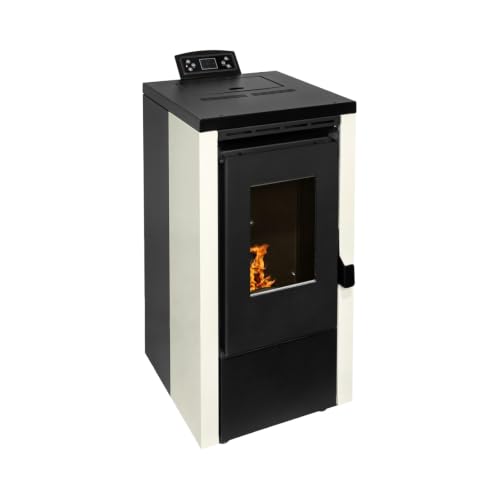
Best for a living room, or for anyone who only wants to heat the part of the house they actually live in. It is the lowest output in the whole census and it still declares 6.02 kW rated with a 94 % efficiency, and at that output the permanent vent Approved Document J asks for is 561 mm² rather than several thousand. In Britain that is not a detail: it is the difference between an installation and a building project.
- 6.02 kW rated and 7.01 maximum with a declared 94 %: it is the lowest output of the thirty five listings in the census that declare one, and the highest efficiency that appears in it.
- At 6.02 kilowatts the permanent vent Approved Document J asks for is 561 mm², against 2,332 for the 9.24 kW model and 4,812 for the ducted one. It is the only one here where the building work is a detail rather than a project.
- At half output for eight hours it burns about 5.6 kilos a day, so a 13 kilo hopper lasts more than eighteen hours and gets filled every other day.
- The 245 and 175 cubic metre claims across this range are the same rule of about ten square metres per kilowatt that the whole catalogue applies. The British volume rule, room volume divided by 14, gives a smaller answer, and it is the one the vent arithmetic follows.
- The 94 % it declares is the highest in the census, shared with another model from the same brand. Between 90 % and 94 % the difference is four points of kilos burnt, not half the bill.
- The lowest output in the census, which is the one that fits a British living room
- The highest declared efficiency of the eighteen listings that publish one
- It writes both of its power figures, the rated and the maximum
- 561 mm² of permanent vent: by far the smallest hole in the wall of the seven
- Six kilowatts will not heat a whole house, even with the doors open
- The 13 kg hopper is among the smallest here: less running time on the coldest days
- It is not ducted, so the heat stays in the room it is in
- Even at 6 kW it is above the 5 kW line, so the vent is not optional
EIDER BIOMASA KING 10 view ›
Best for a house where the stove is going to be the main heating rather than a feature in one room. It is one of the eight listings in the census that writes the rated and the maximum power in the same title, and with 9.24 kW and a declared 92 % the whole running cost can be worked out before buying, which is exactly what half the catalogue does not allow.
- It declares 9.24 kW rated and 10.62 kW maximum. Eight of the thirty six listings in the census make that distinction: the other twenty seven give one number and do not say which of the two it is.
- With the 92 % it declares, at half output for eight hours a day it burns about 8.7 kilos of pellet, a little over half a bag, and a 15 kilo hopper lasts nearly fourteen hours straight.
- At 9.24 kilowatts rated, Approved Document J asks for a permanent vent of 2,332 mm² of free area in the room, and 5,082 in a dwelling of modern air tightness. It is the arithmetic to do before the aesthetics.
- Weekly programming matters for money rather than convenience: a pellet stove takes time to light and time to shut down properly, so the saving is in programming it rather than in lighting it once you are already cold.
- Class A+ on the energy label. Since 1 January 2022 no pellet stove can be placed on the market below 79 % seasonal efficiency, so the letter separates less than it appears to.
- It writes the rated and the maximum power, which is what lets the running cost be worked out
- Declared efficiency of 92 %, with which the kilos arithmetic closes
- A 15 kg hopper, the most repeated capacity among the eleven that declare one
- Weekly programming over wifi, which is where the real saving is
- It does not say how long a full hopper lasts, although none of the thirty six gives that beside the kilos
- Nine kilowatts is short for a two storey or poorly insulated house, and far above what one room needs
- Like any pellet stove it needs a flue, a socket and, above 5 kW, a permanent air vent
The 5 kW line, the flue and the vent: what a pellet stove asks of a British house
The kilowatt figure on a pellet stove listing is not just a comfort setting here: it is a building instruction. The volume rule the British trade publishes, room width by length by height divided by 14, puts a 5 by 4 metre room with a 2.4 metre ceiling at about 3.4 kilowatts. Every stove in this guide is above that, and every one of them is above the 5 kW line at which Approved Document J starts asking for a permanent, non adjustable air vent of 550 mm² of free area for every kilowatt over 5.
Applied to these seven that runs from 561 mm² on the smallest to 4,812 mm² on the ducted one. Add the hearth, at least 840 by 840 mm and reaching 300 mm in front and 150 mm to each side, the carbon monoxide alarm that is a legal requirement in the room, and the sign off by building notice or by a HETAS registered installer, and the picture is complete. We would size down rather than up, and the reason is arithmetic rather than taste: an oversized pellet stove spends the winter modulating at its minimum, which is the setting at which any biomass appliance burns worst, and it brings a larger hole in the wall with it for the life of the house.
Three things that sit between the listing and a working installation in a British house.
m8d rule: Every kilowatt above five costs 550 square millimetres of permanent vent through an outside wall, in the room you are trying to warm. Size the stove to the room rather than to the house, because the excess is paid once in building work and then every winter in a stove running at its worst setting.

EIDER BIOMASA VENERE view ›
Best for anyone who arrived here looking for a pellet stove without a flue, because this one answers that question without it being asked: its own listing writes “80 mm outlet” in the title it is sold under. It is the only one of the thirty six that does, and it is the manufacturer's own proof that the flue is not an optional extra.
- Its title includes “80 mm outlet”. Not one of the other thirty five listings in the census writes the diameter of its flue outlet, and in a British house that number is what decides whether it registers into the liner you already have or whether a liner joins the bill.
- 10.8 kW with a declared 90 % and a 16 kilo hopper, the largest of the eleven that publish that figure.
- At 10.8 kilowatts the permanent vent Approved Document J asks for is 3,190 mm², which is roughly six times the figure for the 6 kW model on this page.
- It declares a single power figure. Alongside other models from the same brand that write the rated and the maximum, it is not clear which of the two this is.
- The 90 % declared is the lowest of the three values that appear in the census, which run from 90 to 94 %: four points of kilos, not a change of category.
- The only listing in the census that writes the diameter of its flue outlet
- The largest hopper of the eleven that declare one, 16 kg
- Weekly programming and a digital display
- Close to eleven kilowatts, with the efficiency written down
- It declares one power figure and does not say whether it is the rated or the maximum
- 90 % is the lowest efficiency of those that appear in the census
- 3,190 mm² of permanent vent, well above what a single room needs
The two kilowatt figures on a pellet stove: which of the two a listing is selling you
A pellet stove has a rated output and a maximum output, and the gap between them is the difference between what it holds all evening and what it reaches with the auger running hard. Eight of the thirty six listings write both. The other twenty seven write one number and do not say which of the two it is, which means the vent arithmetic and the fuel arithmetic are both being done on a figure of unknown identity.
| Stove | Rated kW | Maximum kW | Efficiency | Vent Document J forces | Hopper or burn time | |
|---|---|---|---|---|---|---|
| EIDER BIOMASA ELITE 7 view › | 6.02 kW | 7.01 kW | 94 % | 561 mm² | 13 kg hopper | View › |
| EIDER BIOMASA KING 10 view › | 9.24 kW | 10.62 kW | 92 % | 2,332 mm² | 15 kg hopper | View › |
| EIDER BIOMASA VENERE view › | 10.8 kW | not stated | 90 % | 3,190 mm² | 16 kg hopper | View › |
 Stufe a Pellet Italia Canada 12 kW view › Stufe a Pellet Italia Canada 12 kW view › | 12 kW | not stated | 91 % | 3,850 mm² | 15 h burn time | View › |
 EIDER BIOMASA GYDA ducted view › EIDER BIOMASA GYDA ducted view › | 13.75 kW | 14.95 kW | 92 % | 4,812 mm² | 15 kg hopper | View › |
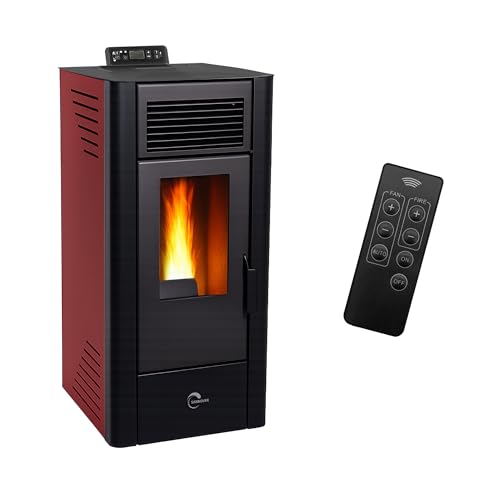 Sannover Anita 10 kW view › Sannover Anita 10 kW view › | 10 kW | not stated | not stated | 2,750 mm² | not stated | View › |
 JOIMA NATUR STYLE 8 kW view › JOIMA NATUR STYLE 8 kW view › | 8 kW | not stated | not stated | 1,650 mm² | not stated | View › |
What each listing writes in its own title, read on 6 September 2026, with nothing added by us. “Not stated” means exactly that: the figure is not on the listing the stove is sold from, not that the appliance lacks it. The vent column is the Approved Document J arithmetic applied to the rated figure each listing prints: 550 mm² of free area for every kilowatt above 5 kW, in a dwelling of ordinary air permeability. In a dwelling at 5.0 m³/(h·m²) or better the same 550 mm² applies to every kilowatt, which takes the first row to 3,311 mm² and the last to 7,563. And look at the final column: nobody gives the kilos in the hopper and the hours it lasts at the same time, and those are the two that tell you what it burns.
Bagged or blown in bulk: what is inside a bag of pellets, and why the delivery decides the bill
A 15 kilo bag of certified pellet holds at least 69 kilowatt hours of fuel, which through a stove at 92 % is about 63 kilowatt hours of heat. Divide what the bag costs you by 63 and you have the price of your heat, and that is the number to compare with the gas bill rather than the price on the pallet.
The British figures put the whole argument in one line. Bagged pellets came out at 10.16 pence per kilowatt hour of delivered heat in September 2026 and blown bulk at 8.31: a 1.85 penny gap that is wider than the entire difference between bagged pellets and kiln dried logs. Bulk needs somewhere dry to put a tonne and somewhere a tanker can reach, which is exactly why a pellet stove makes more sense in a house with a yard than in a terrace, and why the same appliance is a different purchase at two addresses. We would settle that before choosing a model: 1.85 pence a kilowatt hour across a whole heating season is a bigger number than anything separating the seven appliances on this page.
- The heat is the same across all three classes. ENplus asks the same of A1, A2 and B: at least 4.6 kilowatt hours a kilo, which its table writes as “≥ 16.5 MJ/kg” (ENplus ST 1001:2022, annex A, table 4).
- What changes is the ash: 0.70 % in A1, 1.20 % in A2 and 2.00 % in B, on dry matter. A class B bag does not give less heat: it makes nearly three times the mess, and emptying the ash pan is the monthly job of the heating season.
- Moisture has the same ceiling in all three: 10 %. A wet pellet is not a different class of pellet, it is a spoiled one, which is why a pallet is stored under cover.
- Diameter is 6 or 8 millimetres and the minimum mechanical durability is 98 % in A1 and 97.5 % in A2 and B. That is what decides how much loose dust you find at the bottom of the bag.

Naturpellet ENplus A1 wood pellets, 15 kg bag view ›
The fuel behind every figure in this guide. A 15 kilo bag of ENplus certified pellet holds at least 4.6 kilowatt hours a kilo, which is about 63 kilowatt hours of heat through a stove at 92 %. What decides whether pellets pay is not the stove: it is what you pay for those 63 kilowatt hours, and in Britain that is decided by whether they arrive in bags or in bulk.
- ENplus A1 certification requires a minimum of 4.6 kilowatt hours a kilo and a maximum of 0.70 % ash on dry matter. Classes A2 and B have exactly the same heat minimum and allow more ash.
- Fifteen kilos through a stove at 92 % is about 63 kilowatt hours of heat. Divide what the bag costs you by 63 and you have the price of your heat, which is the figure to compare with gas and with electricity.
- This is where the British money is. Bagged pellets came out at 10.16 pence per kilowatt hour of delivered heat in September 2026 and blown bulk at 8.31: a 1.85 penny gap, wider than the entire difference between bagged pellets and kiln dried logs.
- A pellet with more ash does not give less heat: it makes more mess, and emptying the ash pan is the monthly job of the heating season.
- Bulk delivery needs a tanker that can reach you and somewhere dry for a tonne. That is why the same stove is a different purchase in a house with a yard and in a mid terrace.
- ENplus A1 certification, the class with the least ash of the three
- 6 mm diameter, one of the two the standard allows
- Suitable for both stoves and boilers
- Buying loose bags always costs more per kilowatt hour than buying in bulk
- A pallet weighs more than a tonne and needs somewhere dry to keep it
- Bulk delivery is only an option where a tanker can get to you
Ducted pellet stove: what actually changes, and how many rooms make it worth the work
Ducting means a second fan pushes part of the hot air down a pipe into another room. The stove is still in one room: what travels is the air, and it arrives cooler the further it goes. The decision is not really about the appliance, it is about the building: the duct has to run through a ceiling or under a floor, and that is settled before the purchase rather than after it.
The arithmetic to do first is the vent. The ducted model here is 13.75 kilowatts rated, which is 4,812 mm² of permanent vent under Approved Document J, and 7,563 in an air tight dwelling. Put fourteen kilowatts into a small British house and it will not heat faster: it will modulate at its minimum almost permanently, which is the setting at which any biomass appliance burns worst, and it will do it behind a considerably larger air brick.
EIDER BIOMASA GYDA ducted view ›
Best for a house where a living room and two more rooms have to be heated. It is the highest output here and the only one that carries hot air by duct to another room. The difference against a normal stove is not in the appliance, it is in the work: the duct has to run through a ceiling or a floor and the vent it forces is nearly nine times the smallest one here, and both are decided before buying rather than after.
- 13.75 kW rated and 14.95 maximum with a declared 92 %: the highest output of the seven here and the one that claims the most space, 340 cubic metres.
- Ducting means a second fan sends part of the hot air down a pipe to another room. The stove is still in one room: what travels is the air, and it arrives cooler the further it goes.
- At 13.75 kilowatts the permanent vent under Approved Document J is 4,812 mm², and 7,563 in an air tight dwelling. Add the duct run through a ceiling or a floor and this stops being a purchase and becomes building work.
- At half output for eight hours it burns about thirteen kilos a day, close to a whole bag, and the 15 kilo hopper is down to about nine hours.
- Fourteen kilowatts in a small British house will not heat it any faster: it will make the stove modulate at its minimum almost permanently, which is the setting at which any biomass appliance burns worst.
- It spreads heat to other rooms without a second stove
- The highest output here, for a house with two living spaces
- It writes both of its power figures and its efficiency
- A 15 kg hopper with weekly programming
- Ducting is building work: the run has to go through a ceiling or a floor
- 4,812 mm² of permanent vent, the largest of the seven
- Too much output for a small house, and an oversized stove runs worse
- Close to a bag a day at a middling setting, more than twice a six kilowatt model
The socket and the fan: the two things a pellet stove needs that a log burner does not
This is where the comparison at the top of the page turns physical. An air pellet stove feeds itself with an auger, spreads its heat with a fan and decides what to do with a controller, and all three run on mains electricity. In a power cut it stops, which is precisely when a British household wants it most, and the fan is also the noise: it runs continuously and it is the sound you live with, not the fire.
Not one of the thirty six listings we counted publishes a decibel figure. One of the seven here answers the problem by removing the cause: no fan, no electronics, heat by natural convection and radiation. It keeps working through a power cut and it is silent, and it gives up the thermostat, the timer and most of the heat distribution to get there. It still needs a flue, like everything else that burns.
Best for anyone with a fixed budget who accepts buying with less information in front of them. It is the cheapest pellet stove of the thirty six we counted, and its listing is also the one that says least: an output figure and nothing else. Without the efficiency there is no way to work out what it will burn, and that is precisely what you want to know before spending.
View ›Best for a single storey house with the living room in the middle, and for anyone who wants to know how many hours it runs for. Twelve kilowatts is the most repeated output in the census, and this is one of the nine stoves that publish the burn time. What it does not publish, like none of the thirty six, is the kilos in the hopper.
View ›Best for a house that loses power, for somewhere with frequent cuts, or for anyone who does not want to listen to a fan all evening. It is what you actually find when you search for a pellet stove without a flue: not a stove without a chimney, which does not exist, but a stove without electricity, which does. And it needs a flue exactly like the rest.
View ›The fuel behind every figure in this guide. A 15 kilo bag of ENplus certified pellet holds at least 4.6 kilowatt hours a kilo, which is about 63 kilowatt hours of heat through a stove at 92 %. What decides whether pellets pay is not the stove: it is what you pay for those 63 kilowatt hours, and in Britain that is decided by whether they arrive in bags or in bulk.
View ›How these seven pellet stoves were chosen, and where every figure on this page comes from
We went through the pellet stove catalogue that m8d tracks, Amazon Spain, which is part of Amazon's shared European catalogue, through our API on 6 September 2026, and kept the 36 different listings it returned. For each one we counted what the listing itself prints in its title: rated kilowatts, maximum kilowatts, efficiency, the area or volume claimed, the hopper and the burn time. That count is the spine of this guide: 35 print the kilowatts, 18 print an efficiency, 11 print the hopper, 9 print the burn time and none prints the last two together.
The British rules are read at source. The Ecodesign floors of 79 % for a pellet appliance and 65 % for a closed wood one, and the four emission limits, come from HETAS, read on 16 September 2026. The smoke control rules and the penalties come from GOV.UK. The ventilation, hearth and carbon monoxide requirements are the Approved Document J figures. The cost of a kilowatt hour of heat comes from Nottingham Energy Partnership's September 2026 comparison, and the electricity and gas unit rates from the Ofgem price cap for 1 October to 31 December 2026. The pellet standard figures come from ENplus ST 1001:2022.
The vent figures in the table are ours, and they are a division rather than a measurement: 550 millimetres squared for every kilowatt above five, applied to the rated figure each listing prints. Where a listing prints no rated figure, the column says so.
The seven products are the ones the API returned with stock that day, chosen for the part each plays in the decision and not for what they pay: the smallest, the one that prints both power figures, the one that prints its flue diameter, the one that prints its burn time, the ducted one, the one that runs without electricity and the cheapest, plus the fuel itself. Availability and model ranges vary by country: the buttons take you to your local Amazon store so you can check yours, and the rules quoted here are the ones that apply in Great Britain.
The lowest output in the census, six kilowatts, with the highest declared efficiency in it, and the smallest permanent vent of the seven at 561 mm².
See it on Amazon ›Is a pellet stove cheaper to run than a log burner?›
Barely, if the pellets come in bags. Nottingham Energy Partnership's September 2026 comparison, which includes appliance efficiency, puts bagged wood pellets at 10.16 pence per kilowatt hour of delivered heat and kiln dried logs at 10.73, a difference of 0.57 pence. Blown in bulk, pellets come out at 8.31, which is most of the way to mains gas at 7.86. So the saving is in the delivery rather than in the appliance, and it depends on having somewhere a tanker can reach and somewhere dry to store a tonne.
Are pellet stoves more efficient than wood burners?›
The rules say so and they say by how much. Since 1 January 2022 an appliance placed on the market in Great Britain has to reach an Ecodesign seasonal efficiency floor, and the floor is 79 % for a pellet appliance against 65 % for a closed one burning wood. Both face the same four emission ceilings: 40 mg/m³ of particulates, 120 of organic gaseous compounds, 1,500 of carbon monoxide and 200 of nitrogen oxides. Fourteen points is a real gap, and it is smaller in the bill than it looks because the fuel costs more per kilowatt hour than the logs do unless it arrives in bulk.
Can I use a pellet stove in a smoke control area?›
Only if the appliance is on Defra's list of exempt appliances and its exemption covers the fuel you intend to burn. Pellets are wood, and GOV.UK is clear that unauthorised fuels such as wood can only be burned in an exempt appliance, and that you must only use the types of fuel the manufacturer says can be used in it. Smoke from a chimney in a smoke control area can carry a penalty of up to £300, and buying unauthorised fuel for an appliance that is not approved up to £1,000. There is no national map: the areas were declared council by council, so your council's environmental services team is who knows.
Do I need an air vent for a pellet stove?›
Above 5 kW, yes. Approved Document J asks for a permanent, non adjustable air vent to outside with a free area of 550 mm² for every kilowatt above 5 kW, and in a dwelling built to an air permeability of 5.0 m³/(h·m²) or better the same figure applies to every kilowatt of rated output. On the seven stoves here that runs from 561 mm² on the 6 kW model to 4,812 mm² on the 13.75 kW ducted one. The hearth also has to be at least 840 by 840 mm, extending 300 mm in front and 150 mm to each side, and a carbon monoxide alarm in the room is a legal requirement.
How much pellet does a stove burn a day?›
It depends on three figures, and two of them are on the spec sheet. A 9.24 kilowatt stove at 92 % efficiency, run at half output for eight hours a day, burns about 8.7 kilos a day, which is a little over half a bag, and a 15 kilo hopper lasts nearly fourteen hours. The calculator on this page does the whole chain with the numbers you put in, and the constant behind it is the pellet standard itself: ENplus requires at least 4.6 kilowatt hours a kilo from all three classes.
Is there a pellet stove that does not need a flue?›
No. Everything that burns has to vent what it burns, and the search results that promise otherwise are not selling a stove without a flue: they are selling one without electricity. That is a real product and there is one in this guide, with no fan and no electronics, which keeps working through a power cut and makes no fan noise. It still needs a flue. The figure worth looking for instead is the flue outlet diameter, because that decides whether it fits the liner you already have, and exactly one of the thirty six listings prints it.
Does a pellet stove work in a power cut?›
An air pellet stove does not. It has an auger to feed itself, a fan to distribute the heat and a controller to decide what to do, and all three need mains electricity. That is the clearest advantage a log burner has, and it is why one of the seven stoves here is built without a fan or electronics at all, heating by natural convection and radiation. The trade off is that it has no thermostat and no timer, and the heat stays in the room it is in.
Every figure on this page comes from one of these, with the exact section and the date it was read.
- HETASEcodesign explainedSeasonal efficiency of 79 % for a pellet appliance and 65 % for a closed appliance burning wood or smokeless fuel; particulates 40, organic gaseous compounds 120, carbon monoxide 1,500 and nitrogen oxides 200 milligrams per cubic metre; in force from 1 January 2022. Read on 16 September 2026
- GOV.UKSmoke control areas: the rulesUnauthorised fuels such as wood can only be burned in an exempt appliance, and only with the types of fuel the manufacturer says can be used in it; penalty of up to £300 for smoke from a chimney in a smoke control area and up to £1,000 for buying unauthorised fuel for an appliance that is not approved; the local council holds the boundaries. Read on 16 September 2026
- Nottingham Energy PartnershipEnergy cost comparisonSeptember 2026 table. Bagged wood pellets 10.16, blown bulk wood pellets 8.31, kiln dried logs 10.73, air source heat pump 10.54, smokeless fuel 13.41, mains gas 7.86 and standard electricity 31.00 pence per kilowatt hour of delivered heat, for a medium sized property of around 12,500 kilowatt hours of annual heat demand, quoted in the East Midlands, with standing charges included and appliance efficiency applied. Read on 16 September 2026
- OfgemEnergy price cap unit rates and standing chargesFor 1 October to 31 December 2026 on direct debit: electricity 26.32 pence per kilowatt hour with no VAT in that window, gas 7.97 pence per kilowatt hour including VAT at 5 %. These are the two unit rates the calculator on this page uses. Read on 16 September 2026
- Direct StovesAre there building regulations for a stove?Sets out the Approved Document J figures used in this guide: a permanent air vent of 550 mm² for every kilowatt above 5 kW, a hearth of at least 840 by 840 mm extending 300 mm in front and 150 mm to each side, and a carbon monoxide alarm as a legal requirement in the room. Read on 16 September 2026
- HETASBuilding Regulations guidance for wood burning stovesApproved Document J applies to solid fuel appliances, and work carried out by a HETAS registered installer can be self certified instead of the owner applying for a building notice from the local authority. Read on 16 September 2026
- ENplus, European Pellet CouncilENplus ST 1001:2022, the pellet certification standardAnnex A, table 4: a minimum of 16.5 MJ per kilo, which is 4.6 kilowatt hours, for all three classes A1, A2 and B; ash of 0.70, 1.20 and 2.00 % on dry matter; moisture of 10 % for all three; diameter of 6 or 8 millimetres; minimum mechanical durability of 98 % for A1 and 97.5 % for A2 and B
- m8d.iom8d census of the pellet stove catalogue36 different listings read through our API on 6 September 2026. What each title prints: 35 the kilowatts, 18 an efficiency, 24 an area or a volume, 11 the hopper in kilos, 9 the burn time in hours, 8 both power figures, 1 the flue outlet diameter, and none the hopper and the burn time together
For a normal British living room, the ELITE 7: the lowest output of the thirty six at 6.02 kilowatts rated, the highest declared efficiency in the census at 94 %, and the smallest permanent vent of the seven at 561 mm². For a house the stove is going to heat on its own, the KING 10, one of only eight listings that writes both power figures and its efficiency, which is what lets the running cost be worked out before paying. And for a living room plus two more, the GYDA, which is ducting and therefore building work, not a purchase.
One thing above all three, and it is the honest answer to the question at the top. On the published British figures a pellet stove and a log burner cost just over half a penny apart per kilowatt hour of heat if the pellets come in bags, and the pellet stove wins clearly only when the fuel is blown in bulk. Our advice is to settle the delivery before the appliance: find out whether a tanker can reach you and whether you have somewhere dry for a tonne, because that answer moves more money than the choice between any two stoves on this page.
m8d pick · the smallest, and the one the vent rule punishes leastEIDER BIOMASA ELITE 7See it on Amazon ›

Comments
Be the firstNo sign-up: just a name. Every comment is reviewed before it is published.