Best electric bikes UK 2026: which ones are legal to ride, how far they really go, and which to buy
 m8d.ioUpdated on

This guide contains affiliate links. As an Amazon Associate, m8d.io earns from qualifying purchases, at no extra cost to you.
The best electric bike is chosen on the watt hours of its battery, not on the miles printed on the box, and in this country on one thing before either: whether it is an EAPC. Of the 88 e-bikes we counted in the catalogue, only 29 declare the watt hours and the range at the same time, and dividing one by the other the consumption each maker claims for itself runs from 4.32 to 16 Wh per km.
| Bike | Battery | Declared torque | Weight | Assist cut-off | |
|---|---|---|---|---|---|
 Moma Bikes Ebike 28.2 view › Moma Bikes Ebike 28.2 view › | 576 Wh | Its sheet does not say | Its sheet does not say | 25 km/h, 15.5 mph | View › |
 Moma Bikes E-MTB 27.5 view › Moma Bikes E-MTB 27.5 view › | 624 Wh | 55 Nm | Its sheet does not say | 25 km/h, 15.5 mph | View › |
 ENGWE EP-2 Boost view › ENGWE EP-2 Boost view › | 624 Wh | 55 Nm | 30 kg | 25 km/h, 15.5 mph | View › |
 Legend eBikes Milano view › Legend eBikes Milano view › | 504 Wh | 40 Nm | 24 kg with the battery | 25 km/h, 15.5 mph | View › |
 Cecotec Capital view › Cecotec Capital view › | 468 Wh | 36.5 Nm | Its sheet does not say | 25 km/h, 15.5 mph | View › |
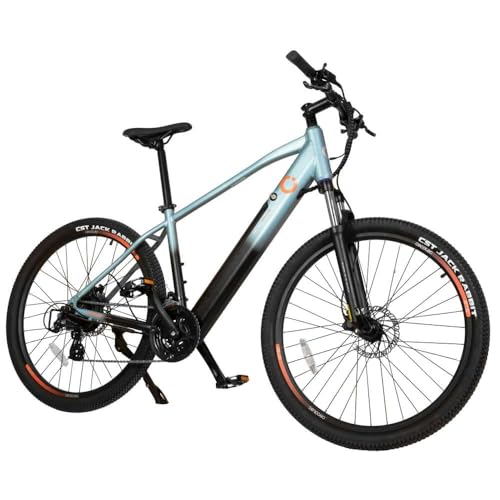 Cecotec Mountain Ventus view › Cecotec Mountain Ventus view › | 460 Wh | 36.5 Nm | Its sheet does not say | 25 km/h, 15.5 mph | View › |
 ENGWE P20 view › ENGWE P20 view › | 345.6 Wh | 42 Nm | 18.5 kg | 25 km/h, 15.5 mph | View › |
 HillMiles Mile 1 view › HillMiles Mile 1 view › | 374 Wh | Its listing does not say | Its listing does not say | 25 km/h, 15.5 mph | View › |
Every figure is the one the manufacturer publishes on its own spec sheet, read on 5 September 2026, and where a maker does not publish one the cell says so instead of being filled in. All eight declare a 250 W motor and assistance that stops at 25 km/h, which is 15.5 mph: the two numbers the EAPC rules ask for. A throttle that drives the bike without pedalling is a separate question and is covered in the first section.
Is an electric bike legal in the UK: 250 W, 15.5 mph, and the throttle that turns one into a moped
In Great Britain an electric bike is a bicycle as long as it meets a short list of conditions, and gov.uk writes them plainly. It has to have pedals that can be used. "Its electric motor must have a 'continuous rated power' output of no more than 250 watts" and it "must not be able to propel the bike when it's travelling at more than 15.5 miles per hour". If it does all that, it is an EAPC: "You do not need a licence to ride an EAPC and it does not need to be registered, taxed or insured", and "you can ride an electric bike if you're 14 or over".
The consequence of missing the list is the part that matters, and it is not a fine for the bike, it is a change of vehicle: "If your electric bike does not meet the EAPC rules then it's classed as a motorcycle or moped", which means registration, tax, insurance, a valid driving licence and an approved motorcycle helmet. That is the difference between a purchase and a problem, and it is decided by two numbers on a listing and by one control on the handlebars.
The two numbers that decide are published in different units on either side of the same transaction. The law is written in miles per hour; every listing in this category is written in kilometres per hour, because the bikes are built for a European specification. They are the same number, and almost nobody writes it down.
gov.uk, electric bike rules: no more than 250 watts of continuous rated power, and the motor "must not be able to propel the bike when it's travelling at more than 15.5 miles per hour". Read on 16 September 2026.
All eight bikes in this guide declare 250 W and assistance that cuts at 25 km/h. Those are the same two numbers: 25 km/h is 15.5 mph to one decimal place, which is how the same ceiling is written in each system. Only 10 of the 88 listings we counted write the assisted top speed in their title at all.
A machine sold as assisting to 20 mph or 28 mph, which is what a North American class 3 e-bike does, is above the British limit. So is one advertised at 32 km/h. Those are legal somewhere, and not here.
A throttle that drives the bike without pedalling is the other way out of the EAPC definition. gov.uk is explicit that a twist and go requires approval, and without it the machine is a motorcycle or moped. Check the photographs of the handlebars before ordering, because a throttle is fitted to plenty of the cheap machines on this shelf and it is rarely the headline of the listing.
m8d rule: 25 km/h is the metric form of the 15.5 mph limit, so a listing that says its assistance stops at 25 km/h is quoting the same ceiling the British rules do. A listing that says 20 mph, 28 mph or 32 km/h is not, and in Great Britain that bike is classed as a motorcycle or a moped.
What the EN 15194 sticker does and does not tell you. One of the 88 listings we counted sells itself as "certified to CE and 15194 standards". The standard is real: it is the European standard for electrically power assisted cycles, and it covers electrical safety, battery protection, braking and frame strength. What it does not do is tell you whether a particular machine meets the British rules on the day it arrives: the throttle, the assisted top speed and the continuous rated power are what the EAPC definition turns on, and a bike can carry the sticker and still be set up outside that definition. Read the two numbers and look at the handlebars.
Cycle to Work: the saving that only exists in this country, and what it does to where you buy
Here is the part of a British e-bike purchase that has no equivalent anywhere else in this guide's other editions, and it is worth more than any discount on this page. Cycle to Work is a salary sacrifice arrangement: your employer buys the bike, you pay for it out of gross salary over twelve to eighteen months, and the saving is the income tax and National Insurance you never paid on that money. For a basic rate taxpayer that is around 28 to 32%; for a higher rate taxpayer it reaches around 42%. The bike has to be roadworthy and it has to be an EAPC, which brings you straight back to the previous section.
The catch, and the reason it belongs in a buying guide rather than in a tax guide, is that it changes where you buy. The scheme runs through providers, and each provider has its own network of participating retailers. If the shop you are looking at is not in your provider's network, the scheme is not available for that purchase, however good the machine is. And the old £1,000 cap was removed in 2019, although individual providers may still set their own limit, so a bike above a thousand pounds is not automatically out.
We would check this before anything else on the page, and not because it is complicated: because a 32% saving through your employer beats comparing two listings for an hour, and it is the single cheapest thing a British commuter reading this can do. If your employer does not run a scheme, the rest of this guide applies unchanged.
Legend eBikes Milano view ›
It is the only one in the category that publishes the complete protocol behind its range figure, and also the only one that declares the weight with the battery in, 24 kg, the cell brand, Panasonic, and three years of warranty. You pay for that: there are city bikes with more watt hours for less money, and none with this traceability.
- Its sheet publishes the whole range test: a flat course, without stopping, first level of assistance, 20 degrees and a 70 kg rider. It is the sentence that explains where the range figures of the entire catalogue come from.
- It declares Panasonic cells in the 14 Ah, 504 Wh version. The cell brand is what decides how many recharges the battery takes before it loses capacity, and almost nobody writes it.
- It publishes the weight with the battery in, 24 kg, and the weight of the battery on its own, 2.75 kg. None of the 88 listings in the count says what the bike weighs.
- The hub motor declares 40 Nm and the warranty is three years on all components except consumables, according to the brand.
- It publishes the complete range measurement protocol
- Panasonic cells declared
- 24 kg with the battery, a figure almost nobody gives
- Three years of warranty on components
- A replacement battery on sale separately
- 504 Wh at the upper end of the city bike range: there is more battery for less elsewhere
- 40 Nm of torque: this is not a bike for long climbs
- A 7 speed drivetrain on a city bike at this level
Cecotec Capital view ›
It is the sensible way into a 28 inch city bike from a brand with service and spares: 468 Wh declared in the listing title itself, which already puts it ahead of two out of three. What it does not say, in the listing or on the sheet, is what it weighs or under what conditions those 80 km were measured.
- Cecotec's official sheet declares 468 Wh (36 V and 13 Ah) and a 36.5 Nm motor in the rear wheel, with a 28 inch wheel, a 6 speed Shimano drivetrain and dual mechanical disc brakes.
- The 80 km it advertises work out at 5.85 Wh per kilometre, above the median of the catalogue, which makes it one of the less optimistic declarations in the count. Even so, its sheet does not say what conditions those were measured under.
- Its official sheet does not publish the weight of the bike. On a 28 inch city bike with the battery on the rack, that is the figure that decides whether it goes up to the landing.
- Cecotec also sells it on its own site, so the listing can be checked against the manufacturer before paying. That is the check that catches an inflated reference price with a discount hung on it.
- 468 Wh declared in the listing title itself
- A brand with service and spares
- A 28 inch wheel, the one that rolls best on tarmac
- The same model is sold on the manufacturer's own site, so the listing can be checked against it
- 36.5 Nm of torque: the same motor as its own mountain model
- Mechanical disc brakes, not hydraulic
- Neither the listing nor the sheet publishes the weight
- A 6 speed drivetrain
Torque, not watts: why 250 W is the same on every legal bike, and what actually gets you up a hill
Every legal electric bike in this country carries 250 W. That figure is fixed by the rules and it distinguishes nothing. What does distinguish them is torque, measured in newton metres: the turning force the motor pushes with. The 250 W is how much energy it can deliver continuously; the torque is how hard it does it from a standstill and on a ramp. Which is why two bikes with the same 250 W climb completely differently, and why a spec sheet without a newton metre figure tells you nothing about the only thing a hill cares about.
And this is where reading the sheets of one single brand becomes instructive.
Two bikes from the same maker, one sold for the city and one sold for the mountain, and the same motor inside both. Only the spec sheets say so, because the listings do not.
A city bike and a mountain bike from the same brand, sold as different machines for different terrain, with a suspension fork, 24 gears and hydraulic brakes on the mountain one.
Both declare a rear hub motor of 36.5 Nm. The same figure, the same position, the same motor. Read on the manufacturer's sheets on 5 September 2026.
In the fork, the gears and the brakes, which is worth having and is not what most people think they are buying. For climbing, the mountain model of this pair pushes exactly as hard as the city one. Compare that against the 55 Nm the two bikes at the top of this guide declare, which is half as much force again.
Only 13 of the 88 listings we counted write the torque at all. On the other 75 there is no way to know how the bike will climb, and asking is faster than guessing.
m8d rule: On a hill it is not the battery that decides, it is the torque: the 250 W is identical on every legal bike by law. If the listing does not write the newton metres, you do not know how it will climb, and a mountain model can carry exactly the same motor as the city model from the same brand.
The other half of the question is where the motor sits. In the hub, which is what the Cecotec and Legend sheets in this guide declare and what nearly everything below the premium tier carries, the motor drives the wheel directly: it is simple, cheap and quiet, and it knows nothing about your gears, so on a long ramp it always turns at the same speed. A mid drive, mounted at the pedals, sends its force through the same gears you use, and that is what lets it climb slowly with a lot of force. It is also what raises the price and what wears the chain faster. The way to find out which one you are looking at: if a manufacturer has a mid drive, it puts it in the model name, because it is the expensive part.
How far an electric bike really goes, where the number on the box comes from, and a calculator for your own weight and hills
An electric bike travels as far as its battery divided by what it uses per unit of distance, and the second half depends on your weight, the climbing and the assistance level you actually ride in. So the number in the advert does not describe the bike: it describes a scenario. And the scenario is published, just not in the advert.
Here is the count of the whole catalogue: of the 88 listings, 29 declare the watt hours and the range at the same time. Divide one by the other and out comes the consumption each manufacturer claims for itself, from 4.32 to 16 Wh per kilometre, which is close to four times the difference for the same act of moving one person along a road.
Nobody in this category is inventing the range figure. They are all publishing the result of the same test, and three of the makers in this guide write that test down on their own sheets. Once you have read it, every range claim in the catalogue reads differently.
"Up to 80 km", "up to 100 km", "up to 120 km", with no conditions attached, in the listings of a category where 34 of 88 do not even declare the battery.
The whole test, written out: "Maximum Range according to tests performed on a flat course without stopping, using first level of assistance, with a temperature of 20 °C and a 70 kg rider". That is 504 Wh and 100 km, or 5.04 Wh per kilometre. Read on its sheet on 5 September 2026.
"120 km (PAS 1)", and separately that the range is tested with a 75 kg rider on a flat path at 25 °C. That is 624 Wh and 120 km, or 5.20 Wh per kilometre, which is exactly the median of the whole catalogue count.
Flat, no stopping, lowest assistance, 70 to 75 kg. Change any one of those and the figure moves. The calculator below changes all four at once and shows the arithmetic in newtons, so you can see which term is eating your battery.
m8d rule: Divide the watt hours of the battery by the range the listing claims. If it comes out below 6 Wh per kilometre, that figure was measured on the flat, without stopping, in the lowest assistance level, with a rider of around 70 kg. That is what the three manufacturers here who publish their conditions declare, and the median of the 29 listings that give both figures is 5.2.
Electric bike range calculator for your weight, your hills and your assistance level
The advert fixes three things that real life does not: your weight, the climbing on your route and the assistance level you actually use. This calculator changes those three and does the physics in the open, term by term, in newtons. With 504 Wh, 75 kg, a city with hills and medium assistance it comes out around 56 km where the listing promises 97. Free, no account. Distances are in kilometres because that is the unit every maker in this catalogue publishes; multiply by 0.62 for miles.
rolling   0.008 x 99 kg x 9.81            = 7.8 N
air       0.5 x 1.225 x 0.55 x (6.1 m/s)2 = 12.6 N
climbing  99 kg x 9.81 x 1.5 %            = 14.6 N
                                            --------
total                                       34.9 N

at the wheel    34.9 N / 3.6      = 9.7 Wh/km
from the motor  9.7 x 70 % / 0.75 = 9.1 Wh/km
range           504 Wh / 9.1      = 56 km
Climbing is the term that runs away with it: at 22 km/h and with 99 kilos on board, every percentage point of gradient adds 9.7 newtons, more than rolling on smooth tarmac contributes in total. That is why the same bike does twice the distance across a flat city as it does around steep lanes, with nothing at all happening to the battery.
Count by m8d on 5 September 2026 over the Amazon catalogue, fourteen searches of the family: 88 distinct listings, of which 29 declare both the watt hours and the range. Dividing one by the other, the consumption they claim runs from 4.3 to 16.0 Wh/km. The scenario behind that median is published by the makers themselves: Legend eBikes writes it out in full for the Milano ("flat course, without stopping, first level of assistance, 20 °C and a 70 kg rider"), ENGWE repeats it for the EP-2 Boost ("PAS 1", "a 75 kg rider on a flat path at 25 °C") and Moma Bikes abbreviates it ("in eco mode"). Sheets read that same day. The count was taken on Amazon's Spanish shopfront, which is part of the same European catalogue that serves amazon.co.uk.
This calculator does not measure: it does the physics of cycling with five constants in plain sight and the three conditions the brochure holds fixed. They are gravity (9.81 m/s²), the density of air in the standard atmosphere at sea level (1.225 kg/m³), a rolling resistance coefficient of 0.008 and a frontal area of 0.55 m², which are those of a city tyre on tarmac and an upright riding position, and an efficiency of 75% for the hub motor and controller together. The weight of the bike is fixed at 24 kg because none of the 88 listings counted states it and the three brands that publish it on their sheets give 18.5, 24 and 30. Distances are in kilometres because that is the unit every maker in this catalogue publishes its range in: multiply by 0.62 for miles. Change any of those numbers and the result changes, which is why they are written here rather than hidden.
Every figure in this guide carries its source and its date. On 5 September 2026 we went through fourteen searches of the family with our Amazon API and collected 88 distinct electric bike listings, on Amazon's Spanish shopfront, which is part of the same European catalogue that serves amazon.co.uk. On those 88 titles we counted who declares the battery, who declares the torque, who declares the weight and who writes the assisted top speed, and those counts are what several sections of this guide are built on. Availability, model numbers and pricing vary by country, so check the listing in your own store.
The battery capacities, the torque figures, the weights, the cell brands and the range conditions of the eight selected come from each manufacturer's own spec sheet, with the date we read it, and where a maker publishes nothing the cell says so instead of being filled in. The range calculator does not measure anything: it applies the physics of cycling with five constants printed at its foot.
The British rules in this piece come from British sources, read on 16 September 2026: the EAPC conditions, the 250 W and 15.5 mph limits, the minimum age and the consequence of failing them are quoted from the electric bike rules page on gov.uk; the Cycle to Work figures are the income tax and National Insurance bands the scheme saves, and the removal of the £1,000 limit in 2019; and the charging advice is the London Fire Brigade's own. Five criteria order the selection and none decides alone: that the manufacturer publishes a spec sheet you can check, that it declares the watt hours, that it declares torque or weight, that the two EAPC numbers are on the listing, and that the bike is on sale today. No manufacturer has paid to appear and the order does not change for what a link pays.
City, folding or mountain: which one is for you, and who each one is not for
The format is decided by the journey, not by taste. A 28 inch city bike rolls better on tarmac, rides more comfortably, takes a rack, and uses the least energy per kilometre because a big wheel rolls better. A folding bike solves a different problem, which is where you keep it and how you carry it, and there the number that rules is the weight rather than the battery. A mountain bike is bought for its fork, its brakes and its torque, and only makes sense if you are genuinely leaving the tarmac.
The expensive mistake is buying a folding bike to take on the train and discovering at home that it weighs 30 kilos. None of the 88 listings counted says what the bike weighs; the three manufacturer sheets that do publish it give 18.5, 24 and 30 kg. On a British commute that difference is the difference between a bike that goes up the stairs at the station and one that lives in the shed.
576 watt hours is the largest 36 volt battery in the count, and its maker is one of only three that publish what conditions its range was measured under. With those watt hours, a 75 kg rider across a city with hills on medium assistance lands near 60 km, which is a week of commuting without plugging it in.
See it on Amazon ›Charging and storing an e-bike battery in the UK: where to plug it in, and what the fire brigade asks you not to do
This section does not exist in most buying guides and it should, because in this country it is the part of e-bike ownership with an official body publishing advice about it. The London Fire Brigade puts it plainly: on average there is a fire from a lithium ion battery in an e-bike or e-scooter every two days in London. Its advice is not to give up the bike. It is about which battery, which charger and where you charge it.
The three things that change a purchase, rather than a habit: buy a bike whose battery and charger come from the same manufacturer and are sold together, because a mismatched charger is the recurring factor; treat a conversion kit as a different product with different risk, which the Brigade says in as many words; and think about where the bike will live before you buy it, because a 30 kg folding bike charging in a hallway is both the heaviest and the worst of the options on this page. On a British terraced house or a flat with one way out, that is a specification, not a lifestyle note.
What that means when you are comparing two listings:
- Battery and charger from the same maker. All eight bikes here are sold complete, which is the straightforward case. A replacement battery bought separately from a third party is not.
- A published replacement battery is a feature. Two of the eight have one on sale on the maker's own site with its compatibility stated. That is the difference between a bike that lasts eight years and a frame with a dead motor, and it is also the way you avoid buying a generic pack later.
- Weight decides where it charges. 18.5 kg goes up the stairs; 30 kg stays on the ground floor. The three sheets that publish a weight are the only ones you can plan around.
- A conversion kit is not this guide. If that is what you are looking at, read the fire brigade's page on conversion kits before anything else.
The eight electric bikes in this guide, one by one, with what each maker declares
How to read the eight cards. As an Amazon Associate, m8d.io earns from qualifying purchases, and that does not change the order: these eight are here because their manufacturers publish a spec sheet that can be checked, and the other 80 in the count were left out for what they do not say, not for what they pay. All eight declare the two figures the EAPC rules ask for, 250 W and a cut-off at 25 km/h, which is 15.5 mph. Check the handlebar photographs for a throttle before ordering, because that is the one thing a spec sheet will not settle for you.
Moma Bikes Ebike 28.2 view ›
The largest 36 volt battery in the count from a brand with a public spec sheet, and the only one of the eight whose maker writes down the conditions behind its range figure: up to 80 km in eco mode. With those watt hours, a 75 kg rider across a city with hills on medium assistance lands close to 60, and that is a week of commuting without plugging it in.
- Its official sheet declares 36 V and 16 Ah, which is 576 Wh: the largest of the 36 volt packs in the count of 5 September, and 108 Wh more than the city bike from Cecotec further down this guide.
- Moma publishes the assumption behind its range: up to 80 km in eco mode with a rider of 70 to 75 kg. Divide it out and that is 7.2 Wh per kilometre, the most conservative figure any maker in this catalogue declares.
- The replacement battery is sold on its own on Moma's site, and its sheet warns that it fits only the Ebike 28. Knowing it exists is the difference between a bike that lasts eight years and a frame with a dead motor.
- It carries 160 mm hydraulic disc brakes front and rear, a Suntour NEX fork and a 7 speed Shimano drivetrain, according to the manufacturer's sheet. On a bike of this weight a hydraulic brake is not a luxury: it is what stops it downhill with the battery on board.
- 576 Wh declared, the largest 36 volt battery in the count
- Its maker publishes the conditions its range is measured under
- A replacement battery sold separately with its compatibility stated
- Hydraulic disc brakes front and rear
- A brand with a public spec sheet and spares
- Its sheet publishes neither the torque in newton metres nor where the motor sits
- Neither the listing nor the sheet says what the bike weighs
- A 7 speed drivetrain, short if your route has serious climbing
ENGWE P20 view ›
It is the only one of the eight whose manufacturer publishes a weight under 20 kilos, and on a folding bike the weight is the figure that decides whether it is useful or whether it lives in the hallway. In exchange it carries the smallest battery in the selection, 345.6 Wh, so it is a short journey city bike rather than a Sunday ride.
- The ENGWE sheet for the P20 declares 18.5 kg. None of the 88 listings counted says what the bike weighs, and on a folder that has to go in a boot or onto a train it is the figure you use most on day one.
- Its battery is 36 V and 9.6 Ah, which is 345.6 Wh: the smallest in this guide. On the calculator's sum, a 75 kg rider across a flat city on medium assistance goes from the 80 km of the listing to a little over 40.
- The manufacturer's sheet declares 42 Nm of torque and hydraulic disc brakes, which on a loaded 20 inch wheel is what keeps it stopping the same in the rain.
- Its Amazon listing is one of the few that writes all three of the figures that matter at once, battery, power and top assisted speed, which is why it can be checked without leaving the page.
- 18.5 kg on the manufacturer's sheet, the lightest in the selection
- Hydraulic disc brakes on a folding bike at this level
- The listing declares battery, power and top assisted speed together
- 42 Nm of declared torque
- 345.6 Wh is not much battery for leaving town
- A 20 inch wheel: every pothole registers more than on a 28
- It costs what city bikes with nearly twice the battery cost
ENGWE EP-2 Boost view ›
It carries a torque sensor rather than a cadence sensor, which is the difference between a bike that answers the force you put in and one that switches on when the pedals turn. Its 624 Wh and 55 Nm are good figures. The catch is on the scales: its own manufacturer declares 30 kg, which is a bike that folds but does not travel.
- ENGWE declares 30 kg on its official sheet. This is a fat tyre folder, and that weight changes completely what the word folding means: it fits in a large boot, it does not go up a staircase.
- The torque sensor is what separates it from almost everything at its level: it measures the force of your pedalling rather than just detecting that the pedals are turning. The ride is progressive and the consumption drops, because the motor is not all or nothing.
- Its sheet declares 120 km of range at PAS 1, and adds what it measures that with: a 75 kg rider, a flat path and 25 degrees. Divided into its 624 Wh that is 5.2 Wh per kilometre, exactly the median of the whole catalogue count.
- The brakes are 180 mm mechanical discs front and rear, not hydraulic, according to the manufacturer. With 30 kg of bike plus the rider, that is the point you notice most going downhill.
- A torque sensor, not a cadence sensor: the assistance answers the force
- 624 Wh removable and 55 Nm declared
- The manufacturer publishes the weight and the range test conditions
- Fat tyres: it takes kerbs and tracks
- 30 kg declared: it folds, but it is not carried by hand
- Mechanical disc brakes, not hydraulic
- It costs what a mountain bike with a proper fork costs
Moma Bikes E-MTB 27.5 view ›
On a climb it is not the battery that rules, it is the torque, and this one declares 55 Nm against the 36.5 of the budget electric mountain bikes. Its 624 integrated watt hours, the Suntour XCM fork with lockout and the 180 mm hydraulic front brake are the combination that holds up on a real track rather than on a gravel path.
- Its sheet declares 55 Nm of torque, which is the figure that decides on a ramp. Only 13 of the 88 listings counted write the torque at all, so on most of them there is no way to know how they will climb.
- The battery is 48 V and 13 Ah, 624 Wh integrated into the frame and removable. Moma publishes the assumption: up to 120 km in eco mode. On the calculator's sum, off road and on medium assistance that figure comes down to less than half.
- A Suntour XCM fork with 120 mm of travel and lockout, and 180 mm front and 160 mm rear hydraulic disc brakes, according to the manufacturer. The lockout is what stops the suspension eating your pedalling on the tarmac ride home.
- Moma publishes two sizes with their rider height ranges, M-L for 1.65 to 1.79 m and L-XL for 1.80 to 2.00 m. Almost no listing in the category gives that, and it decides whether the bike fits you.
- 55 Nm of declared torque, half as much force again as the entry level mountain bikes
- 624 Wh, integrated and removable
- A 120 mm Suntour XCM fork with lockout
- 180 mm hydraulic brake at the front
- Two frame sizes with their rider height ranges published
- Moma keeps its mid drive badge for another model in its catalogue: this one does not carry it
- The manufacturer does not publish the weight of the bike
- It sits at the price step where mid drive motors start
It is a correct bike below the premium step, with Tektro hydraulic brakes, an aluminium frame and a 24 speed Shimano Altus. It is also the proof of what you have to look at: its sheet declares the same 36.5 Nm motor as the city bike from the same brand. What changes between them is the fork, the gears and the brakes, not the push on a hill.
View ›It is the cheapest of the 88 counted and one of the few that gives a range with a floor, 40 to 65 kilometres, rather than an up to. That floor is more informative than any ceiling. In exchange it is 374 Wh on a 14 inch wheel: it is for the last mile and for going in the car, not for replacing a long journey.
View ›It is the only one in the category that publishes the complete protocol behind its range figure, and also the only one that declares the weight with the battery in, 24 kg, the cell brand, Panasonic, and three years of warranty. You pay for that: there are city bikes with more watt hours for less money, and none with this traceability.
View ›It is the sensible way into a 28 inch city bike from a brand with service and spares: 468 Wh declared in the listing title itself, which already puts it ahead of two out of three. What it does not say, in the listing or on the sheet, is what it weighs or under what conditions those 80 km were measured.
View ›Is an electric bike legal in the UK without a licence?›
Yes, if it is an EAPC. gov.uk sets the conditions: pedals that can be used, a motor with a continuous rated power output of no more than 250 watts, and a motor that cannot propel the bike above 15.5 miles per hour. You can ride one if you are 14 or over, and it does not need to be registered, taxed or insured. If it does not meet those rules it is classed as a motorcycle or moped, which means registration, tax, insurance, a driving licence and an approved helmet.
Are throttle e-bikes legal in the UK?›
Not as an ordinary EAPC. gov.uk is explicit that a twist and go, which drives the bike without pedalling, needs approval, and without it the machine falls outside the EAPC definition and is treated as a motorcycle or moped. Plenty of the cheaper machines on this shelf are fitted with a throttle and it is rarely the headline of the listing, so look at the photographs of the handlebars before ordering and ask the seller if you cannot tell.
How far will an electric bike really go on one charge?›
As far as its watt hours divided by what it uses per kilometre, and the number on the box is the best case. Of the 88 listings we counted on 5 September 2026, 29 declare both figures, and the consumption they claim runs from 4.32 to 16 Wh per kilometre with a median of 5.2. That median corresponds to a published test: flat, no stopping, lowest assistance and a rider of around 70 to 75 kg. Change your weight, add hills or use more assistance and the figure falls, which is what the calculator on this page shows.
What is the difference between 250 W and 500 W on an electric bike?›
In Great Britain, the difference is whether it is a bicycle. The EAPC rules cap continuous rated power at 250 watts, so a machine advertised at 500 W of continuous rated power is not an EAPC here and is classed as a motorcycle or moped. Where a listing is advertising a peak figure rather than a continuous rated one, that is a different number and the listing should say so. What actually decides how it climbs is the torque in newton metres, and only 13 of the 88 listings we counted write it.
Can I get an electric bike through the Cycle to Work scheme?›
Yes, as long as it is roadworthy and meets the EAPC rules. The scheme is a salary sacrifice arrangement, so the saving is the income tax and National Insurance you do not pay on the money: around 28 to 32% for a basic rate taxpayer and around 42% for a higher rate one. The £1,000 limit was removed in 2019, although individual providers may still set their own. The one thing to check before you choose a bike is that the retailer is in your provider's network, because that decides where you can buy.
Is a mid drive motor better than a hub motor?›
For climbing, yes, and for everything else it depends. A mid drive sends its force through the same gears you use, which is what lets it climb slowly with a lot of force; a hub motor drives the wheel directly, knows nothing about the gears and always turns at the same speed on a ramp. The mid drive costs more and wears the chain faster. If a manufacturer has fitted one, it puts it in the model name, because it is the expensive part.
How long does an e-bike battery last and can I replace it?›
Ask before you buy rather than after, because the answer is not on most listings. The battery is the part that dies first, and if the manufacturer does not sell it separately the bike becomes a very heavy ordinary bicycle. Two of the eight makers here publish a replacement battery on their own site with its compatibility stated, which is a feature worth paying for. Buying a generic replacement pack from a third party is the situation the fire brigade's advice is mostly about.
Where should I charge an e-bike battery?›
Not in a hallway or anywhere that blocks your way out, and with the charger the bike came with. The London Fire Brigade says there is a fire from a lithium ion battery in an e-bike or e-scooter in London on average every two days, and its advice centres on using compatible equipment, not leaving batteries charging unattended and treating conversion kits as a higher risk. If the bike weighs 30 kilos it will be charging wherever it can be parked, which is a reason to look at the weight before you buy.
If we had to buy one today for a British commute, it would be the Moma Ebike 28.2: 576 watt hours is the biggest 36 volt battery in the count, and its maker is one of only three that publish the conditions behind the range figure, which is the only way to know what the number on the box means. For lanes and climbing, the Moma E-MTB 27.5, because 55 newton metres against 36.5 is the figure that decides a hill and the cheaper mountain bikes do not have it. And if you want the bike to answer your legs rather than your cadence, the ENGWE EP-2 Boost, whose maker publishes both the torque sensor and the 30 kilos it weighs.
Before any of that, two things that cost nothing. Check the two numbers and the handlebars: 250 watts of continuous rated power and assistance that stops at 15.5 mph, which is what 25 km/h means on every listing here, and no throttle unless it is approved, because the alternative is a machine that needs tax, insurance and a licence. Then ask your employer about Cycle to Work, because a saving of around a third of the price beats every comparison on this page, and it is the one recommendation here that pays us nothing.
Every number on this page comes from one of these sources, with the date we read it.
- GOV.UKElectric bikes: licensing, tax and insurance. The EAPC conditions, the 250 W continuous rated power, the 15.5 mph cut-off, the minimum age of 14 and what happens if a bike does not meet themQuoted directly in the first section. Read on 16 September 2026.
- London Fire BrigadeThe dangers of e-scooter and e-bike batteries: on average a lithium ion battery fire in an e-bike or e-scooter every two days in LondonRead on 16 September 2026.
- London Fire BrigadeE-bike conversion kits: fire risks and safety adviceRead on 16 September 2026.
- Legend eBikesMilano spec sheet and its replacement battery: the full range test protocol written out, Panasonic cells, 24 kg with the battery and the warrantyThe sentence that explains where the range figures of this whole catalogue come from. Read on 5 September 2026.
- Moma BikesEbike 28 hydraulic and E-MTB 27.5 spec sheets, and the E28 replacement battery: 576 Wh, 624 Wh, 55 Nm, range in eco mode and the two frame sizes with their rider heightsRead on 5 September 2026.
- ENGWEEP-2 Boost and P20 spec sheets: 624 Wh, 55 Nm, torque sensor, 30 kg, 18.5 kg, and the conditions behind the range testRead on 5 September 2026.
- CecotecCapital and Mountain Ventus spec sheets: 468 Wh and 460 Wh, the same 36.5 Nm rear hub motor on both, and the rider height and weight rangesThe two sheets that give this guide its torque finding. Read on 5 September 2026.
- m8d registerCensus over the 88 distinct electric bike listings returned by our Amazon API across fourteen searches of the family5 September 2026, Amazon's Spanish shopfront, which is part of the same European catalogue that serves amazon.co.uk. Includes who declares the battery, the torque, the weight and the assisted top speed, and the 29 that declare watt hours and range together.
Comments
Be the firstNo sign-up: just a name. Every comment is reviewed before it is published.