Best DTF printer UK 2026: what each shirt costs in ink, film and powder, and when buying transfers by the metre wins
 m8d.ioUpdated on

This guide contains affiliate links. As an Amazon Associate, m8d.io earns from qualifying purchases, at no extra cost to you.
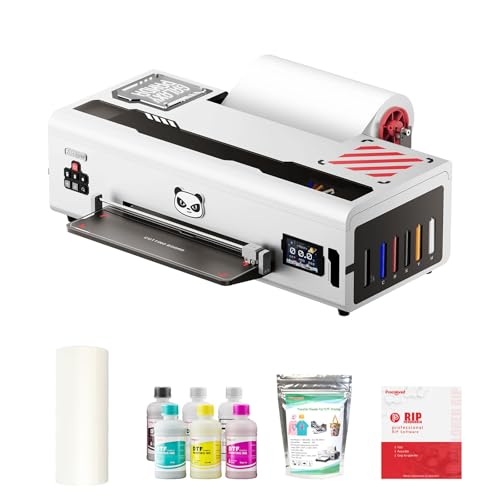
A DTF printer pays off only when printing a design yourself costs less than buying it as a transfer. With UK consumable prices of 22 September 2026, an A4 print costs about 33p in material at home against £1.48 ordered by the metre. For daily production, the Procolored K13 Lite; to start, the EXPLUX A4.
Is it cheaper to print your own DTF transfers? The cost per shirt against buying them by the metre
This is the gap in this search. The three UK suppliers at the top sell machines and consumables, and none of them publishes what each garment costs or how that compares with the real alternative, which is ordering the transfer ready printed by the metre. The calculator below does it with UK prices read on 22 September 2026: Ink Experts' film and powder, dtf-printers.co.uk's ink, Procolored's consumption per print, Ofgem's electricity cap and the published rates of two UK print services.
DTF cost per shirt calculator: print it yourself or buy transfers by the metre
The figure that decides whether a DTF printer is worth owning is in no spec sheet: what each garment costs you. Say what you print, at what size, on which film format and how many a month, and you get your cost per print item by item, what the same design costs ordered in by the metre and how much you keep on each one. With the figures it opens on (an A4 on cotton, a 60 cm roll, 100 a month), that is 33p of material against £1.48 ordered in, so you keep £1.14 per garment. A tool from m8d.io, free, with no account and no adverts.
The sum in full view: a 21.0 × 29.7 cm design is 624 cm² of ink, and on a 60 cm roll you fit 2 side by side, so it uses 891 cm² of film. At 40 ml of ink per square metre, £1.42 per square metre of film and 24.1 g of powder per square metre, that is £0.33 per garment. Ordered in, the same design takes 29.7 cm of a metre 55 cm wide, which comes to £1.48.
The four film prices and the powder price are the ones Ink Experts publishes on 22 September 2026, all from the same own-brand film so the comparison between formats is clean. The litre of ink is the price at dtf-printers.co.uk the same day, with VAT. The millilitres of ink and the grams of powder per A4 print come from Procolored, the maker of the first printer in this guide, and they vary with colour coverage: a full design uses more than an outline. The per-metre prices are the published rates of Ink Experts and Above the Below, with VAT, and each one comes with its usable width. The oven's wattage is the one declared in a curing-oven listing on Amazon's Spanish store, and the electricity price is Ofgem's cap unit rate for October to December 2026, because that item barely moves the result. Neither the garment, nor your labour, nor printhead upkeep is included.
What that £1.14 means for the machine. Divide the price of the printer you are looking at by £1.14 and you have the garments it takes to pay for itself against ordering in, before your time, the heat press and printhead upkeep: every £1,000 of printer is 874 garments, about nine months at 100 a month and three at 300.
DTF ink, film and powder in the UK: what each one costs per shirt, and the figure that does not add up
The machine is paid for once and the consumables every month. There are three, plus the electricity to cure: ink in five colours, film and hot-melt powder. With Procolored's figures of 2.5 ml of ink and 1.5 g of powder per A4 print, ink is the largest share on a 60 cm roll, and film takes over when you buy it in sheets: the same Ink Experts film costs £1.42 per square metre on a 60 cm roll and £6.25 in A4 sheets.
One warning before trusting any cost figure, this one included: published ink consumption disagrees by a factor of ten. Procolored gives 2.5 ml per A4 print and says a litre makes 200 to 500 T-shirts depending on the size of the image; the cost guide of dtf-france.com, an ink seller, gives 15 to 25 ml per A4 design. This guide uses the printer maker's figure, and the check is simple: at 20 ml per A4, a litre would make 50 prints.

Ink is the largest share of what a garment costs on this guide's default sum, 53%, and the five-litre set is the format people actually work with: one white for every four colours, because white is the base that makes a design show on a dark garment.
View ›
The roll is what stops film being the second line of the bill. With the same film from the same maker, on 22 September 2026 the square metre cost more than four times as much in A4 sheets as on a 60 cm roll: the premium for coming pre-cut.
View ›
It is the glue of the process and the smallest line of the bill, so it is not where you save. What is worth understanding is the difference between the powder you sprinkle and the powder that stays, because published figures for one and the other are easy to confuse.
View ›DTF transfers by the metre in the UK: why the width matters more than the price per metre
A by-the-metre service charges for a length of film, and what fits across its width decides what you really pay per design. On 22 September 2026, Ink Experts' print service charged £9.95 with VAT for a 55 × 100 cm sheet, Above the Below £12.00 for a metre 57 cm wide, and Future Transfers £12.54 for a single 56 × 100 cm metre, falling with volume to £7.74 a metre from 81 metres. On all three, two A4 designs fit side by side and each one uses 29.7 cm of length, which is why the calculator above compares services per design, not per metre.
Three UK services, three prices per metre and three widths. The sum that compares them is per design, and it takes ten seconds.
m8d rule: Divide the price per metre by its usable width before comparing two DTF-by-the-metre services: the one that looks cheaper per metre can cost more per printed square metre.
DTF, HTV vinyl or sublimation: which is cheaper per shirt, and which fabric each one needs
Heat transfer vinyl (HTV), the material a Cricut-type cutter cuts, is the other way to put a design on a T-shirt at home, and for single-colour work it competes on cost. On 22 September 2026, G.A.B Vinyls, a UK stockist, sold Siser EasyWeed at £2.06 per A4 sheet and £11.31 for a 50 cm by 1 metre roll, which is about £1.41 of vinyl for an A4-sized design. That is more than the 33p of DTF material at home and about the same as the £1.48 of a DTF transfer ordered in, and it covers one colour only: every extra colour is another layer of vinyl, cut, weeded and pressed, while DTF prints full colour for the same money.
Sublimation is the third route, and it depends on the fabric: it dyes polyester fibre and only works on light, high-polyester garments. DTF lays down its own layer and bonds to cotton, blends and dark garments. The cost follows from the same sentence: sublimation prints no white, so it uses less ink and no powder, while in DTF the white goes under the whole design.
If your work is single-colour names and numbers on cotton, we would cut vinyl before buying a printer: at £2.06 an A4 sheet, HTV needs no ink, no powder and no printhead to keep alive. The moment designs go full colour or a second colour appears, the sum turns in DTF's favour.
Why the cheapest "DTF printer" listings are curing ovens, and how to tell from the title
Of the 26 listings sold as DTF printers that m8d counted on Amazon's Spanish store on 9 September 2026, the five cheapest are the ones that come up when you look for a cheap DTF printer. All five carry the same signature in their own title.
m8d rule: If a DTF printer listing gives degrees and seconds but names no printhead and no ink, it is not a printer: it is the curing oven, the machine that comes after printing.
A curing oven is not a con: it is a necessary part of the process, and anyone who already has a printer buys one separately. The problem is the title, which is why it pays to read the listing with the three questions of the checker in the calculator above: does it name a printhead, does it say which ink, does it give a print width.
What printer you need for DTF: A4, A3 or 60 cm, by what you print and how many a month
DTF prints the design onto a film, covers it with hot-melt powder, cures it with heat and transfers it to the garment with a press. So a DTF printer never comes alone: film, ink, powder, an oven and a press are needed before the first T-shirt, and a standard desktop inkjet will not do, because it prints no white and its ink is not made to transfer with heat. That is why the first decision is not the brand but the width, which sets the largest design you can make and the film you will buy for years.

Below this level the catalogue stops selling printers and starts selling ovens. It is A4, so the largest design it prints is a front, and on that format the payback sum works best: the machine has the least to recover and a 33 cm roll keeps the film cost down.
View ›The one to produce with every day: its listing declares white ink circulation and infrared printhead protection, which is what decides whether the machine still prints after a weekend switched off. Its 33 cm take a portrait A3 back or one A4 per row, and its maker is the one that publishes how much ink and powder each A4 uses.
View ›
It is the only machine in the catalogue that declares continuous automatic maintenance, and that sentence is what separates a workshop from a hobby: cleaning the printhead stops being a job someone has to remember. It only makes sense with the volume to pay for it.
View ›A4 machines print fronts and logos and have the least to pay back. A3 machines of 33 cm, ten of the 21 in the upper tier of m8d's count, take a full back in portrait, one design per row. Above them sit the dual-printhead machines, bought for machine time and for not having to remember to clean the printhead, not for print quality. And the UK dealers at the top of this search sell 42 and 60 cm production printers, for workshops that print every day.
The five DTF printers compared by width, printhead and white ink
| DTF printer | Width | Printhead | White ink | Oven | |
|---|---|---|---|---|---|
| Procolored K13 Lite A3 view › | A3, 33 cm | Not stated | Circulation | Depends on version | View › |
| EXPLUX DTF A4 XP600 view › | A4 | XP600 | Not stated | No | View › |
| xTool Apparel Printer view › | A3, 356 mm | Dual I1600 | Automatic maintenance | No | View › |
 PLK DTF A3 L18058 view › PLK DTF A3 L18058 view › | A3 | XP600 | Agitation | Dryer included | View › |
 Procoloredfun F13 kit view › Procoloredfun F13 kit view › | A3 | Not stated | Cycle | Included | View › |
What each listing's title declares on Amazon's Spanish store on 9 September 2026. "Not stated" is a finding, not a gap: in that count 13 of the 21 machines in the upper tier name their printhead and 14 of 26 say something about white ink.
Each DTF printer: who it is for and who it is not
Procolored K13 Lite A3 view ›
The one to produce with every day: its listing declares white ink circulation and infrared printhead protection, which is what decides whether the machine still prints after a weekend switched off. Its 33 cm take a portrait A3 back or one A4 per row, and its maker is the one that publishes how much ink and powder each A4 uses.
- Its listing is one of the 14 of 26 in m8d's count (Amazon's Spanish store, 9 September 2026) that say what the machine does with white ink when it is idle. DTF white ink carries pigment in suspension, settles under its own weight and is the costly fault of this category.
- Its 33 cm width takes the 33 cm film roll, which costs about a third per square metre of what the same film costs in A4 sheets (Ink Experts, read on 22 September 2026).
- Its maker, Procolored, is also the one that publishes consumption per print: 2.5 ml of ink and 1.5 g of powder for an A4, the figures the calculator in this guide uses.
- Its spec does not give speed in square metres per hour, and it is not the exception: none of the 26 listings counted gives it.
- Declares white ink circulation and infrared printhead protection
- 33 cm wide: a portrait A3 back, or one A4 per row
- Its maker publishes ink and powder per A4 print
- Publishes neither speed nor ink consumption on its spec
- Too narrow for a landscape A3 or for two A4s side by side
If you will print every day, we would start with the K13 Lite, and not for the price: it is one of the 14 of 26 listings that say what the machine does with white ink when it sits idle, and that is the fault that takes a DTF printer off the bench. The next two are the ends of the catalogue, the entry machine and the workshop.
EXPLUX DTF A4 XP600 view ›
Below this level the catalogue stops selling printers and starts selling ovens. It is A4, so the largest design it prints is a front, and on that format the payback sum works best: the machine has the least to recover and a 33 cm roll keeps the film cost down.
- It names its printhead, the XP600, which is what separates a printer from a curing oven in this catalogue: the five cheapest listings in m8d's count name none.
- It is A4: the width does not stretch to a full back, and software does not fix that.
- Its listing talks about anti-clogging but does not say whether the white ink circulates when the machine is idle, which is when it settles.
- Printhead named in its own title
- The entry tier, with the least to pay back
- A4 format, enough for fronts and logos
- Cannot print an A3 back
- Its spec does not say how it handles white ink at rest
xTool Apparel Printer view ›
It is the only machine in the catalogue that declares continuous automatic maintenance, and that sentence is what separates a workshop from a hobby: cleaning the printhead stops being a job someone has to remember. It only makes sense with the volume to pay for it.
- Dual I1600 printheads and a 356 mm width declared in its title, and one of the three machines of the 26 counted that publishes its resolution in dots per inch.
- Automatic maintenance tackles the costly fault of the category: a printhead clogged by settled white ink.
- At its level, the saving on material per garment takes a very long run to pay a machine back: what justifies it is machine time, not consumables.
- Continuous automatic maintenance declared
- Dual I1600 printheads and a 356 mm width
- Publishes its resolution, which almost nobody does
- The top of this list by some way
- Without high volume, the saving on material does not pay it back
And the two that solve the whole process: one brings the powder shaker and the roll feeder at the same station, and the other is sold as a kit with the oven inside. It is the difference between buying a printer and setting up a line.
PLK DTF A3 L18058 view ›
It brings the three machines of the process in one: the one that prints, the one that powders and the one that cures. That is the difference between a workstation and a printer that needs an oven bought separately.
- One of the few listings that names printhead, ink and oven together: in m8d's count, only 13 of the 26 name a printhead and 12 talk about ink.
- The roll feeder is what lets you work with continuous film instead of sheets, and the same film costs more than four times as much per square metre in A4 sheets as on a 60 cm roll (Ink Experts, read on 22 September 2026).
- Its spec declares white ink agitation, not permanent circulation: two different mechanisms, and the listing does not say how often it agitates.
- Printing, powder and curing at one station
- Roll feeder, not sheets only
- Declares printhead, ink and oven
- Needs the space of a whole workstation
- Does not say how often it agitates the white ink
Procoloredfun F13 kit view ›
It is sold as a kit, and that word matters here: the price of a DTF printer is never the price of the machine, because film, ink, powder and a heat press are needed before the first T-shirt. This one brings the oven and declares a white ink cycle.
- It declares a white ink cycle, one of the features that decide printhead life, and only 14 of the 26 listings counted mention white ink handling in any form.
- Its oven comes included, so the budget does not jump with the curing machine.
- Like the rest of the catalogue, its listing does not publish how much ink it uses or how fast it prints, although its maker, Procolored, publishes consumption per A4 print on its own blog.
- Curing oven included in the kit
- Declares a white ink cycle
- One supplier for machine and curing
- You still need the heat press, which is not included
- No consumption or speed on its listing
m8d went through the DTF printer catalogue of Amazon's Spanish store on 9 September 2026 over six different searches: 36 distinct listings, of which 26 are sold as DTF printers and 10 are heat presses or sublimation machines, excluded one by one. Across those 26, m8d noted what each title declares: width, printhead, ink, oven, resolution, speed and consumption. Model availability varies from one country to another, and the buttons take you to Amazon's store for yours.
The UK consumable prices were read on 22 September 2026 with VAT: the four film formats and the powder from the same own-brand range at Ink Experts, so the comparison between formats is clean, and the ink at dtf-printers.co.uk. Consumption per print is what Procolored publishes, cited in the sources next to the figure that contradicts it. The by-the-metre rates are those published by three UK services, with their usable width, and the electricity price is Ofgem's cap unit rate for October to December 2026.
The selection is reviewed every quarter; consumable prices, whenever a supplier changes them.
What printer do you need for DTF?›
A printer built for white ink and film, with a declared inkjet printhead (XP600, I1600 and I3200 are the ones that appear in the listings m8d counted) and a system that moves the white ink while the machine is idle. A standard desktop printer will not do: it prints no white and its ink is not made to transfer with heat.
Is it cheaper to print your own DTF transfers?›
Per garment, yes: with UK prices of 22 September 2026, an A4 design costs about 33p in material at home against £1.48 ordered in by the metre, so you keep about £1.14 per garment. Whether owning the printer pays depends on its price and your volume: divide the one by £1.14 to get the garments it takes.
Is owning a DTF printer worth it?›
Only with steady volume. At £1.14 kept per A4 garment, every £1,000 of printer takes 874 garments to pay back before labour and printhead upkeep: about nine months at 100 a month, three at 300. At a few dozen a month, buying transfers by the metre keeps the money in your pocket and the printhead out of the equation.
Which is cheaper, DTF or HTV?›
For a single-colour design they are close: Siser EasyWeed vinyl works out at about £1.41 for an A4-sized design bought by the metre, against 33p of DTF material at home and £1.48 for a DTF transfer ordered in. For full-colour designs DTF wins, because each extra vinyl colour is another layer to cut, weed and press.
Is DTF better than sublimation?›
It depends on the fabric. Sublimation only works on light polyester, because it dyes the fibre; DTF bonds to cotton, blends and dark garments because it lays down a layer with a white base. That white base is why DTF uses more ink per garment.
What do I need to make my own DTF transfers?›
Film, ink in five colours including white, hot-melt powder, a curing oven if the printer does not bring one and a heat press to transfer onto the garment. The real start-up budget is never the price of the printer alone.
How much does it cost to print a DTF shirt?›
In material, about 33p for an A4 front on a 60 cm roll with UK prices of 22 September 2026: 53% ink, 38% film, 8% powder and the rest electricity. It does not include the garment, your time or printhead upkeep. The calculator in this guide recalculates it with your design size and your film format.
What backs each figure, with its reading date.
- m8d.iom8d's count of DTF printer listings36 distinct listings over six searches on Amazon's Spanish store, 9 September 2026; 26 sold as DTF printers
- Ink ExpertsInk Experts DTF film, 60 cm x 100 m roll£85.00 with VAT, read on 22 September 2026
- Ink ExpertsInk Experts DTF film, 33 cm x 100 m roll£65.00 with VAT, read on 22 September 2026
- Ink ExpertsInk Experts DTF film, A4 sheets100 A4 sheets £39.00 with VAT, read on 22 September 2026
- Ink ExpertsInk Experts DTF film, A3 sheets100 A3 sheets £59.00 with VAT, read on 22 September 2026
- Ink ExpertsInk Experts DTF powder1 kg £17.00 with VAT, read on 22 September 2026
- dtf-printers.co.ukDTF Ink White 1L£59.00 before VAT, £70.80 with VAT, read on 22 September 2026
- ProcoloredTips for estimating and reducing DTF printing costs2.5 ml of ink and 1.5 g of powder for an A4 print. Read on 22 September 2026
- ProcoloredHow to estimate DTF printing cost200 to 500 T-shirts per litre of ink; about 1.5 g of powder per shirt. Read on 22 September 2026
- dtf-france.comWhat a DTF print really costs per garment15 to 25 ml of ink and 8 to 12 g of powder per A4 design, the figure that disagrees with Procolored's. Spanish-language page, read on 22 September 2026
- Ink ExpertsCustom DTF print service, 55 x 100 cm printed transfer sheet£9.95 with VAT, read on 22 September 2026
- Above the BelowDTF Transfers by the Metre£12.00 with VAT for a metre 57 cm wide, read on 22 September 2026
- Future TransfersDTF Metre Gang Sheet Transfers, hot peel£12.54 with VAT for one 100 x 56 cm metre, falling to £7.74 from 81 metres, read on 22 September 2026
- OfgemEnergy price cap, 1 October to 31 December 2026Electricity 26.32p per kWh, Direct Debit, average for England, Scotland and Wales; no VAT on electricity from 1 October 2026 to 31 March 2027. Read on 22 September 2026
- G.A.B VinylsSiser EasyWeed heat transfer vinyl£2.06 per A4 sheet and £11.31 for a 50 cm x 1 m roll, read on 22 September 2026
To set up a workshop, the K13 Lite is the one we would buy: it declares what it does with white ink, takes a portrait A3 back and comes from the maker that publishes its consumption per print. If you are starting and print fewer than a hundred garments a month, a saving of about £1.14 each pays a printer back slowly, and transfers by the metre, from £1.48 an A4, are the lighter start. And if you already produce every day, the jump to dual printheads is justified by machine time, not by ink.


Comments
Be the firstNo sign-up: just a name. Every comment is reviewed before it is published.