Best budget projectors 2026: which to buy and how many inches you will really see in your room
 m8d.ioUpdated on
This guide contains affiliate links. As an Amazon Associate, m8d.io earns from qualifying purchases, at no extra cost to you.
The best budget projectors of 2026 are the LYNCAST X6 (the cheapest that declares both a native 1080p panel and 800 ANSI lumens), the finade S106 (the only one at the entry level that states its brightness at all) and the WiMiUS P62 Pro, which holds up in a room with daylight in it. Of 41 listings counted today, 23 say 4K and 1080p in the same headline.
Jump to what you came for: why brightness is the only figure that decides · what the 4K of a cheap projector actually means · how many inches you will really see · two listings, one model, two figures · all nine compared · one by one · frequently asked questions

It declares both a native panel and 800 ANSI on the same listing, and with that you can watch something on an afternoon with the curtains half drawn.
See it on Amazon ›Lumens are the only figure that decides whether you can see it, and almost nobody declares them
In a projector, resolution decides almost nothing and brightness decides almost everything: a hundred-inch image with too little light is a grey smear, whatever its pixel count. So before looking at a single product we counted what every listing declares.
What the 4K on a cheap projector actually means
There is no argument to have with the manufacturer: the answer is on the same line of the listing. Twenty-three of the forty-one listings counted today say both things at once, and only one of the two describes what comes out of the lens.
How many inches you will really see in your room: the brightness and size calculator
The four questions a search engine shows for this query are the same question written four ways, and none of the pages occupying them answers the one that actually decides the purchase. This is a division, and it depends on two things you already know.
A projector's light is spread across whatever surface it illuminates, so twice the diagonal means a quarter of the brightness. At the 200 ANSI of the entry level with the curtains half drawn, the usable image comes out at about forty-five inches, smaller than a 55-inch television; at 800 it passes ninety-five, and at 1,400 it holds about a hundred in daylight. Choose the two options and your number appears, with the arithmetic in view.
200 lumens spread over 6.7 square feet of image gives the 30 foot-lamberts that a room with some light in it needs. Increase the diagonal and brightness falls with the square: twice the inches is a quarter of the light.
Translated into what you will actually do with it: with 200 ANSI you have an evening projector with the curtains shut. The moment afternoon light gets in, the image turns grey and the blacks disappear.
At this point the projector is not giving you a screen: it is giving you fewer usable inches than the television you already own, and with the lights off at that. If the plan is to watch things in the afternoon, the answer is not to move it further back, because further back is bigger and bigger is dimmer. The answer is lumens.

The target foot-lambert figures are reference levels for each kind of use: 16 is the brightness a cinema is projected at in a dark room, and 30 and 50 are the usual guidance for a room with some light and for daylight. The calculation assumes a matt white wall (gain 1.0): a high-gain screen raises the number and a coloured wall lowers it. And the starting lumens are the ones each listing declares, which is precisely the problem this guide is about.
Two listings with the same manufacturer model number and two different brightness figures
This is the finding that best explains why this guide is built by counting listings rather than by repeating brand names. Both listings are live today, both declare the same manufacturer model, and there is a substantial gap between what they cost.

Magcubic HY450MAX, 800 ANSI view ›
If 800 ANSI is enough for you, here they are for less. And if the shared model number makes you hesitate, that hesitation is exactly the information this category does not give you.
- This listing and the Unicview next to it declare the same manufacturer model number, HY450MAX, and yet publish 800 and 1,100 ANSI lumens with a substantial gap in price. We show it because it is the cleanest proof of what this guide argues: the brightness figure on a listing is declared by whoever is selling, and measured by nobody from outside.
- We do not say which of the two is correct, because we cannot check it and neither listing explains under what conditions it was measured. What can be said is that anyone comparing the two figures as though they were comparable is comparing two declarations, not two measurements.
- Declares 800 ANSI and a 1080p panel, the two figures that matter
- Android 14 built in
- Materially cheaper than the listing that shares its model number
- Its listing declares 800 ANSI where the listing for the same model declares 1,100: one of those two figures is not describing the same thing
- Neither figure has been measured by anyone independent
Unicview HY450MAX with certified Google TV view ›
It is the most complete listing in the whole category at this level, and that is why it is here. But before paying for it, look at the shared model number: you may be paying a premium for a figure nobody has measured.
- It is the only one of the forty-one listings counted that declares all four things at once: which system it runs and with what certification, which panel it actually projects, how many ANSI it gives, and what connectivity it has. When an entire category is selling an input resolution, finding a listing you can read end to end is itself the finding.
- The Google TV certification is not decoration: it is the difference between having the official licensed apps and having a launcher that one day stops opening the one you use.
- And the thing to know before paying for it: it shares its manufacturer model number with the Magcubic in this same selection, which costs noticeably less and declares 800 ANSI rather than 1,100. Both figures are published and they do not agree. We say so here, on the listing for the expensive one.
- Declares system, native panel and ANSI brightness in the same headline, which nothing else in the sweep does
- Certified Google TV: the apps are the official, licensed ones
- 1,100 ANSI gives more than a hundred usable inches with some light in the room
- It costs considerably more than a listing carrying the same manufacturer model number
- It sits outside the tier where most of this search lives
We do not say which of the two figures is the correct one, because we cannot check it and neither listing says under what conditions it was measured. What can be said, and it is the thing to take away, is this: in this category the brightness figure is declared by whoever is selling, and measured by nobody from outside.
If the brightness is not what the listing said: what you can actually do
Everything above is about a number that a seller writes and nobody verifies. That has a legal consequence here that no guide in this category mentions, and it is the reason the counting exercise is worth doing before you pay rather than after.
m8d rule: A projector sold on a brightness claim it does not meet is a question of description, not of taste. You have 30 days from delivery to reject goods that are not as described, and on a marketplace you claim against the seller named on the listing.
The nine projectors at a glance
Ordered by what each listing declares, not by what the name promises. The columns are exactly the four things the sweep proves almost nobody publishes together.
| Product | Best for | Declared brightness | Real panel | Resolution advertised | System | |
|---|---|---|---|---|---|---|
| LYNCAST X6, native 1080p and 800 ANSI view › | Getting it right without overthinking | 800 ANSI | 1080p native | 4K compatible | Android 14 | View › |
 finade S106, the cheap one that states its brightness view › finade S106, the cheap one that states its brightness view › | Evening films, spending little | 200 ANSI | 1080p | 4K compatible | not declared | View › |
 WiMiUS P62 Pro, 1,400 ANSI for a room with daylight view › WiMiUS P62 Pro, 1,400 ANSI for a room with daylight view › | A living room in daylight | 1,400 ANSI | 1080p | 4K compatible | Licensed Netflix | View › |
| Unicview HY450MAX with certified Google TV view › | A listing you can read end to end | 1,100 ANSI | 1080p native | 4K compatible | Certified Google TV | View › |
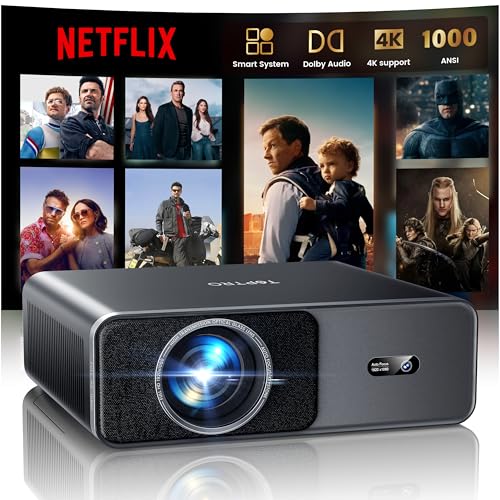 TOPTRO A1, 1,000 ANSI with Netflix view › TOPTRO A1, 1,000 ANSI with Netflix view › | A thousand ANSI without going premium | 1,000 ANSI | 1080p | 4K compatible | Licensed Netflix | View › |
| Magcubic HY450MAX, 800 ANSI view › | The same model for less | 800 ANSI | 1080p | 4K compatible | Android 14 | View › |
 ZDK 450 ANSI with Android TV built in view › ZDK 450 ANSI with Android TV built in view › | The cheapest jump in brightness | 450 ANSI | not declared | 4K compatible | Android TV | View › |
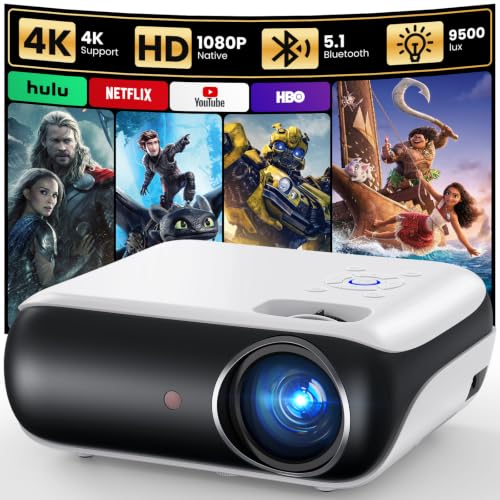 HAPPRUN H1, declared native panel, no brightness view › HAPPRUN H1, declared native panel, no brightness view › | Honest panel, silent on brightness | not declared | 1080p native | does not claim 4K | not declared | View › |
 KRATOSWORLD The cheapest in the sweep view › KRATOSWORLD The cheapest in the sweep view › | The floor of the category | not declared | not declared | 4K compatible | Android 14 | View › |
Each cell records what the listing or the manufacturer's own datasheet declares, read on 31 August 2026. Where it says "not declared", the listing does not say it, which is not the same as the device not having it. Availability and the exact model on sale vary by country.
The nine, one by one
LYNCAST X6, native 1080p and 800 ANSI view ›
This is the point where money stops buying promises and starts buying figures you can check. Below this tier the listings stop declaring brightness altogether, and above it you are mostly paying for lumens an ordinary living room will not need.
- It is the only one in the middle of the range that declares both figures that decide: the real panel and the brightness in the comparable unit. In today's sweep only twelve of forty-one listings state their ANSI, and only eight say their panel is native. This one says both. Translated: you know what you are buying before it arrives.
- With 800 ANSI lumens and the calculator above, the image holds about ninety-five inches with some light in the room, and passes a hundred and twenty-five in the dark. That is a proper screen, close to twice the diagonal of an ordinary living-room television.
- It runs Android 14 on the device, so the apps run on the projector itself. That is the difference between switching it on and watching something, and switching it on and hunting for another remote.
- Declares a native 1080p panel and 800 ANSI lumens on the same listing, which only eight and twelve of the forty-one listings counted manage
- At 800 ANSI the image holds up on an afternoon with the curtains half drawn, not only at night
- Android 14 on the device: you do not need to hang a player off the back of it
- It accepts 4K but projects 1080p, and its own headline says so
- It does not declare its throw ratio, so the inches at a given distance have to be calculated
finade S106, the cheap one that states its brightness view ›
The right choice if the plan is evening films in a dark room, and you know in advance that this is exactly what you are buying. It stops making sense the moment you want to switch it on on a Sunday afternoon.
- What puts it in this guide is not that it is the best: it is that it is the only one at its level that can be checked. We counted twenty listings at the entry level and nineteen do not say how many ANSI lumens they give. That this one does is, in this category, the only way to know what you are buying.
- At 200 ANSI in the dark the image holds about sixty-five inches, which is bigger than almost any living-room television. With the curtains half drawn it drops to about forty-five, and at that point it is smaller than the television you probably already own. That drop is the reason a cheap projector ends up in a cupboard.
- Its headline is the summary of the whole category: it says 4K and 1080P on the same line. The second figure is what it projects; the first is what it accepts down the cable.
- It publishes its brightness in the comparable unit: 200 ANSI lumens
- It is the way into the category, with a declared 1080p panel
- It does exactly what most people buy one for: an evening film with the curtains shut
- At 200 ANSI with any afternoon light the usable image drops to about forty-five inches, smaller than a 55-inch television
- It accepts 4K and projects 1080p, like the rest of its tier
WiMiUS P62 Pro, 1,400 ANSI for a room with daylight view ›
The one you buy if the projector is going to replace the television rather than accompany it. If you are only going to switch it on at night, you are paying for lumens you will not see.
- At 1,400 ANSI the calculator above gives about a hundred usable inches in daylight, and about a hundred and twenty with the curtains half drawn. Translated: it is the first in this line-up you can switch on on a Sunday afternoon without shutting anything.
- The jump in brightness from the 800 of the middle tier costs a good deal less than the picture it buys, because it roughly doubles the light. It is the only price increase in this entire category that translates into something you notice by looking at the wall.
- It has automatic focus and keystone correction. That sounds like convenience and it is more than that: a projector you have to reframe every time stops being used within a fortnight.
- 1,400 declared ANSI lumens: the image holds up with the window open
- Automatic focus and keystone correction, which is what makes one actually get used
- Licensed Netflix on the device, instead of having to hang a player off it
- It is the most expensive in this selection and sits outside the tier where most of this search lives
- It is still a 1080p panel: the 4K in its headline is the signal it accepts
ZDK 450 ANSI with Android TV built in view ›
The honest middle ground if the budget does not stretch to the next tier up. It buys real brightness, which is the only thing you notice.
- The 450 ANSI is the first step where a projector starts to be usable with some light in the room: about seventy usable inches with the curtains half drawn, against the forty-five of the entry level. For a modest step up in price, it is the jump with the best return on the whole ladder.
- It runs Android TV, which is not the same as the generic launchers almost everything at this level uses: the apps are the official ones and they get updated.
- It is one of three listings in this selection showing a crossed-out previous price. We do not say it is false: we say that no public series exists to support it, and that the device on the next step up, with nearly twice the brightness, costs less than that crossed-out figure.
- 450 declared ANSI: more than twice the entry level
- Android TV built in, not a generic launcher
- Electric focus, which avoids adjusting it by hand every time
- With afternoon light it still comes out at about seventy usable inches
- Its listing shows a crossed-out previous price that cannot be checked against any series
TOPTRO A1, 1,000 ANSI with Netflix view ›
The middle step between 800 and 1,400 ANSI, with a licence for the app almost everyone is going to use.
- At 1,000 ANSI the image holds about a hundred and five inches with some light in the room. It is the step where a projector stops being a night-time device.
- That Netflix comes licensed matters more than it sounds in this category: on most of the cheap ones the app is not authorised and you have to hang a player off the back, which is one more cable and one more remote.
- 1,000 declared ANSI without reaching the premium tier
- Licensed Netflix inside the device rather than on a separate box
- Automatic focus and keystone correction
- A 1080p panel, with the 4K in the headline as the input signal
- It also shows a crossed-out previous price with no series to support it
The honest half is welcome, but the missing half is precisely the one that decides. For the same money, one that states its ANSI lets you know what you are buying.
View ›If this is the budget, at least go in knowing what you are not being told. For a small step up, the one that declares its ANSI lets you do the arithmetic before you buy.
View ›Frequently asked questions about budget projectors
What is the best value projector?›
The LYNCAST X6, because it is the cheapest of the forty-one listings we counted that declares both figures that decide: a native 1080p panel and 800 ANSI lumens. At that brightness the image holds around ninety-five inches with some light in the room. Below that tier, listings stop publishing their brightness at all, and above it you are mostly paying for lumens that an ordinary living room will not show off.
Which projector is best for home use?›
It depends on one thing, and it is not what you spend: whether you will switch it on with the lights on or in the dark. For an evening film with the curtains shut, 200 ANSI lumens is enough. To watch something on a Sunday afternoon you need 800 or more. And to replace the television with the window open, 1,400. Resolution does not enter into that decision at any point.
How do I choose between so many similar projectors?›
The one that declares what it does. In the catalogue we counted on 31 August 2026, thirty-two of forty-one listings sell themselves as 4K, twelve say how many ANSI lumens they give and eight say their panel is native. Choosing only from the ones that do declare reduces the list to about a dozen and removes the part of the catalogue that is selling you the resolution it accepts rather than the one it projects.
Is a cheap 4K projector really 4K?›
Almost certainly not, and its own listing usually tells you so. A cheap projector's headline resolution is the signal it accepts down the cable; the panel that actually projects is 1080p, and twenty-three of the forty-one listings we counted print both figures on the same line. If the headline says 4K and also says 1080p, it is a 1080p projector.
Can you use a projector during the day?›
No, unless it declares a high brightness in ANSI lumens. At 200 ANSI, which is the entry level, an image in a room with the curtains half drawn holds about forty-five usable inches, which is smaller than a 55-inch television, and in full daylight it is not watchable. At 1,400 ANSI it holds around a hundred inches with daylight in the room. That is the whole difference, and it has nothing to do with resolution.
What if the projector is nowhere near as bright as advertised?›
You have the same rights as with anything else you buy. Under the Consumer Rights Act 2015 goods must match their description, and a brightness claim is part of the description. You have 30 days from delivery to reject something that is not as described for a full refund, then a right to repair or replacement. Screenshot the listing before you buy, and prefer a seller with UK contact details, because on a marketplace you claim against the seller rather than the marketplace.
m8d pick · The cheapest that declares both panel and brightnessLYNCAST X6, native 1080p and 800 ANSISee it on Amazon ›The only one at entry level that declares ANSIfinade S106, the cheap one that states its brightnessSee it on Amazon ›The sources behind the specific figures in this piece, with the date each was read.
- International Electrotechnical Commission, official standardIEC 61947-1: Electronic projection. Measurement and documentation of key performance criteriaThe standard that sets out the measurement method for projection brightness: a white field and nine measurement points. Consulted on 31 August 2026.
- legislation.gov.ukConsumer Rights Act 2015, sections 22 to 24The short-term right to reject within 30 days, repair or replacement, and the six months in which a refund cannot be reduced for use. It is what turns an unverifiable brightness claim into something you can act on. Consulted on 31 August 2026.
- m8d registry, our own dataOur own sweep of the projector catalogue41 distinct listings across eight searches in this family, read on 31 August 2026. We count what each listing's sales headline declares. The registry page itself is published in Spanish, so it is cited here rather than linked.
Comments
Be the firstNo sign-up: just a name. Every comment is reviewed before it is published.