Best bone conduction headphones 2026: six compared, the battery rule, and what UK law says about cycling
 m8d.ioUpdated on
This guide contains affiliate links. As an Amazon Associate, m8d.io earns from qualifying purchases, at no extra cost to you.
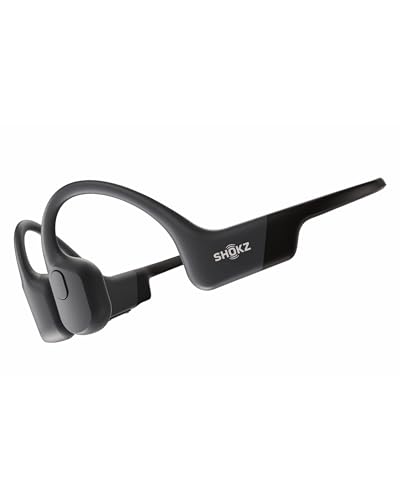
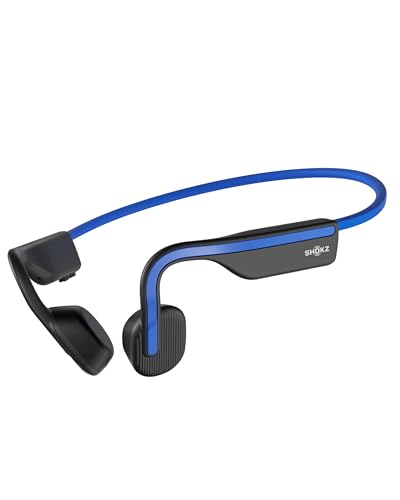
The best bone conduction headphones in 2026 are the Shokz OpenRun, because in a climate where the rain is not an edge case the IP67 rating is the specification that decides whether they survive a winter of training. The OpenMove is the same fit for indoor and dry-weather use. Before you buy anything, one check: a large share of what is sold as bone conduction is not bone conduction, and this page shows how to tell in ten seconds.
- If you are buying one pair: Shokz OpenRun. IP67, 26 grams, 8 hours. Rain is the normal condition here and IP55 is not rated for it.
- Gym, walking, podcasts: Shokz OpenMove. The same headband and transducers, IP55, 6 hours.
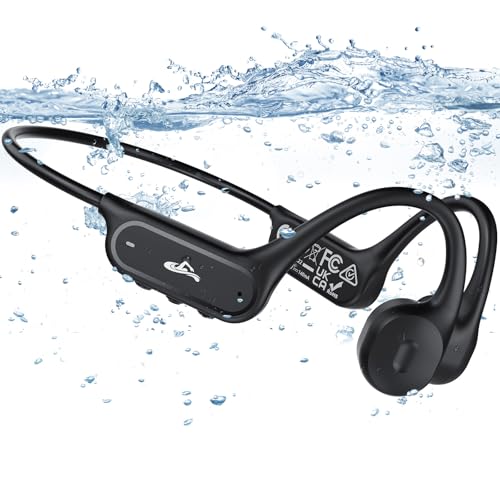 Swimming is a different product entirely. Bluetooth does not travel through water, so a swim model needs onboard storage as well as a submersion rating. None of the six here is that product, and section five says what to look for.
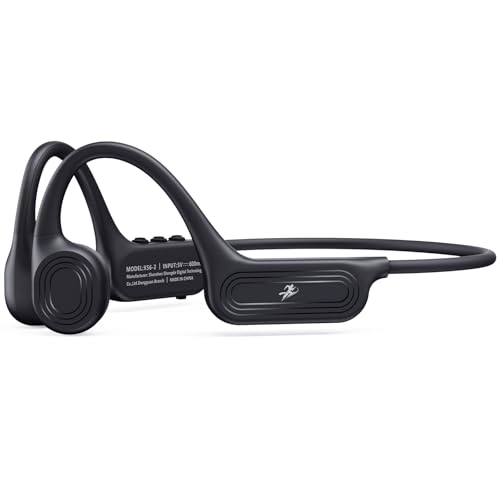
- Just trying the format: Guudsoud. Some people cannot get on with the vibration, and finding that out cheaply is sensible.
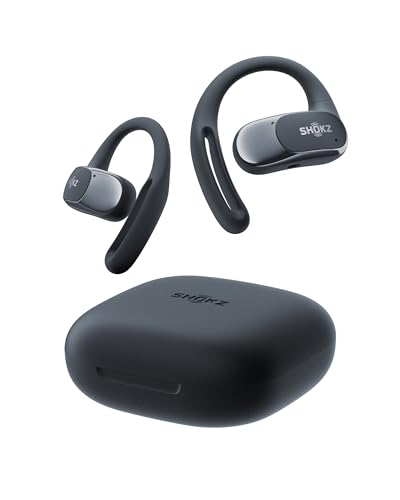 If what you actually want is sound and battery life, do not buy bone conduction: buy air-conduction open ear, like the Shokz OpenFit Air. It is in this comparison as the reference point, and it is a different technology.
What UK law actually says about wearing these on a bike
This is the question the whole category raises and none of the buying guides answers, so here it is with the sources, because the British position is genuinely different from the continental one.
There is no rule prohibiting headphones for cyclists. The rules for cyclists in the Highway Code are numbered 59 to 82, and the two that people cite are Rule 66 and Rule 67. Rule 66 says a cyclist should "avoid any actions that could reduce your control of your cycle". Rule 67 says a cyclist should "be aware of traffic coming up behind you, including other cyclists". Neither rule mentions headphones, earphones or music at all, and both are written as "you should" rather than "you MUST", which in the Code's own convention means advice rather than a legal requirement. Neither carries a legal reference alongside it.
What does exist is a general offence. Section 29 of the Road Traffic Act 1988, headed "Careless, and inconsiderate, cycling", provides that "if a person rides a cycle on a road without due care and attention, or without reasonable consideration for other persons using the road, he is guilty of an offence". Nothing in it names headphones either. The point is that a court would look at how you were riding, and what you were wearing could form part of that picture. Wearing them is not the offence; riding badly is.
The practical reading, and it is the one that makes this category make sense here: because there is no prohibition, the argument for bone conduction in Britain is not legal compliance, it is that leaving both ears open is the version of listening that survives the Rule 67 test. You can hear the car, the other cyclist and the person calling out. That is what the format is for, and it is why we would put a pair on a commuter before we would put a pair of earbuds on them.
Driving is a separate question with a separate answer: there is no specific offence of wearing headphones at the wheel either, but careless driving under section 3 of the same Act is a considerably more serious matter than careless cycling, and a driver has no reason to be listening through anything other than the car. We are not a legal service and this is not legal advice: both the Highway Code and the Act are published on gov.uk and legislation.gov.uk, and we read them on 1 September 2026.
Half of what is sold as bone conduction is not bone conduction
Search the category and most of the cheap results share a pattern: a battery claim of 40 or 50 hours, a low price, and a title carrying both "bone conduction" and "open ear" at once. They are legitimate products. Most of them are not bone conduction: they are open-ear air conduction, a small speaker aimed at the ear from outside, which is a different technology and considerably cheaper to build.
The proof is in the catalogue of the company that created the category. Shokz, formerly AfterShokz, sells both technologies and publishes both sets of figures. Put them side by side and the mechanism becomes obvious:
| Shokz model | Technology | Shape | Hours the maker publishes |
|---|---|---|---|
| OpenMove | Bone | Headband | 6 h, and no case exists |
| OpenRun | Bone | Headband | 8 h, and no case exists |
| OpenRun Pro 2 | Bone | Headband | 12 h, and no case exists |
| OpenFit Air | Air | Separate buds | 6 h each, 28 h with the case |
Look at the last row twice. The air-conduction model's headline figure of 28 hours is six hours of listening plus the recharges the case gives it. A bone conduction headband is one continuous piece that goes round the back of your neck: there is nowhere to put a charging case, so its headline figure is the only figure it has. Shokz's best bone conduction band stops at 12. That is not a Shokz limitation, it is physics: vibrating the bone of your cheek costs far more energy than pushing air with a tiny speaker.
If something shaped like a headband claims more than 15 hours, it is not bone conduction, because the number can only be that high if a charging case is doing part of the work, and a headband has no case. If it is shaped like separate buds, it was never bone conduction to begin with.
This is not a criticism of air conduction. It is a warning that the two get sold as one thing and they are not interchangeable, and the person who ends up disappointed is the one who bought the wrong one. If after reading this you conclude that what you wanted was more battery and better bass with your ears still open, we cover that shape separately in the budget open ear and clip-on guide, and we would rather send you there than sell you the wrong technology.
Why Shokz dominates this category, and when it stops being worth it
Open any British buying guide for this category and the same brand occupies most of the list. That is worth explaining rather than repeating, because the reason is specific and it tells you what to look at in anything else.
Shokz, formerly AfterShokz, took the technology from specialist use into consumer products and it holds the category on one thing that is not sound quality: the fit. The wraparound titanium frame holds a consistent pressure on the cheekbone for hours without squeezing, and on a headband that never goes inside your ear, pressure is everything. It is the difference between a pair you wear every day and a pair that ends up in a drawer after a fortnight. The second thing is that they publish the figures for both of their technologies separately, which is precisely what makes the decoder above possible.
When does it stop being worth it? When you do not yet know whether the format suits you. A minority of people find the vibration on the cheekbone tiring, and there is no way to find that out except by wearing a pair. Spending the price of a premium band to discover that is an expensive way to learn something, and that is exactly what the cheapest model on this page is for.
And the balancing note the category deserves: a headband from a name you have never heard of is not automatically worse at conducting sound through bone. What tends to differ is the frame, the tuning and whether the specification on the listing matches what is inside. The one on this page that we are happy to name does something unusual for its tier: it does not inflate its battery claim, which by the rule above is the single most reliable signal in the whole category.
The six models, side by side
| Model | Technology | Battery | Water | Weight | |
|---|---|---|---|---|---|
| Bone | 8 h | IP67 | 26 g | View | |
| Bone | 6 h | IP55 | 29 g | View | |
| Bone plus air | 12 h | IP55 | ~30 g | View | |
| Bone | ~6 h | IP56 | not published | View | |
| Bone | ~8 h | IP68 | not published | View | |
| Air | 6 h, 28 h with case | IP54 | not published | View |
Two rows to read carefully. The OpenRun Pro 2 is the model most British buying guides put at the top, and on the specification it deserves that: twelve hours is the ceiling of the technology and its second driver adds the bass the format normally lacks. Our recommendation is the OpenRun instead, on the water rating and on availability, and we will come back to that. And the unbranded IP68 row is in the table because its combination is interesting and in the analysis below because that combination is not what it looks like.
IP67 and "not for swimming": what a water rating actually licenses
This is the second place the category misleads people, and again the proof is in the manufacturer's own material rather than in anyone's opinion.
What the number promises. IP ratings come from the international standard IEC 60529. The first digit is dust, the second is water, and a 7 means the product survived being immersed at up to one metre for thirty minutes in a laboratory. Read on its own, IP67 sounds exactly like permission to get in a pool.
What the maker says. On the OpenRun's own specification page, Shokz lists the rating as IP67, and in the same breath writes "Not for swimming". It is not a contradiction. An immersion test is a one-off in still, fresh water: it says nothing about repeated immersion, about the mechanical stress of a swim stroke, or about chlorine and salt. The company that certified the rating is telling you what the rating does not cover.
And the reason a swim model is a different product. Water absorbs a 2.4 GHz radio signal within centimetres, so Bluetooth does not work underwater. Shokz says so itself in its own support material for the model it does sell for swimming: underwater you have to use the onboard storage, not a phone. That is why every genuine swimming headphone in this category carries flash memory and a music player inside it, and why a phone in a locker is useless to you in the water.
For swimming you need two things together and neither is enough alone: a submersion rating the maker explicitly extends to swimming, and onboard storage with music already loaded onto it. A high IP number with Bluetooth only is a headphone that survives being dropped in the water, not one you can swim in.
What that means for this page, said plainly: none of these six is a swimming headphone. The OpenRun is IP67 and its maker says not for swimming. The OpenMove is IP55, which is splash protection. The one row carrying IP68 and onboard storage is an unbranded listing whose specification we cannot verify against a manufacturer's own published sheet, and it is currently the least available product on this page in our catalogue reading. We are not going to put it forward as the swimming recommendation on the strength of a listing. If swimming is the reason you are here, look for a model whose maker states a swim depth in its own words and publishes the storage capacity, and treat the two as one requirement.
Which pair for your use: the thirty-second test
Four ways people use these, and they lead to different answers, including one where the answer is that nothing on this page fits. Tap yours. It opens on the most common case in this country: road running and commuting.
The four drawbacks nobody in this category mentions
None of the guides we read to write this one names a single disadvantage. These are the four real ones, and they are all limitations of the format rather than faults in any particular product:
The other three in this comparison
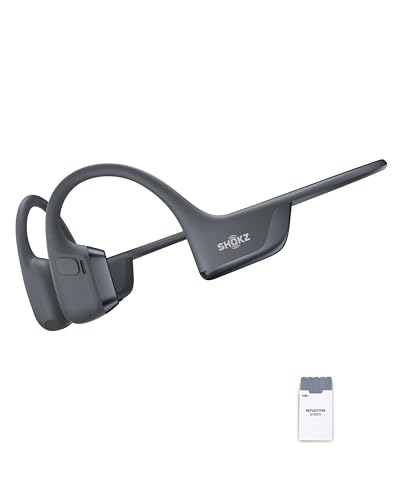

The specification that moves this to the top of the page in Britain is the water rating. IP67 covers heavy rain and a brief immersion; the IP55 of the entry model covers splashes and sweat. Given how many training runs here happen in weather, that is not a premium feature, it is the baseline. At 26 grams it is also the lightest of the six, which is what stops a headband bouncing on a descent.
The way into real bone conduction. Shokz describes the transducers as its seventh generation of the technology, and the frame and fit are the same idea as the models above it. What you give up is two hours of battery, the improved bass of the Pro line, and the water rating: IP55 is described by Shokz as sweatproof and protected against splashing water, which is a fair description of a gym and a dry commute rather than a February morning.
Here for one job: telling you whether your head gets on with a transducer resting on it, before you commit to a premium band. Its battery claim sits in the six-hour range that the decoder above says a real bone conduction headband should sit in, which in this tier is a genuine mark in its favour and the reason it is the unbranded product we are willing to name.
The names you will meet, and the discount that is not one
The high street is not much help here. Bone conduction is a specialist shape, and in Britain the shops that carry it consistently are the running and triathlon specialists rather than the general sports chains, where the shelf tends to be one Shokz model and a wall of ordinary earbuds. That matters for one practical reason: it is the fit you cannot judge from a listing, so if a specialist near you has a pair on display, go and put them on your head before you order anything.
Xiaomi comes up constantly in these searches, and mostly it should not. The company sells a lot of inexpensive open sports headphones, and the great majority of that range is open-ear air conduction rather than bone conduction. It is not a deception by the brand; it is that the search engine treats the two categories as one, which is the same confusion the decoder at the top of this page exists to fix.
And a warning about the percentages. In this category we have seen an unbranded headband advertised with a crossed-out reference price close to four times what it was actually selling for, a discount of more than seventy per cent. No bone conduction headphone at that price has ever sold at that reference. When the anchor is that far above the price, the discount belongs to the listing rather than to the product, and the number to compare is the one you are being asked to pay, against the other listings on the same page.
We started from the searches people actually run in this market and read the guides ranking for them to find what they do not cover. Specifications, battery figures and water ratings come from each manufacturer's own published material rather than from a retail listing, which is what lets us set a bone conduction model and an air conduction model from the same company side by side. The Highway Code rules for cyclists and section 29 of the Road Traffic Act 1988 were read on gov.uk and legislation.gov.uk on 1 September 2026, and quoted rather than paraphrased.
Every figure here carries its source. Our judgement is based on verified specifications, on the physics of the technology and on what the makers themselves publish about the limits of their own products. Availability was read from the Amazon Spain catalogue on 1 September 2026: availability, model variants and delivery times differ by country, so what your local Amazon shows may not match this list. Where something is a limitation of the format rather than of a product, we say so. No manufacturer pays to appear here or to appear first.
Checklist before you buy
Questions about bone conduction headphones

m8d.io
We compare what a product promises against what can be checked, and we publish the method. Behind every guide there is a full read: more than 40 sources per guide, the specification each maker publishes, and the official sources of the country the guide is written for. No manufacturer pays to appear here, the buying links are affiliate links and they are declared, and the order is decided on the merits.
Comments
Be the firstNo sign-up: just a name. Every comment is reviewed before it is published.