Best home EV chargers in the UK for 2026: what a single phase supply will give you, and what fitting one costs
 m8d.ioUpdated on

This guide contains affiliate links. As an Amazon Associate, m8d.io earns from qualifying purchases, at no extra cost to you.
A home EV charger is chosen by what your supply will give it, not by the number on the box: on the single phase supply British homes have, 7.4 kW is the ceiling. Of 54 listings counted on 8 September 2026, 51 give the kilowatts and only 5 say whether they detect DC leakage, the line that decides your quote.
What 7 kW really means on a British single phase supply, and where the ceiling is
Almost every home in this country has a single phase supply: one live, one neutral, 230 volts. A domestic charge point circuit is run at 32 amps, and 32 amps at 230 volts is 7.36 kW. That is why the whole market sells a 7 kW charger and why the spec sheets say 7.4: it is the same thing, rounded two ways, and it is a physical ceiling rather than a marketing tier.
Above it you need three phase, 400 volts, which in a British house is unusual enough that it is worth checking before anything else. That is what separates the tiers: 3.7 kW and 7.4 kW are single phase; 11 kW and 22 kW are not. Buying 22 kW for a house is, nearly always, paying for a number that will never come out of the socket.
Translated into what you get: at 7.4 kW with the car plugged in for eight hours, 59 kWh go in, which is a full battery for almost anything on sale. Two things can hold it below that, and neither is the charger. One is the car, because many on board chargers stop at 7.4 kW however much the point offers. The other is your main fuse, the one stamped 60, 80 or 100 amps in the meter cupboard, which has to cover the shower, the oven and the car at once. When it will not, the answer is not a bigger supply: it is a charger that backs off, and there is one in this guide that declares it.
- The supply: single phase at 230 volts is the norm here, and 32 amps of it is 7.4 kW. That is the ceiling.
- The main fuse, stamped 60, 80 or 100 amps in the meter cupboard, which has to cover the whole house at once.
- Load management in the charger, which backs the car off when the house draws, and is what makes a 7.4 kW point sit behind a 60 amp fuse.
- The car's own on board charger, which on many models stops at 7.4 kW whatever the point delivers.
- The earthing arrangement: on a PME supply an outdoor point needs either an earth rod or a charger that detects an open PEN fault.
- Whether the listing says it detects the 6 mA of DC leakage, because if it does not, that device goes in your consumer unit.
EV charger power calculator: the tier your supply will take, and what fitting it costs
Free EV charger power calculator: what your home supply will actually deliver
The power that reaches the car is the power your supply will let through, not the figure on the box. Say what your supply can spare for the charger, whether it is single or three phase, the battery, the miles you do and the hours the car sits plugged in, and out comes the tier that fits, the miles it puts back overnight and the time from empty to full, with the sum shown in the open. A second panel prices the fitting by line, with the British range published for a fitted 7 kW point and the grant taken off if you qualify. Free, no account, no advertising.
The sum, in the open: 25 km a day at 0.300 kWh a mile, which is 7.5 kWh to put back. At 7.4 kW that is 1 h 1 min, and in the 8 hours the car is plugged in, in go 59.2 kWh, about 197 km. Consumption per mile is a conversion of the maker's published figure: an hour of charging at 7.4 kW adds about 25 miles.
There is no tier above this one on a single phase supply: 7.4 kW, sold as 7 kW is the ceiling. What is left to check is not the supply, it is that the car's own on board charger accepts that figure, because many models stop at 7.4 kW however much the point delivers.
The sum, in the open: 10 m of cable, plus the labour, come to £700 to £1,200. The chargepoint grant gives back 75 per cent of that, up to 500 pounds a socket, so the net range is £200 to £700. The grant is for renters, flat owner occupiers and households fitting an approved cross pavement solution, so it comes off only if you qualify.
If the listing does not say 6 mA, type B or RCBO, that function is not inside the charger and the device that does it goes in your consumer unit, on top of everything above. It is not a rare case: of the 54 listings we counted on 8 September 2026, only 5 say whether they carry it. The wiring regulations ask for a residual current device of no more than 30 mA on each charge point, so the question for the installer is a concrete one: which device is going in, and does the charger you have chosen force a special one. The second line is British and it is not optional: on a PME supply an outdoor point cannot rely on the PME earth alone, so either the installer drives an earth rod or the charger detects an open PEN fault itself.
The range for supply and installation is the one published for a fitted 7 kW point (Zapmap, home charging guide, read on 18 September 2026), not a measurement of any kind: it is there to give you an idea before you ask for a quote, not to replace one. There is no charge in Britain for raising contracted power, because supply is not sold by contracted power (GOV.UK, electric vehicle chargepoint grant, read on 18 September 2026), so that line is zero by design and what can be needed instead is a load calculation or a supply alteration by the network operator. Electricity is priced at the price cap unit rate (Ofgem, energy price cap unit rates, read on 18 September 2026), and your own tariff may be lower. Consumption per mile is a conversion of the maker's published figure and every car uses its own.
PEN fault protection: the line in a British quote that does not exist anywhere else
This is the part of a British installation that surprises people, and it is not in any product title. Most homes here are earthed through the supply cable itself, an arrangement called PME. It works, and it has one failure mode: if the combined neutral and earth conductor breaks somewhere outside your house, everything bonded to that earth can rise to a dangerous voltage.
Indoors that is contained. A charge point on an outside wall is not, because the person touching the car is standing on the ground. So the wiring regulations do not let a PME earth be the only protection for an outdoor charge point. The installer has two ways out: drive a separate earth electrode into your ground, or fit a charger that detects an open PEN fault itself and disconnects the car when the voltage goes out of range.
The second one is now common and it is worth looking for by name, because it takes a rod, a trench and a job out of the quote. We would ask the question in those words before accepting any price: does this unit have open PEN detection built in, or is there an earth rod in this quote?
It is the one line of a British EV charger quote that has no equivalent in any other market, and the makers that solve it say so in their own manuals, which is the strongest kind of proof there is.
Kilowatts, metres of cable and an app. Those are the three figures the catalogue repeats: of the 54 listings counted on 8 September 2026, 51 give the kilowatts and 47 give the metres. Earthing appears in none of the titles, in any market.
Ohme writes in its own product manual that the Home Pro has an in built PEN fault detection function, as described in 722.411.4.1 (iv), to disconnect the vehicle from the live, neutral and earth conductors if the voltage is above or below the prescribed levels. Easee states integrated protection for an open PEN condition to the same standard, and myenergi says its approach means no earth rods are needed. Three makers, three published statements, one clause.
An earth electrode is not a component, it is a job: a rod driven into ground you may not have, in a flat or a shared car park, plus the testing that goes with it. A charger that handles it internally removes that line. It is the single biggest difference between two quotes that look identical on the page.
m8d rule: Before comparing prices, ask one question: does the unit have built in open PEN fault detection? If it does, the quote has no earth rod in it. If it does not, or the answer is vague, there is a rod, a trench and a test in that price, and it is not in the product title.
What a charge point sold in Great Britain has to do by law, and what that means on your first night
Since 30 June 2022 a charge point sold for private use in Great Britain has to be smart, and the requirements are in a statutory instrument rather than in a brochure: The Electric Vehicles (Smart Charge Points) Regulations 2021. Two of them are visible on your first night with the car.
The first is that the unit arrives with a default off peak charging schedule already set, which you are asked to confirm and can change whenever you like. It is regulation 10, and it is why a brand new charger may not start the moment you plug in.
The second is stranger and it is regulation 11, the randomised delay. The text requires that the charge point operates with a delay of up to 600 seconds, of a random duration determined to the nearest second, each time charging would start or change rate. It exists so that hundreds of thousands of cars do not all switch on at the same second when a cheap rate begins. You can override it, and knowing it is there saves a call to the installer.
What this means when you are comparing listings: a charge point offered for private use in Great Britain is covered by these regulations, and the makers that build to them say so. If a listing says nothing about smart functionality, a charging schedule or an app at all, that is the question to ask before ordering rather than after. And if your new charger seems to hesitate before it starts, that is regulation 11 doing its job, not a fault.
DC leakage protection, and why it moves the price of the installation when the charger does not have it
A car that is charging can let a small amount of direct current leak to earth, and an ordinary residual current device stops seeing faults when that happens. The fix has to sit in one of two places: inside the charger, or in your consumer unit. Where it sits is decided by the product, and it is paid for by you.
When it is inside, makers put it in the title, because it is a selling point. The five listings in the sweep that say so say it plainly: type A RCD 30 mA AC plus 6 mA DC, or an RCBO with the same figures. The other forty nine say nothing, which does not mean the unit lacks it: it means the question has to be asked before a quote is written, because the answer decides whether another device goes on your board.
The wiring regulations require each charge point to be protected by a residual current device of no more than 30 mA, and section 722, the one written for electric vehicle charging, is where the detail lives. What the regulations do not say is which box the DC detection sits in, and that is exactly the part that changes what you pay.
Power, metres of cable and an app. Three figures, repeated across the catalogue: 51 listings give the kilowatts and 47 give the metres.
Only 5 of the 54 say whether the unit detects DC leakage, and only 8 name any residual current protection at all. It is the figure that decides whether the installer has to add a special device to your board.
Each charge point protected individually by a residual current device rated at no more than 30 mA, on its own dedicated circuit, with section 722 of the wiring regulations covering electric vehicle charging specifically.
If the DC detection is inside the charger, the board takes an ordinary device. If it is not, the board takes one that can see it. Ask for that in writing before signing, alongside the open PEN question above.
m8d rule: If a charger listing does not say 6 mA, type B or RCBO, ask before you buy: that function then lives in your consumer unit, it is fitted by the electrician and it is charged separately.
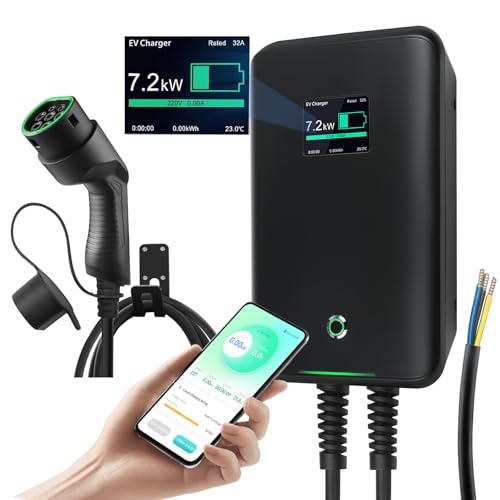
astoneves 7.4 kW wall charger with app view ›
Of the five listings in the sweep that say whether the unit detects DC leakage, three are wall chargers, and this is the one we would start from. It is the line that falls out of quotes and the one that can add another device to your consumer unit, and saying it in the title is worth more than a spec nobody checks.
- Its title declares type A RCD 30 mA AC plus 6 mA DC. The DC half is the part an ordinary residual current device stops seeing once a car is charging, and it is the line that decides whether the installer has to add another device to your consumer unit.
- 7.4 kW is the physical ceiling of a single phase supply, which is what nearly every British home has: 32 amps at 230 volts. Above that you need three phase, and in a house here that is unusual.
- Its listing does not say how many metres of cable it comes with, and in the sweep of 8 September 2026 that figure was given by 47 of the 54 listings. Worth asking, because a standard quote covers a run of about ten metres.
- The question its listing leaves open is the British one: on a PME supply an outdoor charge point cannot use the PME earth on its own, so either the unit detects an open PEN fault itself or the electrician drives an earth rod. Ask which before the quote is written.
- It names the 6 mA DC protection in its own title, which 5 of 54 listings do
- 7.4 kW is the ceiling of a normal single phase supply, so nothing is wasted
- App control, which is how an off peak charging window gets set
- Its listing does not give the cable length or the ingress rating
- Its listing does not mention open PEN detection, which on a PME supply decides whether an earth rod goes in

ELECQ 7.4 kW wall charger with load management view ›
It is the only one in this selection whose listing declares both dynamic load management and solar surplus charging, and it also warns in the same title that its meter is sold separately. That warning, written by the seller, is worth more than the feature: it tells you the real cost. If your main fuse is 60 amps, this is the function to look for.
- Dynamic load management is the British answer to a 60 amp main fuse. The charger reads what the rest of the house is drawing and backs off when the shower and the oven are on, so a 7.4 kW point can sit behind a fuse that could not take everything at once. It is the alternative to a supply alteration, and it is what an installer will suggest first.
- The title says it requires the Power Monitor, which means the meter that makes both features work is a separate purchase and is not in the box.
- Solar surplus charging only earns its keep if there are panels and the car is at home during the day, which is not the case for someone charging overnight on a cheap window.
- 5 metres of cable and 32 amps single phase, which is the ceiling of a normal domestic supply here.
- Dynamic load management declared: it is the answer to a main fuse that will not take everything at once
- Solar surplus charging for a house with panels
- Its own listing warns that the meter is a separate purchase
- The meter both features need is not included
- Its listing does not say whether it detects DC leakage
How much it costs to have an EV charger fitted at home, and what the grant gives back
It is the first thing people also ask on this search, and the only pages that answer it are the ones selling the installation. The headline figure is published and it is worth starting from: Zapmap puts a fitted 7 kW point at between 700 and 1,200 pounds fully installed, unit included, read on 18 September 2026.
What that range does not tell you is which lines move it, and there are four. The cable run, because a standard quote covers roughly ten metres from the consumer unit to the car and anything beyond is priced separately. The earthing, because a charger without open PEN detection brings an earth rod with it. The DC leakage device, if the charger does not carry it. And the main fuse, because if the load calculation fails, the way out is a charger with load management rather than a bigger supply.
Then there is money coming back. The electric vehicle chargepoint grant on GOV.UK pays 75 per cent of the cost of buying and installing a socket, up to a maximum of 500 pounds. It is not for everybody: it is aimed at renters and flat owner occupiers, with a separate route for households that have only on street parking and fit an approved cross pavement solution. Where there is no off street parking and no cross pavement route, a home charge point is not the answer at all, and the kerbside schemes councils run are.
- The unit itself. The only line that appears in a product listing, and the one that varies least.
- The cable run from the consumer unit to where you park. A standard quote covers around ten metres; past that it is priced separately, so measure before you ask.
- The earthing. Either the charger detects an open PEN fault or an earth electrode goes in, and that is a rod, a trench and a test.
- The DC leakage device, if the charger does not carry it. Five listings out of 54 tell you which case you are in.
- The certificate and the notification, which the qualified installer files. A quote that does not mention them is incomplete even when it is the cheapest.
- The grant, which is 75 per cent up to 500 pounds for renters, flat owner occupiers and approved cross pavement installations, and comes off the total rather than being added to it.
A flat, a rented home or a shared car park: what changes and who has to say yes
This is where most people stop, and the money is arranged the other way round from what they expect: the grant exists for precisely this case. GOV.UK's chargepoint grant is aimed at renters and flat owner occupiers, with its own application route for landlords, and it pays 75 per cent of buying and installing a socket up to 500 pounds.
What the grant does not do is give permission. That comes from whoever owns the building or the parking space, the freeholder or the landlord, and it is the conversation to have first rather than last, because it decides the cable route, the metering and who pays for the electricity. Two practical things make it easier: a charger that detects an open PEN fault, because driving an earth rod into somebody else's car park is not a small ask, and a unit with its own access control so the point is not open to the whole building.
And if there is no off street parking at all, the honest answer is that none of this applies. The route then is a cross pavement solution where one is approved, or the kerbside charging schemes local councils run, and a wall box is the wrong purchase.
Which home EV charger to buy, by where you are going to put it
7.4 kW is the ceiling of a single phase supply, and its listing declares the 6 mA DC detection.
See it on Amazon ›| Charger | Power | Phases | Cable | Does it say it detects the 6 mA of DC? | |
|---|---|---|---|---|---|
| astoneves 7.4 kW wall charger with app view › | 7.4 kW | single phase | its listing does not say | yes: type A RCD 30 mA AC plus 6 mA DC | View › |
 dé 7.4 kW wall charger with a 7.5 m cable view › dé 7.4 kW wall charger with a 7.5 m cable view › | 7.4 kW | single phase | 7.5 m | its listing does not say | View › |
| ELECQ 7.4 kW wall charger with load management view › | 7.4 kW | single phase | 5 m | its listing does not say | View › |
 Wallbox Pulsar Max 7.4 kW view › Wallbox Pulsar Max 7.4 kW view › | 7.4 kW | single phase | 5 m | its listing does not say | View › |
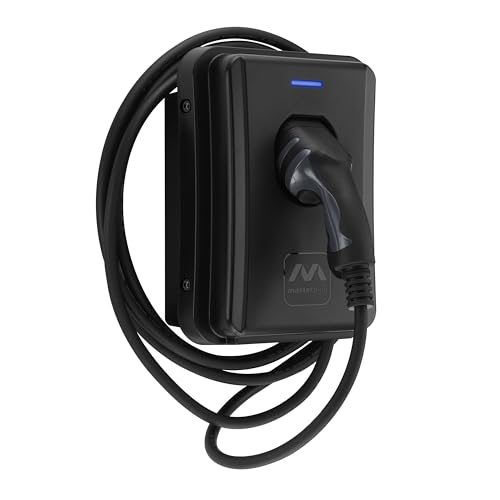 Masterplug Wall charging station with cable view › Masterplug Wall charging station with cable view › | its listing does not say | single phase | 5 m | its listing does not say | View › |
 AIMILER 11 kW wall charger with a display view › AIMILER 11 kW wall charger with a display view › | 11 kW | three phase | 7.6 m | yes: type A RCBO 30 mA plus 6 mA DC | View › |
 GONEO 11 kW three phase wall charger view › GONEO 11 kW three phase wall charger view › | 11 kW | three phase | 7 m | yes: type A RCD 30 mA AC plus 6 mA DC | View › |
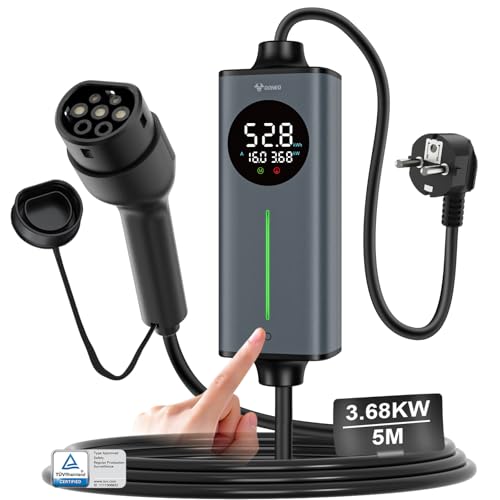 GONEO 3.68 kW portable charger view › GONEO 3.68 kW portable charger view › | 3.68 kW on a continental plug | single phase | 5 m | yes: 30 mA AC plus 6 mA DC | View › |
 tomons 5 metre type 2 cable view › tomons 5 metre type 2 cable view › | up to 22 kW | three phase | 5 m | not applicable: it is a cable | View › |
What each listing declares in its own title, read on 8 September 2026. "Its listing does not say" does not mean the unit lacks it: it means it has to be asked before the installation is quoted. None of these listings mentions open PEN detection either way, which is the second question for the installer.
We start from the whole catalogue rather than from a shortlist. On 8 September 2026 we went through Amazon's European catalogue with eight searches of the family and counted 54 distinct listings, noting from each one what its selling title declares, which is what a buyer reads: power, phases, metres of cable, residual current protection, DC leakage detection and ingress rating. That count is the chart on this page and it is what the selection rests on. The second source is the British layer, and it is the one that makes this a different guide from its Spanish original: the Ofgem price cap unit rate for what charging costs, the electric vehicle chargepoint grant on GOV.UK for what comes back, Zapmap for the published range of a fitted 7 kW point, The Electric Vehicles (Smart Charge Points) Regulations 2021 on legislation.gov.uk for what a charge point sold here has to do, and the product manuals of three charger makers for open PEN detection and the clause of the wiring regulations they cite. All of them are linked at the foot with the date they were read. What we could not verify, said plainly: there is no single published British figure for extra cable per metre, the ranges we found run from five to thirty pounds, and a spread that wide is not a figure worth printing, so the calculator leaves that line unpriced and prints the question to ask instead. Review rhythm: price and availability daily from the register; the selection and the catalogue count every quarter.
Questions about home EV chargers in the UK
How much does it cost to have an EV charger fitted to your house?›
The published British figure to start from is Zapmap's: a 7 kW charge point typically costs between 700 and 1,200 pounds fully installed, unit included, read on 18 September 2026. Four things move it inside and outside that range. The cable run, because a standard quote covers roughly ten metres from the consumer unit and beyond that it is priced separately. The earthing, because on a PME supply a charger without built in open PEN detection brings an earth rod and the work that goes with it. The DC leakage device, if the charger does not carry it, which only 5 of the 54 listings counted tell you either way. And the main fuse, if the load calculation does not clear. Against all that, the chargepoint grant pays 75 per cent up to 500 pounds for renters, flat owner occupiers and approved cross pavement installations.
What size EV charger does a British home need?›
On the single phase supply nearly every British home has, 7.4 kW is the ceiling, because a 32 amp circuit at 230 volts is 7.36 kW, and that is what the market sells as a 7 kW charger. Eight hours plugged in at that power puts in 59 kWh, a full battery for almost anything on sale. Going higher means 11 or 22 kW, which need three phase, and many cars stop at 7.4 kW on their own on board charger anyway. The real question in this country is not whether to go higher, it is whether your main fuse, stamped 60, 80 or 100 amps, will cover the house and the car at the same time, and the answer when it will not is a charger with load management.
Can you install an EV charger at home yourself?›
No, and the reasons are practical rather than bureaucratic. A charge point goes on its own dedicated circuit with a residual current device rated at no more than 30 mA, it has to satisfy section 722 of the wiring regulations, and on the PME supply most homes here have, an outdoor point needs either a separate earth electrode or a charger that detects an open PEN fault. It is also the installer who notifies the work and issues the certificate, and that certificate is what the chargepoint grant application needs. A quote that does not mention the notification and the certificate is incomplete even if it is the cheapest.
What is PEN fault protection, and is it needed?›
If your home is earthed through the supply cable, an arrangement called PME, and the charge point is outdoors, then yes, something has to cover it. The failure mode is that the combined neutral and earth conductor breaks somewhere outside the house and metalwork connected to that earth rises to a dangerous voltage, with the person touching the car standing on the ground. The wiring regulations do not allow the PME earth to be the only protection there, so the installer either drives a separate earth electrode or fits a charger that detects the fault itself. Ohme states in its own manual that the Home Pro has an in built PEN fault detection function as described in clause 722.411.4.1 (iv), Easee states integrated protection to the same standard, and myenergi says its approach removes the need for earth rods. Asking which case you are in is the single question that most changes a quote.
Do home chargers have to be smart in the UK?›
For private sale in Great Britain, yes, since 30 June 2022. The Electric Vehicles (Smart Charge Points) Regulations 2021 set what a charge point sold here has to do, and two of the requirements show up on your first night. Regulation 10 means the unit arrives with a default off peak charging schedule already set, which you confirm on first use and can change later. Regulation 11 requires a randomised delay of up to 600 seconds, of a random duration determined to the nearest second, each time charging would start or change rate, so that large numbers of chargers do not switch on in the same second when a cheap rate begins. You can override it, and knowing it exists saves a call to the installer.
Can you charge an electric car from a normal plug socket?›
You can, with a portable charger, and the ceiling is the socket rather than the car. A British socket is a 13 amp BS 1363, so the honest figure here is nearer 3 kW than the 3.68 a continental 16 amp socket allows, and it is worth checking the plug on any portable unit before ordering. What should not be done is an extension lead or a tired old socket, because this is eight hours at close to full load, every night. Using the maker's own published conversion, an hour at 7.4 kW gives about 25 miles, so at roughly half that power and eight hours plugged in you are looking at something over 90 miles put back overnight, which is more than most people drive in a day.
Do you need a three phase supply to charge at home?›
No, unless you specifically want 11 or 22 kW. Single phase caps at 32 amps at 230 volts, which is 7.4 kW, and with eight hours overnight that is 59 kWh, a full battery for nearly anything on sale. Three phase is rare in a British house, and two of the chargers in this guide need it: without it they run at a third of their rated power. And there is the car to consider, because many models have an on board charger that stops at 7.4 kW however much the point offers.
Can you get a grant for a home EV charger?›
If you rent, own a flat, or have only on street parking and are fitting an approved cross pavement solution, then very likely. GOV.UK's electric vehicle chargepoint grant pays 75 per cent of the cost of buying and installing a socket, up to a maximum of 500 pounds, with a separate application route for landlords. It is applied for through the installer with the certificate for the work, which is another reason the certificate belongs in the quote. If you have no off street parking and no approved cross pavement route, the grant does not cover a home point, and the kerbside schemes local councils run are the way in.
We would start from the astoneves 7.4 kW wall charger with app view ›, and not because of the price: of the five listings in the count that say whether the unit detects DC leakage, three are wall chargers and this is the one we would pick of the three. It is the line that falls out of quotes and the one that can add another device to your consumer unit.
If your main fuse is 60 amps and the house is all electric, the answer is not a bigger supply: we would look for load management, which the ELECQ 7.4 kW wall charger with load management view › declares, and which lets a 7.4 kW point back off while the shower is running. If the supply is three phase, the 11 kW tier charges in half the time and costs little more, and the AIMILER 11 kW wall charger with a display view › declares the same protection plus IP66. If the car parks a long way from the consumer unit, the dé 7.4 kW wall charger with a 7.5 m cable view › and its 7.5 metres of lead buy you cable inside the quote rather than outside it.
And the last check, the one that is in no listing anywhere: ask whether the unit has built in open PEN fault detection. On a PME supply, the answer decides whether there is an earth rod in your quote.
m8d pick, the one that names the protection that moves the quoteastoneves 7.4 kW wall charger with appSee it on Amazon ›For a 60 amp fuse, and for a house with panelsELECQ 7.4 kW wall charger with load managementSee it on Amazon ›Only with a three phase supply, and the most declared of the three phase pairAIMILER 11 kW wall charger with a displaySee it on Amazon ›The ones that hold up the specific figures on this page, with the date they were read.
- GOV.UKElectric vehicle chargepoint grant for renters or flat owners"You can get 75% off the cost of buying and installing a socket, up to a maximum of 500 pounds", and the eligibility aimed at renters and flat owner occupiers with a separate route for landlords. Read on 18 September 2026.
- legislation.gov.uk, SI 2021 No. 1467The Electric Vehicles (Smart Charge Points) Regulations 2021, regulation 11The randomised delay: the charge point must operate "with a delay of up to 600 seconds, such delay to be of a random duration which is determined, to the nearest second". Regulation 10 covers off peak charging and regulation 4 the sale of charge points. Read on 18 September 2026.
- Ohme, maker's manualOhme Home Pro product manual"The Ohme Home Pro has an in-built PEN fault detection function, as described in 722.411.4.1 (iv), to disconnect the vehicle from the live, neutral and earth conductors if the voltage is above or below the prescribed levels." It is the source of the open PEN clause cited on this page. Read on 18 September 2026.
- myenergi, maker's pagePEN protectionThe maker's own statement that its approach to protection against a damaged PEN conductor removes the need for earth rods with its charger. Read on 18 September 2026.
- ZapmapElectric car charging at home"Typically a 7kW charge point will cost between 700 and 1200 pounds fully installed", and 7 kW as the standard power rating for a home charger. Read on 18 September 2026.
- OfgemEnergy price cap unit rates and standing chargesThe average electricity unit rate for direct debit customers in England, Scotland and Wales: 26.11 pence per kilowatt hour for 1 July to 30 September 2026, and 26.32 from 1 October. Read on 18 September 2026.
- Wallbox, maker's guideGuide to installing an electric vehicle chargerThe power to range conversion used by the calculator on this page: an hour of charging at 7.4 kW gives about 40 kilometres, which is roughly 25 miles, and about 120 kilometres at 22 kW. Spanish language page. Read on 8 September 2026.
- AmazonAmazon product listingsThe declared specifications of the nine chargers and the count of 54 distinct listings across eight searches of the family, read through our interface on 8 September 2026 from the European catalogue m8d tracks daily.
Comments
Be the firstNo sign-up: just a name. Every comment is reviewed before it is published.