Best record players and turntables in 2026: which to buy, what else you need to hear one and when the stylus runs out

The word on the box is not the same as the word on the shelf: a record player usually has speakers inside and a turntable usually does not, and that single difference decides whether your records play on the day the box arrives. Here are the seven decks worth buying, the tracking force and stylus life each maker publishes, and the setup checker that tells you which link of the chain you are missing.
This guide contains affiliate links. As an Amazon Associate, m8d.io earns from qualifying purchases, at no extra cost to you.
The best record player for most people is the one whose maker publishes two numbers: which cartridge it carries and how hard its stylus presses. Starting from nothing, the Audio-Technica AT-LP60X view ›. If a speaker or a soundbar already plays in the house, the Teac TN-180BT-A3 view ›. To keep for years, the Audio-Technica AT-LP120XUSB view ›, where the tracking force becomes yours to set.
Record player, turntable or vinyl player: what the three words mean once you read the listing
British shops sell one shelf under three names, and the name is the first thing that tells you whether it plays on its own. Richer Sounds titles its page "Buy Turntables Online / Record Players". Argos calls the same aisle "Record Players & Turntables / Vinyl Players". John Lewis lists "Record Players / Turntables / Vinyl Players". Three of the biggest places a British buyer looks, three different words, one shelf, all read on 18 September 2026.
The words are not interchangeable in practice, and the difference is the whole purchase. A listing that leads with record player usually means a box with speakers inside: the suitcase formats and the furniture ones, which plug into the wall and play. A listing that leads with turntable or deck usually means the opposite: a motor, a platter and an arm, and the sound has to be made somewhere else. Between those two there is a third case that catches most people, which is a deck that has the phono stage inside but no speakers.
That is why record player with speakers is a search of its own in Britain, and why the answer to "which is the best vinyl player for home use" depends less on the deck than on what is already plugged in at home. The checker further down asks you those two questions and nothing else.
The strongest evidence in this category is not a laboratory: it is what the shops themselves write above the products, and what the makers write on their own spec sheets. The two do not say the same thing, and the gap between them is where the money goes.
m8d rule: If the listing says record player, expect speakers in the box. If it says turntable or deck, expect to supply the sound yourself, and check the words phono stage or line output before you pay.
What a record player needs to make a sound: the phono stage, the amplification and the speakers
A turntable does not play on its own, and that is not an opinion: it is written into the standard. The international standard for the category is IEC 60098:2020, "Analogue audio disk records and reproducing equipment", the fourth edition, which cancels and replaces the third of 1987. It fixes what makes an analogue record and the equipment that plays it compatible, and in the first line of its scope it expressly excludes amplifiers and loudspeakers, which are measured by four other standards in the IEC 60268 family. The body that defines what a turntable is leaves out, on purpose, the two things you need to hear one.
Between the stylus and your ear there are four links. The cartridge turns the groove into a tiny signal with the bass cut back, because that is how the record was cut so the grooves would fit. The phono stage undoes that curve and lifts the signal to line level. The amplification turns line level into power. The speakers turn power into sound. A turntable always brings the first. Sometimes it brings the second. The third and the fourth, almost never, except in the suitcase and furniture formats.
That is what decides the purchase and what the listing rarely tells you. The checker below asks what you already have at home and what the listing says the deck brings, and it names the link you are missing, why it has to be there and what is sold in that gap in Britain today.
Free record player setup checker: what else you need to hear one, and when your stylus runs out
Free record player setup checker, and a stylus life calculator. Two sums no listing does. The first takes what already plays in your house and what the listing says the deck brings, and names the link of the chain you are missing, why it is needed and what is sold in that gap in Britain today. The second takes the shape of your stylus tip and how much you listen, and turns the hours the maker publishes into a date and a replacement code. Free, no account, no ads. Example with what loads by default: a deck with a phono stage inside and nothing else at home means the speakers are the missing link, and an entry conical ATN3600L stylus, at an hour of records a day, lasts from 10 to 16 months, which is the 300 to 500 hours Audio-Technica publishes for it.
- The cartridgeTurns the groove into a tiny electrical signal, with the bass cut back by the RIAA curve of the recordingThe deck brings it
- The phono stagePuts the bass back where it belongs and lifts the signal to line level. This is the inverse equalisation of the IEC 60098 standardThe deck brings it
- The amplificationTurns line level into power. It lives inside a pair of active speakers, a soundbar or an amplifierMissing
- The speakersThe last link of the chain and the one that changes what you hear mostMissing
The sum, in the open: of the 2 pairs of active speakers we priced, the cheaper is £319, and they carry the amplification inside, so no separate amplifier is needed. These are prices published by British shops on 18 September 2026, not the price of any product on this page.

The sum, in the open: 300 to 500 hours over 7 hours a week is 43 to 71 weeks, which is 10 to 16 months. The hours are the ones Audio-Technica publishes for each tip shape, and the figure surprises people: the elliptical lasts less than the conical, and the microlinear, twice the conical and more than three times the elliptical.
The hours of life of each tip shape and the tracking force in grams are the ones Audio-Technica and Sumiko publish on their own spec sheets, listed in the sources of this guide and checked on 18 September 2026: each maker gives its own figure. The entry conical of the ATN3600L series, fitted to several of the decks in this guide, is declared by its maker at between 300 and 500 hours. The money figures are prices published by British shops for 2 phono stages and 2 pairs of active bookshelf speakers on 18 September 2026, in whole pounds, and they do not state what any particular product costs. The 7 decks in this guide and the source of every figure are listed at the foot of the page.
This is the rung where the numbers start existing. Audio-Technica publishes that the integrated cartridge takes an ATN3600LC stylus, that the stylus tracks at 3.5 grams from the factory and that it lasts roughly 300 to 500 hours, and none of those three things appears on a shop listing anywhere. The phono stage is inside and switchable, so it plugs into an old amplifier with a PHONO input and into a pair of active speakers just the same, and that is what decides whether it plays music the day the box arrives.
View ›
It carries an Audio-Technica AT3600L cartridge and says so in its own listing, which almost nothing at this level does. It is the same entry stylus the Audio-Technica AT-LP60X asks for, the ATN3600L, so the replacement is identical and costs the same. What it adds is the way out: it transmits over Bluetooth to a speaker or a soundbar you already own, and it also has a phono output and a line output on RCA. If something in your house already makes sound, this is the one that makes you buy nothing else on day one.
View ›Vinyl has grown in Britain for sixteen years running, and that is what the bottom of the shelf is made of
This is not a revival any more, it is a market. The BPI, the trade body that counts recorded music in the United Kingdom, published on 12 March 2026 that vinyl revenue reached £174.7 million in 2025, up 19.9 per cent year on year, an extra £29.0 million, and that vinyl accounted for 62.9 per cent of all physical music sales, up from 59.1 per cent the year before. It was the sixteenth consecutive year of revenue growth and the highest level in more than three decades.
Sixteen years of growth is long enough to build a shelf, and the shelf it built has a shape. At the top, decks whose makers publish the cartridge, the tracking force and the replacement stylus, because their buyers ask. At the bottom, a format built for a present: a case that shuts, speakers inside and a price that fits a stocking. And in between, the gap this guide exists for, where a deck arrives that cannot be heard until something else arrives too.
The thing worth knowing before December, and it is the one thing a shop assistant will not say out loud: at the bottom of this shelf the cartridge is the first specification a listing stops publishing. Not the drive type, not the speeds, not the Bluetooth. The cartridge. And the cartridge is what decides how hard the diamond presses on a record that somebody is going to keep.
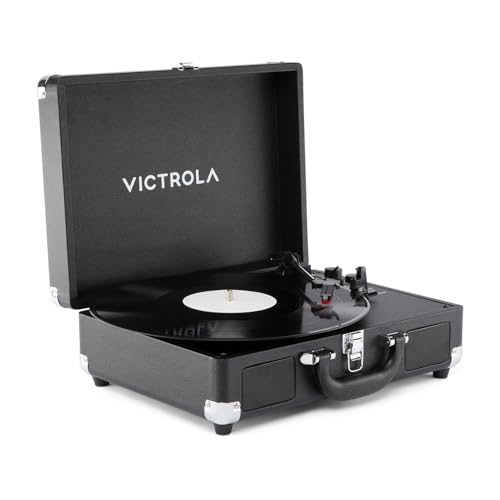
This is the format the bottom of the shelf is made of, and it is here as the example rather than as a pick. It plays on its own, it shuts and it travels, and what you want to know before any of that is what its own official page does not publish: not which cartridge it carries, not what the stylus presses at, not which replacement it takes. With those three gaps there is no way to know how long the stylus will last or what to order when it goes, and that is the check this guide is built around.
View ›Tracking force and stylus life: what every maker publishes, deck by deck, and which replacement you will be ordering
A gram and a half is the whole distance between the entry rung and the next one. Audio-Technica's entry cartridge, the AT3600L, which three of the seven decks here carry, works with the stylus pressing at 3.5 grams. The AT-VM95C and the AT-VM95E, on the other two Audio-Technicas, work at 2.0. The Sumiko Rainier on the Pro-Ject, between 1.8 and 2.2 depending on how the counterweight is set.
The highest form of evidence in this category is not a review: it is the maker contradicting the shelf. Audio-Technica sells turntables with two different cartridges and publishes both sheets, so the comparison admits no argument. Its own support pages write that the entry stylus, the ATN3600L, "has a down-force of 3.5g", and warn that fitting a different stylus to that arm would make the preset tracking force excessive, "resulting in damage to the stylus and possibly your vinyl". The same brand declares 1.8 to 2.2 grams for its AT-VM95C, with 2.0 as the reference. And both carry exactly the same tip: conical, 0.6 mil. Same diamond shape, 43 per cent less force.
So the tip shape does not tell you how hard it presses. What decides is the cartridge and the arm that holds it, and that is published on the maker's site and nowhere else. The table below puts the four figures side by side for all seven, and every cell comes from the sheet of the company that makes that cartridge.
| Turntable | Cartridge fitted | Stylus tip | Tracking force its maker declares | Replacement stylus | |
|---|---|---|---|---|---|
 Audio-Technica AT-LP120XUSB view › Audio-Technica AT-LP120XUSB view › | AT-VM95E | Elliptical 0.3 x 0.7 mil | 1.8 to 2.2 g (2.0 reference) | AT-VMN95E, and any stylus in the VM95 series | View › |
 Audio-Technica AT-LP70XBT view › Audio-Technica AT-LP70XBT view › | AT-VM95C, fixed body | Conical 0.6 mil | 1.8 to 2.2 g (2.0 reference) | AT-VMN95C, and any stylus in the VM95 series | View › |
 Pro-Ject T2 Super Phono view › Pro-Ject T2 Super Phono view › | Sumiko Rainier | Elliptical 0.3 x 0.7 mil | 1.8 to 2.2 g | Interchangeable with Olympia, Moonstone, Wellfleet and Amethyst | View › |
| Audio-Technica AT-LP60X view › | Integrated Dual Magnet | Conical 0.6 mil | 3.0 to 4.0 g (3.5 from the factory) | ATN3600LC or ATN3600LE, and only those two | View › |
| Teac TN-180BT-A3 view › | AT3600L, VM type | Conical 0.6 mil | 3.5 g, within a 0 to 5 range the arm accepts | ATN3600L | View › |
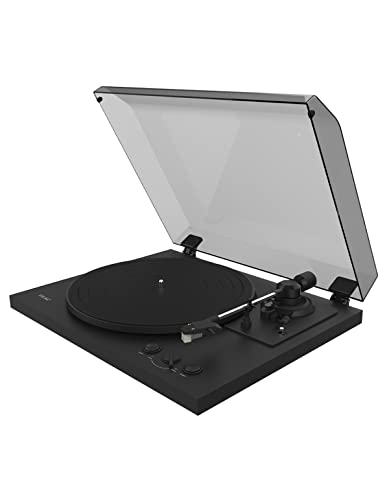 Teac TN-175 view › Teac TN-175 view › | AT3600L, VM type | Conical 0.6 mil | 3.5 g from the cartridge itself | ATN3600L | View › |
| Victrola Journey II view › | Its page does not say | Its page does not say | Its page does not say | Its page does not say | View › |
Every figure comes from the sheet of the company that makes the cartridge, not from a shop listing: audio-technica.com for the four Audio-Technica cartridges, teacusa.com for the TN-180BT-A3 and sumikophonocartridges.com for the Rainier, all read on 8 September 2026. The official Victrola page for the Journey II publishes none of the four, and that is a finding too.
And a figure that surprises people when they read it, published by the maker itself: the better stylus lasts less. Audio-Technica writes for its VM95 series that a conical tip lasts around 500 hours, an elliptical around 300, a Shibata around 800 and a microlinear around 1,000. The elliptical reads the groove better because it touches more of the wall, and that is exactly why it wears out sooner. The practical consequence: on a deck that accepts the whole series, moving from elliptical to microlinear is not only a sound decision, it is more than three times the hours per stylus.
Which record player to buy in 2026: three decks for the three situations people actually arrive in
Audio-Technica AT-LP60X view ›
This is the rung where the numbers start existing. Audio-Technica publishes that the integrated cartridge takes an ATN3600LC stylus, that the stylus tracks at 3.5 grams from the factory and that it lasts roughly 300 to 500 hours, and none of those three things appears on a shop listing anywhere. The phono stage is inside and switchable, so it plugs into an old amplifier with a PHONO input and into a pair of active speakers just the same, and that is what decides whether it plays music the day the box arrives.
- Its official page declares an "integrated Dual Magnet phono cartridge with replaceable diamond stylus (ATN3600LC)" and a "switchable internal phono preamp, for phono or line output" (audio-technica.com, read on 8 September 2026).
- The ATN3600LC tracks between 3.0 and 4.0 grams with 3.5 as the reference, is conical at 0.6 mil and its maker gives it roughly 300 to 500 hours before it needs changing (ATN3600LC spec sheet, read on 8 September 2026).
- Audio-Technica's own support pages write that this arm has no tracking-force adjustment and takes only the ATN3600LC or the ATN3600LE, because with any other stylus the preset tracking force would be "too much for it to work correctly, resulting in damage to the stylus and possibly your vinyl" (audio-technica.com support, read on 8 September 2026).
- What changed against the model before it: its maker writes that the AT-LP60X updates the AT-LP60 with a redesigned arm base and headshell "to improve tracking and reduce resonance", and with the transformer moved outside the chassis to lower noise (audio-technica.com, read on 8 September 2026).
- Its maker publishes the stylus reference, what it tracks at and how long it lasts: the three figures no listing carries
- Switchable phono stage inside: works with an amplifier that has a PHONO input and with active speakers
- Fully automatic, and the arm lifts itself at the end of the side, which is what prevents the first-fortnight scratch
- The replacement stylus is bought on its own and changed with two fingers, no tools
- The arm has no counterweight and no adjustment: the tracking force is whatever it left the factory at
- 33 and 45 rpm only, no 78
- No speakers and no Bluetooth: you need something to plug it into
- The cartridge body does not come off, only its stylus, and only two references fit
Teac TN-180BT-A3 view ›
It carries an Audio-Technica AT3600L cartridge and says so in its own listing, which almost nothing at this level does. It is the same entry stylus the Audio-Technica AT-LP60X asks for, the ATN3600L, so the replacement is identical and costs the same. What it adds is the way out: it transmits over Bluetooth to a speaker or a soundbar you already own, and it also has a phono output and a line output on RCA. If something in your house already makes sound, this is the one that makes you buy nothing else on day one.
- TEAC publishes that it ships with an Audio-Technica AT3600L cartridge of the VM type (equivalent to moving magnet) and that its replacement stylus is the ATN3600L (teacusa.com spec sheet, read on 8 September 2026).
- Its declared stylus pressure range is 0 to 5 grams, and the ATN3600L it carries tracks at 3.5 according to Audio-Technica's sheet: the two figures come from the two makers, both read on 8 September 2026.
- It has a phono equaliser amplifier inside and two RCA outputs, PHONO and LINE, plus a Bluetooth transmitter on the SBC codec with about ten metres of range (TEAC spec sheet, read on 8 September 2026).
- It is one of the few decks whose own listing names the cartridge, the phono stage and the drive type at the same time.
- What changed against the model before it: TEAC does not publish a comparison between the TN-180BT-A3 and the TN-180BT, so there is nothing to tell here without making it up.
- Names the cartridge, the phono stage and the drive type in its own listing
- Transmits over Bluetooth to a speaker or soundbar you already own, with nothing else to buy
- Line output and phono output on cable as well, so it also suits an amplifier
- Its replacement stylus is a public Audio-Technica reference, the ATN3600L, sold on its own
- The Bluetooth codec is SBC, the basic one: no aptX and no LDAC
- The arm has no tracking-force adjustment
- Its entry stylus tracks at 3.5 grams, the same as the cheapest deck on this list
- Bluetooth adds delay, which shows if you are watching video at the same time
Audio-Technica AT-LP120XUSB view ›
This is where the tracking force stops arriving from the factory and becomes your decision. It carries an AT-VM95E, which its maker declares between 1.8 and 2.2 grams with 2.0 as the reference, and it takes any stylus in the VM95 series: you can go from elliptical to microlinear without changing the cartridge or touching anything else. It is the rung at which a deck gets upgraded instead of replaced, and if the budget reaches, it is the one we would buy.
- Its spec sheet declares an AT-VM95E cartridge with an elliptical stylus of 0.3 by 0.7 mil, compatible with any replacement stylus in the VM95 series (audio-technica.com, read on 8 September 2026).
- For the AT-VM95E the maker publishes a range of 1.8 to 2.2 grams with 2.0 as the reference, against the 3.5 of the cartridge its entry models carry (AT-VM95E spec sheet, read on 8 September 2026).
- Direct drive with a DC servo motor, adjustable dynamic anti-skate control, switchable phono stage, three speeds including 78 rpm and a USB output (official spec sheet, read on 8 September 2026).
- What changed against the model before it: Audio-Technica writes that the AT-LP120XUSB updates the AT-LP120-USB with a new DC servo direct-drive motor, adjustable dynamic anti-skate control and a selectable phono preamp (audio-technica.com, read on 8 September 2026).
- The arm is an S-shape with a detachable half-inch headshell, which is the standard fitting: it takes any cartridge on the market with that thread, not only its own brand.
- Tracking force set with a counterweight, and adjustable anti-skate too: the stylus works at 2.0 grams rather than 3.5
- Detachable half-inch headshell: the whole cartridge swaps for any other on the market
- Three speeds, 78 rpm included, for records made before 1950
- USB output to move the collection onto a computer without buying anything else
- It is manual: the arm goes down and comes up by hand on every side
- No Bluetooth in this version
- It weighs and occupies like a piece of hi-fi separates, not like a small piece of furniture
- It still needs speakers: the phono stage is inside, the amplification is not
Where the money actually goes when you spend more on a turntable: the cartridge first, the arm second
Spending more does not buy sound: it buys adjustment, and it arrives in two separate steps. The first is the cartridge. On the cheaper decks here the stylus presses at 3.5 grams from the factory and cannot be changed, and the Audio-Technica AT-LP70XBT drops to 2.0 without carrying a counterweight at all, purely by fitting a different cartridge. The second is the arm: only the Audio-Technica AT-LP120XUSB brings a counterweight, adjustable dynamic anti-skate and a detachable half-inch headshell, which is the standard fitting and what lets any cartridge on the market go on. That is where a turntable stops having a ceiling.
The second step is the phono stage, and it is not that it appears: it is that it stops being an accessory. On the Audio-Technicas and the Teacs here it is inside and switchable, so you choose whether the output leaves at phono or at line level. On the Pro-Ject it is a named part, two stages with split passive filtering, and it switches off entirely the day a moving-coil cartridge arrives with its own external stage. In both tiers the stylus is bought on its own: the six cartridges of the VM95 series share a body, and the Sumiko Rainier's stylus swaps with those of the four cartridges above it.
If you are choosing between the two upper rungs and ask us, we would take the AT-LP120XUSB view ›, and not for the drive type: it is the only deck here whose arm lets you set the tracking force yourself, which is the figure its own maker warns can damage a record when it is wrong.
Audio-Technica AT-LP70XBT view ›
This is the point at which being automatic and wireless stops costing you the cartridge. It carries a fixed-body AT-VM95C, which its maker declares at 2.0 grams rather than 3.5, and it takes any stylus in the VM95 series: you can move from conical to microlinear by changing only the stylus, and the microlinear lasts a thousand hours against the conical's five hundred. And it transmits on aptX Adaptive, not on the basic codec.
- Its spec sheet declares a "fixed-body AT-VM95C dual magnet cartridge, compatible with any VM95 series replacement stylus" and a "switchable internal phono preamp" (audio-technica.com, read on 8 September 2026).
- The AT-VM95C tracks between 1.8 and 2.2 grams with 2.0 as the reference, is conical at 0.6 mil and its replacement is the AT-VMN95C (AT-VM95C spec sheet, read on 8 September 2026).
- Its maker declares compatibility with the aptX Adaptive codec, and it also includes an RCA cable with an earth lead for connecting it by wire to active speakers or an amplifier (official spec sheet, read on 8 September 2026).
- Audio-Technica publishes that VM95 series styli last around 500 hours for a conical, 300 for an elliptical, 800 for a Shibata and 1,000 for a microlinear, and that all six share the same body (audio-technica.com, VM95 series, read on 8 September 2026).
- Tracks at 2.0 grams while being automatic and wireless, which is the combination that does not exist lower down
- Any VM95 stylus fits: the upgrade is bought on its own and goes in inside a minute
- aptX Adaptive instead of the basic Bluetooth codec
- J-shaped arm with a rest lock, which cuts the risk of knocking the stylus
- The cartridge body is fixed: you change the stylus, not the whole cartridge
- 33 and 45 rpm only
- No USB output
- aptX Adaptive only helps if the speaker has it too
Pro-Ject T2 Super Phono view ›
At this rung the phono stage stops being an extra and becomes the argument: Pro-Ject builds a two-stage design with split passive filtering into the plinth, and it can be switched off the day a better one is bought. The cartridge is a Sumiko Rainier, elliptical, with a stylus interchangeable with the four cartridges above it in the same range, so the future upgrade is a stylus rather than a turntable.
- Pro-Ject declares a two-stage moving-magnet phono stage with split passive filtering, which can be switched off to use a moving-coil cartridge with an external stage (project-audio.com, read on 8 September 2026).
- The Sumiko Rainier is a moving-magnet design with an elliptical stylus of 0.3 by 0.7 mil and a tracking force range of 1.8 to 2.2 grams (sumikophonocartridges.com, Rainier spec sheet, read on 8 September 2026).
- Its maker publishes that the Rainier's stylus is interchangeable with those of the Olympia, Moonstone, Wellfleet and Amethyst, because the bodies are the same: the upgrade is bought on its own (sumikophonocartridges.com, read on 8 September 2026).
- It has spring-loaded adjustable anti-skate and a solid glass platter, according to the maker's sheet read on 8 September 2026.
- Two-stage phono stage inside, and it can be switched off when an external one arrives
- Elliptical cartridge as standard at 1.8 to 2.2 grams, with a stylus interchangeable with four cartridges above it
- Solid glass platter and spring-loaded adjustable anti-skate
- Its maker publishes the whole upgrade path, cartridge by cartridge
- No Bluetooth and no USB
- Manual: the arm goes down and comes up by hand
- It still needs amplification and speakers separately
- It is the most expensive deck here by a distance
Teac TN-175 view ›
Its listing writes the exact model of the cartridge it carries, "AT3600L MM system", and that is rarer than it sounds. It looks like a detail and it is the opposite: with that code a buyer can go to the maker's sheet and find out what the stylus tracks at, what shape the tip is and which replacement it takes, all before paying. It is automatic and has the phono stage inside, so it behaves like the entry Audio-Technica.
- Its listing declares an "integrated phono preamp" and an "AT3600L MM system", which is the cartridge code written out in full.
- The AT3600L is the same cartridge the Teac TN-180BT-A3 carries and the same stylus family as the entry Audio-Technica: conical at 0.6 mil, 3.5 grams of reference tracking force and an ATN3600L replacement (TEAC and Audio-Technica spec sheets, read on 8 September 2026).
- It is fully automatic and belt-driven, with a high-density MDF plinth, according to its own listing.
- Its delivery is not immediate: on 8 September 2026 the shop quoted two to three days rather than direct stock.
- Writes the cartridge code in the listing, and with that everything else can be checked
- Built-in phono stage: it plugs into active speakers with nothing in between
- Fully automatic, with the arm stopping and returning at the end of the side
- High-density MDF plinth rather than hollow plastic, which is what sends vibration back into the platter
- No Bluetooth and no USB
- The same 3.5-gram entry stylus as the cheapest rung
- The arm has no tracking-force adjustment
- Availability is patchier than the rest of this list
Phono stage inside and switchable, so all that is left to add is a pair of active speakers.
See it on Amazon ›We start from what the makers publish, not from what the shelf shouts. One. Every cartridge figure on this page comes from the spec sheet of the company that makes that cartridge: Audio-Technica, TEAC, Pro-Ject and Sumiko, each read on 8 September 2026 and each linked at the foot. Where a maker publishes a range rather than a single number, the range is shown whole, because rounding to the friendly end would be decorating somebody else's data.
Two. Five criteria decide the order, and none of them is a shop rating. What the maker publishes: a deck whose brand publishes neither the cartridge nor the tracking force gives you no way to know how long the stylus will last, and that drops it. The declared tracking force, which is the quantity that decides groove wear. Whether the stylus or the cartridge can be replaced, and with which references. Whether it solves a concrete situation, starting out, using what already plays at home, keeping it for years, rather than being the most complete.
Three. The standard cited is IEC 60098:2020, and its scope is linked at the foot. The market figures for the United Kingdom come from the BPI release of 12 March 2026. The price bands inside the setup checker are prices published by named British shops on 18 September 2026, and they are bands for the missing link, not the price of any product on this page.
How often this is revised. Price and stock, daily, by the register. The selection and the maker sheets, every quarter, and sooner if a maker changes the cartridge on a model.
What is the difference between a vinyl player and a record player?›
In British shops they are the same shelf: Argos, John Lewis and Richer Sounds all use record player, turntable and vinyl player on the same page, read on 18 September 2026. The difference that matters is not the word, it is whether the box makes sound. A listing that leads with record player usually has speakers inside. One that leads with turntable or deck usually does not, and then you need a phono stage, amplification and speakers before anything is heard.
Which is the best record player to buy?›
Of the ones here, the Audio-Technica AT-LP120XUSB goes longest without running out of room: its AT-VM95E cartridge works at 2.0 grams against the 3.5 of the entry ones, it takes any stylus in the VM95 series, and its detachable half-inch headshell accepts any cartridge on the market. To start without spending that, the Audio-Technica AT-LP60X is the cheapest deck here whose maker publishes the tracking force, the stylus reference and how long it lasts.
What is the best vinyl record player for home use?›
That depends on what already plays in the room, which is the question the shelf never asks. If nothing does, a deck with a phono stage inside plus a pair of active speakers is the shortest complete chain. If a Bluetooth speaker or a soundbar is already there, a deck that transmits, like the Teac TN-180BT-A3, finishes the chain on day one. If an amplifier with a PHONO input is already there, almost any deck will do and the phono stage inside becomes irrelevant.
How much is a decent vinyl player?›
The honest answer is that the deck is not the whole spend. If it has no phono stage inside you need one, and if nothing in the house makes sound you need speakers as well. The setup checker on this page takes what you already have and names which of those two is missing, with the band published by British shops on 18 September 2026 for that gap. Judge the total, not the box.
Do I need a phono stage?›
Yes, always: what leaves a cartridge is a very small signal with the bass cut back by the cutting curve, and the phono stage puts it back. The real question is whether you already have one. You do if the deck says built-in preamp, phono EQ or line output, or if your amplifier has a socket marked PHONO. If neither is true, it has to be bought separately, and it is the cheapest link in the chain.
How often do you have to change the stylus?›
It depends on the shape of the tip, and the maker publishes it. Audio-Technica gives around 500 hours for a conical tip, 300 for an elliptical, 800 for a Shibata and 1,000 for a microlinear, and for its entry ATN3600L stylus, between 300 and 500. At an hour of records a day, 500 hours is about 16 months. The calculator on this page does the sum with your own listening and tells you which replacement code to order.
Can I connect a record player to a Bluetooth speaker or a soundbar?›
Only if one of the two supplies the connection. Either the deck transmits over Bluetooth, like the Teac TN-180BT-A3 or the Audio-Technica AT-LP70XBT, or the speaker has a cable input, an AUX socket or a pair of RCA sockets, and the deck has a line output. If the soundbar only has HDMI and Bluetooth and the deck only has a phono output, there is nowhere for the sound to go in and two pieces are missing: a phono stage and a cable.
Does a cheap record player damage your records?›
What wears the groove is the tracking force, not the price. Audio-Technica writes on its own support pages that fitting a stylus other than the intended one to its entry arm would make the preset force excessive and would cause "damage to the stylus and possibly your vinyl". The problem at the bottom of the shelf is not that it presses hard: it is that it does not publish how hard it presses, so there is no way to know before buying.
What do 33 and 45 mean on a record player?›
They are the turns the platter makes in a minute: 33 and a third for 12-inch albums and 45 for 7-inch singles. The more turns, the more centimetres of groove pass under the stylus every second and the more information fits, which is why a 45 sounds better and runs shorter. The third speed, 78, belongs to records made before 1950 and only two of the seven decks here declare it.
Which record player should I buy to start?›
An automatic one, with a phono stage inside, whose maker publishes the stylus. Automatic because the arm lowers and lifts itself, which is what prevents the scratch of the first fortnight. With a phono stage because otherwise another box has to arrive before anything is heard. And with the stylus published because it is the one part that is certain to wear out. The Audio-Technica AT-LP60X meets all three.
If you are starting and nothing in the house makes sound, the AT-LP60X view ›: it is the cheapest deck here whose maker publishes all three stylus figures, and its switchable phono stage makes it compatible with almost anything. If a Bluetooth speaker or a soundbar is already there, we would take the TN-180BT-A3 view ›, which sends the record to what already plays and forces you to buy nothing else. And if the idea is never to replace it, the AT-LP120XUSB view ›, where the tracking force is set by you and the cartridge comes off whole.
And one thing above the three. The deck decides a small part of what you will hear. Between the stylus here that presses hardest and the one that presses least there is a gram and a half, and between the tip that lasts longest and the one that lasts least, two hundred hours: both figures are published by their maker and both are fixed by buying a stylus. Between playing those records through speakers that share a box with the spinning platter and playing them through a pair of active speakers, the difference is of another order entirely, and that is the link most buyers do not know they are missing until the box is open.
m8d pick: the cheapest deck whose maker publishes the tracking forceAudio-Technica AT-LP60XSee it on Amazon ›The one that plays through whatever already makes sound in your houseTeac TN-180BT-A3See it on Amazon ›Everything asserted above comes from one of these, with the date it was read.
- International Electrotechnical CommissionIEC 60098:2020, "Analogue audio disk records and reproducing equipment", scopeThe international standard for the category: it applies to analogue disk records and their reproducing equipment, and expressly excludes amplifiers and loudspeakers, which are measured by IEC 60268-3, -5, -21 and -22. Fourth edition, cancelling and replacing the third of 1987.
- Audio-Technica"Replacing the stylus on the AT-LP60X and Sound Burger", support page"The ATN3600L has a down-force of 3.5g", and the warning that another stylus on that arm would give an excessive force, "resulting in damage to the stylus and possibly your vinyl". Read on 8 September 2026.
- Audio-TechnicaATN3600LC replacement stylus spec sheetVertical tracking force of 3.0 to 4.0 g (3.5 reference), conical 0.6 mil tip and approximate life of 300 to 500 hours. Read on 8 September 2026.
- Audio-TechnicaAT-VM95E cartridge spec sheetVertical tracking force of 1.8 to 2.2 g (2.0 reference), elliptical 0.3 by 0.7 mil tip and AT-VMN95E replacement stylus. Read on 8 September 2026.
- Audio-TechnicaAT-VM95C cartridge spec sheetVertical tracking force of 1.8 to 2.2 g (2.0 reference), conical 0.6 mil tip and AT-VMN95C replacement stylus: the same tip shape as the entry cartridge, with 43 per cent less force. Read on 8 September 2026.
- Audio-TechnicaVM95 series, stylus compatibility and life of each tip"Around 500 hours for a conical stylus, 300 hours for an Elliptical stylus, 1000 hours for a Microlinear stylus, and 800 hours for a Shibata stylus", and the six cartridges of the series share a body. Read on 8 September 2026.
- Audio-TechnicaAT-LP60X turntable spec sheetIntegrated Dual Magnet cartridge with replaceable ATN3600LC stylus, switchable internal phono preamp, and the comparison against the previous model, the AT-LP60. Read on 8 September 2026.
- Audio-TechnicaAT-LP120XUSB turntable spec sheetAT-VM95E cartridge, universal half-inch headshell, adjustable dynamic anti-skate, switchable preamp, and the comparison against the previous model, the AT-LP120-USB. Read on 8 September 2026.
- Audio-TechnicaAT-LP70XBT turntable spec sheetFixed-body AT-VM95C cartridge compatible with the whole VM95 series, switchable preamp and aptX Adaptive codec. Read on 8 September 2026.
- TEACTN-180BT-A3 turntable technical sheetAT3600L VM cartridge fitted at the factory, ATN3600L replacement stylus, stylus pressure range of 0 to 5 g, PHONO and LINE outputs and a Bluetooth transmitter on the SBC codec. Read on 8 September 2026.
- Pro-Ject Audio SystemsT2 Super Phono turntable spec sheetTwo-stage moving-magnet phono stage with split passive filtering, defeatable to run a moving-coil cartridge, and spring-loaded adjustable anti-skate. Read on 8 September 2026.
- SumikoRainier cartridge spec sheetElliptical 0.3 by 0.7 mil tip, tracking force range of 1.8 to 2.2 g and a stylus interchangeable with the Olympia, Moonstone, Wellfleet and Amethyst cartridges. Read on 8 September 2026.
- VictrolaJourney II official product pageThree speeds, belt drive, built-in stereo speakers, headphone socket, aux input, RCA output and Bluetooth in and out. It publishes neither the cartridge, nor the tracking force, nor the replacement stylus reference. Read on 8 September 2026.
- BPI, the British recorded music industry body"New generation of British artists helped UK recorded music market in 2025 surpass £1.5 billion in annual revenue for the first time"Published 12 March 2026. Vinyl revenue of £174.7 million in 2025, up 19.9 per cent and £29.0 million on 2024, 62.9 per cent of all physical music sales against 59.1 per cent the year before, a sixteenth consecutive year of revenue growth and the highest level in more than three decades. Read on 18 September 2026.
- Richer Sounds, Argos and John LewisCategory pages of Richer Sounds, Argos and John Lewis for turntables and record playersThe three titles quoted in the decoder, and the source of the observation that the same shelf carries three names in British shops. Read on 18 September 2026.
- Richer Sounds and AndertonsPublished prices for a phono stage and for a pair of active speakers in the United KingdomThe bands used inside the setup checker for the missing link: a Behringer PP400 phono preamp at Andertons and a Pro-Ject Phono Box MM at Richer Sounds, and a pair of active speakers with a line input at Richer Sounds. Read on 18 September 2026. They are bands for the missing part, not the price of any product recommended on this page.
Comments
Be the firstNo sign-up: just a name. Every comment is reviewed before it is published.